

Every year, thousands of urban construction projects grind to a halt not because of structural problems or planning refusals, but because a crane jib swings over a neighbour's roof without the right paperwork in place. On constrained city sites, Party Wall Agreements for Complex Sites: Managing Access, Scaffolding, and Crane Oversails represent one of the most technically demanding areas of construction law — and one of the most frequently underestimated by developers and contractors alike.
This article explains how these specialist agreements work, what they must cover, how surveyors negotiate them, and why getting them right from the outset is the single most effective way to protect a project's programme and budget.
Key Takeaways
- Party wall agreements on complex urban sites must address far more than shared wall works — they must cover scaffolding licences, crane oversail rights, and temporary access arrangements.
- Crane oversailing without a formal licence constitutes a legal trespass and can result in injunctions that stop a project entirely.
- Early engagement with adjoining owners — ideally at the design stage — dramatically reduces the risk of delays and disputes.
- A professionally drafted party wall award or access licence should include indemnity provisions, insurance requirements, working hour restrictions, and reinstatement obligations.
- Specialist party wall surveyors play a central role in negotiating, drafting, and enforcing these complex arrangements.

Understanding the Legal Framework
What the Party Wall Etc. Act 1996 Actually Covers
The Party Wall Etc. Act 1996 provides a statutory framework for resolving disputes and regulating works that affect shared walls, boundary structures, and excavations near neighbouring buildings. It applies in England and Wales and gives building owners defined rights to carry out notifiable works — but it also imposes clear obligations to notify adjoining owners and, where necessary, obtain a formal party wall award before work begins.
The Act covers three main categories of work:
- Line of junction works — building a new wall on or at the boundary
- Party structure works — altering, repairing, or demolishing a shared wall or floor
- Excavation works — digging within three or six metres of a neighbouring structure, depending on depth
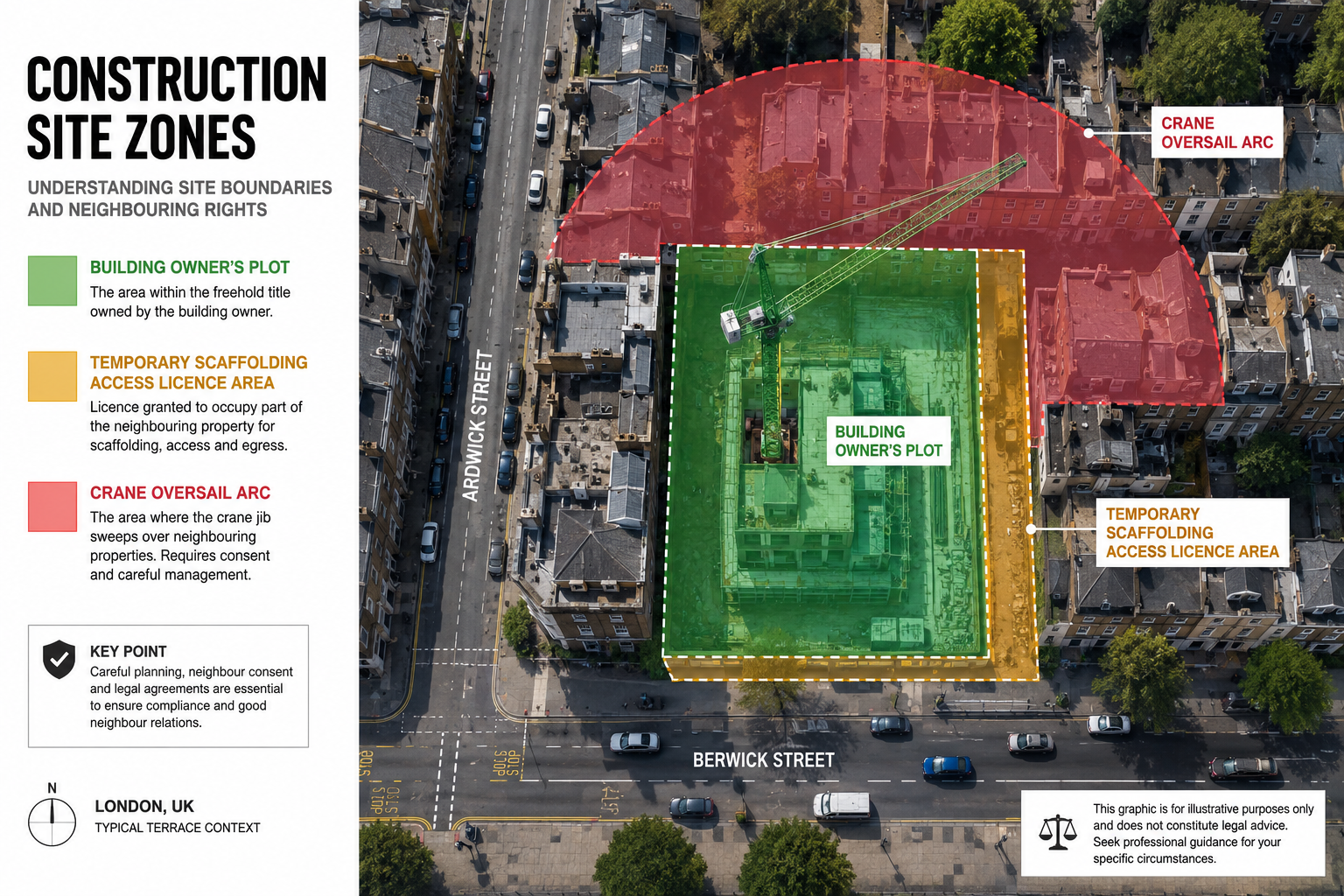
What the Act does not automatically cover is the full range of physical intrusions that complex sites demand: scaffolding erected on or over a neighbour's land, crane jibs that oversail an adjoining property, and temporary access for workers or plant. These require separate legal instruments — but they are almost always negotiated alongside the party wall process.
For a broader understanding of types of party wall works and which category applies to a given project, it is worth reviewing the statutory definitions carefully before serving any notices.
Jurisdictional Variations
It is worth noting that legal requirements differ significantly between countries. In the United States, there is no single federal statute governing party walls. The legal framework instead relies on a combination of common-law doctrines, local building codes, and private agreements recorded against property deeds [1]. In New York City, for example, construction access to neighbouring properties is typically managed through licence agreements — private contracts granting temporary rights. Where neighbours refuse access, developers can petition under RPAPL § 881 to obtain court-ordered permissions [2].
In England and Wales, the Party Wall Etc. Act 1996 provides a more structured statutory route, but the principles of early negotiation and formal documentation remain universal.
Scaffolding Licences and Temporary Access Rights
Why a Party Wall Award Is Not Always Enough
A party wall award addresses the works themselves — what can be done, how, and under what conditions. But on a tight urban site, the physical execution of those works often requires stepping onto, over, or through a neighbour's property. A scaffold tower may need to be tied to an adjoining wall. A hoarding may need to be erected partly on a shared boundary. Workers may need to cross a neighbour's garden to reach a rear elevation.
None of these activities are automatically authorised by a party wall award. Each requires a separate scaffolding licence or temporary access licence — a private agreement between the building owner and the adjoining owner that grants specific, time-limited rights.
"Securing proper licences before work begins is not a formality — it is the difference between a project that runs smoothly and one that faces injunctions, compensation claims, and programme collapse."
What a Scaffolding Licence Should Include
A well-drafted scaffolding licence will typically address the following:
| Provision | Purpose |
|---|---|
| Precise description of access area | Defines exactly where scaffold may be erected or tied |
| Duration of licence | Sets start and end dates, with extension provisions |
| Working hours | Restricts noisy or disruptive activity to agreed times |
| Insurance requirements | Requires the building owner to hold adequate public liability cover |
| Indemnity clause | Protects the adjoining owner from loss or damage |
| Reinstatement obligations | Requires the building owner to make good any damage |
| Licence fee | Compensates the adjoining owner for the use of their airspace or land |
Licence fees are negotiable and will reflect the extent of the intrusion, the duration, and any inconvenience caused. Adjoining owners are entitled to seek independent advice before signing, and it is common for their reasonable legal and surveying costs to be met by the building owner [5].
A schedule of condition survey conducted before any access begins is strongly recommended. This creates a photographic and written record of the adjoining property's condition, providing a clear baseline against which any damage claims can be assessed.

Crane Oversails: The Most Complex Challenge
Why Crane Oversailing Requires a Separate Licence
When a tower crane is installed on a development site, its jib will almost inevitably sweep over neighbouring properties during operation. This is not a minor technicality. Swinging a crane jib over an adjoining property without permission constitutes a legal trespass — a violation of the adjoining owner's right to the airspace above their land [3]. The consequences can be severe: an adjoining owner who has not granted permission can apply for an injunction to stop crane operations entirely, potentially halting the entire project.
An oversailing licence is the formal agreement that grants the building owner the right to operate a crane jib over specified neighbouring properties. It is distinct from the party wall award and must be negotiated separately, though the party wall surveyor often plays a key role in facilitating these discussions [4].
Key Elements of a Crane Oversailing Licence
A properly structured oversailing licence should address:
- Identification of the crane and its operational parameters — jib length, maximum load, sweep arc, and height
- Properties affected — a precise schedule of all properties over which the jib will pass
- Operational restrictions — times of day when oversailing is permitted, and any "no-fly zones" above sensitive areas
- Lift plans — detailed documentation of planned lifts, particularly heavy or complex ones [6]
- Insurance — the building owner's contractor must carry adequate cover, with the adjoining owner named as an interested party
- Indemnity — protection for the adjoining owner against any loss arising from crane operations
- Compensation — an agreed fee for the use of the adjoining owner's airspace
- Duration — the licence period, aligned with the construction programme
Early negotiation is critical. Initiating dialogue with adjoining property owners at the design stage — before planning permission is even granted — allows sufficient time to address concerns, agree terms, and avoid the scenario where a crane is ready to be erected but the licence has not been signed [5].
What Happens When Adjoining Owners Refuse
Refusal is rare when negotiations are handled professionally and compensation is fair. However, it does occur. In England and Wales, there is no direct statutory equivalent of New York's RPAPL § 881 for crane oversailing — the building owner cannot compel an adjoining owner to grant airspace rights. This means that if agreement cannot be reached, the developer may need to redesign the crane strategy entirely, using a different crane type, a different position, or a luffing jib crane that can operate without oversailing neighbouring properties.
This is a costly and time-consuming outcome. It reinforces why early engagement and professional negotiation are not optional extras on complex sites — they are essential project management tools.
Managing the Process: The Surveyor's Role
Coordinating Multiple Agreements on a Single Site
On a large urban development, a single project may require:
- Multiple party wall notices served on several adjoining owners
- Separate party wall awards for each affected property
- Scaffolding licences for two or three neighbouring plots
- A crane oversailing licence covering four or five properties
- Temporary hoarding licences for highway or shared land
Coordinating all of these simultaneously, while keeping the construction programme on track, demands a high level of professional expertise. This is where specialist party wall surveyors earn their fee [4].
The surveyor's role extends beyond drafting documents. They conduct pre-commencement condition surveys, liaise with adjoining owners' representatives, negotiate licence terms, and monitor compliance during the works. Where disputes arise, they act as the statutory dispute resolution mechanism under the Act.
For those carrying out works, understanding what the party wall process involves as a building owner is an important first step before appointing a surveyor.
Serving Notices Correctly
The party wall process begins with formal notices. A party structure notice must be served at least two months before works begin for most party wall operations. Line of junction notices require one month's notice. Notices must be served on all owners of the adjoining property — including freeholders, leaseholders, and mortgagees in some circumstances.
Errors in notice-serving are a common source of delay. A notice served on the wrong person, or without sufficient notice period, can be invalid — meaning the entire process must restart. Understanding how party wall notices work and how to respond is essential reading for both building owners and their neighbours.
The Party Wall Award
Once notices have been served and adjoining owners have either consented or dissented, the surveyors produce a party wall award. This is the legally binding document that governs how the works are to be carried out. On complex sites, the award will often incorporate or reference the scaffolding and access licences, creating a coherent package of documentation that all parties can rely on.
Practical Steps for Complex Site Management
A Step-by-Step Approach
Managing Party Wall Agreements for Complex Sites: Managing Access, Scaffolding, and Crane Oversails effectively requires a structured approach from the earliest stages of project planning. The following sequence reflects best practice:
- Appoint a specialist party wall surveyor at the design stage — before planning permission is submitted if possible.
- Identify all affected properties — not just those sharing a wall, but any property over which scaffolding or a crane will intrude.
- Commission a crane strategy report — to determine whether oversailing is unavoidable and, if so, which properties are affected.
- Begin informal engagement with adjoining owners — introduce the project, explain what is planned, and listen to concerns.
- Serve statutory notices — within the required timeframes and on the correct parties.
- Negotiate access and oversailing licences — in parallel with the party wall process, not after it.
- Conduct pre-commencement condition surveys — on all affected properties before any work or access begins.
- Monitor compliance during works — the surveyor should make periodic site visits to ensure the award and licence conditions are being followed.
- Conduct post-completion inspections — to confirm that any damage has been made good and that reinstatement obligations have been met.
Keeping Costs Under Control
Complex party wall arrangements can be expensive, but the costs are manageable with good planning. The building owner is typically responsible for the reasonable surveying and legal costs of adjoining owners, in addition to their own professional fees. Crane oversailing licence fees and scaffolding licence fees add further costs.
However, these costs are modest compared to the financial impact of an injunction, a programme delay, or a compensation claim arising from unauthorised access or damage. For practical guidance on how to keep party wall costs down without cutting corners on compliance, early appointment of a single experienced surveyor who can manage the entire process is consistently the most cost-effective approach.
Conclusion
Party Wall Agreements for Complex Sites: Managing Access, Scaffolding, and Crane Oversails sit at the intersection of construction law, property rights, and practical project management. The statutory framework provided by the Party Wall Etc. Act 1996 is a strong foundation, but on constrained urban sites it must be supplemented by carefully negotiated scaffolding licences, access agreements, and crane oversailing licences — each tailored to the specific circumstances of the project and the concerns of the adjoining owners.
The consequences of getting this wrong are not theoretical. Unauthorised crane oversailing is a trespass that can be stopped by court order [3]. Scaffolding erected on a neighbour's land without consent exposes the building owner to compensation claims. Poorly drafted licences leave both parties exposed when disputes arise.
Actionable next steps for anyone planning a complex urban development:
- Appoint a specialist party wall surveyor before the design is finalised — their input can shape the construction methodology and avoid problems before they arise.
- Identify every property that may be affected by scaffolding, crane operations, or access requirements, not just those sharing a wall.
- Begin conversations with adjoining owners early and approach those conversations with transparency and fairness.
- Ensure every licence is professionally drafted, properly executed, and supported by a pre-commencement condition survey.
- Do not allow construction to begin until all necessary agreements are signed and in place.
For projects across London, specialist advice is available from surveyors covering North London, South London, East London, and West London — each with the local knowledge to navigate the specific challenges of urban construction in their area.
References
[1] Party Wall Construction Rules Requirements And Costs – legalclarity.org
[2] License Agreements Rpapl 881 Access Faq New York City Nyc – nyconstructionlaw.com
[3] Oversailing Licences For Crane Operations – charrettelaw.co.uk
[4] Neighbourly Matters – colmor.net
[5] Scaffold Crane Access Licences – tayross.com
[6] Barge Crane Access Projects – erwalls.com
How Prince Surveyors can help: explore our party wall surveyors or learn about our party wall surveyor costs.