

Over one-third of UK shopping centres have vacancy rates above 20%, and developers are racing to convert redundant retail space into residential, hospitality, and leisure uses before planning momentum fades. That construction surge brings a legal obligation that catches many project teams off guard: the Party Wall etc. Act 1996. Understanding the Party Wall Act Essentials for 2026 Retail Revitalisation: Surveys for Shopping Centre Mixed-Use Conversions is not optional — it is a statutory requirement that, if mishandled, can halt a multimillion-pound scheme at the worst possible moment.
The Act has not been fundamentally reformed for 2026. No new retail-specific legislation has been introduced. What has changed is the scale and complexity of schemes now being brought forward, which means the existing 1996 framework must be applied with greater care, earlier in the process, and across a far wider pool of adjoining owners than a typical residential project would involve [3].
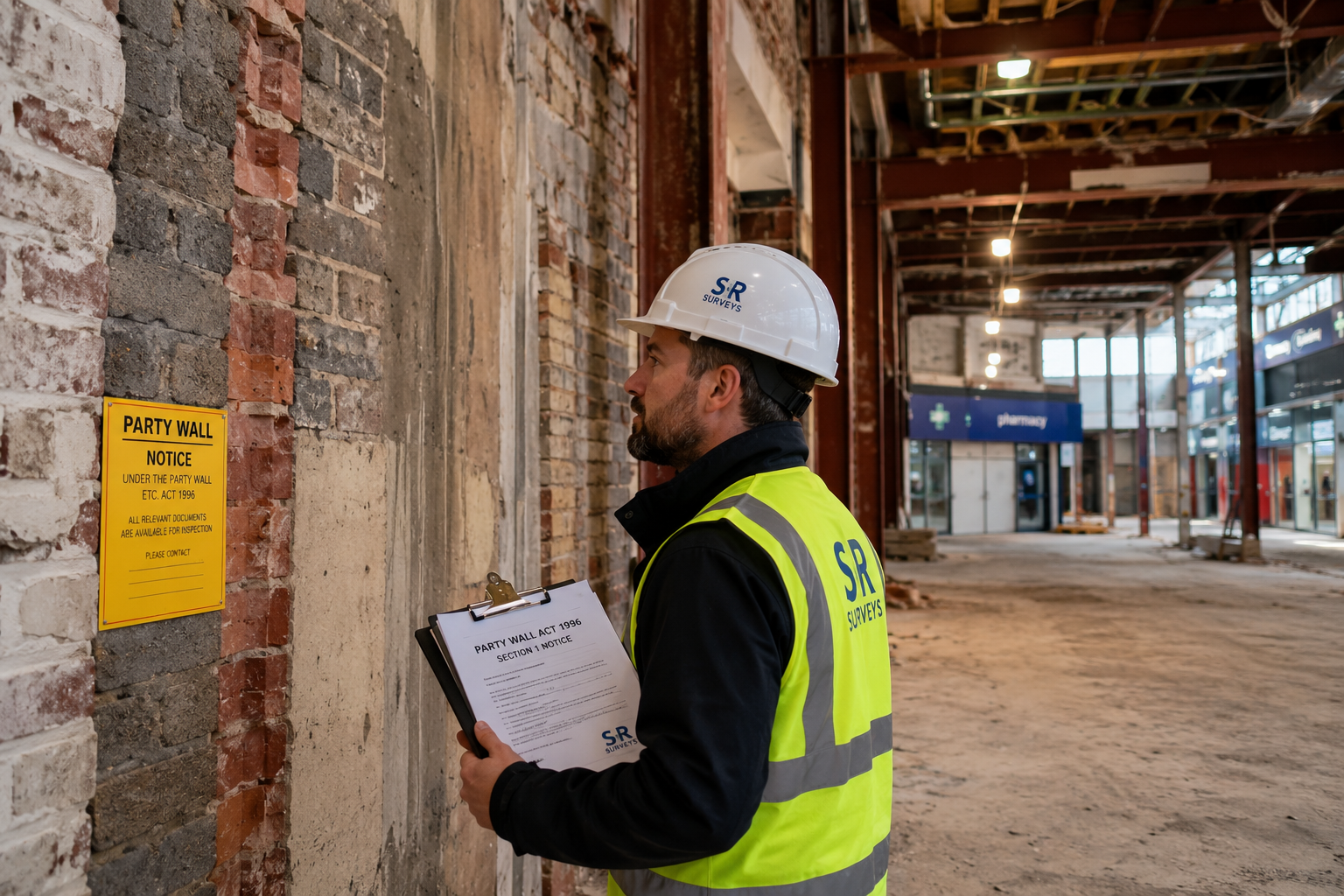
Key Takeaways
- The Party Wall etc. Act 1996 governs all notifiable works in shopping centre mixed-use conversions, with no new 2026-specific reforms in force.
- Early identification of every adjoining owner — including upper-floor tenants, basement operators, and neighbouring unit freeholders — is the single most critical step in large retail schemes.
- Statutory notice periods (one or two months depending on work type) must be served before any notifiable works begin, and missing them can trigger injunctions.
- A professionally prepared schedule of condition protects both the building owner and adjoining owners from disputed damage claims.
- RICS-compliant party wall surveyors should be appointed at pre-application stage on complex mixed-use conversions, not after planning permission is granted.
Why the Party Wall Act Matters More Than Ever in 2026 Retail Conversions
Urban retail revitalisation is accelerating. Analysts tracking the repurposing of failing high streets and enclosed malls note that mixed-use conversion — adding residential floors above retail, inserting mezzanine apartments, or subdividing anchor stores — now represents a significant share of new housing delivery in town centres [10]. Each of these interventions almost certainly triggers the Party Wall etc. Act 1996.
The Act applies to three categories of work [1][3]:
| Work Type | Relevant Act Section | Typical Notice Period |
|---|---|---|
| Works to an existing party wall or structure | Section 2 | Two months |
| New building on or at the boundary line | Section 1 | One month |
| Excavation within 3m or 6m of an adjoining structure | Section 6 | One month |
In a shopping centre conversion, all three categories frequently apply simultaneously. A developer inserting residential units above a retail podium may be cutting into a party wall (Section 2), constructing new boundary structures (Section 1), and deepening a basement car park (Section 6) — all on the same programme.
The GOV.UK guidance confirms that the Act "is intended to prevent and resolve disputes" and that it applies equally to commercial buildings [3][5]. Ignoring it is not a viable strategy. Proceeding without a valid party wall agreement or award can expose the building owner to injunctions, damages claims, and project delays far costlier than the surveyor fees saved [2].
For those unfamiliar with what happens when notices are not served correctly, the consequences are explored in detail in this guide on proceeding without a party wall agreement.
Step-by-Step: Serving Party Wall Notices for Shopping Centre Mixed-Use Schemes
Applying the Party Wall Act Essentials for 2026 Retail Revitalisation: Surveys for Shopping Centre Mixed-Use Conversions requires a structured approach. The following steps reflect current best practice for large-scale retail conversion projects [3][6].
Step 1: Map Every Adjoining Owner
In a residential context, an adjoining owner is usually a single neighbour. In a shopping centre, the picture is far more complex. Adjoining owners may include:
- Freeholders of adjacent retail units
- Long leaseholders (those with seven or more years remaining on their lease)
- Basement operators or car park concession holders
- Residential occupiers above existing retail parades
- Neighbouring office or hotel freeholders sharing a structural wall
Every one of these parties must be identified before any notice is served. Missing even one adjoining owner can invalidate the entire process and expose the project to legal challenge mid-construction [3][6].
Step 2: Confirm Which Works Are Notifiable
Not every construction activity on a shopping centre site triggers the Act. Works entirely within the building owner's own property, not affecting any party structure or boundary, do not require notice. However, in practice, most structural interventions in a mixed-use conversion do qualify. These include:
- Cutting into or through a party wall to insert beams or services
- Raising or underpinning a party wall
- Demolishing and rebuilding a party wall
- Inserting damp-proof courses through a party wall
- Any excavation within 3 metres of an adjoining owner's structure where the excavation goes deeper than the adjoining foundations
A structural survey carried out at pre-application stage will clarify which elements of the proposed scheme are notifiable and which are not, saving significant time later.
Step 3: Serve Notices in the Correct Form and Timeframe
Notices must be served in writing and must contain specific information prescribed by the Act [3][5]. For Section 2 works (party wall works), the notice must be served at least two months before works begin. For Section 1 and Section 6 works, one month's notice is required.
Key notice requirements include:
- The building owner's name and address
- A clear description of the proposed works
- The proposed start date
- A statement that the notice is served under the relevant section of the Party Wall etc. Act 1996
Notices can be served personally, by post, or — where the adjoining owner cannot be found — by fixing the notice to a conspicuous part of the premises [5].
Step 4: Manage Consent and Dissent Responses
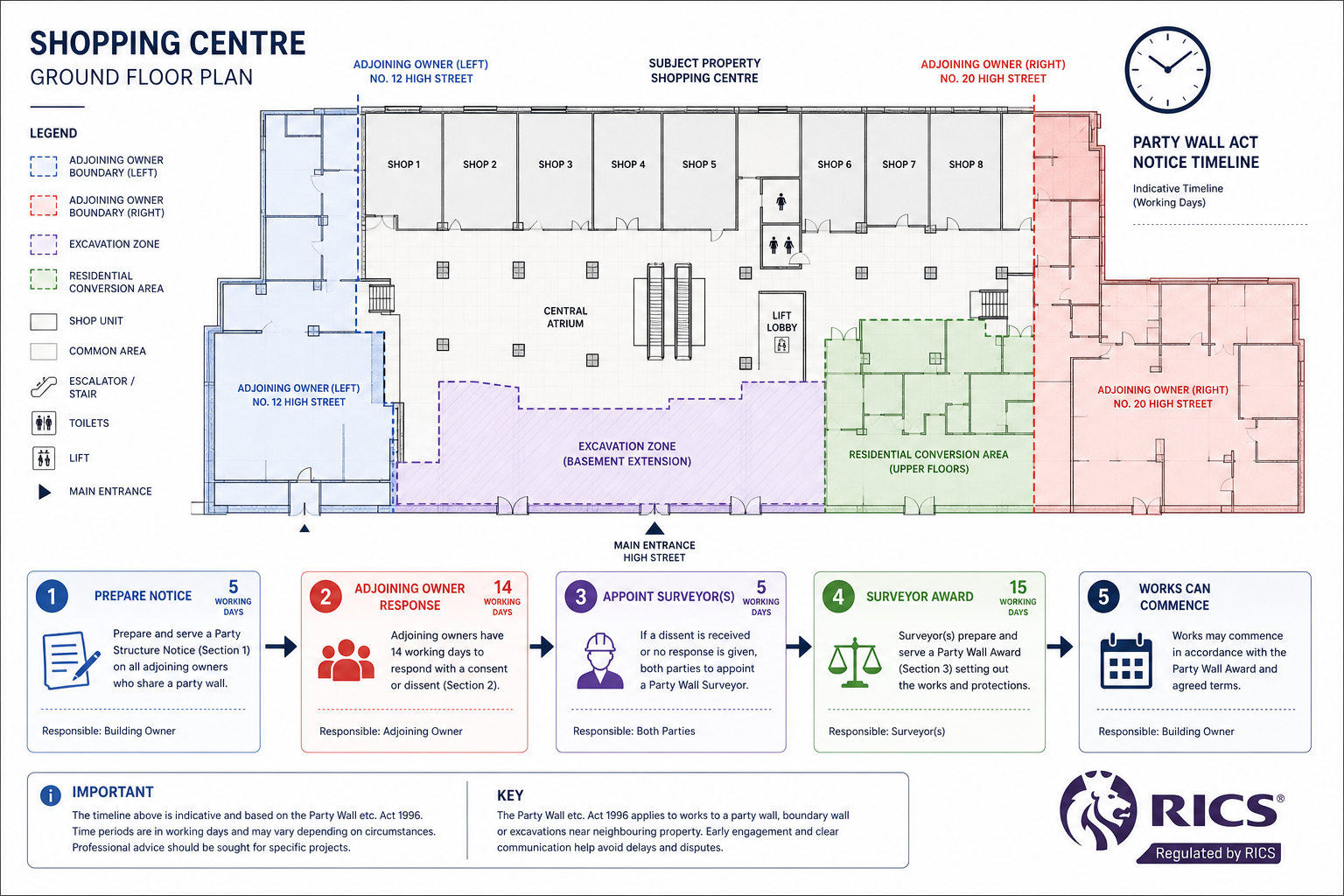
Once a notice is served, the adjoining owner has 14 days to respond. They may:
- Consent in writing, allowing works to proceed without a formal award
- Dissent, triggering the appointment of surveyors
- Fail to respond, which is treated as dissent after the 14-day period
On a large shopping centre conversion with multiple adjoining owners, it is common to receive a mixture of consents and dissents. Each dissent requires the appointment of either an agreed surveyor or two party wall surveyors (one for each party). Understanding the process for obtaining consent for party wall work is essential to keeping the programme on track.
Step 5: Prepare a Schedule of Condition
Before any notifiable works begin, a thorough schedule of condition should be prepared for all adjoining properties. This document records the existing state of the adjoining owner's building — cracks, settlement, finishes, and structural condition — with photographs and written descriptions.
A properly prepared schedule of condition for party wall works is the primary defence against spurious damage claims after construction. In a shopping centre conversion, where vibration, ground movement, and structural alteration are all likely, this document is indispensable.
Step 6: Obtain or Issue a Party Wall Award
Where surveyors are appointed following dissent, they must produce a party wall award. This is a legally binding document that sets out:
- The works permitted
- The method and timing of those works
- Any protective measures required
- Rights of access for inspection
- How any damage will be assessed and compensated
Detailed guidance on what a party wall award should contain and how it functions is available in this guidance for party wall awards.
RICS Compliance Tips for Complex Mixed-Use Conversions
Applying the Party Wall Act Essentials for 2026 Retail Revitalisation: Surveys for Shopping Centre Mixed-Use Conversions in a way that satisfies RICS standards requires more than simply serving notices on time. The following compliance tips reflect current RICS consumer guidance and practitioner recommendations [8][6].
Appoint a party wall surveyor at pre-application stage. On complex schemes, waiting until planning permission is granted before engaging a party wall surveyor is a common and costly mistake. Early appointment allows the surveyor to advise on notice strategy, identify all adjoining owners, and flag any works that may require negotiation before the programme is fixed.
Use a single agreed surveyor where possible. Where all parties are cooperative, a single agreed surveyor acting for both the building owner and the adjoining owner can reduce costs and speed up the award process significantly. This approach works best when relationships between parties are positive and the works are relatively straightforward [8].
Commission monitoring surveys for high-risk works. Where deep excavations or significant structural alterations are planned adjacent to occupied buildings, monitoring surveys provide real-time data on ground movement and structural response. This protects all parties and provides an evidence base if damage claims arise.
Do not confuse planning consent with party wall compliance. Planning permission does not grant any rights under the Party Wall etc. Act 1996. The two regimes operate independently. A developer with full planning consent can still be injuncted for failing to serve valid party wall notices [5][7].
Keep records of all communications. Every notice served, every response received, and every surveyor appointment should be documented and retained. In the event of a dispute, this paper trail is essential.
Consider dilapidation surveys for adjoining commercial tenants. In a retail context, adjoining tenants may have dilapidations obligations under their leases. A dilapidation survey carried out before works begin establishes a clear baseline, separating pre-existing deterioration from construction-related damage.
Common Pitfalls in Shopping Centre Party Wall Procedures
Even experienced development teams make avoidable errors on large mixed-use schemes. The most frequently encountered problems include:
Underestimating the number of adjoining owners. In a multi-tenanted shopping centre, the freehold and leasehold interests can be highly fragmented. A thorough title investigation is essential before notices are served.
Serving notices too late. Notice periods are statutory minimums, not targets. On a complex scheme with many adjoining owners, some of whom may dissent and require surveyors to be appointed, the party wall process can take three to four months from first notice to final award. This must be factored into the programme from day one.
Failing to address damage claims promptly. If construction causes damage to an adjoining owner's property, the building owner is liable to make good that damage [3]. Delays in acknowledging or addressing damage claims escalate disputes unnecessarily. The process for handling damage to property under the Party Wall Act should be understood before works begin, not after a complaint is received.
Assuming a licence to alter replaces party wall notices. A licence to alter is a landlord's consent for a tenant to carry out works within a leased property. It operates under lease law, not the Party Wall Act. Both may be required simultaneously, and neither substitutes for the other.
Neglecting upper and lower neighbours. In a vertical mixed-use conversion — retail at ground level, residential above — the floors and ceilings between uses may constitute party structures. Works to these elements require the same notice and award process as works to vertical party walls.
The Role of the Party Wall Surveyor in Urban Retail Renewal

The party wall surveyor's role in a shopping centre mixed-use conversion goes well beyond paperwork. A competent surveyor will:
- Advise on the scope of notifiable works at design stage
- Draft and serve notices on behalf of the building owner
- Negotiate with adjoining owners' surveyors to reach agreed awards
- Inspect works in progress to ensure compliance with the award
- Assess and determine any damage claims
For answers to common questions about the process, the party wall FAQs resource covers many of the issues that arise on both residential and commercial projects.
The RICS recommends that party wall surveyors acting on complex commercial schemes have demonstrable experience of the building type and the specific works involved [8]. A surveyor experienced only in domestic extensions may not be best placed to manage the multi-party, multi-section complexity of a large retail conversion.
Working with local chartered surveyors who have direct experience of mixed-use and commercial schemes in the relevant area adds practical value — local knowledge of title structures, neighbouring occupiers, and local authority expectations can significantly smooth the process.
Conclusion
The Party Wall Act Essentials for 2026 Retail Revitalisation: Surveys for Shopping Centre Mixed-Use Conversions come down to one overriding principle: early, thorough, and properly documented compliance with the Party Wall etc. Act 1996. The Act has not changed, but the schemes to which it is being applied are larger, more complex, and more time-sensitive than ever.
Actionable next steps for development teams in 2026:
- Commission a structural survey and title investigation at pre-application stage to identify all notifiable works and all adjoining owners.
- Appoint a RICS-qualified party wall surveyor before the planning application is submitted, not after consent is granted.
- Build statutory notice periods — a minimum of one to two months, plus time for awards to be made — into the construction programme from the outset.
- Prepare schedules of condition for all adjoining properties before any notifiable works begin.
- Establish a clear internal process for responding to damage claims promptly and professionally.
- Do not conflate planning consent, licences to alter, or building regulations approval with party wall compliance — each regime operates independently.
Retail revitalisation is one of the most significant planning and construction stories of 2026. Getting the party wall process right is not a bureaucratic hurdle — it is a foundation for delivering these schemes without injunctions, disputes, or programme overruns.
References
[1] Section – legislation.gov.uk
[2] Party Wall Act – eastriding.gov.uk
[3] The Party Wall Etc Act 1996 Explanatory Booklet – gov.uk
[4] Partywall Booklet – eastonbevins.co.uk
[5] Party Walls Building Works – gov.uk
[6] A Reasonable Party Wall Guide – howorth.uk
[7] Party Walls – rbkc.gov.uk
[8] Party Walls – rics.org
[9] 130618 Circular Letter Revised Party Wall Act Explanatory Booklet Final – assets.publishing.service.gov.uk
[10] The Revitalization Of Urban Retail – matthews.com
How Prince Surveyors can help: explore our party wall surveyors or learn about our party wall surveyor costs.