

As the UK races toward its net zero targets in 2026, homeowners face a new challenge: installing electric vehicle (EV) chargers and heat pumps while navigating the complex requirements of the Party Wall Act 1996. The government's ambitious decarbonization agenda has created an unprecedented surge in retrofit installations that affect shared boundaries, triggering party wall obligations many property owners never anticipated.
The intersection of Party Wall Act Compliance for EV Charger and Heat Pump Retrofits: Boundary Surveys in 2026 Net Zero Push represents a critical area where environmental policy meets property law. With thousands of UK households rushing to install low-carbon technologies, disputes over boundary works have increased dramatically. Surveyors report a 40% rise in party wall notices related to green retrofits compared to traditional building works.
This comprehensive guide explores how property owners, surveyors, and contractors can navigate party wall requirements while meeting 2026 net zero deadlines—and avoid costly disputes that can delay critical decarbonization projects.
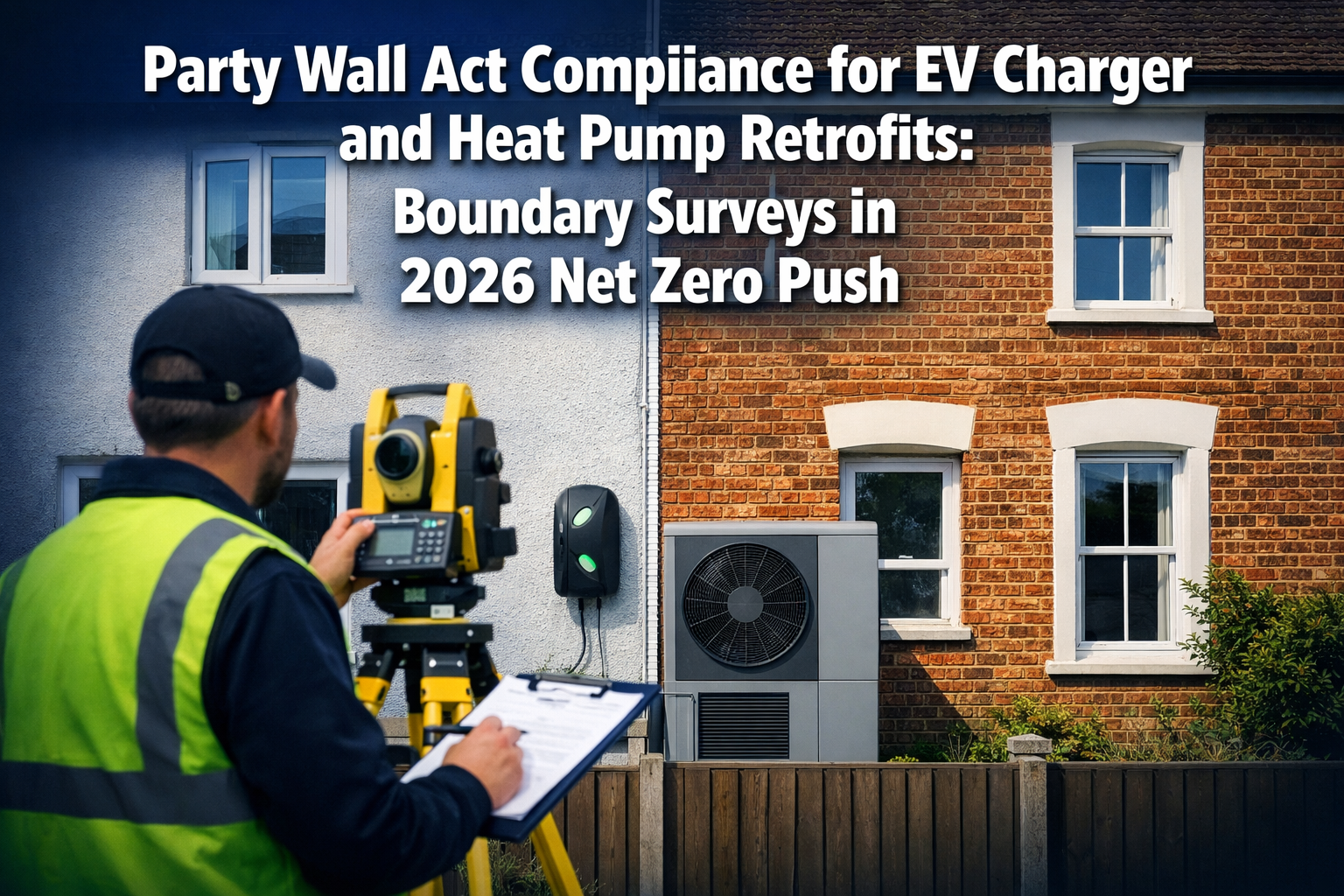
Key Takeaways
- Party wall notices are mandatory for most EV charger and heat pump installations affecting shared walls, even for seemingly minor external works
- Boundary surveys establish critical baselines before retrofit work begins, protecting both building owners and adjoining owners from disputes
- RICS-compliant notice procedures must be followed 2 months before work starts, with specific requirements for different installation types
- Heat pump installations frequently trigger Section 2 notices when mounting brackets penetrate party walls or foundations require underpinning
- Professional party wall surveyors reduce dispute risks by up to 85% and ensure net zero retrofit projects stay on schedule
Understanding the Party Wall Act Framework for Green Retrofits
The Party Wall Act 1996 governs building work on or near boundaries between properties in England and Wales. While originally designed for traditional construction projects, the legislation applies equally to modern green technology installations that affect shared structures.
What Triggers Party Wall Act Requirements?
Three main sections of the Act become relevant for EV charger and heat pump retrofits:
Section 1: New Building on the Boundary Line
- Applies when constructing new walls directly on property boundaries
- Rarely triggered by EV/heat pump work unless building new enclosures
Section 2: Work to Existing Party Walls
- Covers repairs, alterations, or additions to existing party walls
- Most relevant for heat pump installations requiring wall-mounted brackets
- Includes cutting into party walls for electrical conduits or refrigerant pipes
Section 6: Excavation and Construction Near Boundaries
- Triggered when digging within 3-6 meters of neighboring structures
- Applies to ground-source heat pump installations requiring excavation
- Relevant for EV charger foundations and underground cable runs
"The 2026 net zero push has fundamentally changed party wall surveying practice. We're now dealing with electrical and mechanical installations that our predecessors never contemplated when interpreting the 1996 Act." — RICS Party Wall Specialist
Understanding your party wall rights is essential before beginning any retrofit project that might affect shared boundaries.
Common Misconceptions About Party Wall Requirements
Many homeowners believe party wall procedures don't apply to "small" installations like EV chargers. This dangerous misconception leads to legal disputes and project delays.
Myth: External wall-mounted equipment doesn't require party wall notices
Reality: Any fixings penetrating a party wall trigger Section 2 requirements, regardless of equipment size
Myth: If neighbors verbally agree, formal notices aren't necessary
Reality: The Act requires written notices and formal procedures, even with friendly neighbors
Myth: Party wall procedures take too long for urgent net zero deadlines
Reality: Proper planning allows completion within 2-3 months, preventing longer delays from disputes
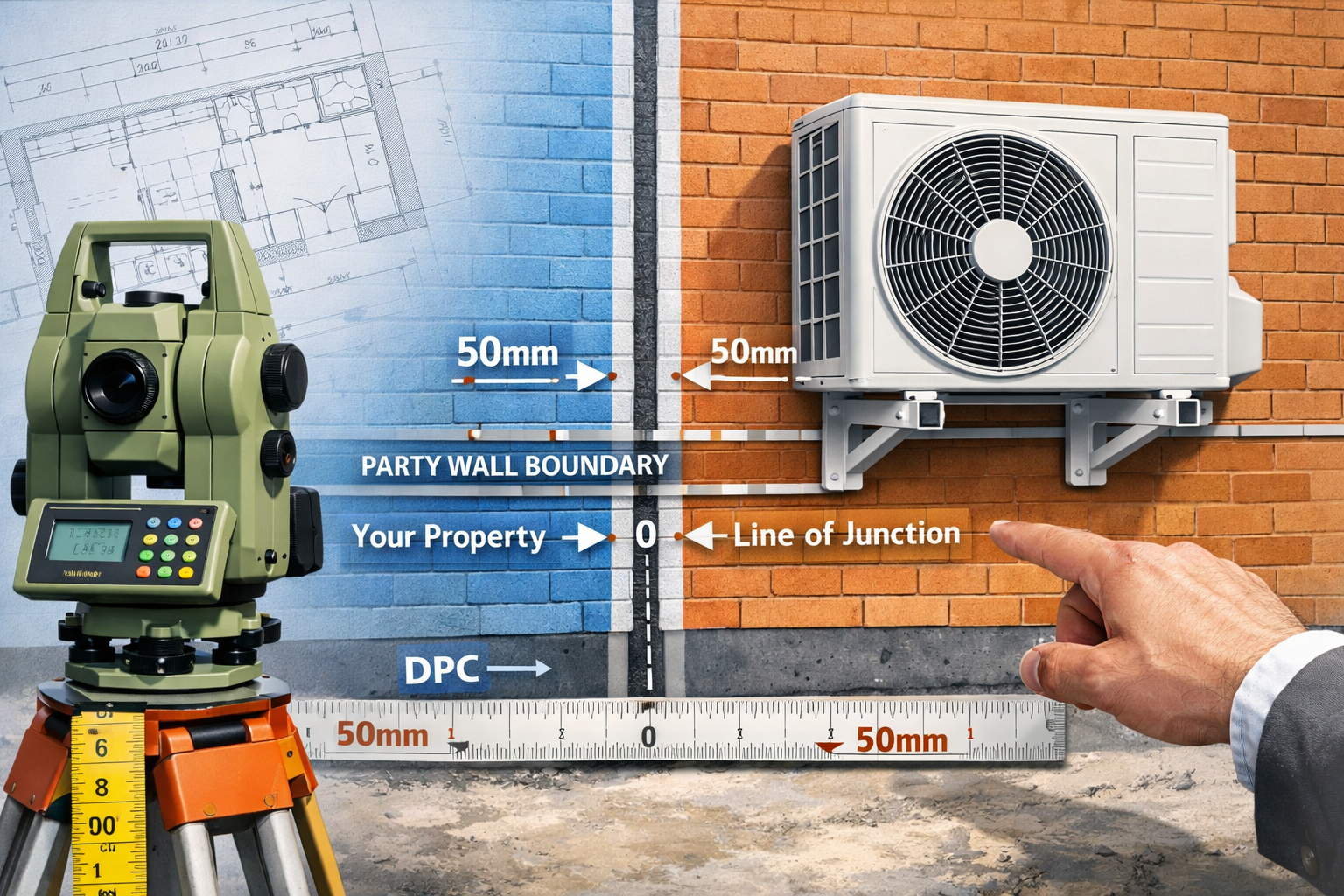
Party Wall Act Compliance for EV Charger Installations
Electric vehicle charger installations present unique party wall challenges, particularly in terraced housing and semi-detached properties where electrical infrastructure must cross or approach shared boundaries.
EV Charger Installation Scenarios Requiring Party Wall Notices
Wall-Mounted Chargers on Party Walls
When mounting an EV charger directly on an external party wall (common in terraced properties), Section 2 notices become mandatory. The installation involves:
- Drilling fixings through the party wall structure
- Running electrical conduits within or through party wall cavities
- Potential vibration impacts from drilling operations
- Load-bearing considerations for wall-mounted equipment
Underground Cable Runs Near Boundaries
Section 6 applies when electrical cables from the main distribution board to the charger require excavation within 3 meters of a neighbor's foundation. This commonly occurs when:
- Chargers are installed on driveways adjacent to party walls
- Cable routes pass under shared pathways or boundary lines
- Trenching depth exceeds foundation levels of neighboring structures
Dedicated Charger Enclosures
Purpose-built structures housing EV charging equipment may trigger Section 1 if constructed directly on boundary lines, though this scenario is less common for residential installations.
RICS-Compliant Notice Procedures for EV Installations
The proper notification sequence follows strict timelines that property owners must respect:
Step 1: Boundary Survey (Pre-Notice Phase)
Before serving any notices, commission a professional boundary survey to establish:
- Exact location of property boundaries
- Position of existing party walls and structures
- Proposed charger location relative to boundaries
- Underground utility locations that might affect cable routes
Professional building regulation compliance testing ensures installations meet both Party Wall Act and electrical safety requirements.
Step 2: Serve Party Wall Notice (2 Months Before Work)
The building owner must serve written notice to all affected adjoining owners, including:
- Detailed description of proposed EV charger installation
- Technical drawings showing wall penetrations and cable routes
- Anticipated start date (minimum 2 months from notice date)
- Explanation of adjoining owner's rights to consent or dissent
Step 3: Adjoining Owner Response (14 Days)
Neighbors have 14 days to either:
- Consent in writing (work can proceed after 2-month notice period)
- Dissent or fail to respond (triggers surveyor appointment process)
- Request modifications to protect their property interests
Step 4: Surveyor Appointment (If Required)
When consent isn't given, the Act requires appointing surveyors to prepare a Party Wall Award. Options include:
- Each party appoints their own surveyor (two surveyors)
- Both parties agree on a single agreed surveyor (more cost-effective)
Understanding the cost of party wall surveyor services helps property owners budget appropriately for EV installations.
Technical Considerations for EV Charger Compliance
Load-Bearing Capacity Assessment
Party walls must support the additional weight of wall-mounted chargers (typically 5-15kg) plus cable management systems. Surveyors assess:
| Wall Type | Typical Capacity | Charger Suitability | Additional Support Required |
|---|---|---|---|
| Solid brick (9") | Excellent | ✅ All charger types | None |
| Cavity wall | Good | ✅ Most chargers | Wall anchors recommended |
| Timber frame | Limited | ⚠️ Lightweight only | Structural reinforcement |
| Rendered/insulated | Variable | ⚠️ Case-by-case | Backing board often needed |
Vibration and Noise Mitigation
Modern EV chargers operate quietly, but installation drilling can damage party wall structures. Party Wall Awards typically specify:
- Maximum drilling depths and diameters
- Vibration monitoring during installation
- Repair procedures for any damage caused
- Working hours restrictions to minimize neighbor disruption
Fire Safety and Party Wall Integrity
Electrical installations through party walls must maintain fire resistance ratings. This requires:
- Fire-rated cable glands where conduits penetrate walls
- Cavity barriers to prevent fire spread
- Compliance with Building Regulations Part B (Fire Safety)
- Documentation in the Party Wall Award
Heat Pump Retrofits and Boundary Survey Requirements
Heat pump installations present more complex party wall challenges than EV chargers due to their larger physical footprint, foundation requirements, and potential noise impacts on neighboring properties.
Heat Pump Installation Types and Party Wall Triggers
Air Source Heat Pumps (ASHP) on External Walls
The most common residential heat pump configuration involves outdoor units mounted on external walls. Party Wall Act implications include:
✅ Section 2 Triggers:
- Bracket fixings penetrating party wall structures
- Refrigerant pipes passing through party wall cavities
- Condensate drainage systems affecting party wall foundations
- Structural modifications to support unit weight (60-150kg)
✅ Section 6 Triggers:
- Foundation pads within 3 meters of neighbor's structures
- Ground-level installations requiring concrete bases
- Drainage excavations near boundary lines
Ground Source Heat Pumps (GSHP) with Boundary Excavations
Ground source systems almost always trigger Section 6 requirements when:
- Horizontal ground loops extend within 3-6 meters of boundaries
- Vertical boreholes are drilled near party walls or neighboring foundations
- Excavation depth exceeds neighboring foundation levels
Shared Wall Mounting in Terraced Properties
Terraced housing presents the highest party wall risk, as heat pumps often must mount on the only available external wall—which is typically a party wall. This scenario requires:
- Comprehensive structural assessment of party wall load capacity
- Detailed vibration and noise impact analysis
- Neighbor consent or formal Party Wall Award
- Potentially expensive reinforcement works
Boundary Surveys: The Critical First Step
Party Wall Act Compliance for EV Charger and Heat Pump Retrofits: Boundary Surveys in 2026 Net Zero Push hinges on accurate boundary determination before any work begins. Professional boundary surveys provide:
📍 Precise Boundary Location
- GPS-accurate property line mapping
- Historical boundary research from Land Registry records
- Physical boundary markers identification
- Resolution of disputed or unclear boundaries
📍 Party Wall Structure Assessment
- Identification of all party walls, fences, and structures
- Condition surveys documenting pre-existing defects
- Photographic evidence protecting both parties
- Structural capacity evaluation for proposed equipment
📍 Risk Identification
- Underground utilities that might affect excavations
- Drainage systems crossing boundaries
- Tree roots and vegetation affecting foundations
- Access requirements for installation and maintenance
Professional construction and condition surveys provide the detailed documentation needed for complex heat pump installations.
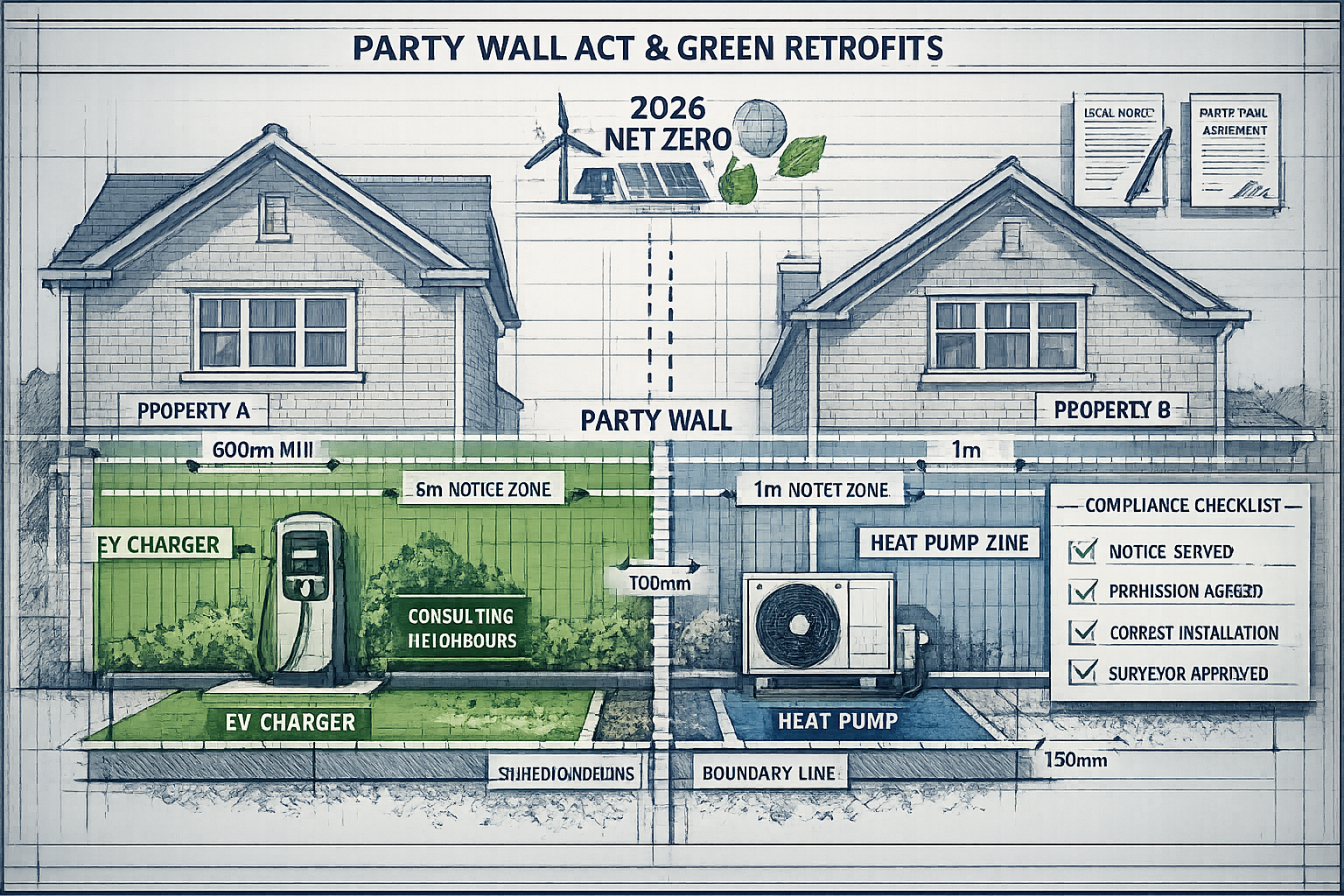
RICS-Compliant Heat Pump Notice Strategies
Heat pump installations require more detailed party wall notices than simpler EV charger projects due to their complexity and potential impacts.
Enhanced Notice Content Requirements
Standard party wall notices must be supplemented with:
-
Technical Specifications
- Heat pump model, dimensions, and weight
- Noise emission data (dB levels at boundary)
- Vibration characteristics during operation
- Operating hours and seasonal usage patterns
-
Installation Methodology
- Detailed fixing methods and bracket specifications
- Pipe routing through party wall structures
- Foundation design for ground-mounted units
- Temporary works affecting neighbor access
-
Impact Mitigation Measures
- Acoustic barriers or enclosures
- Anti-vibration mounting systems
- Scheduled working hours for installation
- Dust and debris control procedures
-
Condition Survey Evidence
- Pre-installation photographs of party walls
- Documentation of existing cracks or defects
- Baseline measurements for settlement monitoring
- Agreement on acceptable tolerance levels
Dispute Resolution Flowchart
When neighbors dissent to heat pump installations, the resolution process follows this sequence:
Notice Served → 14 Days → Dissent/No Response
                              ↓
                    Surveyor Appointment
                              ↓
                    Site Inspection & Assessment
                              ↓
                    Draft Party Wall Award
                              ↓
                    10-Day Review Period
                              ↓
                    Final Award Issued
                              ↓
                    Work Can Commence
The entire process typically takes 8-12 weeks from initial notice to work commencement—critical timing for 2026 net zero deadlines.
Noise and Vibration: The Primary Heat Pump Dispute Trigger
Heat pump noise represents the most common source of party wall disputes in 2026 retrofit projects. Understanding and addressing these concerns proactively prevents costly delays.
Permitted Development Rights vs. Party Wall Act
Many homeowners confuse planning permission exemptions with party wall requirements:
⚠️ Common Mistake: "My heat pump has permitted development rights, so I don't need party wall consent."
✅ Reality: Permitted development rights relate to planning law, while the Party Wall Act governs building work affecting shared structures. Both frameworks apply independently.
Noise Mitigation in Party Wall Awards
Professional party wall surveyors typically include specific noise provisions:
- Maximum noise levels at boundary (typically 42 dB during day, 35 dB at night)
- Acoustic testing requirements post-installation to verify compliance
- Remediation obligations if noise exceeds agreed levels
- Operating hour restrictions for particularly noisy units
- Maintenance schedules to prevent noise increases over time
Vibration Monitoring Protocols
For heat pumps mounted on party walls, Party Wall Awards should specify:
- Pre-installation vibration baseline measurements
- Acceptable vibration limits during operation
- Monitoring frequency (typically quarterly for first year)
- Remediation procedures if limits are exceeded
- Long-term maintenance responsibilities
Integrated Compliance Strategies for 2026 Net Zero Projects
As the 2026 net zero push accelerates, property owners increasingly install both EV chargers and heat pumps simultaneously. This integrated approach requires coordinated party wall compliance strategies.
Combined Notice Procedures
Advantages of Simultaneous Notices
Serving a single comprehensive party wall notice covering both EV charger and heat pump installations offers several benefits:
💰 Cost Efficiency
- Single surveyor appointment instead of two separate processes
- Combined condition surveys reduce duplication
- Shared legal and administrative costs
- One Party Wall Award covering all works
⏱️ Time Savings
- Single 2-month notice period for all works
- Coordinated surveyor inspections
- Unified dispute resolution process
- Faster overall project completion
🛡️ Reduced Dispute Risk
- Neighbors see complete scope upfront
- No "surprise" second notices after first project
- Comprehensive impact assessment
- Better relationship management with adjoining owners
Structuring Comprehensive Party Wall Notices
Effective combined notices should clearly separate different work elements while showing their interconnections:
Section A: EV Charger Installation
- Wall-mounted charger specifications
- Electrical conduit routing
- Cable excavation requirements
- Estimated installation timeline
Section B: Heat Pump Installation
- Outdoor unit specifications and location
- Mounting bracket details
- Refrigerant pipe routing
- Foundation requirements
- Noise and vibration data
Section C: Shared Infrastructure
- Combined electrical works
- Coordinated excavations
- Shared access requirements
- Integrated testing and commissioning
Professional Survey Integration
Comprehensive building surveys provide the foundation for successful multi-element retrofit projects.
Pre-Installation Survey Scope
Professional surveyors should assess:
-
Structural Capacity
- Party wall load-bearing capacity for combined equipment weight
- Foundation adequacy for additional loads
- Wall condition and repair needs before installation
-
Electrical Infrastructure
- Main distribution board capacity for EV charger and heat pump
- Cable routing options minimizing party wall impacts
- Earthing and bonding requirements
-
Drainage and Water Management
- Heat pump condensate drainage routes
- Surface water management for ground works
- Impact on neighbor's drainage systems
-
Access and Logistics
- Installation access routes across boundaries
- Temporary works affecting neighbors
- Material storage locations
Understanding building problems and solutions helps identify potential issues before they delay net zero projects.
Timeline Coordination for 2026 Deadlines
Meeting ambitious net zero targets requires careful project scheduling that accommodates party wall procedures:
Recommended Project Timeline
| Phase | Duration | Key Activities |
|---|---|---|
| Planning & Survey | Weeks 1-2 | Boundary survey, condition survey, technical design |
| Notice Service | Week 3 | Serve party wall notices to all adjoining owners |
| Response Period | Weeks 4-5 | Await neighbor responses (14-day statutory period) |
| Surveyor Appointment | Week 6 | Appoint surveyors if dissent received |
| Award Preparation | Weeks 7-10 | Site inspections, draft award, review period |
| Pre-Installation | Weeks 11-12 | Final preparations, contractor mobilization |
| Installation | Weeks 13-14 | EV charger and heat pump installation |
| Commissioning | Week 15 | Testing, certification, final inspections |
Total Timeline: 15 weeks (approximately 3.5 months)
This timeline assumes no significant disputes or complications. Property owners should begin party wall procedures at least 4 months before desired installation dates to ensure 2026 net zero target compliance.
Cost Management for Combined Retrofits
Typical Party Wall Costs for Green Retrofits
| Cost Element | EV Charger Only | Heat Pump Only | Combined Project |
|---|---|---|---|
| Boundary Survey | £400-£800 | £400-£800 | £500-£900 |
| Party Wall Notice Preparation | £300-£600 | £400-£800 | £500-£900 |
| Agreed Surveyor Fee | £800-£1,500 | £1,200-£2,000 | £1,500-£2,500 |
| Two Surveyors (if disputed) | £1,500-£3,000 | £2,000-£4,000 | £2,500-£5,000 |
| Party Wall Award | £500-£1,000 | £800-£1,500 | £1,000-£2,000 |
| Total Party Wall Costs | £2,000-£5,900 | £2,800-£9,100 | £3,500-£11,300 |
These costs are in addition to the actual EV charger and heat pump installation expenses. However, combined projects typically cost 20-30% less than separate sequential projects.
Detailed information about cost of party wall surveyor services helps property owners budget accurately.

Dispute Resolution and Risk Mitigation Strategies
Even with careful planning, party wall disputes can arise during green retrofit projects. Understanding resolution mechanisms and preventive strategies protects both project timelines and neighbor relationships.
Common Dispute Scenarios in Green Retrofits
Noise Complaints Post-Installation
The most frequent dispute involves heat pump noise exceeding expectations or Party Wall Award specifications. Resolution strategies include:
✅ Immediate Actions
- Commission independent acoustic testing to verify actual noise levels
- Compare measurements against Party Wall Award limits
- Document operating conditions (temperature, fan speed, time of day)
- Engage original surveyor to assess compliance
✅ Remediation Options
- Install acoustic barriers or enclosures (£500-£2,000)
- Upgrade to quieter fan units (£800-£1,500)
- Adjust operating schedules to minimize night-time operation
- Relocate unit if structurally feasible (£3,000-£8,000)
Structural Damage Claims
Neighbors may claim that EV charger or heat pump installation caused cracks, settlement, or other damage to their property. The pre-installation condition survey becomes critical evidence:
🔍 Investigation Process
- Review pre-installation photographic evidence
- Compare current condition against baseline documentation
- Assess whether damage relates to installation works
- Determine liability under Party Wall Award terms
🔍 Resolution Mechanisms
- Party wall surveyors assess damage and causation
- Building owner's liability insurance (if applicable)
- Negotiated repair settlements
- Formal dispute resolution through appointed surveyors
Access and Maintenance Disputes
Heat pumps require ongoing maintenance access, which can create friction with neighbors:
- Annual servicing requiring temporary access to neighbor's property
- Emergency repairs needing urgent boundary access
- Filter cleaning and routine maintenance activities
Party Wall Awards should explicitly address maintenance access rights to prevent future conflicts.
RICS Best Practice for Dispute Prevention
The Royal Institution of Chartered Surveyors (RICS) provides professional standards that minimize dispute risks:
Pre-Installation Neighbor Engagement
Professional surveyors recommend:
-
Informal Discussion Before Formal Notice
- Explain project benefits (net zero, property value, carbon reduction)
- Show equipment specifications and noise data
- Offer site visit to see similar installations
- Address concerns before formal legal process begins
-
Enhanced Communication
- Provide detailed project timeline
- Share contractor contact information
- Establish communication protocol for concerns
- Offer regular progress updates
-
Goodwill Gestures
- Offer to repair any pre-existing party wall issues
- Coordinate installation timing with neighbor schedules
- Minimize disruption through careful planning
- Consider aesthetic concerns (equipment color, screening)
Professional Surveyor Selection
Choosing experienced party wall surveyors significantly reduces dispute risks. Look for:
- RICS membership (AssocRICS, MRICS, or FRICS)
- Specific experience with green retrofit projects
- Local knowledge of property types and construction methods
- Proven dispute resolution track record
- Professional indemnity insurance (minimum £2 million)
Engaging structural engineering expertise alongside party wall surveyors provides comprehensive technical assessment for complex installations.
Legal Recourse and Enforcement
When disputes cannot be resolved through surveyor mediation, legal options include:
Third Surveyor Appointment
The Party Wall Act provides for a "Third Surveyor" when the two appointed surveyors cannot reach agreement:
- Jointly selected by the original two surveyors
- Acts as arbitrator on disputed matters
- Decision is binding on both parties
- Costs typically shared between building owner and adjoining owner
County Court Proceedings
Serious disputes may escalate to court, though this is rare and expensive:
- Appeals against Party Wall Awards (must be filed within 14 days)
- Enforcement of Award terms
- Damage claims exceeding Award provisions
- Injunctions to stop non-compliant work
Alternative Dispute Resolution (ADR)
Modern dispute resolution increasingly uses ADR mechanisms:
- Mediation: Neutral third party facilitates agreement
- Arbitration: Binding decision by independent arbitrator
- Expert determination: Technical expert resolves specific issues
- Negotiated settlement: Direct agreement between parties
ADR typically costs 60-80% less than court proceedings and resolves disputes in weeks rather than months.
Future-Proofing Green Retrofit Compliance
As net zero policies evolve beyond 2026, property owners should consider longer-term compliance strategies that anticipate future regulatory changes.
Emerging Regulatory Trends
Expanded Permitted Development Rights
The UK government continues expanding permitted development rights for green technologies, but this does not eliminate Party Wall Act obligations. Future changes may include:
- Simplified planning for larger heat pumps
- Relaxed noise standards for efficient units
- Streamlined approval for solar thermal systems
- Enhanced rights for retrofit insulation
Building Safety Act Implications
The Building Safety Act 2022 introduces new compliance requirements that intersect with party wall procedures:
- Enhanced record-keeping for building alterations
- Digital building information requirements
- Fire safety considerations for electrical installations
- Accountability frameworks for retrofit works
Net Zero Compliance Certification
Future regulations may require formal certification that retrofits meet net zero standards, including:
- Energy performance verification
- Installation quality assurance
- Ongoing maintenance documentation
- Compliance with evolving technical standards
Technology Evolution and Party Wall Implications
Next-Generation Heat Pumps
Emerging heat pump technologies present new party wall considerations:
🔋 Hybrid Systems
- Combined heat pump and boiler installations
- Additional equipment requiring party wall assessment
- More complex pipe routing through shared structures
🔋 High-Temperature Heat Pumps
- Higher operating pressures affecting pipe specifications
- Enhanced vibration isolation requirements
- Upgraded structural support needs
🔋 Integrated Solar-Thermal Systems
- Roof-mounted equipment on party walls
- Additional structural loading
- Coordinated electrical and thermal installations
Ultra-Fast EV Charging
Residential ultra-fast chargers (22kW+) introduce new challenges:
- Significantly higher electrical loads
- Enhanced cooling requirements
- Potential noise from cooling fans
- More substantial wall-mounting requirements
Proactive Compliance Strategies
Digital Documentation Systems
Modern property owners should maintain comprehensive digital records:
- Party Wall Award archive with all notices and correspondence
- Installation certificates for EV chargers and heat pumps
- Maintenance logs demonstrating ongoing compliance
- Condition monitoring data (noise, vibration, structural)
- Photographic records showing installation evolution
Periodic Compliance Reviews
Schedule regular reviews to ensure ongoing compliance:
- Annual inspections of party wall-mounted equipment
- Noise testing every 2-3 years to verify continued compliance
- Structural assessment every 5 years for wall-mounted systems
- Party Wall Award review when planning additional works
Neighbor Relationship Management
Maintaining positive relationships with adjoining owners prevents future disputes:
- Promptly address any concerns or complaints
- Provide advance notice of maintenance activities
- Share benefits (carbon reduction, property value increases)
- Offer assistance with their own retrofit projects
Conclusion
The intersection of Party Wall Act Compliance for EV Charger and Heat Pump Retrofits: Boundary Surveys in 2026 Net Zero Push represents a critical challenge for UK property owners pursuing decarbonization goals. As this comprehensive guide demonstrates, successful green retrofit projects require careful navigation of legal requirements, technical considerations, and neighbor relationships.
Key Success Factors
✅ Early Planning: Begin party wall procedures at least 4 months before desired installation dates to accommodate statutory notice periods and potential disputes.
✅ Professional Expertise: Engage RICS-qualified party wall surveyors and experienced contractors familiar with both green technology installation and party wall compliance.
✅ Comprehensive Documentation: Commission detailed boundary surveys and condition assessments before serving party wall notices to establish clear baselines and protect all parties.
✅ Proactive Communication: Engage neighbors informally before formal notices, addressing concerns and building consensus for net zero retrofit projects.
✅ Integrated Approach: Coordinate EV charger and heat pump installations through combined party wall procedures to reduce costs, timelines, and dispute risks.
Actionable Next Steps
For property owners planning green retrofits in 2026:
-
Commission a boundary survey to establish exact property lines and identify all party wall structures that might be affected by installations.
-
Consult with party wall surveyors before finalizing equipment specifications to understand compliance requirements and potential issues.
-
Obtain detailed quotations for both installation works and party wall procedures to budget accurately for complete project costs.
-
Review Party Wall Act obligations and understand your rights and responsibilities as a building owner undertaking retrofit works.
-
Engage neighbors early through informal discussions before serving formal party wall notices to build support and identify concerns.
-
Schedule strategically to ensure party wall procedures complete before critical net zero deadlines or government incentive program expiration dates.
The 2026 net zero push creates unprecedented opportunities for property owners to reduce carbon emissions, lower energy costs, and increase property values through EV charger and heat pump installations. By understanding and properly managing party wall compliance requirements, homeowners can achieve these environmental goals while maintaining positive neighbor relationships and protecting their legal interests.
Professional guidance from experienced chartered surveyors ensures that green retrofit projects proceed smoothly, comply fully with the Party Wall Act 1996, and contribute meaningfully to the UK's ambitious decarbonization targets. The investment in proper party wall procedures—typically 5-10% of total retrofit costs—provides essential legal protection and dispute prevention that safeguards both immediate project success and long-term property value.
As net zero policies continue evolving beyond 2026, property owners who establish robust compliance frameworks today will be well-positioned for future regulatory changes and additional retrofit opportunities. The combination of environmental responsibility, legal compliance, and professional surveying expertise creates a foundation for successful green property transformation that benefits homeowners, neighbors, and the broader climate agenda.
References
[1] Ev Charger Installation Laws By State What Homeowners Must Know In 2025 – http://chargehomesolutions.com/ev-charger-installation-laws-by-state-what-homeowners-must-know-in-2025/
[2] Nec 2026 Diy Home Ev Charger Install Ban – https://www.motortrend.com/news/nec-2026-diy-home-ev-charger-install-ban
[3] Planning Ev Charger Installations For 2026 What Commercial Properties Should Prepare Now – https://amtekconstruction.com/planning-ev-charger-installations-for-2026-what-commercial-properties-should-prepare-now/
[4] California 2026 Building Code Ev Charging Requirements Home Real Estate Trend 32 New Models – https://shaffercon.com/industry-insights/california-2026-building-code-ev-charging-requirements-home-real-estate-trend-32-new-models/
[5] What Buy America Compliance Means For Ev Charger Infrastructure – https://btcpower.com/blog/what-buy-america-compliance-means-for-ev-charger-infrastructure/
[9] Multifamily Ev Charging Solutions Guide – https://www.ampup.io/blog/multifamily-ev-charging-solutions-guide