

Over 60% of commercial lease transactions in the UK now involve regears rather than relocations — a figure that has grown steadily as occupiers prioritise cost certainty over disruption. Yet Party Wall Act compliance for corporate regears, and the specific survey protocols required when occupiers stay put in 2026, remains one of the most overlooked elements of the renegotiation process. When a tenant chooses to remain in situ and the landlord undertakes boundary or structural works as part of a deal, the Party Wall etc. Act 1996 does not pause simply because the occupier is familiar with the building. Compliance obligations are just as binding, and the consequences of ignoring them can be severe.
Key Takeaways
- Corporate regears that involve boundary works, excavation, or structural alterations trigger Party Wall etc. Act 1996 obligations regardless of whether the occupier is staying put.
- Serving correct and timely party wall notices is a legal requirement, not a courtesy — failure to serve can expose building owners and landlords to injunctions and liability.
- A schedule of condition, prepared before any notifiable works begin, is the single most important protective document for both landlord and occupying tenant.
- The three-metre and six-metre excavation rules under the Act apply to commercial properties in exactly the same way as residential ones.
- Engaging a qualified party wall surveyor early in the regear negotiation process reduces delays, disputes, and unexpected costs.
Why Regears and Party Wall Obligations Collide in 2026
The commercial property market in 2026 is defined by cost-driven decision-making. Rising fit-out costs, higher borrowing rates in recent years, and a preference for operational continuity have pushed occupiers toward lease renegotiation rather than relocation. A regear — the renegotiation of an existing lease before expiry, typically in exchange for rent concessions, lease extensions, or landlord capital contributions — often involves physical works to the building. Those works frequently touch shared walls, foundations, or boundary structures.
The Party Wall etc. Act 1996 [1] governs works to party walls, party fence walls, and excavations near neighbouring structures. It applies to England and Wales and has not been materially amended since its enactment. As of 2026, the legislative position remains unchanged: any building owner intending to carry out notifiable works must serve written notice on all adjoining owners and occupiers before work begins [6].
In a regear context, the "building owner" is typically the landlord. The "adjoining owner" may be a neighbouring freeholder or a tenant in an adjacent unit. Critically, the occupying tenant who is staying put is not automatically exempt from the process — they may themselves be an adjoining owner or occupier with rights under the Act.
The core categories of notifiable works in a commercial regear context include:
- Cutting into, exposing, or underpinning a party wall
- Raising or lowering a party wall
- Demolishing and rebuilding a party wall
- Excavating within three metres of an adjoining structure to a depth below its foundations (see the three-metre rule explained)
- Excavating within six metres where the excavation would cut a line drawn downward at 45 degrees from the base of a neighbouring foundation
Understanding which works fall within the Act's scope is the first step in any compliant regear process. For a detailed overview of the Act's framework, the party wall guidance hub provides a practical starting point.
Survey Protocols as Occupiers Stay Put: A Step-by-Step Framework
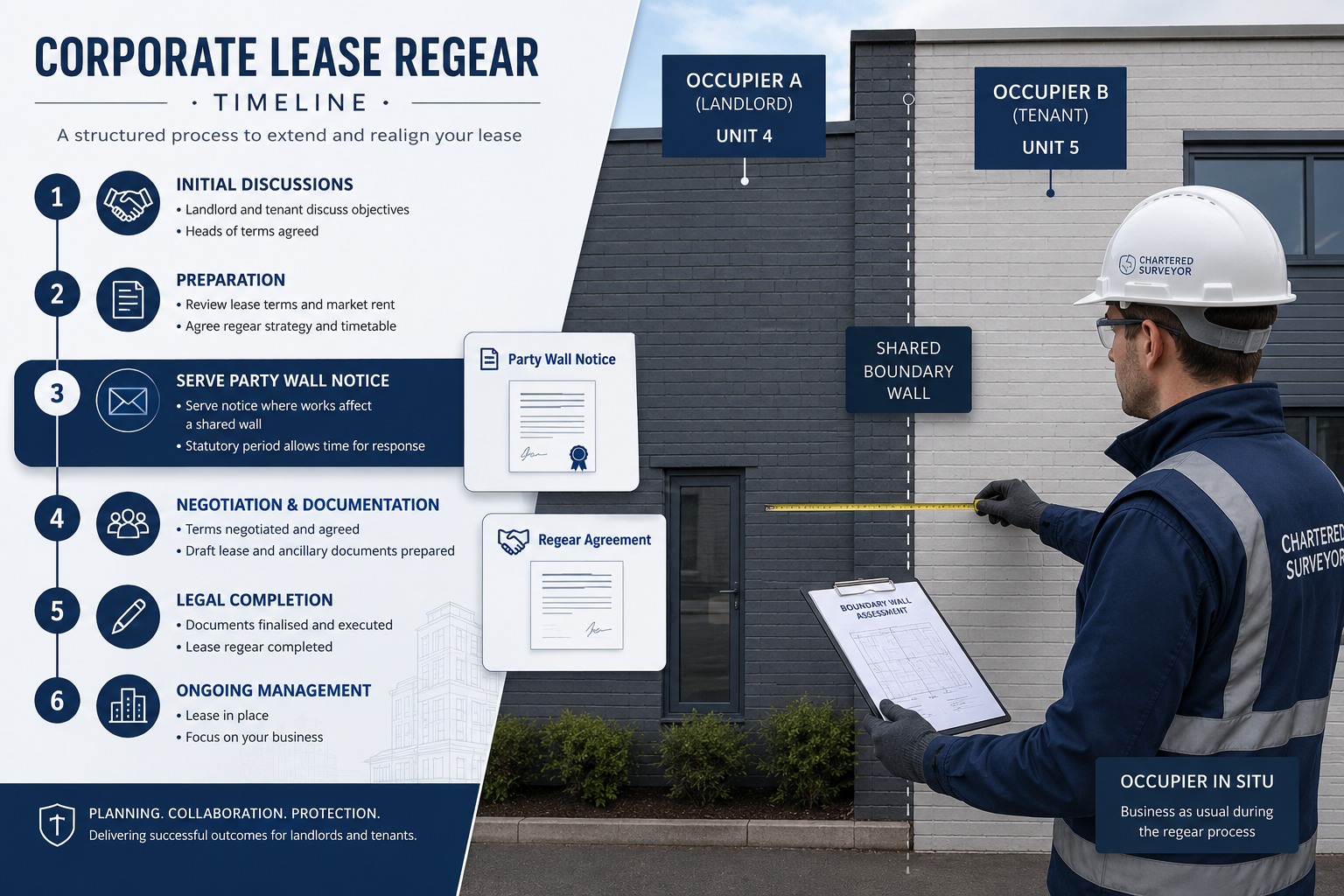
Effective Party Wall Act compliance for corporate regears, particularly when survey protocols are being established for occupiers staying put in 2026, requires a structured approach. The following framework addresses each stage from pre-notice preparation through to the conclusion of works.
Step 1: Pre-Regear Survey Assessment
Before lease terms are finalised, a pre-regear survey should identify all structural and boundary elements that may be affected by proposed works. This is not a statutory requirement, but it is best practice. A commercial building survey at this stage can reveal latent defects, existing damage, or structural vulnerabilities that would otherwise become disputed claims once works begin.
The survey should document:
- The condition of all shared or party walls
- Existing cracks, settlement, or previous repair work
- Foundation depth where excavation is proposed
- The proximity of neighbouring structures
Step 2: Serving Party Wall Notices
Once the scope of works is confirmed, the building owner must serve notice. Notice periods under the Act vary by work type [4]:
| Type of Work | Minimum Notice Period |
|---|---|
| Works to a party wall or structure | 2 months |
| Excavation within 3 or 6 metres | 1 month |
| New building on the line of junction | 1 month |
Notices must be served in writing and must describe the proposed works with sufficient detail. Adjoining owners have 14 days to respond. If they do not consent, a dispute is deemed to have arisen and the surveyor appointment process is triggered [2].
A common error in corporate regears is serving notice too late. Landlords focused on completing a deal quickly sometimes overlook the statutory notice periods, creating programme delays that can unravel the commercial terms of the regear itself. For context on what happens when notice is not served correctly, the guidance on party wall notice not served is directly relevant.
Step 3: Schedule of Condition
The schedule of condition is arguably the most commercially important document in any party wall process involving an in-situ occupier. It records the pre-works condition of the adjoining property — in this case, often the occupied commercial premises themselves — in photographic and written detail.
For leasehold commercial properties, a schedule of condition for leasehold premises establishes a clear baseline. Without this record, any damage claim following works becomes a matter of competing assertions rather than documented evidence. In a regear scenario where the tenant is staying put, this document also protects the landlord from inflated claims of damage caused by works.
The schedule should cover:
- All internal walls adjacent to the works zone
- Ceilings, floors, and structural elements
- Existing finishes, fixtures, and mechanical services
- External elevations visible from the boundary
Step 4: Appointing Surveyors and Agreeing the Award
Where an adjoining owner dissents or fails to respond, each party appoints a surveyor — or they may agree to appoint a single agreed surveyor. The surveyors then produce a party wall award, a legally binding document that sets out how the works are to be carried out, the hours of work, protective measures, and the procedure for dealing with any damage [3].
For detailed guidance on the content and legal standing of a party wall award, the guidance for party wall award outlines what the document must contain and how it protects all parties.
In a corporate regear, the award should also address:
- Access arrangements for the occupied premises
- Noise and dust mitigation during business hours
- Notification procedures if unexpected structural issues arise
- Post-works inspection timelines
Checklist for Boundary Works in Stable Occupancies
The following checklist is designed specifically for property managers, solicitors, and surveyors handling party wall compliance within a corporate regear where the tenant remains in occupation throughout the works.
Pre-Works Checklist
- Confirm whether proposed works are notifiable under the Party Wall etc. Act 1996
- Identify all adjoining owners and occupiers (including the in-situ tenant where applicable)
- Instruct a qualified surveyor to carry out a pre-works condition survey
- Prepare and serve party wall notices with the correct notice periods
- Obtain written consent or manage the dissent/surveyor appointment process
- Agree and execute a party wall award before works commence
During Works Checklist
- Confirm the contractor has received a copy of the party wall award
- Monitor compliance with access, hours, and protective measures specified in the award
- Maintain a site diary recording any incidents, complaints, or unexpected discoveries
- Notify the party wall surveyor immediately if unforeseen structural conditions arise
Post-Works Checklist
- Carry out a post-works inspection against the schedule of condition
- Document any new damage with photographs and written descriptions
- Resolve any damage claims through the surveyor framework before lease terms are finalised
- Retain all party wall documentation as part of the property's title file
This checklist reflects the practical requirements set out in the RICS guidance on party wall legislation and procedure [5], which remains the authoritative professional standard for surveyors operating under the Act.
Common Disputes and How to Avoid Them
Even well-managed regears encounter party wall disputes. Understanding the most frequent causes allows property teams to take preventive action.
Access Disputes
The Act grants the building owner a right of access to carry out works, but this right must be exercised reasonably and with appropriate notice [4]. In an occupied commercial premises, unannounced access can disrupt business operations and create legal exposure. The party wall award should specify access windows, notice requirements, and escalation procedures.
For further detail on what constitutes an obstruction and how it is handled, the guidance on obstruction in party wall is a useful reference.
Damage Claims
Damage claims are the most common source of post-works disputes. Without a schedule of condition, it is almost impossible to determine whether damage pre-existed the works or was caused by them. Courts have consistently held that the burden of proof lies with the claimant, but a well-prepared schedule of condition removes ambiguity entirely.
Excavation Near Foundations
In commercial properties, basement works, service trenches, and new drainage installations frequently trigger the three-metre and six-metre excavation rules. These rules apply to any excavation that goes deeper than the foundations of an adjoining structure within the specified distances [6]. A notice for excavation near a neighbour must be served correctly, and the surveyor should verify foundation depths before works begin.
Dispute Resolution Costs
When disputes escalate, costs can rise sharply. The Act provides a framework for resolving disputes through the surveyor process, but delays and contested awards can add weeks to a programme. Engaging a party wall expert witness surveyor at an early stage can provide an independent assessment that prevents escalation.
Cost Implications for Corporate Regear Transactions
Party wall compliance is not free, and its costs should be factored into the commercial terms of any regear. The main cost heads are:
- Party wall surveyor fees: These vary depending on the complexity of the works and whether a single agreed surveyor or two surveyors are appointed. For a general overview of likely costs, the party wall cost guide provides a useful reference point.
- Schedule of condition preparation: A thorough schedule for a large commercial floor plate can take a full day and generate a substantial photographic record.
- Delay costs: If notice periods are not observed or disputes arise, programme delays can be costly — particularly where the regear includes a rent-free period tied to a works start date.
- Remediation costs: Where damage occurs and is not adequately documented, remediation claims can significantly exceed the original cost of compliance.
"The cost of proper party wall compliance is almost always a fraction of the cost of a dispute. In a corporate regear, where commercial relationships between landlord and tenant must survive the works, investing in the process upfront protects both parties."
The RICS professional statement on party wall legislation [5] is clear that surveyors have a duty to act impartially and that the costs of the process should be proportionate to the works involved.

Practical Considerations for Surveyors and Property Managers in 2026
Several practical factors shape how party wall compliance is managed in the current market environment.
Occupied premises require additional sensitivity. When a commercial tenant is staying put throughout works, the surveyor must balance the building owner's right to carry out works against the occupier's right to quiet enjoyment. The party wall award is the mechanism for achieving this balance, and it should be drafted with sufficient detail to cover all foreseeable scenarios.
Digital documentation is now standard. Schedules of condition are increasingly prepared using high-resolution photography, video walkthroughs, and drone surveys for external elements. The use of drone surveys for external condition recording is particularly valuable for multi-storey commercial buildings where access to upper elevations is restricted.
Dilapidations interact with party wall records. In a regear context, the schedule of condition prepared for party wall purposes may also inform the landlord's schedule of dilapidations at lease end. Maintaining a clear documentary record throughout the regear and works period reduces the scope for dilapidations disputes later.
Early engagement with surveyors saves time. The statutory notice periods under the Act are minimum periods. In practice, the surveyor appointment and award process can take longer than the notice period itself, particularly where adjoining owners are slow to respond or appoint their own surveyor. Building the full party wall timeline into the regear programme from the outset is essential.
Conclusion
Party Wall Act compliance for corporate regears is not an administrative afterthought — it is a legal obligation with real commercial consequences. As occupiers increasingly choose to stay put in 2026, the intersection of lease renegotiation and structural works creates a compliance environment that demands careful planning, timely notice service, and thorough documentation.
Actionable next steps for property professionals handling regears in 2026:
- Audit the works scope early. Before regear terms are agreed, confirm whether any proposed works are notifiable under the Act. Engage a qualified surveyor at heads of terms stage.
- Build notice periods into the programme. A two-month notice period for party wall works is statutory. It cannot be shortened by commercial agreement.
- Commission a schedule of condition before works begin. This single document provides the most effective protection for both landlord and tenant against disputed damage claims.
- Ensure the party wall award addresses occupied premises specifically. Access windows, noise controls, and business continuity provisions should be explicit, not implied.
- Retain all party wall documentation. Notices, awards, schedules of condition, and post-works inspection reports should be stored as part of the property's permanent file.
Compliance with the Party Wall etc. Act 1996 is straightforward when managed proactively. In a regear driven by cost priorities, the investment in proper survey protocols pays dividends in reduced disputes, protected relationships, and a legally sound transaction.
References
[1] Party Wall etc. Act 1996 – legislation.gov.uk
[2] Complete Guide To The Party Wall Act In The UK – charrettelaw.co.uk
[3] Party Walls – rics.org
[4] The Party Wall Etc Act 1996 Explanatory Booklet – gov.uk
[5] Jan 22 Party Wall Legislation And Procedure 7th Edition – rics.org
[6] Party Walls Building Works – gov.uk
How Prince Surveyors can help: explore our party wall surveyors or learn about our party wall surveyor costs.