

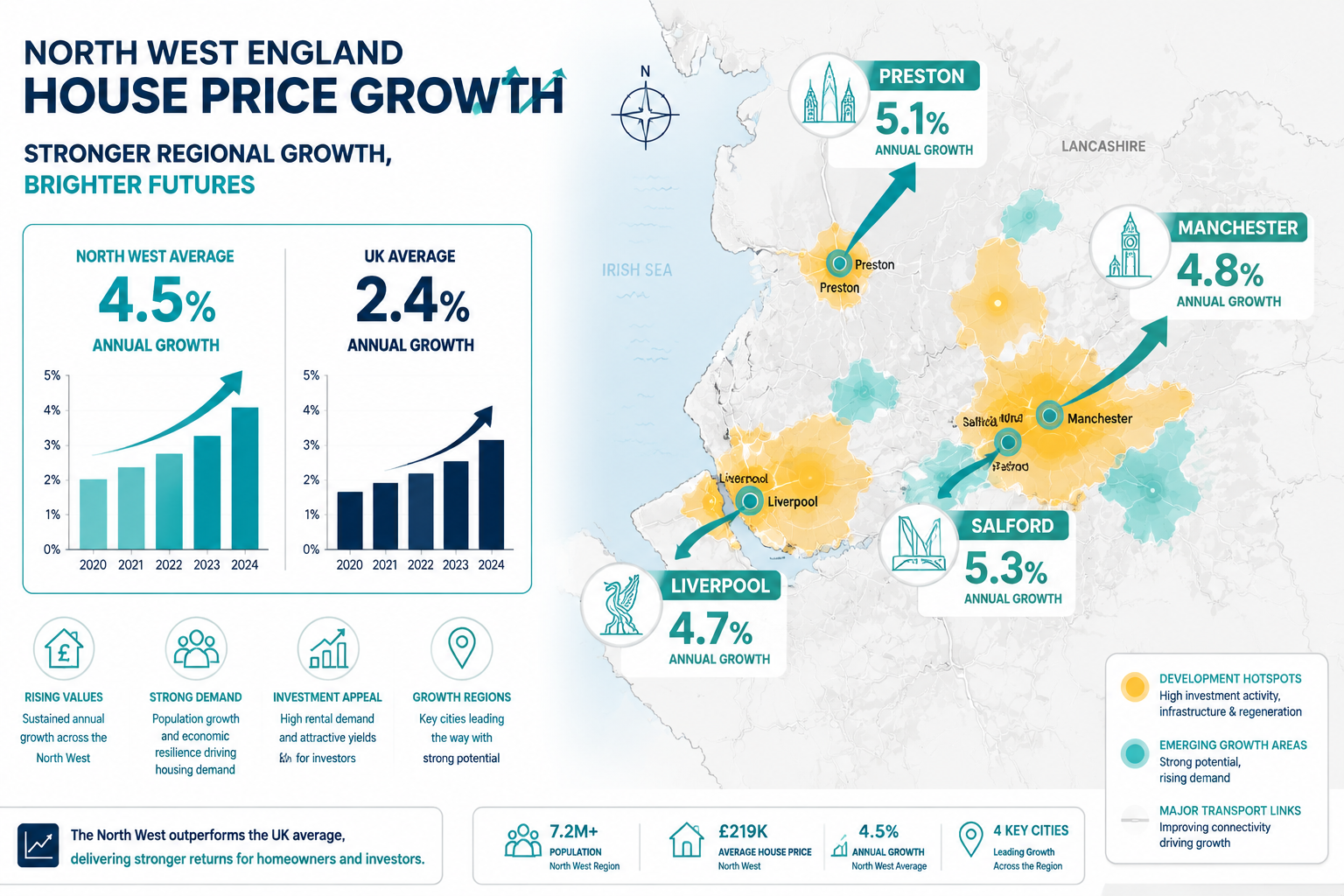
The North West of England recorded 4.5% annual house price growth to December 2025 — nearly double the UK average of 2.4% over the same period [2]. That gap is not a statistical blip. It reflects a structural shift in where buyers, investors, and developers are directing capital, and it has direct consequences for how surveyors, lenders, and project teams must approach due diligence in 2026.
The North West England Valuation Boom: Building Surveys to Unlock Development Potential in 2026 is the defining story of the regional property market right now. Rising valuations create opportunity, but they also raise the stakes. A development project that pencils out on paper can fail at the lender's desk or on site if the underlying building condition has not been properly assessed. That is where professional building surveys become the critical tool for unlocking — and protecting — development value.
Key Takeaways
- The North West is outperforming the UK on house price growth, with forecasts pointing to cumulative gains of around 29% by 2028.
- Rising valuations increase development viability but also increase the financial risk of undiscovered structural or condition defects.
- A thorough building survey is the primary instrument for de-risking acquisitions, supporting lender valuations, and scoping refurbishment works accurately.
- Conversion and extension projects — particularly in secondary stock — are among the highest-value opportunities in 2026, but they demand specialist survey input.
- Developers who commission detailed surveys early in the process move faster, negotiate better, and lose fewer deals to late-stage surprises.
Why the North West Valuation Boom Is Real in 2026
Understanding the scale of the opportunity starts with the numbers. Savills' regional projections indicate cumulative house price growth of approximately 28.8% to 29.4% across the North West between 2024 and 2028 [4]. A separate forecast published in early 2026 expects prices in the region to grow by 5.5% in 2026 alone [9]. Rightmove data cited in February 2026 pointed to the largest January asking price increase in over two decades, feeding directly into higher valuation expectations for schemes across the region [2].
These figures are not driven by speculation alone. The fundamentals are strong. Manchester and Liverpool continue to attract major employers, graduate populations, and inward investment. Rental yields of 7–9.5% in parts of the region make income-based valuations highly attractive for build-to-rent and mixed-use schemes [9]. One investment analysis published in 2026 described the North West as "the most compelling region for UK property investment opportunities in 2026," citing lower entry prices and faster capital growth relative to southern markets [9].
What Is Driving Developer Confidence
Several converging factors are pushing developer activity upward in 2026:
- Price realism from vendors. Record levels of price reductions in 2025 gave way to more realistic pricing and improved buyer confidence heading into 2026 [1]. Developers are finding motivated sellers in secondary stock, particularly in older commercial and residential buildings suited to conversion.
- Growing alignment between asking and achieved prices. This reduces the risk of deals falling through at valuation stage, giving developers greater certainty when committing to acquisition costs [1].
- Flexible terms from sellers. Local agents report that flexible deal structures are allowing developers to acquire assets for refurbishment and change of use [3], precisely the scenarios where building surveys are most essential.
- Strong planning pipeline. The North West has a well-established pipeline of regeneration projects, from city-centre apartment conversions to suburban extension schemes, all of which require detailed pre-acquisition survey work.
"Developers who skip or compress the survey stage in a rising market are not saving time — they are transferring risk from the seller onto themselves."
Building Surveys as the Engine of Development Viability
The connection between rising valuations and the need for rigorous survey work is direct. When a development asset is worth more, the cost of getting the condition assessment wrong is proportionally higher. A missed structural defect, an undetected drainage failure, or an undisclosed asbestos presence can wipe out the margin on a scheme entirely.
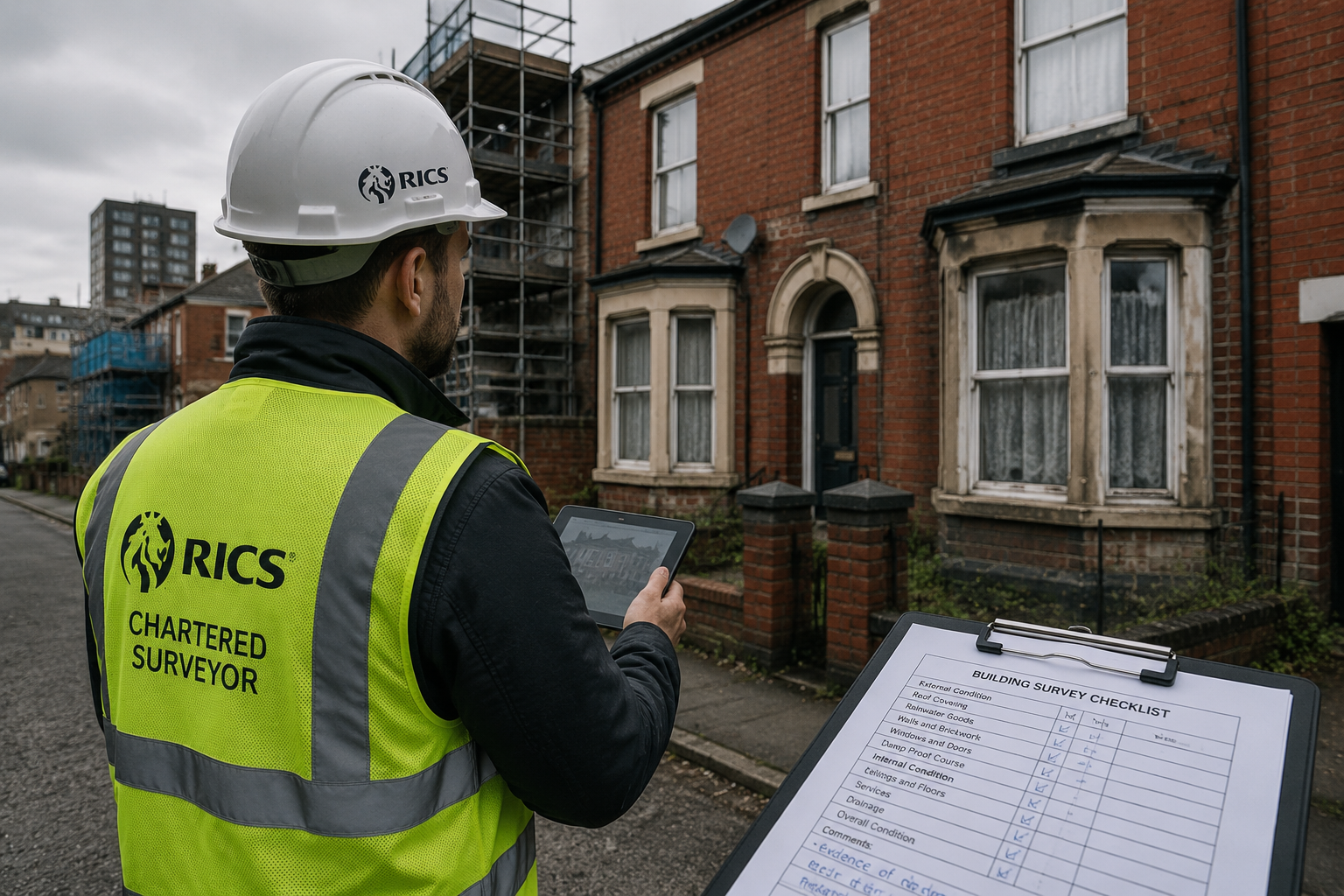
A building survey — also known as a Level 3 survey — is the most comprehensive inspection available for residential and mixed-use properties. It covers the structure, fabric, services, and grounds of a property in detail, and it produces a report that identifies defects, assesses their severity, and recommends remedial action. For developers, this report serves multiple purposes simultaneously: it informs the acquisition price, it supports the lender's valuation, it scopes the refurbishment budget, and it provides a baseline for project management.
How Building Surveys Support the North West England Valuation Boom: Building Surveys to Unlock Development Potential in 2026
The practical value of a building survey in the current North West market operates across several stages of a development project:
1. Pre-Acquisition Due Diligence
Before committing to a purchase, developers need to know what they are buying. A building survey identifies hidden defects that are not visible during a standard viewing — subsidence, damp penetration, roof deterioration, structural movement, and drainage failures. In a market where secondary stock is being acquired for conversion, these issues are common. Understanding them before exchange allows the developer to renegotiate the price, budget accurately, or walk away.
For properties where movement or cracking is a concern, a subsidence survey provides the specialist assessment needed to determine whether movement is historic and stable or active and ongoing. This distinction can be the difference between a viable project and an uninsurable liability.
2. Supporting Lender and RICS Valuations
Lenders in 2026 are more cautious about development finance than they were before the interest rate cycle of recent years. A RICS valuation underpins the loan-to-value calculation, and lenders increasingly expect that valuation to be supported by evidence of building condition. A clean building survey report strengthens the lender's confidence in the security, while a survey that flags significant defects — but also quantifies the remediation cost — gives the lender a clear picture of risk-adjusted value.
3. Scoping Refurbishment and Extension Works
For developers pursuing extensions or conversions, the building survey is the starting point for the project specification. It identifies which elements of the existing structure can be retained, which must be replaced, and what specialist investigations are needed before design work can begin. A structural survey goes a step further, assessing load-bearing elements, foundations, and the structural implications of proposed alterations.
4. Establishing a Schedule of Condition
Where a developer is acquiring a leasehold property or entering a joint venture, a schedule of condition report creates a documented baseline of the property's state at the point of acquisition. This protects the developer from future dilapidations claims and provides clarity for all parties on what works are attributable to the development rather than pre-existing deterioration.
Survey Types Most Relevant to North West Development in 2026
| Survey Type | Best Used For | Key Output |
|---|---|---|
| Building Survey (Level 3) | Full condition assessment before acquisition | Detailed defect report with remediation advice |
| Structural Survey | Conversion, extension, or structural alteration projects | Assessment of load-bearing elements and foundations |
| Subsidence Survey | Properties showing cracking or movement | Determination of cause, severity, and stability |
| Drainage Survey | Older stock, commercial conversions | Condition of drainage infrastructure |
| Asbestos Survey | Pre-1999 buildings, commercial or industrial | Identification and management plan for asbestos |
| Schedule of Condition | Leasehold acquisitions, joint ventures | Documented baseline condition at acquisition |
| Monitoring Survey | Ongoing development adjacent to existing structures | Ongoing movement and settlement data |
For developers comparing options before commissioning, a useful starting point is the guide to comparing different types of survey, which sets out the scope and limitations of each level of inspection.
Practical Survey Tactics for Extensions and Conversions in 2026
The North West England Valuation Boom: Building Surveys to Unlock Development Potential in 2026 is most acutely felt in two categories of development: residential extensions to existing properties and conversions of commercial or industrial buildings to residential use. Both categories require specific survey approaches.
Extensions: Assessing Viability Before Planning
For homeowners and small developers pursuing extensions in the North West, the rising value of the base property makes extension projects more financially viable than they were two or three years ago. A 5.5% price growth forecast for 2026 [9] means that the gross development value of an extended property is moving upward even as the project is being planned.
However, extension viability depends on the condition of the existing structure. A building survey will reveal whether the existing foundations can support additional loads, whether the roof structure is sound enough to be retained or must be replaced, and whether there are any drainage or damp issues that need to be resolved before construction begins. Commissioning a survey before submitting a planning application avoids the costly scenario of receiving planning permission for a scheme that turns out to be structurally impractical.
A solid floor slab survey is particularly relevant for ground-floor extensions, where the condition of the existing slab determines whether it can be extended, broken out, or must be fully replaced. This is a common issue in North West terraced housing stock, where original floor construction varies widely.
Conversions: The Due Diligence Imperative
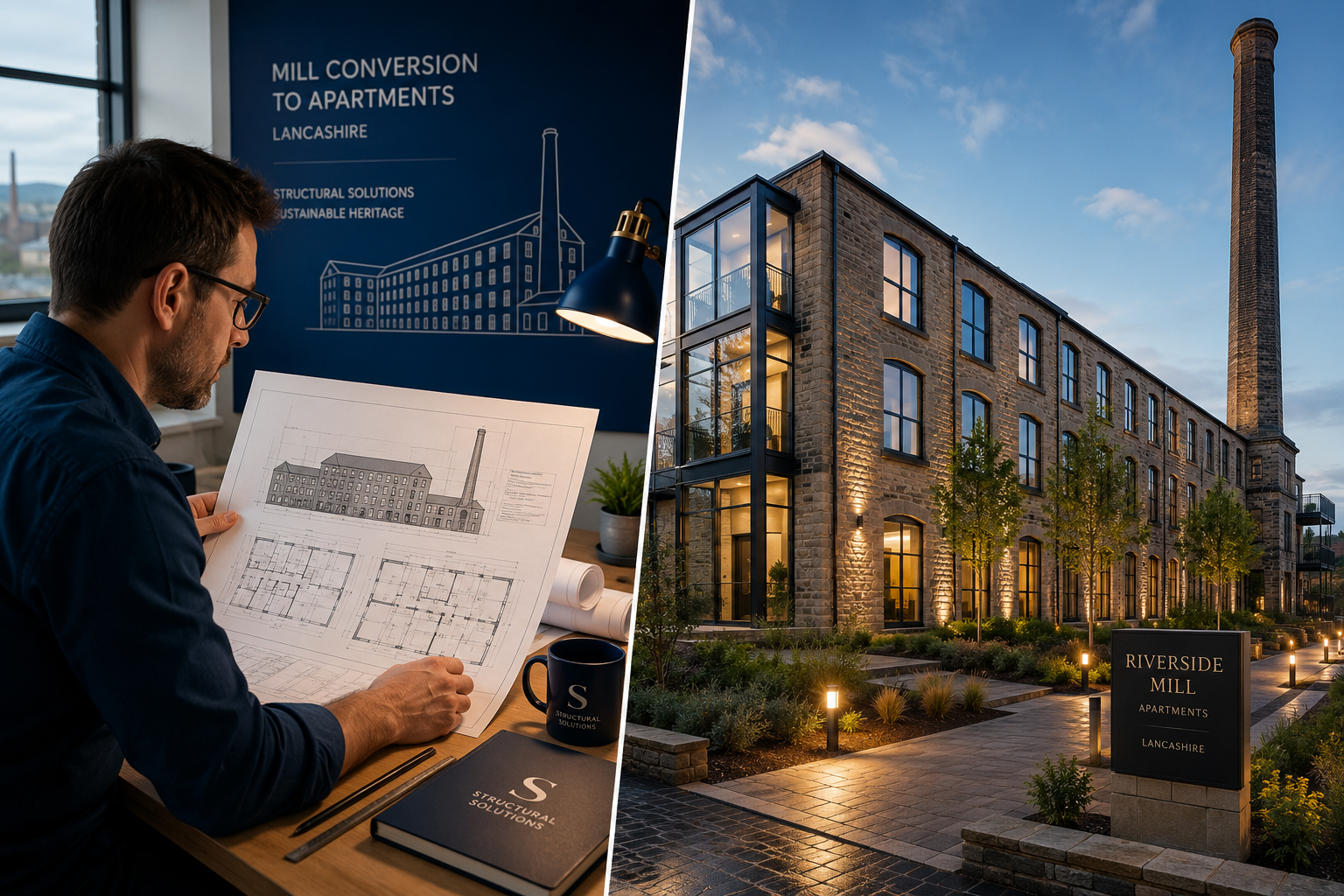
Commercial-to-residential conversions represent some of the highest-value development opportunities in the North West in 2026. Former mill buildings, office blocks, and retail units in cities like Manchester, Salford, Preston, and Liverpool are being acquired for residential conversion, driven by strong rental demand and the region's rental yields of 7–9.5% [9].
These projects carry the highest survey complexity. Key considerations include:
- Structural integrity of the existing frame. Many older commercial buildings in the North West were built with cast iron or early steel frames that require specialist structural assessment before conversion loads are applied.
- Asbestos. Any building constructed before 1999 may contain asbestos-containing materials. An asbestos survey is a legal requirement before refurbishment or demolition work begins, and its findings directly affect project cost and programme.
- Drainage infrastructure. Older commercial buildings frequently have complex or deteriorated drainage systems that are inadequate for residential use. A drainage survey maps the existing system and identifies what must be replaced or upgraded.
- Roof condition. Industrial and commercial roofs often contain flat or low-pitch sections with aging waterproofing. A detailed roof survey assesses remaining life and replacement costs, which can be substantial.
- Damp and water ingress. Long-vacant commercial buildings are particularly susceptible to damp penetration. A damp survey identifies the source, extent, and appropriate remediation strategy.
The Role of Monitoring Surveys During Development
For developers working on sites adjacent to existing occupied buildings — a common scenario in dense urban areas of Manchester and Liverpool — a monitoring survey provides ongoing data on ground movement, vibration, and structural response during construction. This protects the developer from neighbour claims and provides evidence that construction activities are being managed responsibly.
Valuation Costs, Survey Pricing, and Getting the Numbers Right
One of the most common questions from developers entering the North West market in 2026 is how much survey and valuation work costs relative to the value it protects. The answer is straightforward: the cost of a comprehensive building survey is a small fraction of the cost of a defect that was not identified before acquisition.
Valuation costs and survey pricing vary depending on the size, type, and complexity of the property, as well as the scope of inspection required. For development projects, the relevant question is not what the survey costs in isolation, but what it costs relative to the project budget and the potential downside of proceeding without one.
In a market where North West prices are forecast to grow by approximately 29% over five years [4], the gross development value of a well-executed project is substantial. The survey cost — typically a four-figure sum for a comprehensive Level 3 inspection — is a minor line item against that upside. The risk of not commissioning one is not.
For developers who are also considering the insurance implications of their acquisitions, an insurance reinstatement valuation ensures that the property is insured for the correct rebuild cost, which is a separate figure from market value and one that is frequently underestimated on older or unusual properties.
Conclusion
The North West England Valuation Boom: Building Surveys to Unlock Development Potential in 2026 presents a genuine and well-evidenced opportunity for developers, investors, and property owners across the region. With annual price growth running at nearly double the national average [2], cumulative forecasts of around 29% over five years [4], and rental yields that support income-based valuations at 7–9.5% [9], the fundamentals for development activity are as strong as they have been in a generation.
But rising values raise the stakes as well as the rewards. The most successful developers in this market will be those who treat building surveys not as a cost to be minimised, but as the primary instrument for unlocking and protecting development value.
Actionable next steps for developers and property owners in 2026:
- Commission a Level 3 building survey before exchanging contracts on any acquisition intended for refurbishment, extension, or conversion.
- Identify the specific survey types required for the project — structural, drainage, asbestos, damp, or monitoring — and instruct them in parallel rather than sequentially to save programme time.
- Use the survey findings to negotiate the acquisition price where defects are identified, rather than absorbing remediation costs post-exchange.
- Ensure that the lender's RICS valuation is supported by up-to-date survey evidence, particularly for older or unusual properties.
- Establish a schedule of condition at acquisition to protect against future dilapidations claims on leasehold or joint-venture assets.
The North West property market in 2026 rewards those who move with confidence and evidence. A thorough building survey is how that confidence is earned.
References
[1] North West Regional Market Report – fineandcountry.co.uk
[2] UK House Price Index North West Outperforms As Buyers Chase Value Beyond The South – liverpoolchamber.org.uk
[3] North West Property Market Insights May 2026 – edwardmellor.co.uk
[4] North West Property Values Set To Soar By 29.4% Savills – rw-invest.com
[9] North West Property Investment Opportunities 2026 – dbrinvest.com
How Prince Surveyors can help: explore our property valuations or learn about our which survey you need.