

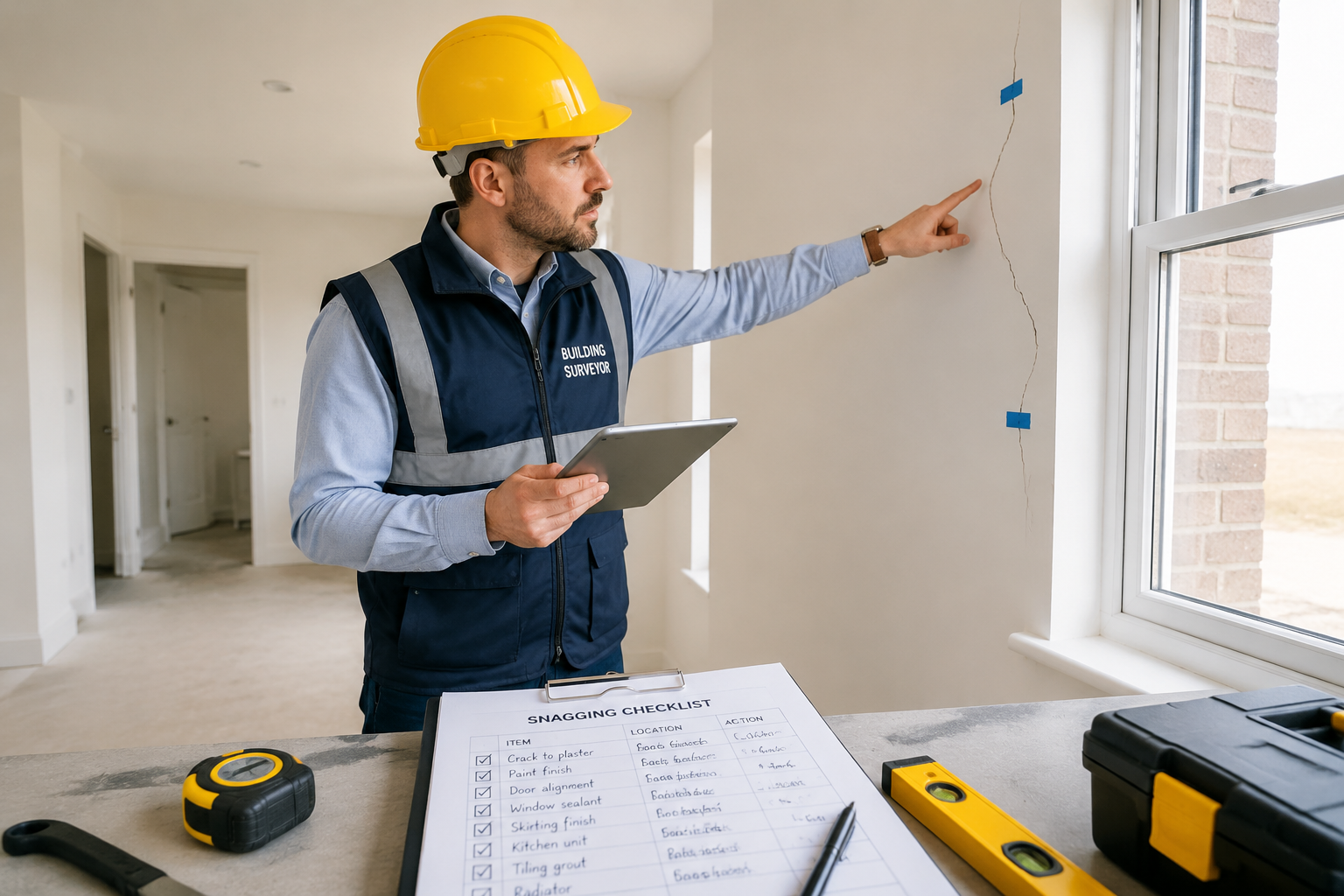
Roughly 80% of new-build homes in England and Wales are handed over with between 80 and 150 defects — yet the majority of buyers walk through their front door without a single independent inspection having taken place [1]. As residential construction output edges upward in 2026, that statistic carries serious financial weight. New-Build Snagging and Building Surveys: Protecting Off-Plan Buyers in the 2026 Construction Uptick is not simply a procedural topic; it is a practical guide to safeguarding what is, for most people, the largest purchase of their lives.
Key Takeaways
- New homes are routinely handed over with dozens of defects; independent snagging surveys catch issues that developer walk-throughs miss.
- The NHBC Buildmark warranty provides two distinct protection periods, but it does not replace the need for a professional inspection before legal completion.
- The New Homes Quality Code and the Building Safety Act 2022 have strengthened buyer rights, but buyers must act promptly to use them.
- Off-plan purchases carry unique risks — including specification changes and uncertain completion dates — that make pre-completion surveys especially valuable.
- Commissioning an independent snagging survey typically costs £300–£600 and can save buyers thousands in remediation costs.
Why New-Build Defects Are So Common in 2026
The construction industry operates under intense pressure. Labour shortages, supply chain disruption, and tight developer margins create conditions where finishing quality is frequently compromised. When residential output rises — as it is doing in 2026 — those pressures intensify further, and the rate of defects per completed unit tends to rise with them.
Independent research consistently identifies the most common issues found during snagging inspections as follows [2]:
| Defect Category | Typical Examples |
|---|---|
| Cosmetic and finishing | Scratched glass, uneven plasterwork, paint runs, missing grout |
| Roof and structural | Poorly fitted roof tiles, inadequate insulation, cracked lintels |
| Services and drainage | Incorrectly wired sockets, slow-draining waste pipes, boiler faults |
| Damp and insulation | Cold bridges, missing cavity wall insulation, condensation risk |
| External works | Unfinished driveways, inadequate garden drainage, poorly hung gates |
These are not trivial cosmetic complaints. Left unaddressed, damp ingress, drainage failures, and insulation gaps can escalate into costly structural problems within a few years of occupation.
The off-plan dimension adds another layer of risk. When a buyer commits to a property before it is built, they are purchasing from drawings, show homes, and specification sheets. Off-plan buyers face risks that include differences between expected and actual finishes, unexpected changes to plans or specifications, uncertain completion dates, and limited recourse against the builder if problems emerge after legal completion [5]. The further a buyer is from the physical building at the point of exchange, the more important independent professional oversight becomes.
Understanding Developer Warranties and Their Limits
NHBC Buildmark: What It Covers — and What It Does Not
The NHBC Buildmark warranty covers approximately 80% of new homes in England and Wales and operates across two distinct periods [1]:
- Years 1–2 (Builder Period): The developer is responsible for repairing defects reported during this window, including cosmetic and workmanship issues. Buyers must report problems promptly and in writing.
- Years 3–10 (NHBC Insurance Period): NHBC's own insurance takes over, but coverage narrows significantly. Only damage caused by structural or physical defects is covered; cosmetic issues and general wear and tear are excluded.
This distinction is critical. A buyer who misses the two-year builder period — perhaps because they were unaware of defects, or because they assumed the developer would act without formal notification — may find themselves with no warranty cover for issues that would otherwise have been remedied at no cost.
Key point: A developer warranty is not a substitute for an independent inspection. It is a mechanism for resolving disputes after defects have been identified. The identification itself is the buyer's responsibility.
The New Homes Quality Code
The New Homes Quality Code (NHQC), launched in 2021 and now widely adopted by developers, sets minimum standards for sales practices, pre-occupation information, and after-sales service [1]. Developers registered with the NHQC are subject to the New Homes Ombudsman Service (NHOS), which provides a formal dispute resolution route when snagging complaints remain unresolved. This is a meaningful escalation path for buyers who encounter developer resistance — but it only applies to registered developers, and it works best when buyers have documented their defects thoroughly from the outset.
Building Safety Act 2022
For buyers of higher-risk buildings — defined as residential buildings over 18 metres or seven storeys — the Building Safety Act 2022 introduced significantly stronger protections [1]. The limitation period for claims against developers has been extended, and new duties have been placed on principal contractors and building owners. Buyers of high-rise new-build apartments in 2026 should familiarise themselves with these provisions before exchange.
The Role of Independent Building Surveys in New-Build Snagging and Building Surveys: Protecting Off-Plan Buyers in the 2026 Construction Uptick
Why Developer Walk-Throughs Are Not Enough
Most developers offer a pre-completion walk-through with a site manager. These appointments are useful for familiarising buyers with the property, but they are not impartial inspections. A site manager's primary interest is in achieving legal completion on schedule. An independent surveyor's sole interest is in identifying every defect, however minor, and documenting it in a format that carries professional weight.
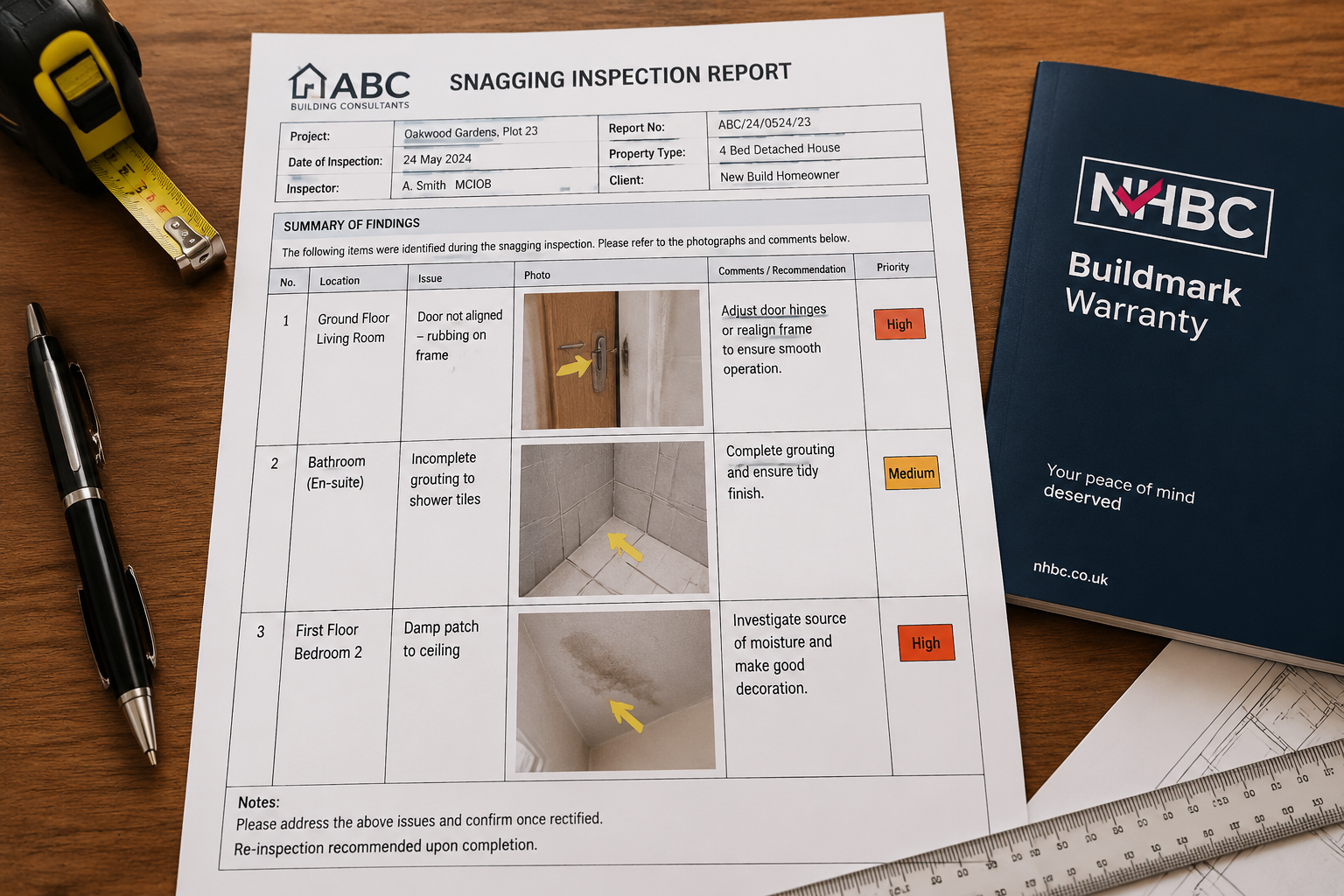
A professional snagging surveyor typically charges between £300 and £600 for a full inspection [1]. That fee is modest relative to the cost of a new home and the potential cost of remediation works. The resulting report provides:
- A comprehensive photographic record of all identified defects
- Clear descriptions suitable for submission to the developer and warranty provider
- Professional credibility that a handwritten buyer's list cannot match
- A timestamped baseline for any future warranty or legal claims
For buyers who want to understand what a thorough professional report looks like before commissioning one, reviewing a Level 3 building survey example and guide gives a useful sense of the depth and structure that professional inspection reports provide.
Timing: Before Completion Is Best
The optimal moment for a snagging inspection is before legal completion [2]. At this stage, the developer is still contractually obligated to hand over a property that meets the agreed specification. Defects identified before completion can be included in a formal schedule that the developer must address prior to — or as a condition of — finalising the purchase.
Once legal completion has occurred, the buyer's leverage diminishes. The developer's obligation shifts from "fix before handover" to "fix within the warranty period," which introduces delays, disputes about severity, and the risk of issues being classified as cosmetic rather than structural.
If pre-completion access is refused, buyers should still commission an inspection as early as possible after moving in, ideally within the first few weeks. Every day of occupation without a documented defect record reduces the buyer's ability to demonstrate that issues were present at handover.
Choosing the Right Type of Survey
Not every new-build buyer needs the same level of inspection. Understanding the options is important:
- Snagging survey: Focused specifically on new-build defects — finishing quality, services, drainage, and external works. Best suited to standard new-build houses and apartments.
- RICS Level 2 HomeBuyer Report: A broader condition survey covering the property's overall condition. Useful for new builds where the buyer also wants an independent valuation.
- RICS Level 3 Building Survey: The most comprehensive option, covering structure, fabric, and all accessible elements in detail. Recommended for larger or more complex new-build properties.
For buyers who are uncertain which level of inspection is appropriate, the survey comparison tool provides a clear side-by-side breakdown. Those purchasing a new-build house with non-standard construction or unusual materials may benefit from a RICS Level 3 building survey rather than a standard snagging inspection alone.
It is also worth considering whether a homebuyers survey is worth it for a new-build property — the answer, in most cases, is yes, particularly when combined with a dedicated snagging inspection.
Practical Steps for Off-Plan Buyers in 2026
Before Exchange of Contracts
The protections available to off-plan buyers begin long before the keys are handed over. At the pre-exchange stage, buyers should:
- Review the specification document in detail. Every material, fitting, and finish should be listed. Any item described as "equivalent" or "subject to availability" is a potential source of dispute.
- Understand the developer's reservation and cancellation terms. Completion date delays are common; the contract should specify what remedies are available if the developer misses agreed milestones.
- Check whether the developer is registered with the NHQC. Registration provides access to the New Homes Ombudsman if disputes arise.
- Confirm warranty arrangements. NHBC Buildmark is the most common, but other providers exist. Confirm the warranty is in place before exchange.
During the Build
Buyers who have purchased off-plan often have the right to visit the site at agreed intervals. These visits are valuable opportunities to identify specification deviations early, when they are easier and cheaper to correct. A Savills survey from late 2025 found that 72% of new-build buyers wanted the ability to customise their home during the build process, and 58% said they would pay a premium for this [4]. Developers have responded with buyer choice programmes and online design portals — but any agreed customisation should be confirmed in writing and reflected in the specification document.
At Handover
The handover appointment is not a formality. Buyers should:
- Attend with a professional snagging surveyor or arrange a separate independent inspection as close to the handover date as possible.
- Document everything photographically before moving furniture in.
- Refuse to sign any document stating the property is defect-free unless an independent inspection has been completed.
- Submit a formal defect schedule to the developer in writing within the first few days of occupation if pre-completion access was not available.
For buyers in London and the surrounding areas, working with chartered surveyors in London who specialise in new-build inspections ensures that the snagging report carries the professional authority needed to compel developer action.
After Moving In
The two-year builder period under the NHBC Buildmark warranty is the most powerful tool available to new-build buyers after completion. To use it effectively:
- Report defects in writing as soon as they are identified. Do not wait to accumulate a list.
- Keep copies of all correspondence with the developer.
- If the developer fails to respond or disputes the defect, escalate to the NHBC or the New Homes Ombudsman (if the developer is NHQC-registered).
- Seek independent professional advice on any defect that the developer classifies as cosmetic but that appears to have structural or services implications.
Buyers who suspect more serious underlying issues — for example, structural movement, significant damp, or drainage failure — should consider commissioning a specific defect report to provide a professional assessment that can support a warranty or legal claim.
New-Build Snagging and Building Surveys: Protecting Off-Plan Buyers in the 2026 Construction Uptick — The Regulatory Landscape
Rising Construction Costs and Quality Implications
Regulatory compliance costs in new home construction have risen sharply in recent years. Data from the US market — where government regulations now add over $131,000 to the price of a typical new single-family home, representing 26.4% of the average sale price — illustrates a global trend toward higher compliance costs that developers pass on to buyers [3]. In the UK context, the Building Safety Act 2022, updated fire safety requirements, and stricter energy efficiency standards have all added to the cost base of new developments.
When developers face higher compliance costs alongside labour and materials inflation, the risk is that quality control in non-regulated areas — finishing, landscaping, services installation — is deprioritised. This makes independent snagging inspections more important, not less, as construction output rises in 2026.
What Buyers Can Expect from the NHOS
The New Homes Ombudsman Service provides a free, independent dispute resolution service for buyers of homes built by NHQC-registered developers. If a developer fails to address snagging complaints within a reasonable timeframe, buyers can submit a formal complaint to the NHOS. The Ombudsman can direct developers to carry out remediation works and, in some cases, award compensation. This route is most effective when buyers have maintained thorough written records from the point of handover.
Conclusion
The combination of rising construction output, persistent quality control challenges, and an increasingly complex regulatory environment makes 2026 a year in which independent professional oversight of new-build purchases is more valuable than ever. Developer warranties and the New Homes Quality Code provide important protections, but they are reactive mechanisms — they respond to documented problems rather than preventing them.
Actionable next steps for off-plan buyers in 2026:
- Commission an independent snagging survey before legal completion wherever possible; if pre-completion access is refused, arrange an inspection within the first two weeks of occupation.
- Review the developer's NHQC registration status before exchange and understand the escalation routes available to you.
- Document all defects in writing and submit them to the developer formally — verbal reports carry no weight in warranty or Ombudsman proceedings.
- For complex or high-value new builds, consider a RICS Level 3 building survey in addition to a standard snagging inspection.
- Keep all correspondence, photographs, and inspection reports in a single organised file throughout the warranty period.
The cost of a professional snagging survey is a fraction of the cost of a single unresolved defect. In a market where new-build output is climbing and quality pressures are real, that investment is not optional — it is essential.
References
[1] New Build Snagging Complete Guide Buyers 2026 – propertypassport.uk
[2] New Build Snagging Survey – cjbloor.co.uk
[3] New Home Construction Regulatory Costs Hit $132k Per Home, NAHB Finds – mpamag.com
[4] New Build Demand Trends 2026 – new-builds.co.uk
[5] Are Melbourne New Builds And Off The Plan Apartments Still Worth It In 2026 – forgeproperty.com.au
How Prince Surveyors can help: explore our independent damp surveys or learn about our Level 3 building survey.