

The Renters' Rights Act 2026 has fundamentally altered the landlord calculus in England. With the abolition of Section 21 "no-fault" evictions now in full effect, every buy-to-let property carrying a sitting tenant must be reassessed through an entirely different valuation lens. Surveyors who continue to apply pre-reform models risk producing figures that neither lenders nor investors can rely upon. Navigating valuation challenges in 2026 rental rights reforms: impact on buy-to-let yield assessments is no longer a theoretical exercise — it is the defining professional task for RICS-accredited surveyors and property investors alike in the current market.
Key Takeaways
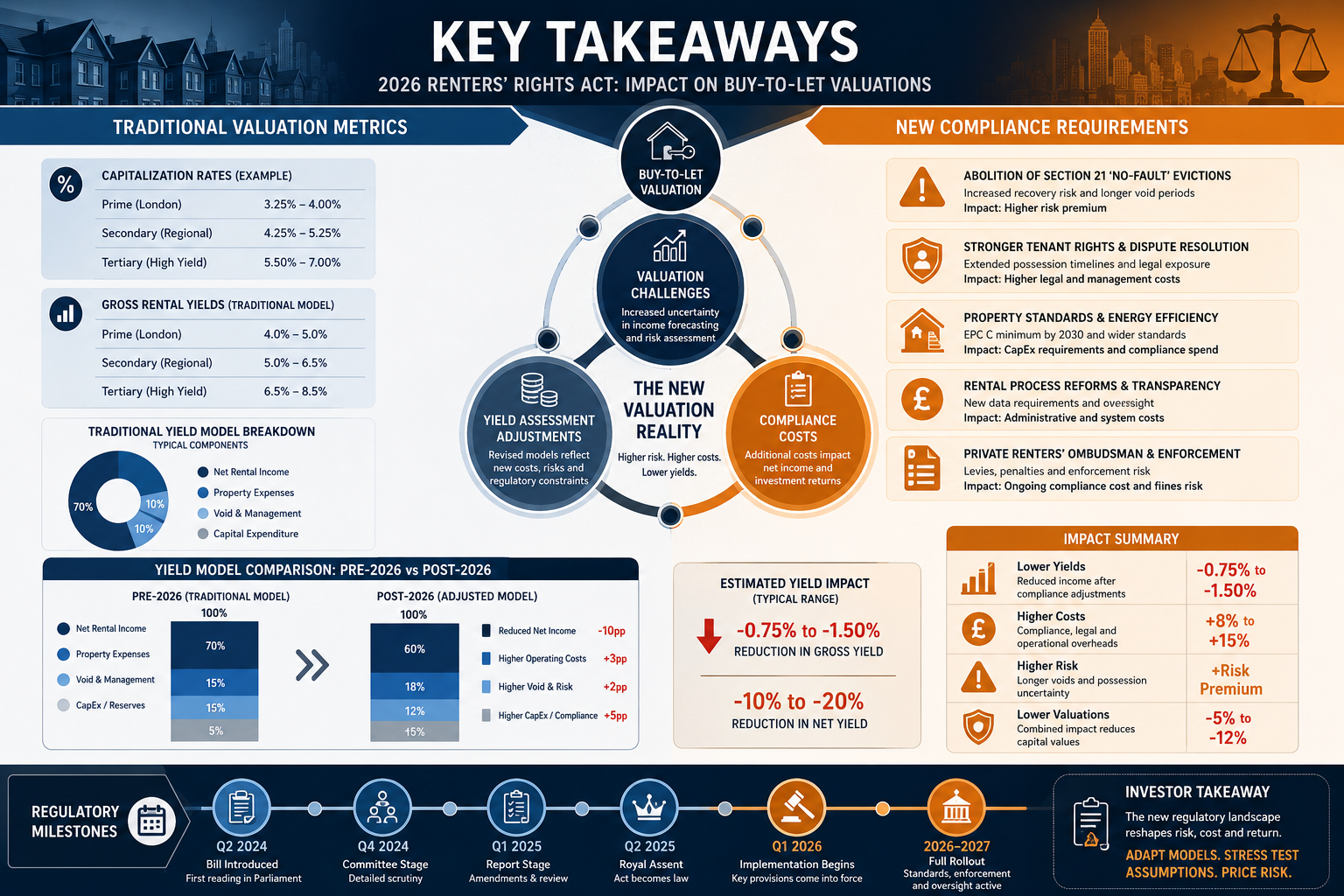
- The abolition of Section 21 and the shift to open-ended periodic tenancies have made tenanted property valuations materially lower, with sitting-tenant discounts now running at 10-20% below vacant possession value.
- Surveyors are advised to raise capitalization rates from approximately 5% to 5.5-6% to reflect heightened legislative and income risk.
- Mandatory landlord registration, EPC upgrade obligations, and rent restriction rules all reduce net yields and must be factored into income-based valuations.
- A clear quality divide is emerging: well-maintained, compliant properties are commanding premium valuations while lower-quality stock faces tighter lending conditions.
- Professional surveys and compliance audits have become essential tools for landlords seeking to protect and accurately represent asset value.
How the Renters' Rights Act 2026 Reshapes the Valuation Landscape
The Renters' Rights Act arrived with a cluster of reforms that, taken individually, each nudge the valuation dial. Taken together, they represent the most significant restructuring of the private rented sector (PRS) in a generation.
The End of Section 21 and Its Valuation Consequences
The cornerstone change is the abolition of Section 21 evictions. Landlords can no longer issue a "no-fault" notice to regain possession; instead, they must rely on specific grounds under Section 8, which requires court proceedings and demonstrable cause [1]. The practical effect is a longer, less predictable possession timeline.
From a valuation standpoint, this matters enormously. A property's investment value has always been partly derived from the owner's ability to reposition the asset — to sell with vacant possession, to refurbish between tenancies, or to re-let at a higher market rent. When that flexibility is curtailed, the investment value falls.
"The removal of Section 21 shifts the risk balance decisively toward the tenant, and surveyors must price that risk into every tenanted asset they assess."
Canterbury Surveyors have noted that properties with long-term sitting tenants are now attracting valuation discounts of 10-20% below vacant possession value, directly reflecting the reduced ability to regain possession [5]. This is not a temporary market sentiment; it is a structural adjustment that should be embedded in every income-based valuation model.
Periodic Tenancies: Uncertainty Baked Into Every Lease
All assured shorthold tenancies have now converted to open-ended periodic tenancies, removing fixed end dates entirely [2]. For landlords, this means there is no natural lease expiry to plan around. Void period forecasting — a critical input into gross-to-net yield calculations — becomes considerably harder.
Consider the practical impact on a standard buy-to-let yield model:
| Input Variable | Pre-Reform Assumption | Post-Reform Adjustment |
|---|---|---|
| Average void period | 2-4 weeks per year | 4-8 weeks (extended possession timelines) |
| Tenancy duration certainty | Fixed term (typically 12 months) | Open-ended; no predictable end point |
| Possession timeline | 2-4 months via Section 21 | 6-12+ months via Section 8 court process |
| Rent review frequency | At lease renewal | Once per year, capped at market value |
These adjustments compound. A landlord who previously modelled a 95% occupancy rate may now need to apply 90% or lower, particularly in properties where tenant relationships are uncertain or where the property requires periodic refurbishment.
Understanding property rights in the context of these reforms is essential for any landlord or surveyor working through the implications of the new tenancy framework.
Navigating Valuation Challenges in 2026 Rental Rights Reforms: Adjusting Capitalization Rates and Net Yield Models
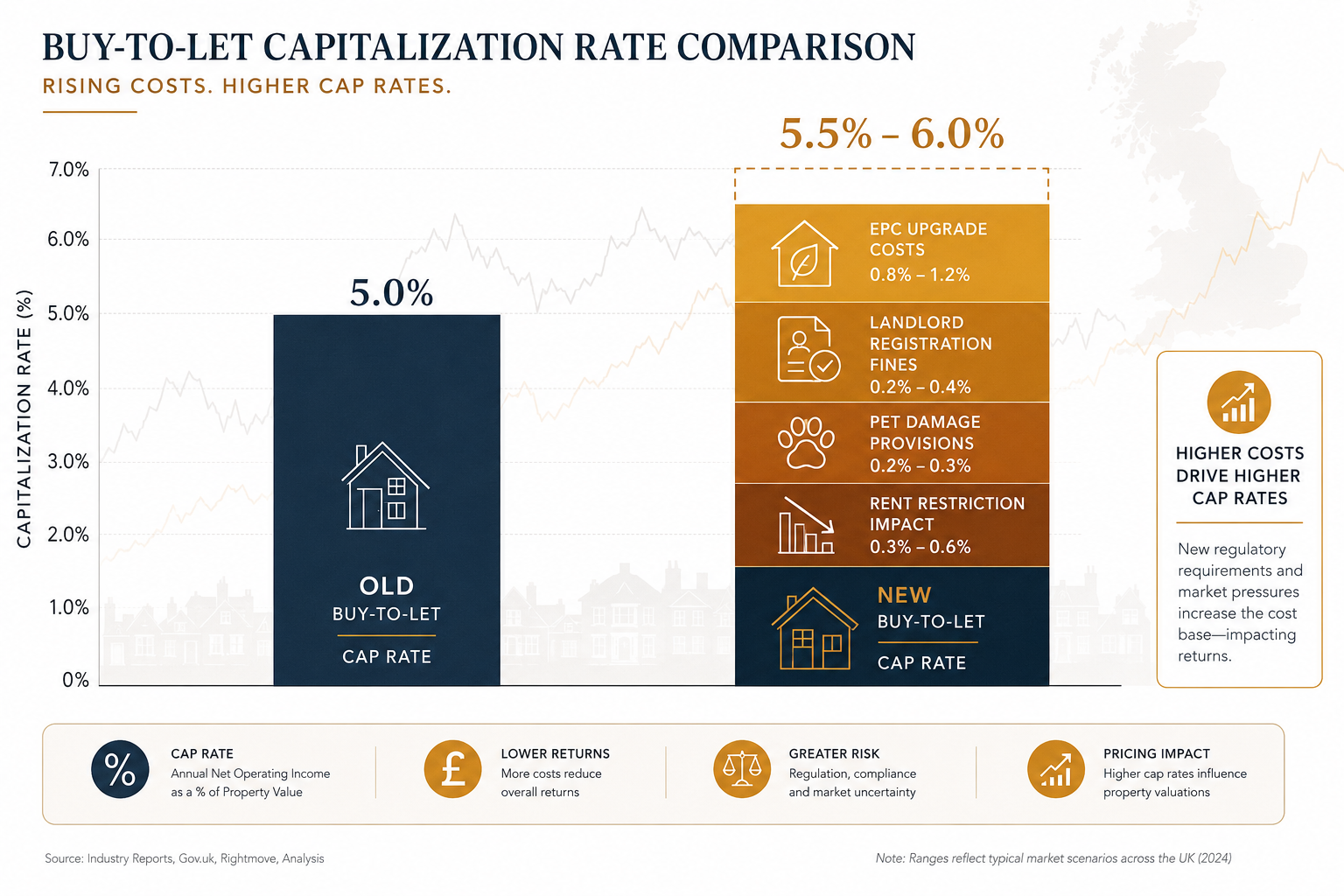
The income approach to valuation — dividing net operating income by a capitalization rate — remains the standard method for buy-to-let assets. What has changed is the appropriate rate to apply.
Why Capitalization Rates Must Rise
Surveyors are now advised to raise capitalization rates from approximately 5% to a range of 5.5-6% to reflect the additional legislative and income risks introduced by the Act [3]. A higher cap rate produces a lower capital value for the same income stream, which is the mathematically correct response to increased risk.
The factors driving this upward adjustment include:
- Reduced income certainty from open-ended tenancies and restricted rent increases
- Extended void and possession periods increasing effective vacancy costs
- Compliance cost obligations including EPC upgrades, landlord registration fees, and potential fines
- Reduced exit flexibility affecting both investment value and lender security
Lenders are also reassessing their risk models. The move to open-ended tenancies and restrictions on rent increases reduce visibility over future rental income, increasing uncertainty around landlord cashflows [6]. This is feeding directly into tighter mortgage stress-testing criteria for buy-to-let products, which in turn affects the pool of buyers willing to acquire tenanted properties.
The Rent Restriction Effect on Yield Projections
Annual rent increases are now restricted: no increase is permitted in the first 12 months of a tenancy, and only one increase per year thereafter, capped at market value [8]. While "market value" provides some protection against below-inflation rents in the long run, it removes the tactical flexibility landlords previously used to reset rents aggressively between tenancies.
For yield assessments, this means:
- Income growth projections must be modelled conservatively
- Reversion yields (the yield anticipated when a tenancy ends and a new one begins at market rent) are less certain
- Properties where current rents sit significantly below market rate carry a longer "correction runway," reducing near-term income
The cap on rent in advance — now limited to one month — also affects cash flow management at the start of tenancies, requiring adjustments in landlord financial planning [8].
EPC Requirements: A Capital Cost That Hits Net Yields
By 2030, all rental properties must achieve a minimum EPC rating of 'C'. Properties failing to meet this standard face fines of up to £30,000 [4]. For surveyors conducting buy-to-let yield assessments in 2026, this creates an immediate obligation: identify the EPC status of the subject property and model the cost of any required upgrades.
A property currently rated 'D' or 'E' may require:
- External or cavity wall insulation: £3,000-£12,000
- Loft insulation upgrades: £300-£1,500
- Double glazing replacement: £4,000-£10,000
- Heat pump installation: £8,000-£15,000
These are not optional expenditures — they are legally mandated capital costs that reduce net yield and must be reflected in any current valuation. Surveyors should consider commissioning a house evaluation that explicitly addresses energy performance alongside structural condition.
For properties with structural defects or significant maintenance backlogs, the combined cost burden of EPC compliance and structural remediation can materially impair investment returns. A homebuyers report or structural survey provides the baseline condition data that any serious yield assessment requires.
Compliance Costs, Fines, and the Quality Divide in Buy-to-Let

Mandatory Registration and the Cost of Non-Compliance
The Act mandates that all landlords register with a new Landlord Ombudsman and a private rented sector database. Failure to comply can result in fines ranging from £7,000 to £40,000 [4]. Councils also now have authority to issue fines up to £7,000 for landlords who fail to address serious housing hazards — including faulty electrics or structural problems [4].
For yield assessments, these compliance obligations translate into:
- Annual registration and membership costs that reduce net operating income
- Contingent liability provisions for properties with known defects or compliance gaps
- Increased due diligence requirements at acquisition, making pre-purchase surveys non-negotiable
The legal liabilities for tenants framework has also tightened, with the Ombudsman scheme providing tenants a formal redress route that landlords must actively manage. Properties with poor maintenance histories now carry a measurable compliance risk premium.
Pet Permissions: A Small Rule With Real Cost Implications
Tenants now have a statutory right to request permission to keep pets, which landlords cannot unreasonably refuse [3]. While this may appear a minor provision, its valuation implications are tangible. Surveyors must now factor in:
- Higher anticipated maintenance and redecoration costs between tenancies
- Potential for accelerated wear to flooring, doors, and garden areas
- Increased cleaning and deep-treatment costs at tenancy end
These costs may appear modest on a per-tenancy basis but compound over a property's investment horizon. In a yield model, even a 0.5% increase in annual maintenance cost allowance can shift a marginal investment from viable to unviable.
The Emerging Quality Divide
A clear quality divide is emerging across the PRS. Well-maintained, compliant properties — those with strong EPC ratings, no structural defects, and fully documented compliance records — are commanding premium valuations and attracting stronger lender appetite [7]. Lower-quality stock, by contrast, faces:
- Declining yields as compliance costs mount
- Tighter lending conditions or outright mortgage refusals
- Reduced buyer pools, particularly among institutional and portfolio investors
This divide has direct implications for how surveyors approach professional surveyor services in the buy-to-let space. A thorough survey is no longer simply a buyer protection tool — it is a valuation instrument that determines which side of the quality divide a property sits on.
For landlords who receive a challenging survey report, understanding what to do after a bad building survey report is a critical first step in preserving asset value and maintaining compliance.
Navigating Valuation Challenges in 2026 Rental Rights Reforms: Practical Steps for Surveyors and Investors
A Framework for Post-Reform Buy-to-Let Valuations
Surveyors conducting buy-to-let yield assessments in 2026 should apply the following structured framework:
Step 1 — Establish Gross Rental Income
Use current passing rent and compare against market rent. Note the gap and model the timeline to correction under the annual rent increase restriction.
Step 2 — Apply Void and Management Deductions
Increase void period allowances to reflect extended possession timelines. Apply realistic management fee assumptions including compliance management costs.
Step 3 — Deduct Capital Expenditure Provisions
Include EPC upgrade costs where the current rating is below 'C'. Include structural and maintenance provisions informed by a current survey.
Step 4 — Apply Adjusted Capitalization Rate
Use a cap rate of 5.5-6% for standard residential buy-to-let assets with sitting tenants. Adjust upward for properties with compliance risks or below-market rents.
Step 5 — Apply Sitting Tenant Discount
For tenanted properties, apply a 10-20% discount to the vacant possession value to reflect reduced flexibility and extended possession timelines [5].
Step 6 — Document Compliance Status
Record EPC rating, landlord registration status, and any known hazards. Compliance gaps should be reflected as contingent liabilities in the valuation narrative.
The Role of Professional Surveys in Yield Protection
The reforms have elevated the importance of pre-acquisition surveys from a discretionary step to an essential one. A survey that identifies structural defects, damp issues, or energy performance shortfalls before purchase allows buyers to:
- Negotiate price reductions that reflect remediation costs
- Model accurate net yields from day one
- Avoid acquiring compliance liabilities that could trigger fines
For landlords already holding stock, periodic condition assessments help maintain the compliance standards that protect both yield and asset value. Understanding home maintenance costs in the context of the new regulatory environment is now a core part of portfolio management.
Conclusion
The Renters' Rights Act 2026 has not simply added a layer of regulation to the private rented sector — it has fundamentally repriced risk across the buy-to-let market. Navigating valuation challenges in 2026 rental rights reforms: impact on buy-to-let yield assessments requires surveyors and investors to abandon pre-reform assumptions and adopt models that honestly reflect the new legislative reality.
Actionable next steps for landlords and surveyors:
- Commission an up-to-date structural and condition survey on all tenanted properties to establish a compliance baseline.
- Obtain a current EPC assessment and model the cost of any upgrades required to reach a 'C' rating before 2030.
- Register with the Landlord Ombudsman and private rented sector database immediately to avoid fines.
- Revise yield models to incorporate adjusted capitalization rates (5.5-6%), extended void allowances, and sitting-tenant discounts of 10-20%.
- Engage a RICS-accredited surveyor who understands the post-reform valuation framework before making any acquisition or disposal decision.
The landlords and surveyors who adapt their models now — rather than waiting for the market to force the adjustment — will be best positioned to protect returns and maintain lender confidence in a rapidly changing regulatory environment.
References
[1] Renters Rights Act New Landscape Lenders Insolvency Officeholders – addleshawgoddard.com
[2] Preparing For 2026 Key Real Estate Law Reforms – tlt.com
[3] Valuing Rental Properties Post Renters Rights Act 2026 Impact Of Periodic Tenancies And Pet Permissions – wimbledonsurveyors.com
[4] Renters Rights Act Landlord Fines – moneyweek.com
[5] Valuing Rental Properties Under The Renters Rights Act 2026 Surveyor Adjustments For Section 21 Abolition – canterburysurveyors.com
[6] Renters Rights Act To Reshape Buy To Let Risk Models – mortgagesoup.co.uk
[7] Quality Divide Emerges In Rental Market As Renters Rights Act Approaches – mpamag.com
[8] Valuation Impacts Of Renters Rights Act 2026 Pet Rules And Ombudsman On Prs Properties Rics Adjustment Frameworks – wimbledonsurveyors.com
How Prince Surveyors can help: explore our block management services or learn about our leasehold services.