

Multifamily construction starts in early 2026 sit roughly 75% below their 2022 peak [4] — a contraction so sharp that developers, investors, and local authorities are being forced to rethink how new residential supply gets created. Rather than building from the ground up, many are turning to commercial-to-residential conversions. These projects almost always involve shared walls, multiple ownership boundaries, and the legal obligations that come with them. That is precisely where Multifamily Declines and Party Wall Notices: Opportunities for Shared Wall Agreements in Conversions becomes a critical framework for anyone navigating this evolving market in 2026.
The Party Wall etc. Act 1996 governs how building owners in England and Wales must notify neighbours before carrying out work that affects shared structures. In a conversion context — where a single commercial building may border several separately owned properties — the notice sequencing, the drafting of awards, and the negotiation of shared wall agreements require careful planning. Getting this right can unlock significant value. Getting it wrong can halt a project entirely.
Key Takeaways
- Multifamily construction starts have fallen approximately 75% from their 2022 peak, pushing developers toward conversion projects that trigger party wall obligations [4].
- Nearly 1.3 million apartments are currently in lease-up nationally, representing 6.9% of total inventory — well above the pre-pandemic norm of 4.7% [3].
- Commercial-to-residential conversions frequently involve multi-owner boundaries, making notice sequencing under the Party Wall etc. Act 1996 especially complex.
- A properly executed party wall award protects both the building owner and adjoining owners throughout the conversion process.
- Early engagement with a qualified party wall surveyor reduces disputes, delays, and costs on conversion projects with shared walls.
The 2026 Multifamily Slowdown and the Case for Conversions
The National Association of Home Builders projected a 5% fall in multifamily starts for 2026, bringing the annual pace to approximately 392,000 units [8]. Vacancy rates are rising, rent growth is modest — averaging just $1,742 per month nationally as of June 2026, up only 0.1% from May [1] — and economic headwinds including weakening consumer spending are dampening demand [9].
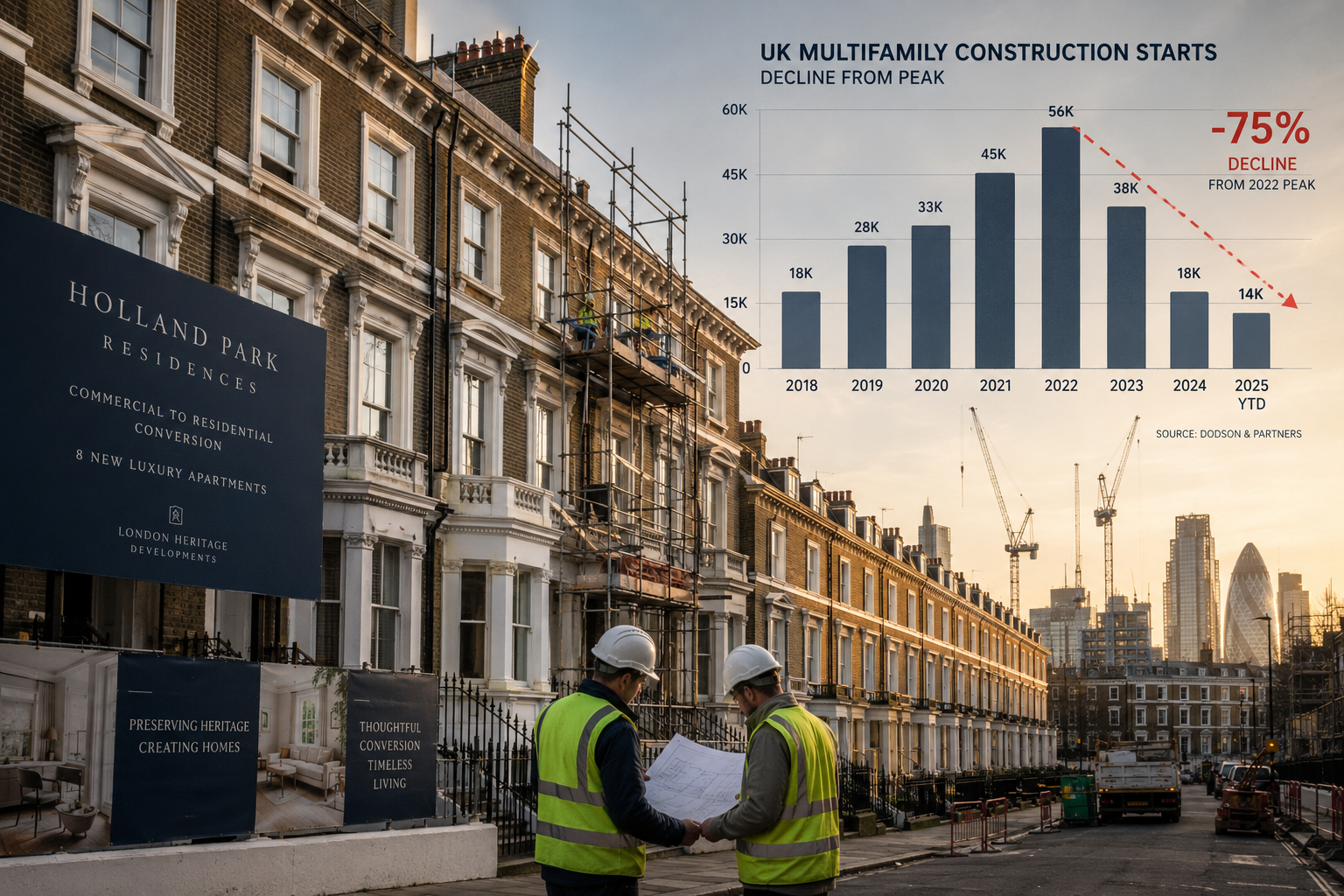
The oversupply problem compounds the picture. Close to 1.3 million apartments are currently in lease-up, representing 6.9% of total inventory against a pre-pandemic norm of 4.7% [3]. Regional variations are significant: Midwest cities and core metro areas are outperforming Sun Belt markets, while cities like Denver face affordability crises that could take generations to resolve at current construction rates [6].
What does this mean for conversions?
When ground-up multifamily development stalls, adaptive reuse fills the gap. Vacant offices, redundant retail units, and underused commercial properties become attractive targets. These buildings often sit in dense urban areas — exactly where housing demand remains strongest. However, they also sit cheek-by-jowl with existing residential and commercial neighbours, meaning shared walls are the norm rather than the exception.
"The shift from new-build multifamily to conversion-led supply is not just a market trend — it is a legal event. Every shared wall on a conversion site is a potential party wall notice waiting to be served."
The small multifamily sector has shown particular resilience. Loan originations have risen, valuations have rebounded, and underwriting conditions have eased modestly in Q2 2026 [5]. Smaller conversion projects — those involving two to four units carved from a single commercial building — are benefiting from this stabilisation and represent a growing share of new residential supply in urban areas.
Understanding Party Wall Notices in Conversion Projects
What Triggers a Party Wall Notice in a Conversion
Under the Party Wall etc. Act 1996, a building owner must serve notice before undertaking any of the following:
- Party structure works: cutting into, raising, underpinning, or otherwise altering a shared wall or floor
- Line of junction works: building a new wall up to or astride the boundary
- Excavation works: digging within three or six metres of an adjoining structure, depending on depth
Commercial-to-residential conversions routinely trigger all three categories. A typical conversion might involve opening up a party wall to insert new floor joists, underpinning shared foundations to accommodate basement units, and excavating near boundary lines for new utility runs.
Understanding what types of party wall works apply to your specific project is the essential first step before any design work is finalised.
The Difference Between a Party Wall and a Boundary Wall
Not every shared wall is a party wall in the legal sense. A party wall stands astride the boundary between two owners and is used by both. A boundary wall, by contrast, may stand entirely on one owner's land even if it abuts a neighbour's property. The distinction matters enormously in conversions because it determines which notice type applies and what rights each owner holds.
For a detailed breakdown, the guide on boundary wall rules and the difference between party fence walls and boundary walls provides clear definitions that apply directly to conversion scenarios.
Notice Sequencing for Multi-Owner Boundaries: The Core Challenge
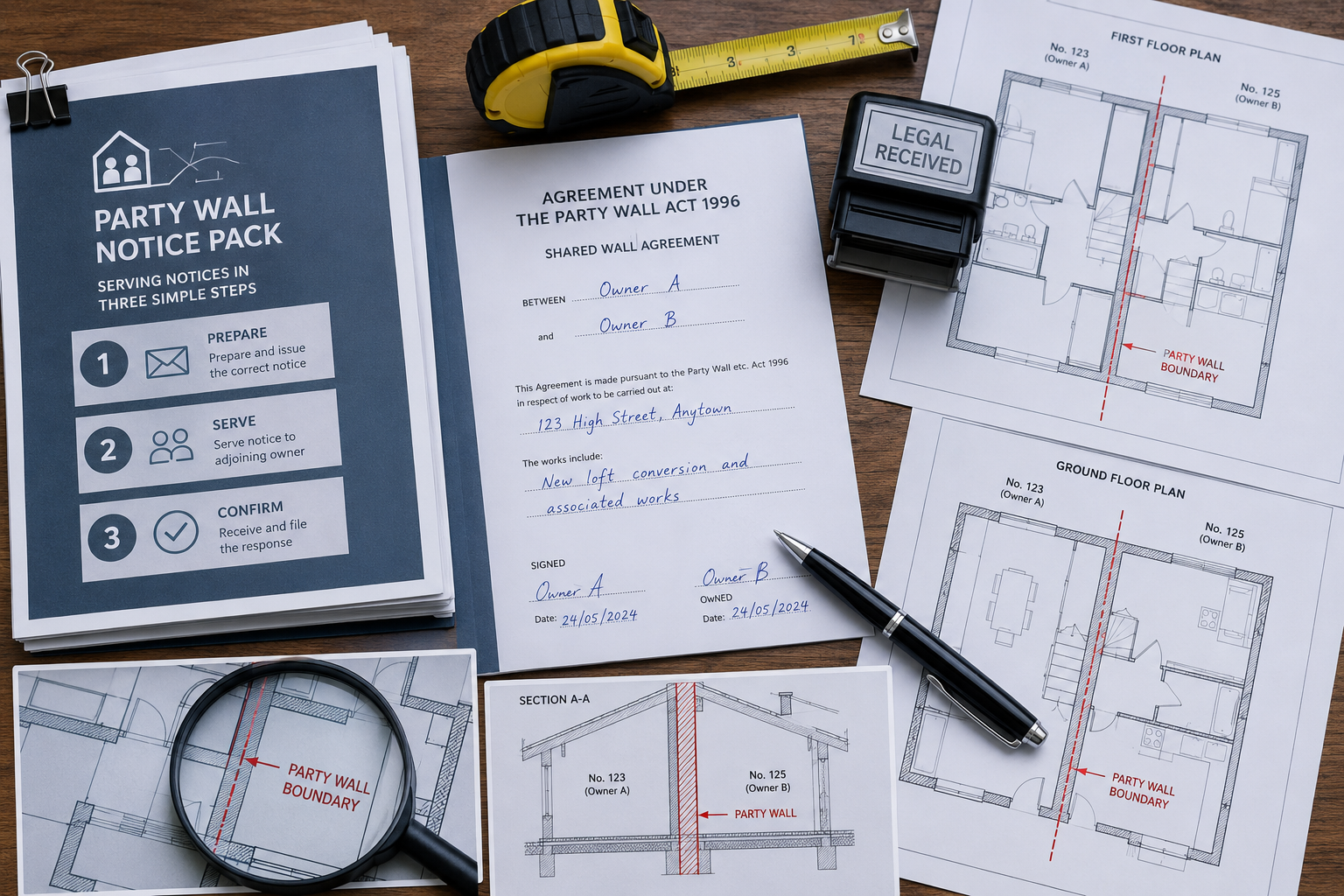
The most complex aspect of Multifamily Declines and Party Wall Notices: Opportunities for Shared Wall Agreements in Conversions is managing notice sequencing when a single conversion project shares walls with multiple separately owned properties. A converted office block in central London, for example, might adjoin a residential terrace on one side, a separate commercial unit on another, and share a rear boundary with a third owner entirely.
Step-by-Step Notice Sequencing for Multi-Owner Sites
| Step | Action | Timeframe |
|---|---|---|
| 1 | Identify all adjoining owners and their legal interest | Before design stage |
| 2 | Confirm which works trigger which notice type for each boundary | During design stage |
| 3 | Serve appropriate notices to each owner simultaneously or in sequence | Minimum 1-2 months before works |
| 4 | Await consent or dissent from each owner | 14 days per notice |
| 5 | Appoint surveyors and agree or award for each boundary | Before works commence |
| 6 | Record schedule of condition for each adjoining property | Before works commence |
The critical point is that each adjoining owner is a separate legal party. A consent from Owner A does not bind Owner B. Each notice must be served correctly, each response tracked, and each award or agreement documented independently. Errors in this process — serving the wrong notice type, missing an owner, or failing to allow the correct notice period — can expose the building owner to injunctions, delays, and significant legal costs.
For a comprehensive overview of party wall act notices, what they are and how to respond, both building owners and adjoining owners will find the process clearly explained.
Party Structure Notices vs. Line of Junction Notices
Two notice types dominate conversion projects:
Party Structure Notice
- Required when working on an existing shared wall or floor
- Must be served at least two months before work begins
- Covers cutting in, raising, thickening, underpinning, and demolition of party structures
Line of Junction Notice
- Required when building a new wall at or near the boundary
- Must be served at least one month before work begins
- Relevant when a conversion creates new internal subdivisions that reach the boundary
Understanding what a party structure notice is and how to serve it in London is particularly relevant for conversion projects in dense urban environments where existing party structures are almost always involved.
Shared Wall Agreements and Party Wall Awards in Conversions
When a Shared Wall Agreement Becomes a Party Wall Award
If an adjoining owner consents to the proposed works in writing within 14 days of receiving a notice, no award is needed. The consent itself forms the agreement. However, in conversion projects involving multiple owners and complex structural works, consent is rarely straightforward. When an owner dissents — or simply fails to respond — the dispute resolution mechanism under the Act kicks in, leading to the appointment of surveyors and the drafting of a party wall award.
A party wall award is a legally binding document that sets out:
- The precise works to be carried out
- The method and sequence of construction
- Hours of working
- Access arrangements
- Compensation provisions
- The schedule of condition of the adjoining property before works begin
In a multi-unit conversion, a single project may require several separate awards — one for each boundary where a dissent has been registered. Coordinating these awards so that they do not conflict with one another, and so that the construction programme remains viable, is a specialist task.
The Role of the Schedule of Condition
Before any notifiable works begin, a schedule of condition should be prepared for each adjoining property. This is a photographic and written record of the existing state of the neighbour's building. It protects both parties: the adjoining owner has documented evidence of any pre-existing damage, and the building owner has a baseline against which any claims of new damage can be assessed.
On conversion projects, where structural interventions are often significant, the schedule of condition is not merely best practice — it is essential risk management.
Using a Party Wall Agreement Template
For straightforward consent situations, a well-drafted template can streamline the process. A sample party wall agreement template provides a starting point, though any template used in a conversion context should be reviewed by a qualified surveyor to ensure it captures the specific works and conditions relevant to that project.
Practical Opportunities Created by the Multifamily Slowdown
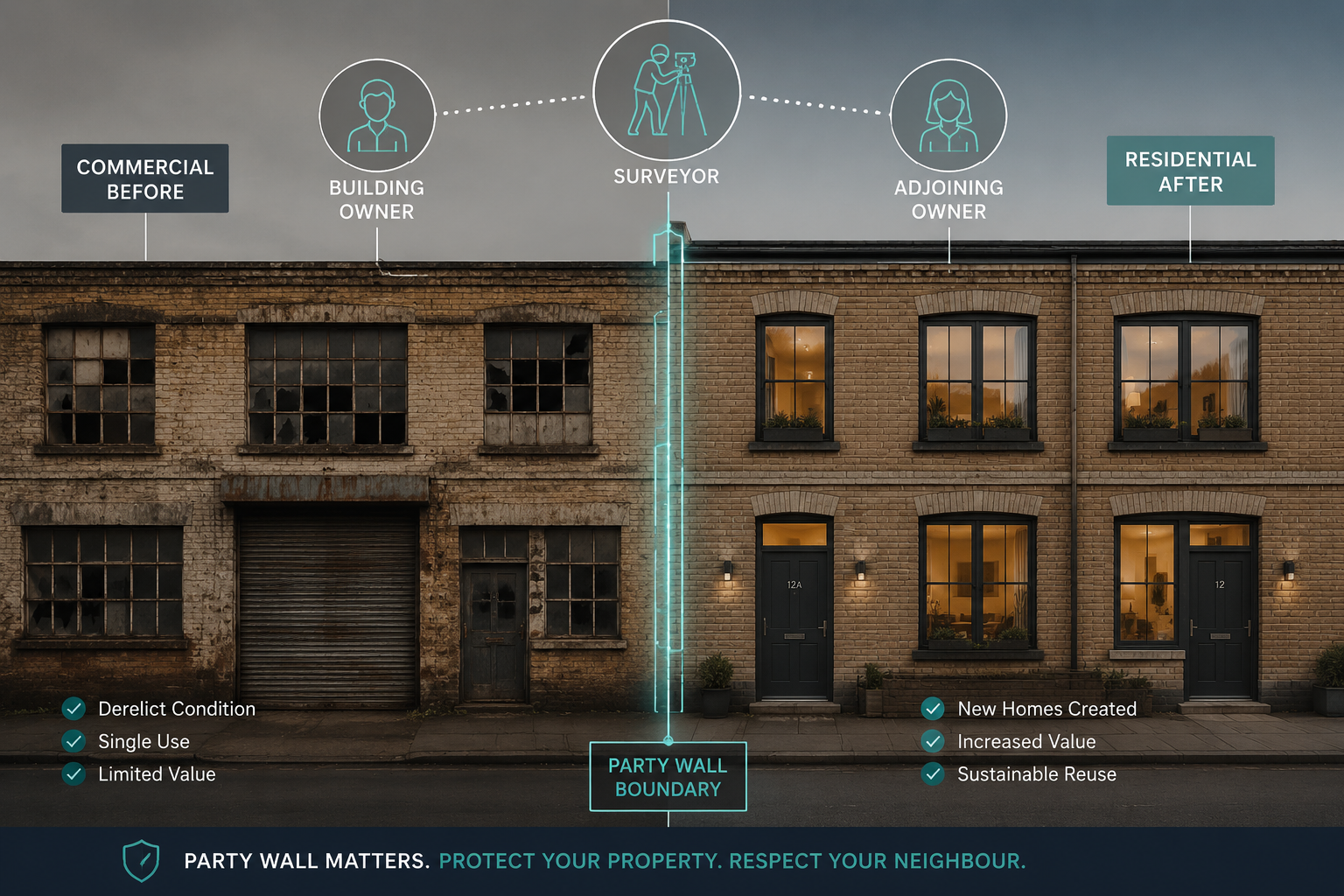
Multifamily Declines and Party Wall Notices: Opportunities for Shared Wall Agreements in Conversions is not just a legal compliance topic — it is a strategic lens through which developers can identify and capture value in a difficult market.
Why Conversions Outperform Ground-Up Development in 2026
Several factors make conversions attractive in the current environment:
- Lower land cost: Existing commercial buildings often carry lower per-unit land costs than cleared development sites in urban areas.
- Faster planning: Permitted development rights for commercial-to-residential conversions (Class MA in England) can significantly reduce planning timescales.
- Existing structure: Party walls and shared structures are already in place, reducing the cost of creating new boundary elements.
- Housing demand: Core urban areas where conversions are most viable continue to see strong rental demand even as the broader multifamily market softens [9].
The small multifamily sector — buildings of two to four units — is particularly well-suited to conversion. Capital market conditions have stabilised for this segment, with loan originations rising and underwriting conditions easing in 2026 [5]. A converted commercial unit producing three or four residential dwellings, properly structured with party wall agreements in place, can offer a more predictable return profile than a large ground-up scheme in an oversupplied market.
Managing Costs in the Party Wall Process
Party wall costs on conversion projects can escalate if the process is not managed proactively. Key cost drivers include:
- Number of adjoining owners (each requires separate notice and potentially a separate award)
- Complexity of structural works affecting shared walls
- Whether disputes arise requiring appointed surveyors on both sides
- Extent of schedule of condition surveys required
For guidance on how to keep party wall costs down, early engagement with a surveyor and clear communication with adjoining owners before formal notices are served are consistently the most effective strategies.
Engaging Adjoining Owners Early
Adjoining owners who feel informed and respected are far more likely to consent to works without triggering the formal dispute process. Early, informal conversations — before notices are even drafted — can identify concerns, allow design adjustments, and build the goodwill that makes the formal process smoother.
The adjoining owners section provides a clear explanation of the rights and responsibilities that neighbours hold under the Act, which can be a useful resource to share during those early conversations.
Regional Considerations for London Conversion Projects
London remains the most active market for commercial-to-residential conversions in the UK, driven by high housing demand, a large stock of redundant commercial buildings, and strong permitted development activity. Party wall obligations are particularly common given the density of the built environment.
Whether a project is located in South London, North London, or East London, the party wall obligations are the same under the Act, but local building stock, typical construction methods, and the nature of adjoining properties vary considerably. Victorian terraced stock in South London presents different structural challenges from post-war commercial buildings in East London, and the party wall process needs to reflect those differences.
Conclusion: Turning Market Headwinds into Conversion Opportunities
The 2026 multifamily slowdown is real, measurable, and likely to persist through the remainder of the year as oversupply works its way through the market [3][8]. But within that slowdown lies a clear opportunity: the commercial-to-residential conversion pipeline is growing, and every conversion project that involves a shared wall is a party wall matter.
Actionable next steps for developers and investors in 2026:
- Audit your conversion site early. Identify every shared wall, every adjoining owner, and every boundary condition before design work is finalised.
- Determine which notices apply to which boundaries. Party structure notices, line of junction notices, and excavation notices each have different triggers and timeframes.
- Serve notices in the correct sequence. On multi-owner sites, sequencing errors can create gaps in legal protection and delay the construction programme.
- Prepare schedules of condition before any work begins. This protects both building owners and adjoining owners from disputed damage claims.
- Engage a qualified party wall surveyor early. The cost of professional advice at the outset is consistently lower than the cost of resolving disputes mid-project.
- Use the party wall award as a project management tool. A well-drafted award sets out method statements, working hours, and access arrangements that benefit the entire construction programme.
The intersection of Multifamily Declines and Party Wall Notices: Opportunities for Shared Wall Agreements in Conversions is where legal compliance meets strategic opportunity. Developers who master this intersection in 2026 will be better positioned to deliver residential supply efficiently, protect their projects from legal challenge, and build the neighbour relationships that make complex urban conversions viable.
References
[1] Apartments Com Releases Multifamily Rent Growth Re – advfn.com
[2] How Minneapolis Kept Aparment Rents Down – axios.com
[3] Multifamily Recovery Stalls Under Weight Of Excess Supply – globest.com
[4] Research Brief Multifamily Outlook – marcusmillichap.com
[5] Small Multifamily Investment Snapshot June 2026 – arbor.com
[6] Denver Affordable Housing Crisis Three Generations – axios.com
[7] arxiv – arxiv.org
[8] Multifamily Market Expected To Cool In 2026 As Vacancies Rise – nahb.org
[9] Yardi Matrix Supply Economic Headwinds Braking Multifamily Rent Growth – yardi.com
How Prince Surveyors can help: explore our party wall surveyors or learn about our party wall surveyor costs.