

Nearly one in five UK homes showed signs of damp in the English Housing Survey 2024-25, yet the most common response from homeowners remains to call a treatment contractor rather than a diagnostician. That sequence, pay first, understand later, is precisely what professional guidance, regulatory reform and consumer protection bodies are now working to reverse. The debate around mold eradication vs professional building survey is no longer just a question of best practice; it has become a matter of legal compliance, financial protection and long-term health. [5]
Key Takeaways
- Mould treatments address visible symptoms only; without a surveyor's diagnosis of the root cause, mould almost always returns.
- RICS guidance explicitly states that "mould treatments can only address the symptoms of dampness, not the underlying causes" and urges homeowners to commission an independent survey first. [5]
- An independent damp and mould survey typically costs £200-£300, often far less than unnecessary eradication packages or mis-sold insulation. [2]
- Government guidance updated in April 2026 requires root-cause investigation before remediation, making surveyor-led assessment the legally expected standard. [5]
- Cold-calling mould treatment scams and defective retrofit insulation cases highlight the financial risk of acting without impartial professional advice.
Why Treating Mould Without a Survey Is a Costly Mistake
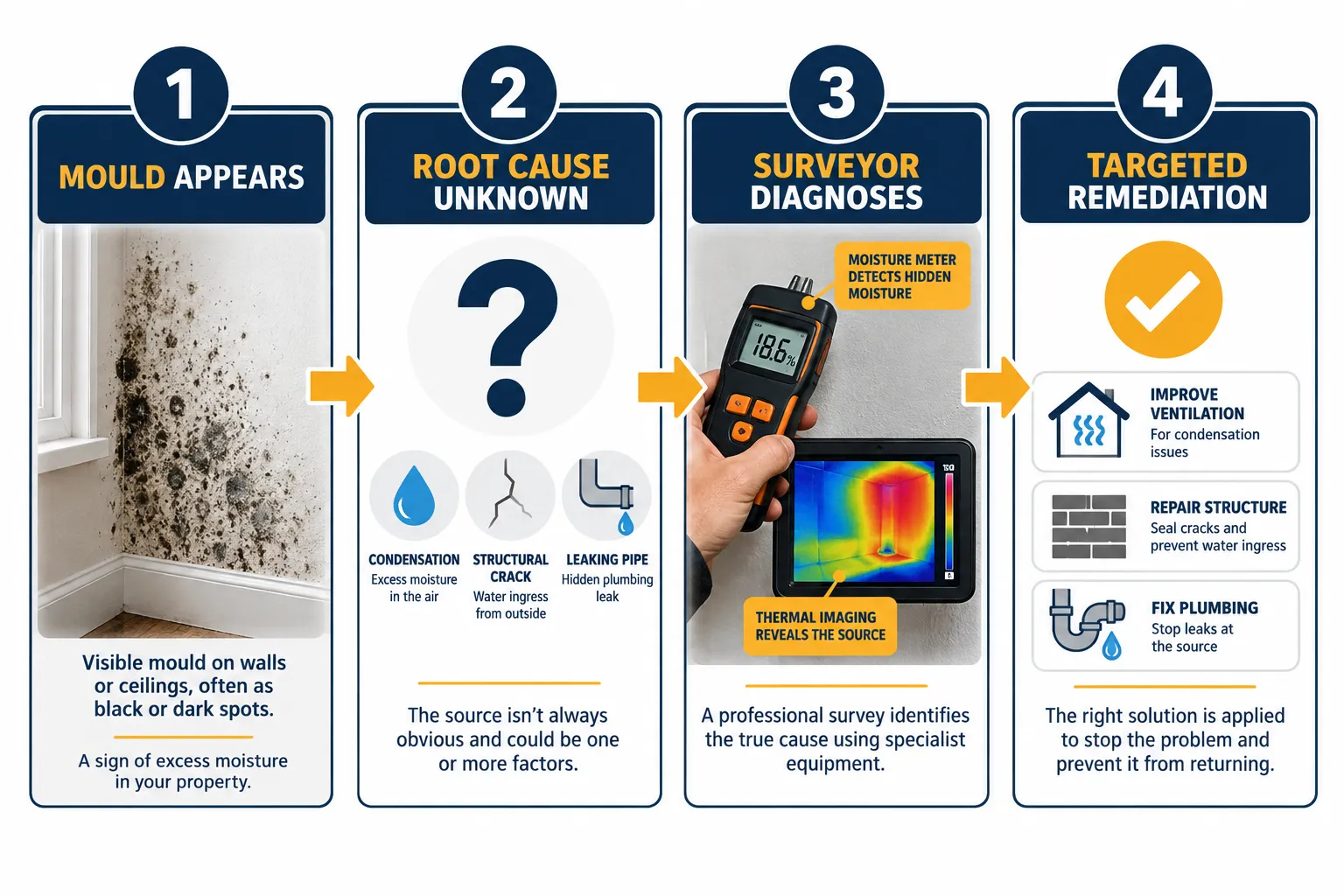
Visible black mould on a wall or ceiling is alarming, and the instinct to eliminate it quickly is understandable. Dozens of companies offer spray treatments, anti-fungal coatings, specialist paints and "ventilation packages" that promise to eradicate the problem. The difficulty is that mould is not the problem, it is the symptom. Moisture is the problem, and moisture enters or accumulates in a building for many different reasons.
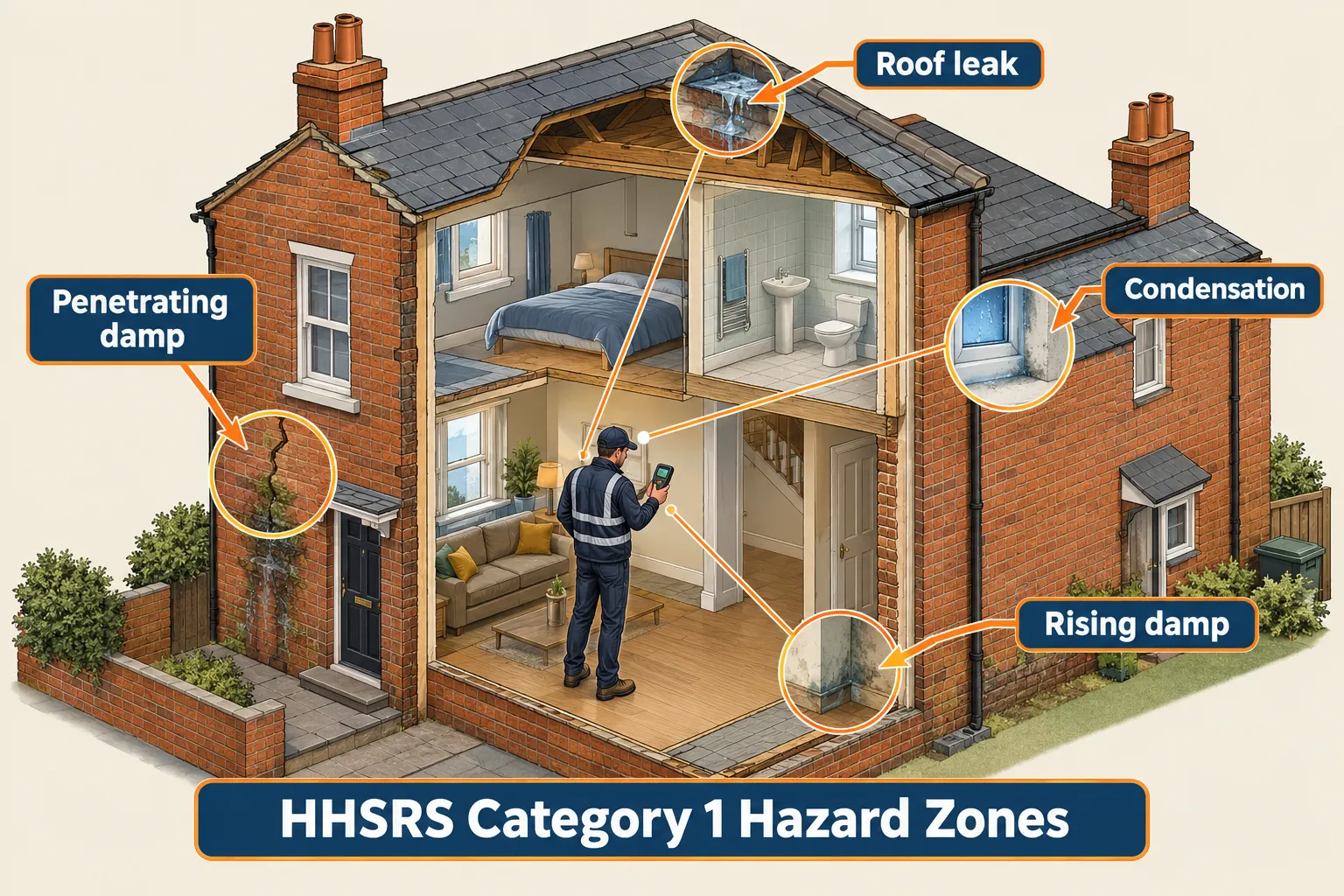
The four main moisture sources in UK homes are:
| Moisture Type | Typical Cause | Risk of Misdiagnosis |
|---|---|---|
| Condensation | Cold surfaces, poor ventilation, thermal bridging | Very high, often blamed on "lifestyle" |
| Penetrating damp | Defective pointing, failed flashings, cracked render | High, invisible until internal damage is severe |
| Rising damp | Failed or absent damp-proof course | Medium, often over-diagnosed by treatment sellers |
| Roof or plumbing leak | Damaged tiles, burst pipes, faulty guttering | Medium, sometimes mistaken for condensation |
Each of these requires a completely different remedial response. Applying an anti-mould coating to a wall that is wet from a leaking parapet gutter will not stop the leak. Installing a positive-input ventilation unit in a house where penetrating damp is soaking through defective render will not stop the penetrating damp. Yet treatment contractors who are not qualified building surveyors may lack either the training or the commercial incentive to distinguish between these causes accurately.
The Royal Institution of Chartered Surveyors (RICS) is unambiguous on this point. Its consumer guide on damp and mould states that "the first step is to identify and remedy the source of moisture" and that "mould treatments can only address the symptoms of dampness, not the underlying causes." [5] RICS advises homeowners to commission a Joint Position Statement 2022 (JPS22)-compliant inspection from a surveyor who has no commercial interest in selling products or treatment packages. [5]
"Mould treatments can only address the symptoms of dampness, not the underlying causes.", RICS Consumer Guide on Damp and Mould [5]
This is the central argument in the mold eradication vs professional building survey debate: eradication without diagnosis is, at best, a temporary cosmetic fix and, at worst, a costly distraction from a defect that continues to worsen.
What a Professional Building Survey Actually Finds That a Treatment Contractor Misses
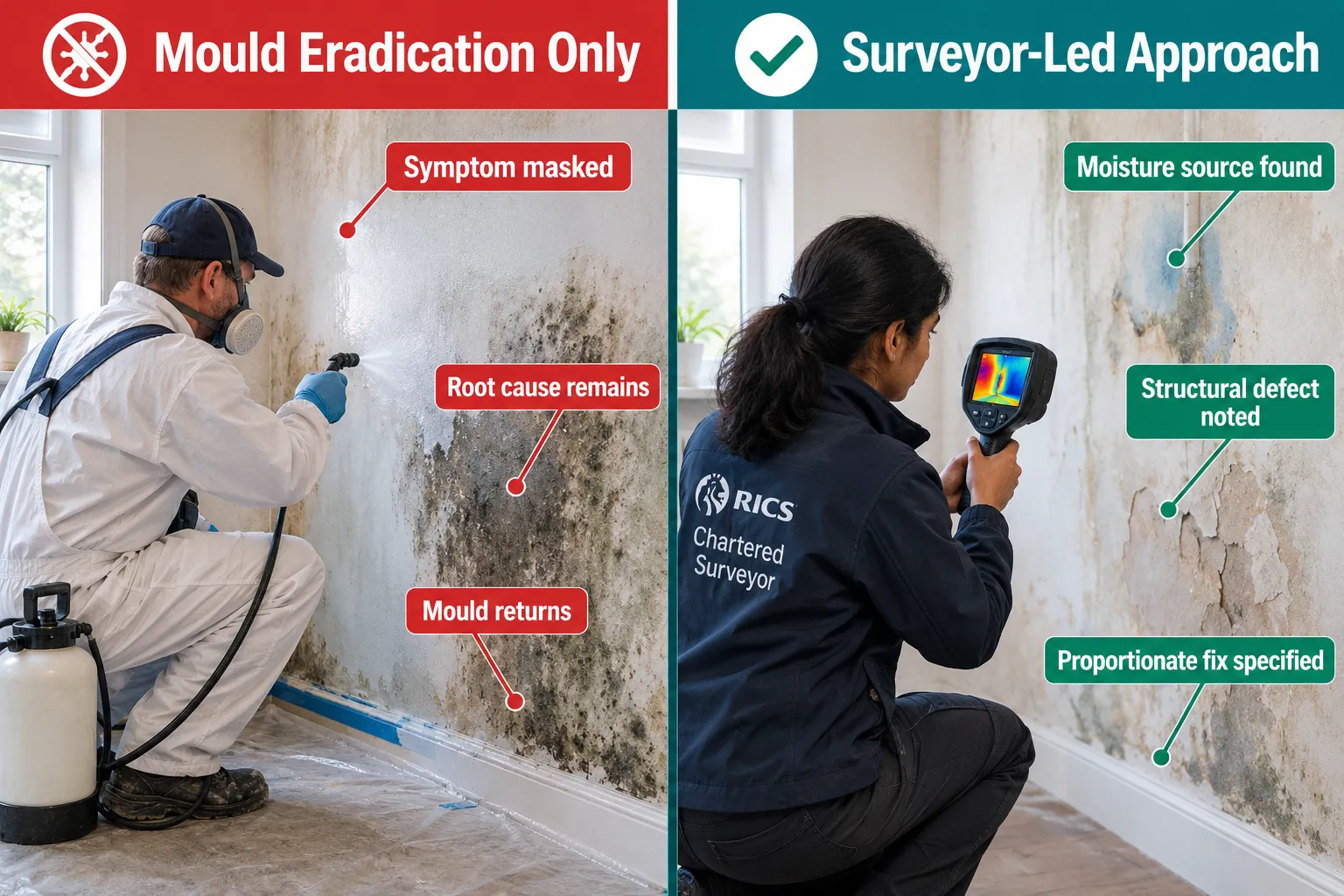
A qualified building surveyor approaches a damp and mould problem as a building pathologist. Rather than starting with a solution, they start with evidence. The tools and techniques used in a competent independent survey go well beyond what a treatment salesperson typically deploys.
Core diagnostic tools used in a professional damp and mould survey:
- Moisture meters, measure moisture content in walls, floors and ceilings at multiple points to map the extent and pattern of dampness
- Hygrometers and data loggers, record relative humidity and temperature over time, distinguishing condensation risk from structural water ingress
- Thermal imaging cameras, reveal cold bridges, missing insulation and hidden wet patches that are invisible to the naked eye
- Borescopes, allow inspection inside cavities and voids without destructive opening-up works
- Visual inspection of external fabric, assessing pointing, flashings, gutters, downpipes, render, window reveals and roof details
Specialist firms such as DampServe and Ministry of Mould explicitly market evidence-led investigations using this range of instruments, producing written diagnostic reports and remediation plans rather than selling proprietary products. [6][1] Independent directories now allow homeowners to search for accredited damp and mould professionals, surveyors, remediation contractors, ventilation engineers and leak specialists, who can investigate all moisture types and produce reports on cause, extent and recommended works. [8]
For homeowners who want the most thorough assessment possible, a Level 3 Building Survey provides the deepest structural and fabric investigation available for residential properties, covering defects in roofs, walls, floors, drainage and services that a damp-only inspection might not capture.
What surveyors identify that treatment contractors typically overlook:
- Structural defects causing water ingress (failed cavity trays, cracked lintels, defective copings)
- Thermal bridging at junctions creating persistent cold surfaces for condensation
- Inadequate or blocked ventilation in bathrooms, kitchens and roof voids
- Interstitial condensation within wall constructions, particularly relevant where insulation has been retrofitted
- Evidence of previous "fixes" that have masked rather than resolved the underlying defect
This last point is increasingly significant. BBC investigations and regulatory scrutiny in 2025-26 have highlighted cases where external wall insulation fitted under government energy efficiency schemes has created or worsened damp and mould problems by trapping moisture within the wall construction. The National Audit Office has reported that virtually all homes with external wall insulation fitted under the Energy Company Obligation (ECO) scheme require remedial work to correct defects including damp and mould. A surveyor assessing the building fabric before any new insulation or coating is installed is the most reliable safeguard against this outcome.
Understanding what questions to ask during a building survey can help homeowners get the most diagnostic value from their appointment, ensuring moisture sources, ventilation adequacy and structural defects are all addressed in the report.
The Health and Legal Stakes of Getting the Diagnosis Wrong
The consequences of treating mould without addressing its root cause extend well beyond wasted money. They include serious health risks and, for landlords, significant legal exposure.
Health impacts of persistent damp and mould:
Manchester University NHS Foundation Trust's patient leaflet (December 2025) states that damp and mould cause thousands of cases of asthma and chest infections every year, and can trigger sore eyes, eczema, skin infections and mental health problems. Babies, children and pregnant women are identified as particularly at risk. [3] West Yorkshire Healthier Together guidance reports that children living in a damp home are up to three times more likely to have breathing problems. [9]
These are not minor inconveniences. When a treatment contractor applies a biocidal spray and declares the problem resolved, but the underlying moisture source continues to feed new mould growth within weeks or months, the health exposure continues uninterrupted. For families with young children or members with asthma or respiratory conditions, that continuation carries real clinical risk. [3][9]
Legal and regulatory stakes in 2026:
Government guidance updated on 1 April 2026 explicitly requires landlords to identify the underlying causes of damp and mould, such as structural defects or inadequate ventilation, and prohibits dismissing issues as a "lifestyle choice." [5] Mould and all forms of damp can constitute a Category 1 hazard under the Housing Health and Safety Rating System (HHSRS), meaning properties must be free from the most dangerous level of risk. [5]
From 23 June 2026, the HHSRS is being streamlined from 29 hazards to 21, with hazard banding simplified to High, Medium and Low. Damp and mould remain prominent within this revised framework, and the change is expected to make hazard identification and enforcement more straightforward for local authorities. For owner-occupiers, this regulatory direction reinforces the importance of a surveyor-quality assessment: if a defect constitutes a Category 1 or High hazard, a surface treatment will not discharge the legal duty to make it safe.
The Housing Ombudsman's 2024-25 Annual Complaints Review recorded 714 severe maladministration findings, with damp and mould at the heart of more than 100 of them. These cases repeatedly involved landlords who had failed to inspect properly, misdiagnosed causes or relied on inadequate remedial works, precisely the pattern that emerges when treatment precedes diagnosis.
For landlords managing buy-to-let portfolios, the stakes are particularly high. Understanding how building surveys inform buy-to-let risk assessment is essential context for anyone making investment decisions where damp and mould defects could affect both tenant safety and asset value.
The Real Cost Comparison: Survey vs Eradication Package
One of the most persistent misconceptions is that commissioning an independent survey is an expensive luxury. In reality, the cost comparison strongly favours getting the survey first.
Typical 2026 UK costs at a glance:
- Focused residential mould survey: £100-£200 [2]
- Thorough independent damp and mould survey with written report: £200-£300 [2]
- Comprehensive HHSRS-compliant report with thermal imaging and moisture mapping: £200-£400 [2]
- Typical "ventilation package" (positive-input ventilation unit, supply and fit): £400-£800+
- Chemical damp-proof course injection (full ground floor): £800-£2,500+
- External wall insulation system: £5,000-£20,000+
The survey cost is frequently a fraction of the treatment being recommended. More importantly, a survey report provides the technical basis for deciding whether the recommended treatment is actually necessary, appropriate or proportionate. Without that report, homeowners are entirely reliant on the judgment, and the commercial incentives, of the person selling the treatment.
UK Trading Standards has documented cold-callers offering "free toxic mould assessments" who then pressure householders into paying administrative fees of £50-£250 or thousands of pounds for spray-foam insulation claimed to have mould-killing properties. In some cases, spray-foam insulation applied in this way has jeopardised mortgage eligibility, because lenders treat it as a material defect. An independent surveyor has no product to sell and no incentive to recommend unnecessary works.
For homeowners who want to understand the broader cost landscape before commissioning any professional assessment, a complete guide to survey pricing factors and regional variations provides useful context on what different survey types cost across the UK in 2026.
Mold Eradication vs Professional Building Survey: Choosing the Right Sequence
The mold eradication vs professional building survey question is not really a choice between two competing services, it is a question of sequence. The correct sequence is always:
1. Commission an independent survey
Instruct a RICS-regulated or otherwise accredited surveyor or damp specialist with no product sales interest. Request a JPS22-compliant inspection where moisture, mould and building fabric are assessed together.
2. Receive a written diagnostic report
The report should identify the moisture source or sources, assess the extent of damage, note any structural defects contributing to the problem, and recommend proportionate remedial works.
3. Obtain competitive quotes for the specified works
With a clear specification from an independent professional, homeowners can approach multiple contractors for competitive quotes on the actual work required, whether that is repointing, gutter repair, improved ventilation or, where genuinely necessary, a damp-proof treatment.
4. Commission eradication or remediation only where justified
If the survey confirms that a biocidal treatment, ventilation system or damp-proof course is genuinely needed, it can be commissioned with confidence and specified correctly. If the survey finds that the problem is a blocked gutter or a missing window seal costing £50 to fix, the homeowner has saved potentially thousands of pounds.
This sequence mirrors the approach that building survey quality standards post-RICS retrofit summit now expect from professional surveyors working on moisture and retrofit assessments in 2026.
For first-time buyers or those unfamiliar with property condition assessments, understanding what every homeowner should know about their property provides a practical foundation for recognising when professional investigation is warranted.
When the Problem Is More Than Mould: Valuation and Mortgage Implications
Damp and mould are not only a health and comfort issue, they are a valuation issue. Unresolved moisture defects can affect a property's market value, its mortgageability and its EPC rating.
Valuation impacts of damp and mould defects:
- Structural damp linked to failed cavity trays or defective flashings can lead to significant downward valuation adjustments
- Spray-foam insulation applied as a "mould solution" can render a property unmortgageable with many mainstream lenders
- Persistent mould in a rental property can constitute a Category 1 HHSRS hazard, triggering local authority enforcement and potential rent repayment orders
- Defective external wall insulation systems, particularly those installed under ECO, may require full removal before a property can be sold or re-mortgaged
A professional building survey identifies these valuation risks before they become transactional problems. For homeowners considering a sale, a pre-sale survey that identifies and resolves damp defects properly, rather than cosmetically, protects the achieved price and reduces the risk of a buyer's surveyor flagging the same issues at a later stage. Understanding building survey red flags that affect valuations helps homeowners understand how surveyors assess and report on defects that affect market value.
The connection between energy performance and damp is also increasingly important. Poorly performing walls and roofs that contribute to condensation and mould also tend to perform poorly on EPC assessments. Understanding how EPC ratings and building surveys interact can help homeowners address moisture, insulation and energy efficiency in a joined-up way rather than as separate problems requiring separate contractors.
Conclusion
The mold eradication vs professional building survey question has a clear answer supported by RICS guidance, government regulation, consumer protection bodies and health services: the survey must come first. Mould is a symptom. The moisture causing it has a source, structural, ventilation-related or maintenance-related, and that source can only be reliably identified by a competent, independent professional with no commercial interest in the outcome.
Actionable next steps for UK homeowners in 2026:
- Do not commission treatment before diagnosis. If mould is present, instruct an independent damp and mould surveyor or RICS-regulated building surveyor before agreeing to any eradication, insulation or ventilation package.
- Check credentials. Look for RICS regulation, PCA (Property Care Association) membership or equivalent accreditation. Avoid firms that combine "free assessment" with immediate product sales.
- Request a written report. A verbal opinion is not sufficient. The report should identify the moisture source, assess severity and recommend specific, proportionate remedial works.
- Use the report to specify and procure remediation. With an independent specification in hand, obtain at least two or three competitive quotes from contractors for the work actually needed.
- Consider the valuation implications. If the property is mortgaged or likely to be sold, ensure any remediation is carried out to a standard that a future surveyor or lender will accept, not merely a cosmetic standard that masks the defect.
The cost of an independent survey is modest. The cost of treating the wrong problem, or being sold an unnecessary one, can run to thousands of pounds, with no improvement in health outcomes and potential damage to property value. Getting a surveyor's opinion before paying for treatment is not a precaution; in 2026, it is the professionally expected and legally aligned standard.
References
[1] ministryofmould.co.uk – ministryofmould.co.uk
[2] How Much Does A Damp Survey Cost – thedampandmouldman.co.uk
[3] Damp And Mould Leaflet Dec 2025 – mft.nhs.uk
[5] Damp And Mould – rics.org
[6] dampserve – dampserve.com
[8] Specialists – stopthemould.com
[9] Damp And Mould Hidden – wyhealthiertogether.nhs.uk