

The UK property market has entered a new chapter in 2026—one defined not by dramatic price swings, but by careful consolidation. After years of volatility driven by pandemic disruptions, interest rate fluctuations, and economic uncertainty, house prices are now stabilizing across most regions. This plateau presents unique challenges for property professionals, particularly chartered surveyors who must refine their assessment methodologies to capture nuanced market conditions. Understanding Market Stabilization and Valuation Accuracy: How Chartered Surveyors Adjust Assessments as House Prices Plateau in 2026 has become essential for buyers, sellers, investors, and lenders navigating this transitional landscape.
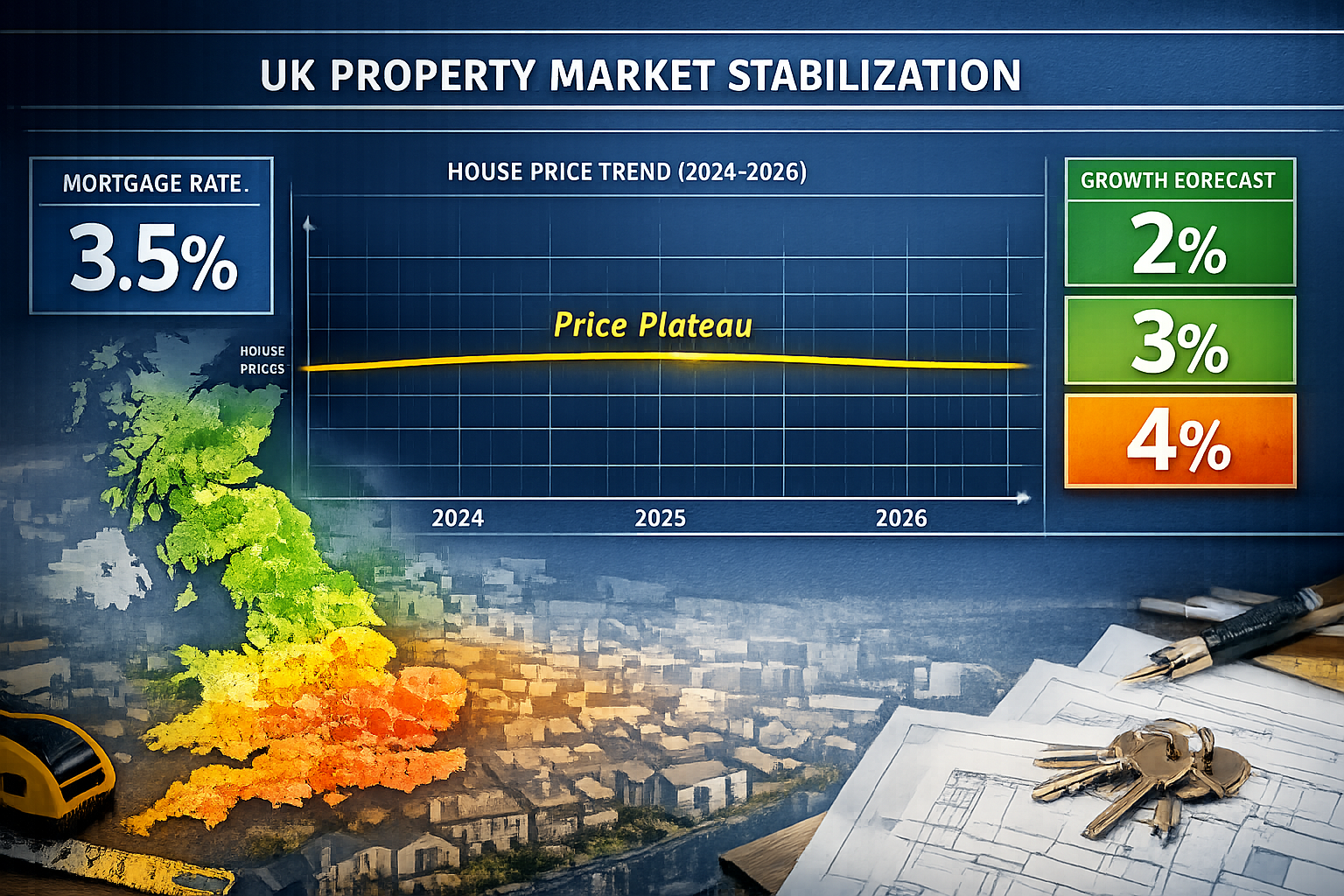
Unlike the boom-and-bust cycles of previous decades, the current market demands precision over speculation. With projected growth rates of just 2-4% nationally—and some lenders forecasting even more conservative figures of 1-2%—every pound matters in property transactions.[1] This environment has elevated the importance of professional valuations, transforming them from routine formalities into strategic tools that protect financial interests and inform critical decisions.
Key Takeaways
- 📊 House prices in 2026 are growing at modest rates of 2-4%, representing market consolidation rather than significant appreciation, with regional variations creating new valuation challenges for chartered surveyors.
- 🏘️ Regional disparities are widening significantly, as the North and Midlands experience stronger growth while the South moves more slowly, requiring surveyors to adjust comparable evidence and methodology based on local market dynamics.
- 💰 Improved mortgage rates around 3.5% are enhancing affordability and buyer confidence, but surveyors must account for new tax measures affecting high-value properties when conducting assessments.
- 🔍 Professional valuation precision has become critically important in the stabilizing market, with surveyors employing refined comparable methods and regional analysis to ensure accuracy when margins are tight.
- 📈 Buy-to-let valuations are surging as the rental market recovers, requiring specialized assessment approaches that account for yield calculations and institutional investor requirements in a changing regulatory environment.
Understanding the 2026 Property Market Plateau
The UK housing market in 2026 represents a fundamental shift from the turbulent conditions of recent years. After experiencing dramatic price increases during the pandemic, followed by sharp corrections as interest rates climbed, the market has entered what economists describe as a consolidation phase. This stabilization reflects a complex interplay of economic factors, policy changes, and shifting buyer behavior.
Current Market Conditions and Price Projections
Expected house price growth in 2026 ranges from 2-4% nationally, a significant moderation from the double-digit increases seen in 2021-2022.[1] Some major lenders, including Halifax, have adopted even more conservative forecasts, predicting growth of just 1-2% as the market finds its equilibrium. This measured pace reflects several underlying factors:
Mortgage Rate Improvements 🏦
Mortgage rates are forecast to stabilize around 3.5% in 2026, a substantial improvement from the 5%+ rates that characterized 2023-2024.[1] This reduction has made borrowing more affordable and helped buyers meet lending criteria, supporting market activity without triggering rapid price inflation.
Affordability Constraints
Despite improved borrowing costs, many potential buyers—particularly first-time purchasers—continue to face affordability challenges. House price-to-income ratios remain elevated in many regions, especially in the South East, creating natural limits on price growth.
Economic Uncertainty
Broader economic conditions, including employment trends, wage growth, and inflation concerns, continue to influence buyer confidence and purchasing power. Chartered surveyors must factor these macroeconomic conditions into their assessments when determining market value.
Regional Market Divergence
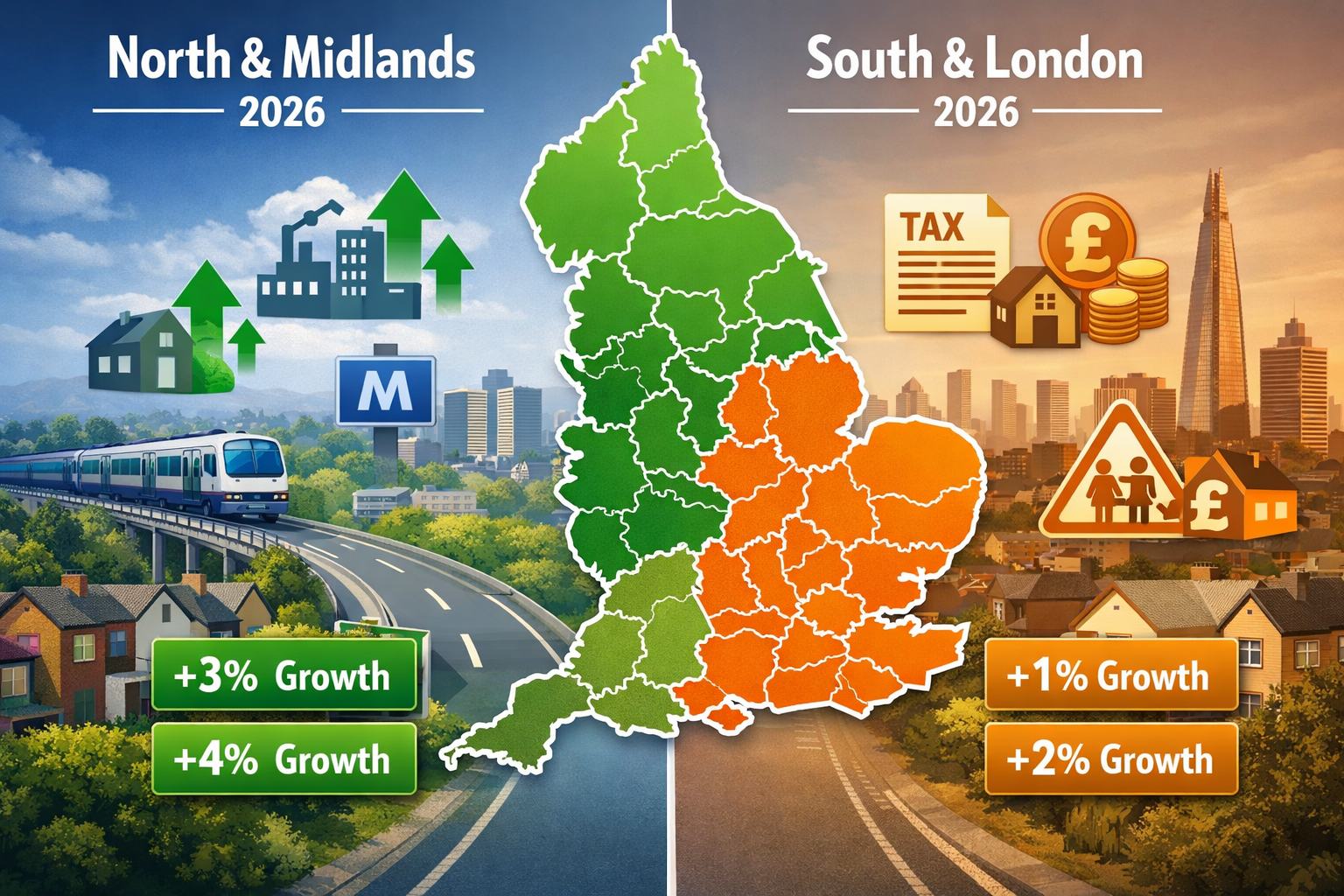
Perhaps the most significant development affecting Market Stabilization and Valuation Accuracy: How Chartered Surveyors Adjust Assessments as House Prices Plateau in 2026 is the widening gap between regional markets. The traditional North-South price divide is narrowing, but not uniformly:
| Region | Expected Growth | Key Drivers |
|---|---|---|
| North & Midlands | 3-4% | Employment growth, affordability, infrastructure investment |
| South East & London | 1-2% | High baseline prices, new tax impacts, affordability constraints |
| Scotland & Wales | 2-3% | Balanced growth, local economic factors |
| Rural Areas | Variable | Depends on connectivity and employment hubs |
The North and Midlands are experiencing the strongest growth as buyers seek better value and employers expand operations beyond traditional London hubs.[1] Meanwhile, the South moves more slowly due to already-elevated prices and the impact of new tax measures on high-value properties. For chartered surveyors in London and surrounding areas, this requires careful calibration of comparable evidence and valuation assumptions.
The New Importance of Precision Valuations
In this stabilizing market, professional survey-led valuations have become critically important. When prices were rising rapidly, small valuation discrepancies were often absorbed by subsequent appreciation. In a plateau market, however, precision is essential to avoid both overpaying for homes and underselling assets.[1]
"In a market where growth is measured in single percentage points rather than double digits, every valuation decision carries greater weight. Buyers and sellers can no longer rely on market momentum to correct pricing errors." — Property Market Analysis, 2026
This environment has transformed the role of chartered surveyors from simple price validators to strategic advisors who must account for multiple variables including regional employment strength, transport links, tax implications, and neighborhood-specific factors.[1] Understanding these dynamics is particularly crucial for professionals providing commercial valuations and residential assessments across diverse markets.
How Chartered Surveyors Adjust Valuation Methodologies for Market Stabilization
As house prices plateau, chartered surveyors have refined their assessment techniques to capture the nuances of a consolidating market. Traditional valuation methods remain foundational, but their application requires greater sophistication and regional sensitivity in 2026.
Core Valuation Methods and Their Application
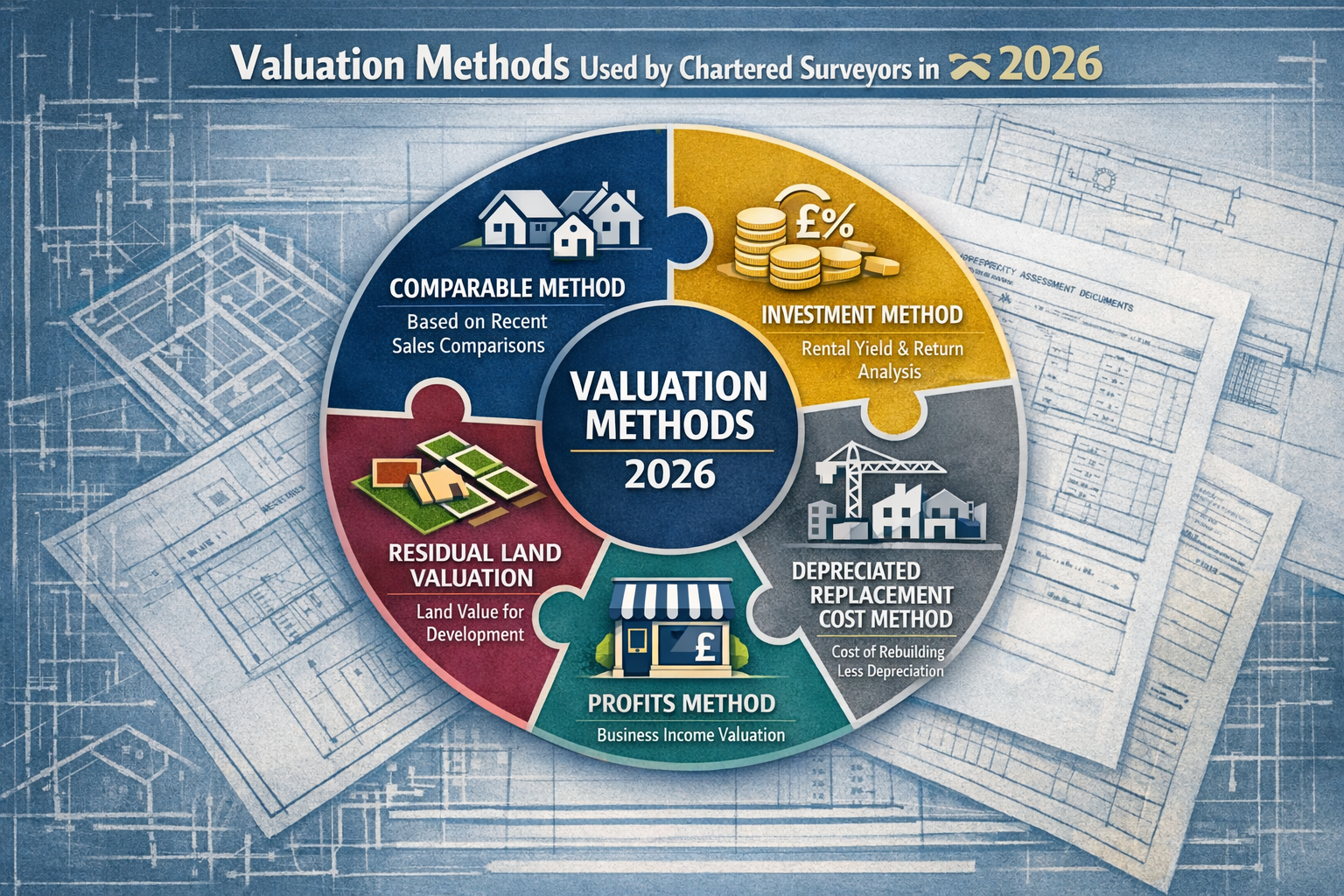
Five core valuation methods sit within three main approaches: market, income, and cost-based assessments.[2] Chartered surveyors select methods based on property type, available evidence, and market conditions. Understanding how these methods adapt to stabilization is crucial for accurate assessments.
The Comparable Method: Refined for Regional Divergence
The comparable method remains the most widely used valuation technique, particularly for assessing market value of residential properties.[2] This approach involves:
- Collating recent sales evidence from similar properties in the local area
- Analyzing transaction data to identify pricing patterns and trends
- Adjusting evidence to reflect differences between comparable properties and the subject property
- Applying regional market factors to account for local conditions
In the stabilizing market of 2026, surveyors must exercise greater care when selecting and adjusting comparables. Key considerations include:
Time Adjustments ⏰
With growth rates of only 2-4% annually, time adjustments between comparable sales must be precise. A sale from six months ago requires different treatment in a 2% growth market than in a 10% growth environment.
Regional Weighting
Surveyors working across multiple regions must apply different growth assumptions. A comparable from Surrey may require different adjustments than one from Essex, even for similar property types.
Micro-Location Factors
In a plateau market, neighborhood-specific factors matter more than broad market trends.[1] Properties near new transport links or employment hubs may appreciate faster than regional averages, requiring careful adjustment of comparable evidence.
Investment Method for Buy-to-Let Properties
The investment method calculates value based on rental income potential and yield expectations. This approach has gained prominence in 2026 as buy-to-let valuations experience a significant surge, representing a shift from the challenging conditions landlords faced in recent years.[4]
For rental properties, surveyors now focus on:
- Current rental values based on local market evidence
- Yield expectations adjusted for regional investment demand
- Void periods and management costs reflecting realistic operating conditions
- Regulatory compliance costs including energy efficiency requirements
The recovering rental market has created opportunities for institutional investors, requiring specialized assessment approaches that account for portfolio-level considerations and long-term yield projections.
Depreciated Replacement Cost (DRC) Method
For specialized properties with limited comparable evidence, the DRC method estimates value based on replacement cost minus depreciation.[2] In a stabilizing market, this method requires careful consideration of:
- Current construction costs (which may be rising even as property values plateau)
- Appropriate depreciation rates reflecting actual market conditions
- Land value assessments based on current market evidence
Residual Land Valuation Method
The residual method calculates land value by estimating the completed development value and deducting all development costs and developer's profit.[2] In 2026's market, this requires:
- Conservative growth assumptions for the development period
- Realistic cost inflation projections
- Appropriate profit margins reflecting market risk
Accounting for New Tax Measures in High-Value Properties
New tax measures taking effect from April 2026 are creating unprecedented challenges for property valuers assessing high-value properties.[3] These changes particularly affect properties valued above £2 million, where buyers are negotiating harder to account for future tax liabilities.
Surveyors must now consider:
Tax-Adjusted Valuations
For properties near tax thresholds, valuations may need to reflect the impact of additional tax burdens on buyer demand and pricing.
Market Evidence Analysis
Post-April 2026 transaction evidence will increasingly reflect tax-adjusted pricing, requiring surveyors to distinguish between pre- and post-implementation comparables.
Buyer Negotiation Patterns
High-value property buyers are seeking to account for future tax bills in their offers, making precision in valuation more important than ever in this segment.[1] This is particularly relevant for chartered surveyors in Chelsea and other prime London locations where properties frequently exceed tax thresholds.
Strategic Timing and Data Analysis
In the stabilizing market of 2026, strategic timing based on data analysis is preferred over emotional decision-making.[1] Chartered surveyors now emphasize:
Employment and Transport Link Analysis 🚆
Surveyors recommend buyers focus on regional employment strength and transport links as key indicators of property value retention.[1] Areas with strong employment growth and improving connectivity are more likely to outperform regional averages, even in a plateau market.
Neighborhood-Specific Research
Rather than relying on broad market statistics, surveyors conduct detailed analysis of specific neighborhoods, considering factors such as:
- Local development plans and infrastructure projects
- School quality and catchment areas
- Crime statistics and community amenities
- Historical price resilience during previous market corrections
This granular approach ensures valuations reflect actual market conditions rather than generalized assumptions, providing clients with actionable intelligence for decision-making.
Regional Considerations and Practical Applications in 2026
The diverging regional dynamics of the 2026 property market require chartered surveyors to adopt location-specific approaches when conducting assessments. Understanding these regional variations is essential for delivering accurate valuations that reflect local market realities.
Northern England and Midlands: Growth Markets
The North and Midlands are experiencing the strongest price growth in 2026, driven by several factors that surveyors must incorporate into their assessments:
Employment Hub Development 💼
Major cities including Manchester, Birmingham, Leeds, and Newcastle have attracted significant business investment, creating employment opportunities that support housing demand. Surveyors must identify properties within commuting distance of these hubs and adjust valuations accordingly.
Infrastructure Investment
Transport improvements, including rail upgrades and road developments, have enhanced connectivity in northern regions. Properties benefiting from improved access to employment centers command premium valuations compared to less-connected areas.
Affordability Advantage
Lower baseline prices in northern regions attract buyers priced out of southern markets, creating sustained demand. However, surveyors must distinguish between genuine value appreciation and speculative pricing unsupported by local fundamentals.
For professionals providing assessments in these growth markets, understanding local employment trends and infrastructure plans is as important as analyzing comparable sales data.
Southern England and London: High-Value Market Adjustments
The South East and London face different challenges that require specialized valuation approaches:
Tax Impact on High-Value Properties
The new tax measures affecting properties above £2 million have created distinct pricing dynamics in prime London locations.[3] Chartered surveyors in areas like Hammersmith, Battersea, and Islington must account for these tax implications when selecting and adjusting comparable evidence.
Affordability Constraints
Despite improved mortgage rates, high baseline prices continue to limit buyer pools in southern markets. Surveyors must be realistic about demand constraints when assessing properties at the upper end of local price ranges.
Market Segmentation
London's property market operates as multiple distinct sub-markets rather than a single entity. A property in Camden may experience different pricing dynamics than a comparable property in Bromley, requiring surveyors to maintain detailed knowledge of specific neighborhoods.
Home Counties and Commuter Belt Considerations
Areas surrounding London, including Buckinghamshire, Hertfordshire, and parts of Surrey, occupy a middle ground between London's high-value market and more affordable regional markets.
Hybrid Working Impact 🏠
The continued prevalence of hybrid working arrangements has sustained demand for properties offering space and connectivity. Surveyors must assess:
- Quality of broadband infrastructure
- Rail connectivity to London employment centers
- Property characteristics supporting home working (office space, garden size)
School Catchment Premiums
Properties within catchment areas of highly-rated schools continue to command premiums, even in a stabilizing market. Surveyors must quantify these premiums based on local transaction evidence.
Specialized Valuation Scenarios
Beyond standard residential assessments, chartered surveyors in 2026 must address several specialized valuation scenarios:
Inheritance Tax Valuations
Inheritance tax valuations require particular care in a plateau market. Unlike market valuations that reflect willing buyer/willing seller scenarios, inheritance tax valuations must determine the price a property would achieve on the open market at the date of death or transfer.
In a stabilizing market, surveyors must:
- Use comparable evidence from the specific valuation date
- Avoid assumptions about future price movements
- Consider market conditions at the time of valuation, not current conditions
- Document methodology thoroughly for HMRC scrutiny
New Build and Development Valuations
The stabilizing market has created challenges for new build valuations, as developers adjust pricing expectations. Surveyors must distinguish between:
- Marketing prices (developer's asking prices)
- Achieved prices (actual transaction values)
- Market value (realistic assessment based on comparable resale properties)
Understanding what questions to ask during a building survey helps ensure comprehensive assessments that account for construction quality and potential defects affecting value.
Commercial Property Considerations
While this article focuses primarily on residential valuations, the principles of Market Stabilization and Valuation Accuracy: How Chartered Surveyors Adjust Assessments as House Prices Plateau in 2026 apply equally to commercial valuations. Commercial properties face additional considerations including:
- Tenant covenant strength and lease terms
- Yield compression or expansion based on investment market conditions
- Sector-specific factors (retail challenges, industrial demand, office market transformation)
Practical Steps for Property Buyers and Sellers
Understanding how chartered surveyors adjust their methodologies in 2026's stabilizing market empowers buyers and sellers to make informed decisions:
For Buyers 🏡
- Commission professional valuations before making offers, especially in competitive situations
- Focus on properties in areas with strong employment and transport links
- Consider regional opportunities where affordability supports sustainable growth
- Account for tax implications when purchasing high-value properties
- Request detailed comparable evidence to understand pricing justification
For Sellers
- Obtain realistic valuations based on current market evidence, not historical prices
- Understand that regional factors significantly affect achievable prices
- Be prepared for longer marketing periods in slower-moving areas
- Consider timing based on local market conditions rather than national trends
- Ensure properties are presented in optimal condition to maximize value
For Investors
- Analyze rental yields carefully using professional investment valuations
- Consider regional diversification to balance growth potential and stability
- Account for regulatory compliance costs in investment calculations
- Focus on areas with strong tenant demand and employment growth
- Work with surveyors experienced in buy-to-let market dynamics
The Future of Valuation Accuracy in a Stabilizing Market
As the UK property market continues its consolidation phase through 2026 and beyond, the role of chartered surveyors will only grow in importance. The transition from volatile price movements to measured, regional-specific growth patterns demands greater sophistication in valuation methodology and deeper understanding of local market dynamics.
Technology and Data Integration
Modern chartered surveyors increasingly leverage technology to enhance valuation accuracy:
Advanced Data Analytics 📊
Sophisticated databases now provide real-time transaction data, enabling surveyors to identify pricing trends more quickly and adjust valuations accordingly. Machine learning algorithms can identify comparable properties more efficiently, though human expertise remains essential for appropriate adjustments.
Geographic Information Systems (GIS)
GIS technology allows surveyors to visualize spatial relationships between properties and important features such as transport links, employment centers, and amenities. This enhances the assessment of location-specific factors affecting value.
Digital Inspection Tools
While physical property inspections remain fundamental, digital tools including thermal imaging, drone photography, and 3D scanning provide additional data points that inform valuation decisions.
Professional Standards and Continuing Education
The Royal Institution of Chartered Surveyors (RICS) continues to update guidance and standards to reflect evolving market conditions. Chartered surveyors must engage in continuing professional development to maintain expertise in:
- Current valuation methodologies and their application
- Regional market dynamics and economic factors
- Tax legislation and its impact on property values
- Technology integration and data analysis techniques
- Ethical considerations and professional conduct
Organizations like Prince Chartered Surveyors demonstrate commitment to professional excellence through rigorous standards and client-focused service delivery.
Building Client Relationships Through Transparency
In a market where precision matters more than ever, successful chartered surveyors build trust through:
Clear Communication 💬
Explaining valuation methodology, assumptions, and limitations in accessible language helps clients understand the basis for assessments and make informed decisions.
Comprehensive Reporting
Detailed valuation reports that document comparable evidence, adjustments, and reasoning provide clients with confidence in the accuracy of assessments.
Ongoing Market Intelligence
Regular market updates and insights help clients understand broader trends affecting their property interests, positioning surveyors as strategic advisors rather than transactional service providers.
Adapting to Regulatory Changes
The property market operates within an evolving regulatory framework. Chartered surveyors must stay informed about:
- Changes to stamp duty and property taxation
- Energy efficiency requirements and their impact on value
- Planning policy updates affecting development potential
- Lending criteria changes influencing buyer affordability
- Consumer protection regulations affecting transaction processes
Understanding property market legislation changes ensures valuations remain compliant and reflect all relevant factors affecting property values.
Conclusion
Market Stabilization and Valuation Accuracy: How Chartered Surveyors Adjust Assessments as House Prices Plateau in 2026 represents a critical evolution in property valuation practice. As the UK housing market transitions from volatility to consolidation, the precision and expertise of chartered surveyors have become more valuable than ever.
The plateau in house prices, combined with significant regional divergence, demands sophisticated valuation approaches that account for local employment trends, transport connectivity, tax implications, and neighborhood-specific factors. Traditional valuation methods—particularly the comparable method—remain foundational, but their application requires greater nuance and regional sensitivity in 2026's market environment.
Key Implications for Stakeholders
Buyers benefit from professional valuations that prevent overpayment in a market where rapid appreciation no longer masks pricing errors. Understanding regional dynamics and focusing on areas with strong fundamentals provides the best foundation for long-term value retention.
Sellers must embrace realistic pricing based on current market evidence rather than historical values or emotional attachments. Properties priced appropriately for local market conditions sell more efficiently, even in slower-moving regions.
Investors can capitalize on the recovering buy-to-let market and regional opportunities by working with chartered surveyors who understand yield calculations, regulatory requirements, and long-term growth prospects.
Lenders rely on accurate valuations to manage risk and ensure lending decisions reflect genuine property values rather than inflated expectations.
Actionable Next Steps
To navigate the stabilizing property market successfully:
- Commission professional valuations from qualified chartered surveyors before making significant property decisions
- Research regional market dynamics to understand local factors affecting property values in your area of interest
- Focus on fundamentals including employment growth, transport links, and neighborhood quality rather than speculative price predictions
- Account for tax implications when purchasing high-value properties or planning estate transfers
- Maintain realistic expectations about price growth, recognizing that 2-4% annual appreciation represents the new normal
- Build relationships with experienced surveyors who can provide ongoing market intelligence and strategic advice
- Consider timing carefully based on local market conditions and personal circumstances rather than attempting to time broader market movements
The stabilizing market of 2026 rewards careful analysis, professional expertise, and patient decision-making. By understanding how chartered surveyors adjust their assessment methodologies to reflect current market realities, property stakeholders can make informed decisions that protect their financial interests and support long-term objectives.
Whether you're buying your first home, selling an investment property, or managing a diverse portfolio, working with qualified professionals who understand the nuances of Market Stabilization and Valuation Accuracy: How Chartered Surveyors Adjust Assessments as House Prices Plateau in 2026 provides the foundation for successful property transactions in this new market environment.
References
[1] Forecasting The Future What To Expect From House Prices In 2026 – https://surveyingcorp.com/2026/01/forecasting-the-future-what-to-expect-from-house-prices-in-2026/
[2] Apc 5 Valuation Methods – https://ww3.rics.org/uk/en/journals/property-journal/apc-5-valuation-methods.html
[3] Valuation Adjustments For High Value Properties Under 2026 Budget Tax Changes Surveyor Tactics For 2m Thresholds – https://nottinghillsurveyors.com/blog/valuation-adjustments-for-high-value-properties-under-2026-budget-tax-changes-surveyor-tactics-for-2m-thresholds
[4] Buy To Let Valuation Surge 2026 Survey Strategies For Institutional Investors In A Recovering Market – https://nottinghillsurveyors.com/blog/buy-to-let-valuation-surge-2026-survey-strategies-for-institutional-investors-in-a-recovering-market