

Last updated: July 24, 2026
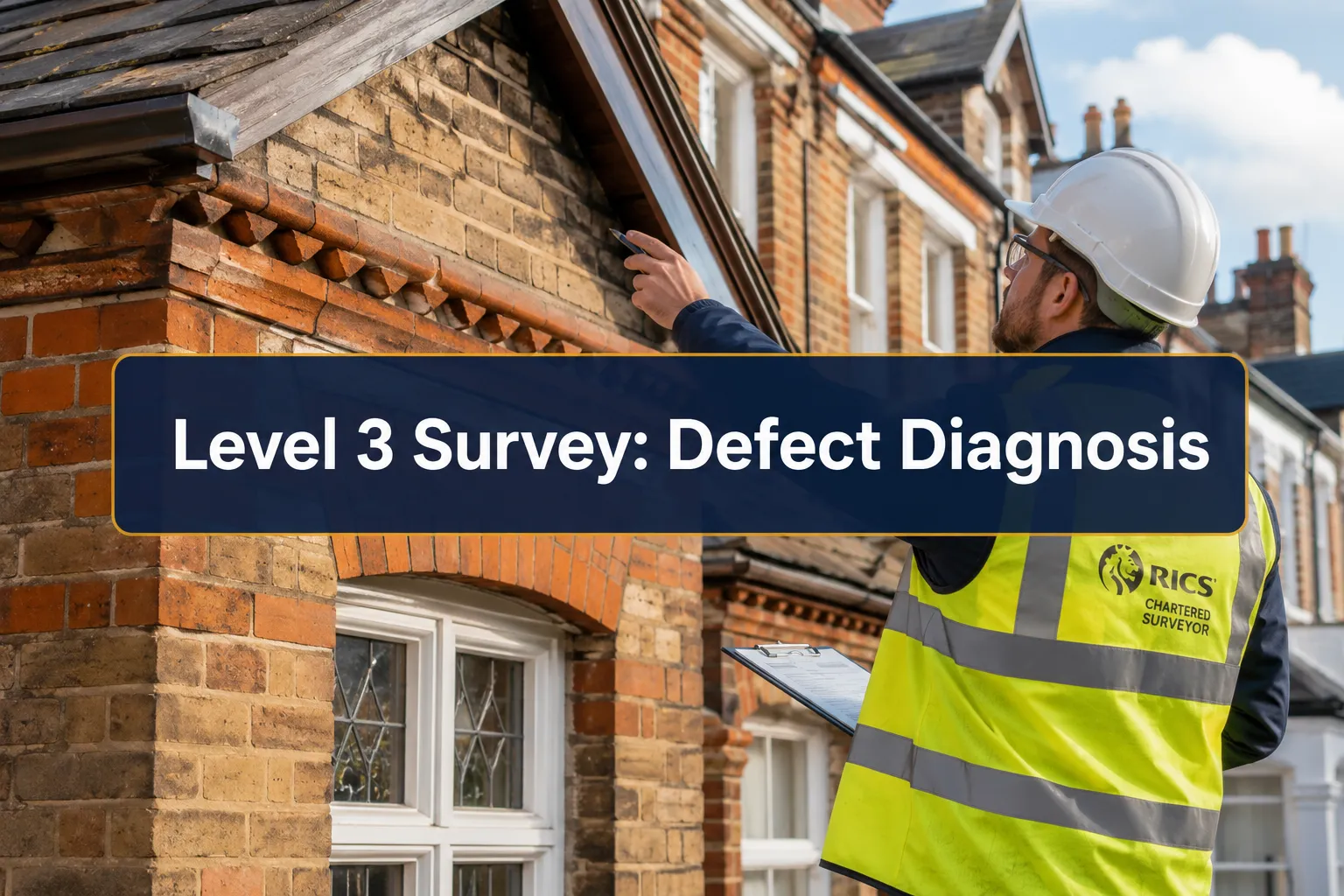
Quick Answer: A Level 3 Building Survey is the most thorough property inspection available to UK buyers and owners. It diagnoses defects, assigns urgency ratings, and provides long-term maintenance advice that directly protects a property's market value. For older, altered, or complex properties, the maintenance guidance in a Level 3 report is often the single most valuable tool for preventing costly surprises and sustaining valuation stability over time.
Key Takeaways
- Long-term maintenance advice in Level 3 Building Surveys is essential for identifying defects before they escalate into structural or financial crises.
- Level 3 surveys cover all accessible areas, including roof voids, sub-floor spaces, and the external envelope, far exceeding what a Level 1 or Level 2 survey covers.
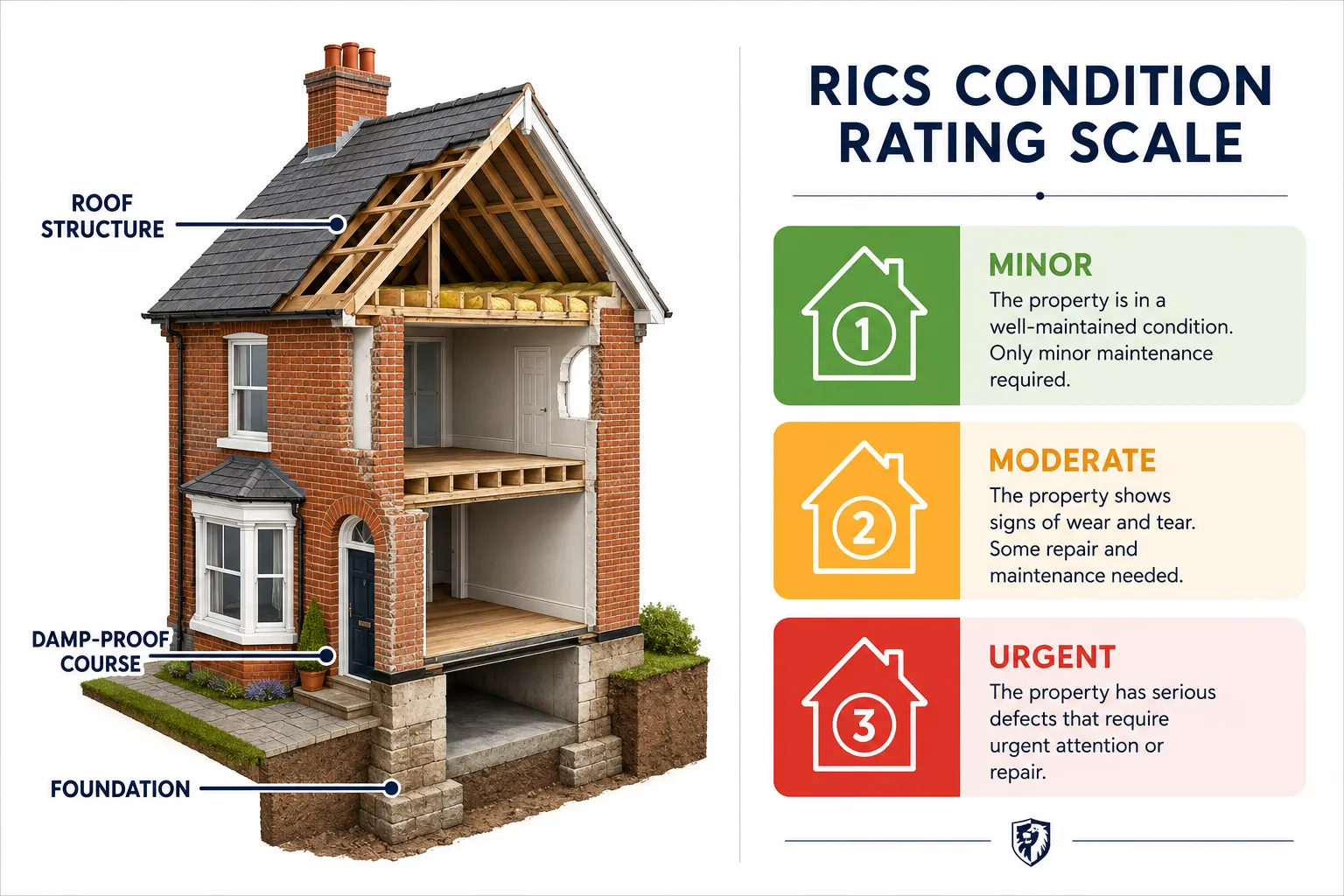
- Surveyors use a condition rating system (1 to 3) to prioritise defects, from minor maintenance to urgent repairs.
- Common value-affecting defects include subsidence, damp penetration, roof failure, and non-compliant alterations.
- A Level 3 survey typically costs between £600 and £1,500, but can reveal repair needs worth £10,000 to £50,000 or more.
- Maintenance recommendations can be used directly in price negotiations with sellers.
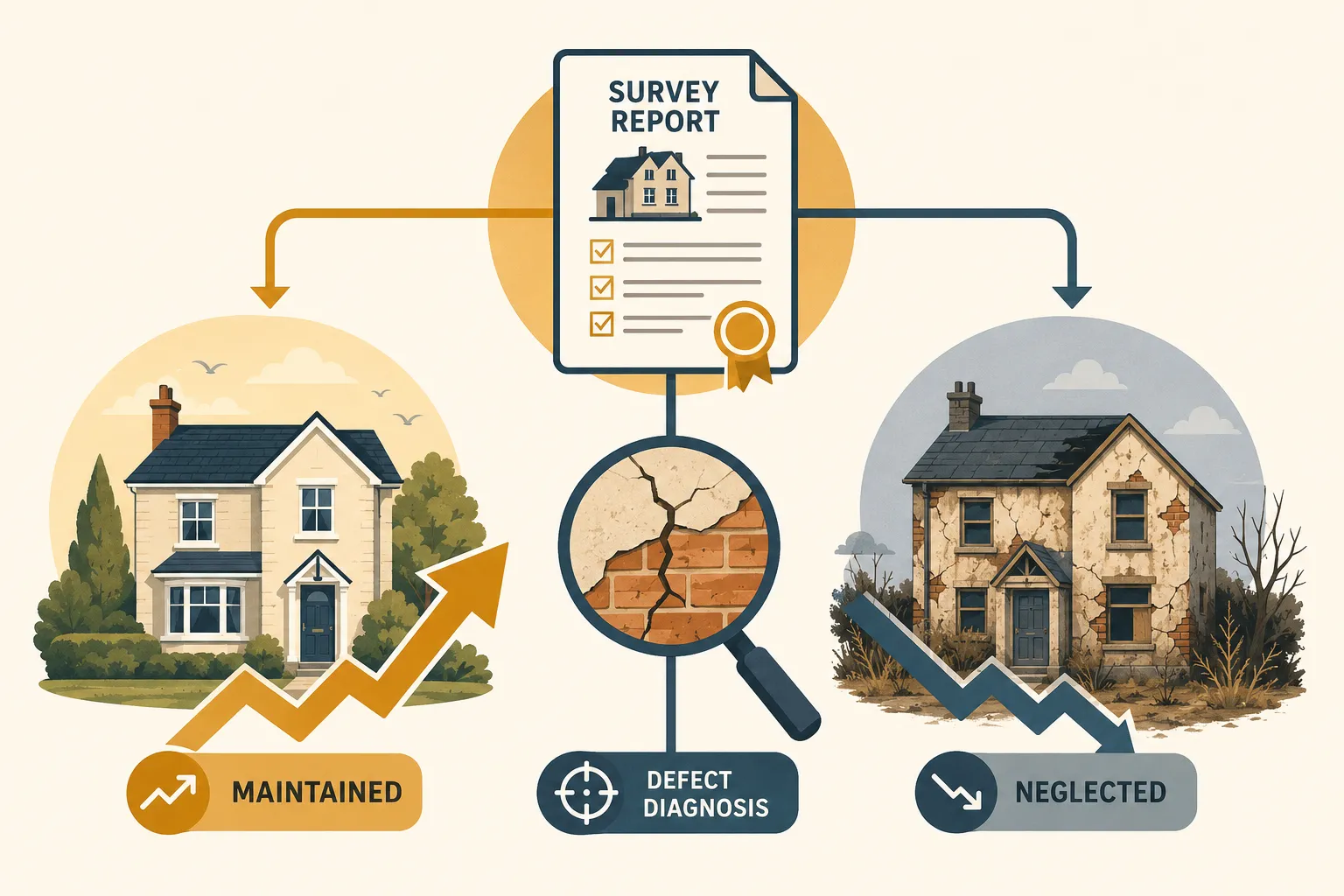
- Ignoring major defects identified in a survey can lead to accelerated deterioration, insurance complications, and significant value loss.
- Level 3 surveys are most appropriate for pre-1970s properties, listed buildings, and homes with visible defects or significant alterations.
What Is a Level 3 Building Survey and How Does It Differ from Level 1 and Level 2?
A Level 3 Building Survey is the most detailed residential survey available under the RICS Home Survey Standard. It provides a full written assessment of a property's construction, condition, and defects, along with long-term maintenance advice and repair cost guidance. Levels 1 and 2 are progressively less detailed.
Here is how the three levels compare:
| Survey Level | Best For | Defect Detail | Maintenance Advice | Repair Cost Estimates |
|---|---|---|---|---|
| Level 1 | New builds, modern homes | Basic condition flags | None | None |
| Level 2 | Standard post-war homes | Moderate detail | Limited | Approximate |
| Level 3 | Older, complex, altered properties | Full defect diagnosis | Comprehensive | Detailed |
A Level 2 (Homebuyer Report) will flag visible issues but rarely explains their cause or long-term implications. A Level 3 survey, by contrast, traces defects back to their root cause, a process known as building pathology, and tells you what will happen if nothing is done. For a deeper look at the differences, see this guide comparing Level 2 and Level 3 surveys.
Choose a Level 3 if: the property is pre-1970, has been extended or converted, shows visible cracks or damp, is listed, or has an unusual construction method.
Why Does Long-Term Maintenance Advice Matter for Property Valuation?
Long-term maintenance advice in Level 3 Building Surveys directly influences valuation stability because unaddressed defects compound over time. A minor roof leak ignored for two years can become a structural timber replacement costing tens of thousands of pounds.
Lenders and valuers assess properties on the basis of current condition and anticipated maintenance liability. A property with documented, costed maintenance needs is far easier to finance and insure than one with unknown defects. Buyers who act on maintenance recommendations also protect their equity by preventing the kind of deterioration that triggers down-valuations at remortgage.
"The maintenance section of a Level 3 report is not a list of problems. It is a financial roadmap for protecting the asset."
In a market where buyer caution has increased noticeably through 2026, sellers and buyers alike benefit from the transparency that a thorough survey provides. Properties with clear maintenance records and addressed defects consistently attract stronger offers and smoother mortgage approvals.
How Do Surveyors Diagnose Defects in Level 3 Surveys?
Surveyors conducting Level 3 surveys perform a systematic defect-analysis exercise, linking visible symptoms to their probable causes. This is not a simple checklist inspection, it is a diagnostic process grounded in building pathology.
The diagnostic process typically follows these steps:
- Visual inspection of all accessible areas, including roof spaces, sub-floor voids, cellars, and the full external envelope.
- Moisture readings taken at walls, floors, and around windows to identify damp patterns.
- Crack mapping to distinguish between structural movement and thermal or shrinkage cracking.
- Material assessment to identify non-standard, hazardous, or deteriorating building materials.
- Cause-and-effect analysis linking each symptom (e.g., cracking above a lintel) to a probable cause (e.g., lintel corrosion or inadequate bearing).
- Condition rating assigned to each element, from 1 (satisfactory) to 3 (urgent action required).
Surveyors also flag areas requiring further specialist investigation, such as structural engineer reports or asbestos surveys, where a definitive diagnosis cannot be reached visually.
What Defects Most Commonly Affect Property Value Stability?
Certain defects carry disproportionate weight in valuation assessments because they affect structural integrity, habitability, or mortgageability. These are the defects most likely to cause a lender's valuer to down-value a property or attach conditions to a mortgage offer.
High-impact defects (Condition Rating 3):
- Subsidence or heave, active ground movement affecting foundations
- Penetrating or rising damp, particularly where it has caused timber decay
- Roof structure failure, sagging rafters, rotten purlins, or failed flat roof coverings
- Structural cracking, especially diagonal or stepped cracks indicating differential settlement
- Non-compliant extensions or conversions, work done without building regulations approval
- Hazardous materials, asbestos, lead paint, or high-alumina cement concrete
Moderate-impact defects (Condition Rating 2):
- Failed pointing or spalled brickwork
- Defective guttering and drainage causing localised damp
- Outdated electrical installations
- Single-glazed windows in an otherwise modernised property
For a comprehensive overview of what appears in a Level 3 report, the building defects survey page provides useful context. You can also review 11 common defects found in older homes for a practical reference.
What's the Difference Between Defects That Affect Valuation vs Cosmetic Issues?
Valuation-affecting defects threaten structural integrity, safety, or legal compliance. Cosmetic issues affect appearance only and carry no meaningful impact on a surveyor's or lender's assessment of market value.
Valuation-affecting defects:
- Active structural movement
- Damp causing timber decay or mould in habitable rooms
- Roof failures affecting weather-tightness
- Electrical or gas installations that fail safety standards
- Unauthorised works without building regulations sign-off
Cosmetic issues (do not affect valuation):
- Scuffed paintwork or dated décor
- Minor hairline plaster cracks from thermal movement
- Worn carpets or kitchen units
- Garden maintenance
A common mistake buyers make is treating all survey findings as equally serious. A well-written Level 3 report separates these clearly. If in doubt, ask the surveyor directly which findings, if any, are likely to concern a mortgage lender's valuer.
How Much Does a Level 3 Survey with Maintenance Advice Typically Cost?
A Level 3 Building Survey in the UK typically costs between £600 and £1,500, depending on property size, age, location, and complexity. London and the South East tend to sit at the higher end of that range.
That cost needs to be weighed against what the survey can uncover. Structural defects requiring remediation commonly run from £10,000 to £50,000 or more. A survey fee of £900 that identifies £25,000 of necessary roof and damp work before exchange is not a cost, it is leverage.
The Level 3 Full Building Survey service page provides more detail on what is included in a full inspection and report. For guidance on budgeting for repairs and restoration following a survey, there is dedicated guidance available.
Can I Use Level 3 Survey Maintenance Recommendations to Negotiate a Lower Price?
Yes, and this is one of the most practical uses of a Level 3 survey's maintenance advice. When a survey identifies defects with costed repair estimates, buyers have a documented, professional basis for renegotiating the agreed purchase price.
How to use survey findings in negotiation:
- Obtain repair cost estimates from the survey report or follow-up specialist quotes.
- Identify which defects are urgent (Condition Rating 3) versus ongoing maintenance items.
- Present the repair costs to the seller as a formal reduction request, supported by the surveyor's report.
- Focus on structural and safety-critical items, sellers are more likely to accept reductions for objective, costed defects than for minor cosmetic concerns.
For detailed guidance on this process, see the article on how to negotiate a house price down after a survey. Sellers who refuse to negotiate on major structural defects should prompt buyers to reconsider whether the property is appropriately priced.
What Happens If I Ignore Major Defects Found in a Level 3 Survey?
Ignoring major defects identified in a Level 3 survey accelerates deterioration, increases repair costs, and can make a property unmortgageable or uninsurable over time.
Specific consequences include:
- Structural worsening, subsidence or timber decay left untreated spreads to adjacent elements, multiplying repair costs.
- Insurance complications, insurers may void claims or refuse renewal if known defects were not disclosed or addressed.
- Down-valuation at remortgage, lenders' valuers reassess at each remortgage; a deteriorated property may attract a lower valuation or conditions.
- Legal liability, for landlords, failing to act on known defects can constitute a breach of the Homes (Fitness for Human Habitation) Act 2018.
- Reduced saleability, future buyers will commission their own surveys, and the same defects will resurface, now worse and more expensive to fix.
The consequences of failing to act page covers this in more detail for those who want to understand the full risk picture.
How Do Surveyors Prioritise Maintenance Recommendations?
Surveyors use the RICS condition rating system to prioritise maintenance recommendations by urgency and impact. This gives property owners a clear hierarchy for spending decisions.
Condition Rating 3, Act now: Defects that are serious and/or need to be repaired, replaced, or investigated urgently. These typically include active structural movement, roof failures, and hazardous materials.
Condition Rating 2, Act soon: Defects that need repairing or replacing but are not considered serious or urgent. Examples include failed pointing, defective guttering, or aging heating systems.
Condition Rating 1, Monitor: Elements in reasonable condition but that require ongoing maintenance attention. No immediate action is needed.
Beyond the rating system, surveyors also consider the knock-on effect of each defect. A blocked gutter (Condition Rating 2) may be elevated in priority if it is directly causing damp penetration into a solid wall, which could become a Condition Rating 3 issue within one winter.
How Long Should I Expect Recommended Maintenance to Take and Cost?
Maintenance timelines and costs vary significantly by defect type, property size, and contractor availability. The table below provides indicative ranges for common defects identified in Level 3 surveys.
| Defect Type | Typical Cost Range | Indicative Timeframe |
|---|---|---|
| Roof re-covering (pitched) | £5,000, £15,000 | 1-3 weeks |
| Damp-proof course injection | £1,500, £5,000 | 1-5 days |
| Subsidence underpinning | £10,000, £50,000+ | 4-12 weeks |
| Repointing (full elevation) | £2,000, £8,000 | 1-2 weeks |
| Electrical rewire | £3,000, £10,000 | 1-2 weeks |
| Asbestos removal | £1,000, £5,000 | 1-3 days |
These are estimates only. Always obtain at least three contractor quotes before committing. The building survey timeframes page covers how long the survey process itself takes, which is a separate but related question for buyers working to exchange deadlines.
Who Needs a Level 3 Survey and Who Doesn't Really Need One?
A Level 3 survey is appropriate for buyers and owners of properties that are older, structurally complex, or showing signs of defects. It is not always necessary for modern, standard-construction homes in good condition.
A Level 3 survey is strongly recommended when:
- The property was built before 1970
- It is a listed building or in a conservation area
- There are visible cracks, damp patches, or roof defects
- The property has been significantly extended, converted, or altered
- The construction uses non-standard materials (e.g., timber frame, concrete panels)
- The buyer intends to carry out major renovation works
A Level 3 survey is likely unnecessary when:
- The property is a modern new-build (a snagging survey is more appropriate)
- It is a recently built flat in a managed block with a recent EWS1 certificate
- A Level 2 survey has been completed and returned no significant findings
For help deciding which survey is right for a specific property, the guide to choosing the right building survey covers the decision in full.
Can a Level 3 Survey Prevent Costly Repairs Down the Line?
A Level 3 survey does not prevent defects from existing, but the long-term maintenance advice it provides can prevent small problems from becoming catastrophic ones. Early diagnosis is the mechanism.
When a surveyor identifies that a chimney stack has failed pointing and the flashing is lifting, that is a £400 repair. Left for three winters, the same defect can result in saturated chimney breast timbers, dry rot in the floor structure below, and a repair bill exceeding £15,000. The survey's value is in the timing of the intervention it enables.
For buyers, the survey also creates a documented baseline. Any future deterioration can be measured against the survey's findings, which supports insurance claims, contractor briefings, and future sale negotiations.
Level 3 Survey vs Full Structural Survey: Which Should I Get?
These two terms refer to the same product. A "full structural survey" is the older, informal name for what RICS now formally classifies as a Level 3 Building Survey. Both terms describe the most comprehensive residential survey available.
Some buyers encounter the term "structural survey" and assume it focuses only on structural elements like foundations and load-bearing walls. In practice, a Level 3 survey covers the full building, including roofing, drainage, services, materials, and legal compliance, not just the structure. If a specialist structural engineering opinion is needed (for example, on active subsidence), that is a separate instruction to a structural engineer, distinct from the Level 3 survey itself.
Frequently Asked Questions
What is included in the long-term maintenance advice section of a Level 3 survey?
The maintenance section covers all elements rated Condition 2 or 3, with guidance on repair urgency, likely causes, and in many cases indicative cost ranges. It also flags items to monitor over time, such as ageing flat roofs or older heating systems approaching end of life.
How is a Level 3 survey different from a mortgage valuation?
A mortgage valuation is carried out for the lender, not the buyer, and is a brief assessment of whether the property is worth the loan amount. It does not diagnose defects or provide maintenance advice. A Level 3 survey is commissioned by and for the buyer, providing full defect diagnosis and long-term guidance.
Can a Level 3 survey be used for insurance purposes?
Yes. The condition ratings and repair cost estimates in a Level 3 report can support insurance claims, help establish reinstatement values, and demonstrate due diligence if a claim is later disputed. Some insurers ask for survey evidence when covering older or unusual properties.
How long does a Level 3 building survey take to complete?
The physical inspection of a typical three-to-four bedroom property takes between three and eight hours, depending on size and complexity. The written report is usually delivered within five to ten working days. For more detail, see the guidance on how long a building survey takes.
Do Level 3 surveys cover environmental issues like flooding or contamination?
A Level 3 survey will note visible signs of past flooding or drainage issues and may flag the need for specialist environmental investigations. Dedicated environmental risk assessments (covering flood zones, radon, ground contamination) are separate reports. The environmental issues section of a Level 3 survey explains what is and is not covered.
Is a Level 3 survey worth it for a flat?
For a leasehold flat in a modern managed block, a Level 2 survey is often sufficient. However, for older converted flats, ground-floor flats with damp risk, or any flat where the buyer has concerns about the building's structure or cladding, a Level 3 survey provides considerably more protection.
Conclusion
Long-term maintenance advice in Level 3 Building Surveys represents one of the most cost-effective forms of financial protection available to UK property buyers and owners. By diagnosing defects at their root cause, assigning clear urgency ratings, and providing costed maintenance guidance, a Level 3 survey gives buyers the information they need to negotiate fairly, plan expenditure, and protect their asset's value over the long term.
Actionable next steps:
- Commission a Level 3 survey before exchange on any property built before 1970, visibly defective, or structurally unusual.
- Read the full report, not just the summary. The maintenance section contains the most actionable long-term guidance.
- Use Condition Rating 3 findings as the basis for a formal price renegotiation with supporting contractor quotes.
- Create a maintenance schedule based on the surveyor's recommendations, prioritising urgent items in year one.
- Revisit the report at each remortgage or before any major renovation to ensure the baseline findings have been addressed.
For properties where the survey identifies complex legal or construction issues, sourcing extra specialist advice through the surveyor's network is a sensible next step. The survey is not the end of the process, it is the beginning of informed ownership.
.cg-wrap{font-family:Arial,sans-serif;max-width:520px;margin:24px auto;border:2px solid #1a3a5c;border-radius:8px;overflow:hidden}
.cg-head{background:#1a3a5c;color:#fff;padding:14px 18px;font-size:1.05rem;font-weight:700}
.cg-body{padding:16px 18px;background:#f7f9fc}
.cg-row{margin-bottom:12px}
.cg-label{display:block;font-size:.88rem;font-weight:600;color:#1a3a5c;margin-bottom:4px}
.cg-sel{width:100%;padding:7px 10px;border:1px solid #b0bec5;border-radius:5px;font-size:.9rem;background:#fff}
.cg-btn{background:#e07b00;color:#fff;border:none;padding:10px 22px;border-radius:5px;font-size:.95rem;font-weight:700;cursor:pointer;margin-top:6px;width:100%}
.cg-result{margin-top:14px;padding:12px 14px;border-radius:6px;font-size:.9rem;display:none}
.cg-r1{background:#d4edda;border-left:4px solid #28a745;color:#155724}
.cg-r2{background:#fff3cd;border-left:4px solid #e07b00;color:#7a4800}
.cg-r3{background:#f8d7da;border-left:4px solid #c0392b;color:#721c24}
function cgCheck(){
var s=document.getElementById(‘cg-defect’);
var v=s.value;
[‘cg-r1′,’cg-r2′,’cg-r3′].forEach(function(id){document.getElementById(id).style.display=’none’;});
if(v===’1′){document.getElementById(‘cg-r1′).style.display=’block’;}
else if(v===’2′){document.getElementById(‘cg-r2′).style.display=’block’;}
else if(v===’3′){document.getElementById(‘cg-r3′).style.display=’block’;}
}
Tags: Level 3 building survey, building survey maintenance advice, defect diagnosis, property valuation stability, RICS building survey, chartered surveyor, building defects, long-term property maintenance, full building survey, structural defects, survey condition ratings, UK homebuyers