

Last updated: July 24, 2026
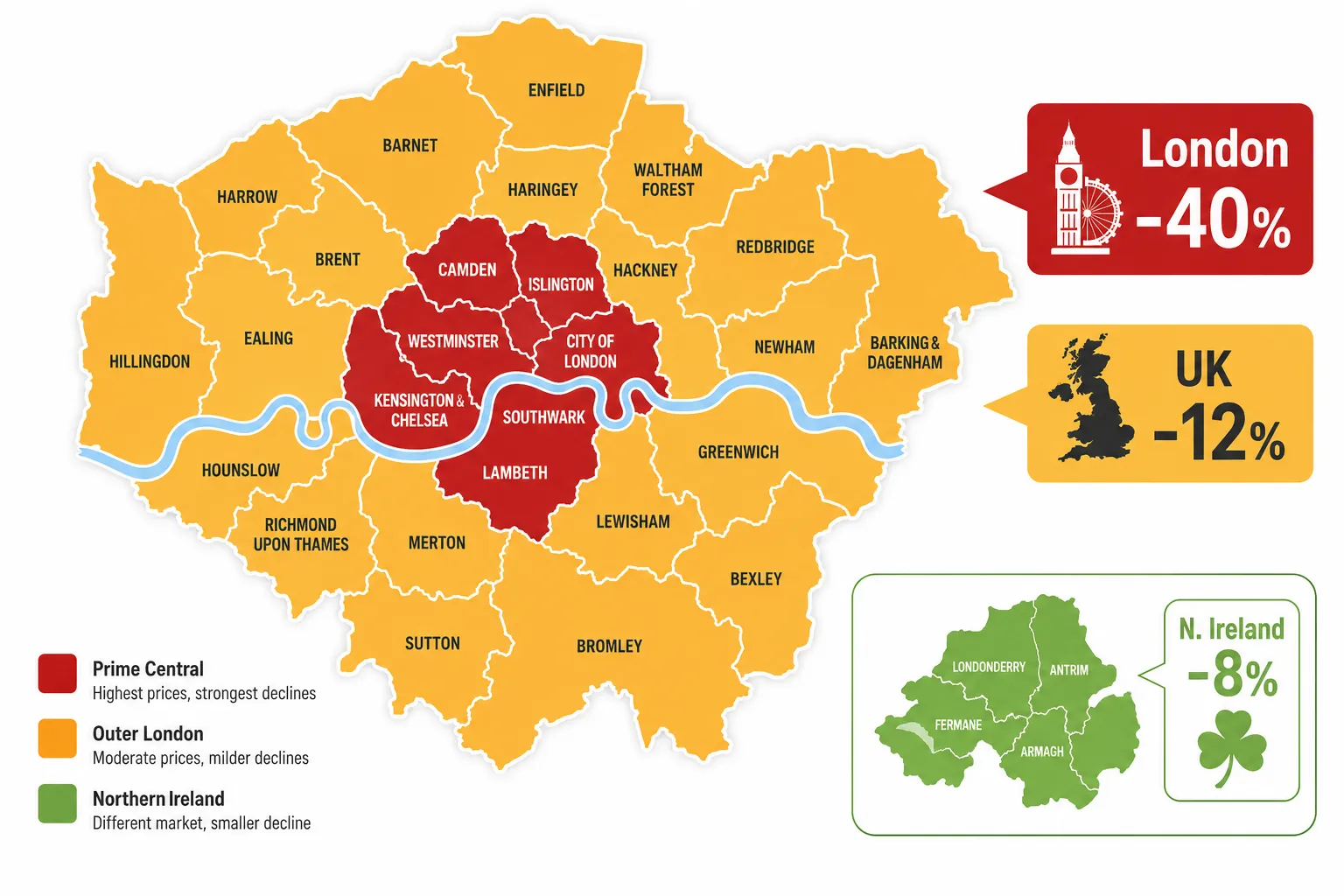
Quick Answer: The RICS February 2026 residential survey recorded a net balance of -40% for London house prices, more than three times the national average decline of -12%. This sharp divergence means building surveyors operating in the capital must now apply more granular, evidence-based valuation methods while actively managing client expectations that were set during a very different market. Sellers, buyers, and landlords all need to understand what these figures mean in practice before making any property decision in 2026.
Key Takeaways
- London's house price net balance fell to -40% in February 2026, far below the UK national figure of -12%, signalling a pronounced regional divergence.
- New buyer enquiries in London dropped to a net balance of -26% in February 2026, down from -15% in January, reflecting accelerating demand weakness.
- Twelve-month price expectations in London collapsed from +56% to +7%, indicating that even longer-term optimism has cooled sharply.
- Geopolitical uncertainty and interest rate sensitivity are cited as key drivers of reduced market confidence in the capital.
- Building surveyors must now anchor valuations to current comparable evidence rather than historic trend lines to avoid overvaluation disputes.
- Sellers who priced based on 2024 or early 2025 comparables are likely to face downward renegotiation after a survey, sometimes significantly.
- Prime central London and higher-value outer boroughs are seeing the steepest corrections; some northern and eastern zones are holding more steadily.
- Mortgage lenders are applying tighter scrutiny to London valuations, increasing the risk of down-valuations on agreed sale prices.
- Commissioning an independent RICS building survey before exchange remains one of the most effective ways to protect against overpaying in a falling market.
What Does the RICS February 2026 Survey Say About London Property Valuations?
The RICS February 2026 UK Residential Market Survey recorded a net balance of -40% for London house prices, meaning 40% more chartered surveyors reported falling prices than rising ones in the capital. This is the sharpest regional reading in the survey and sits well below the UK-wide net balance of -12%.
Key figures from the February 2026 survey for London:
| Indicator | London Net Balance | UK National Net Balance |
|---|---|---|
| House prices (Feb 2026) | -40% | -12% |
| New buyer enquiries | -26% | -15% |
| Near-term price expectations | -18% | Broadly flat |
| 12-month price expectations | +7% | Higher positive |
| New vendor instructions | +2% | +2% |
What this means in practice: Supply entering the market is broadly stable, but demand has fallen sharply. When supply holds steady and demand drops, prices adjust downward. Surveyors in London are seeing this play out in real time on valuations.
Why Are London Property Valuations Diverging After the RICS Survey?
London is diverging from the rest of the UK because it combines several compounding pressures that do not apply equally elsewhere. While regions like Northern Ireland and Scotland recorded positive price trends in February 2026, London's premium price base makes it far more sensitive to interest rate movements, affordability constraints, and shifts in buyer confidence.
The main drivers of London's valuation divergence in 2026 include:
- Interest rate sensitivity: Higher absolute prices mean mortgage repayments in London are disproportionately affected by rate changes. Even modest rate adjustments price out a meaningful share of buyers.
- Geopolitical uncertainty: Surveyors noted that international instability, including the Iran conflict, has dampened confidence among both domestic and overseas buyers, a segment that matters more to London than to most UK regions.
- Affordability ceiling: London prices hit a structural affordability ceiling during 2021-2023. With wages not keeping pace, the pool of qualifying buyers has narrowed.
- Transaction volume compression: Fewer completed sales make it harder to establish reliable comparables, which in turn widens the gap between asking prices and achievable values.
The result is a market where two surveyors can inspect the same property and reach materially different conclusions, a classic condition for valuation divergence.
How Should Building Surveyors Adjust Valuations in a Cooling Market?
In a cooling market, building surveyors should move away from trend-based assumptions and anchor every valuation to current, verified comparable evidence. The RICS Red Book (Valuation, Global Standards) already requires this approach, but in a falling market the discipline becomes critical because historic comparables will consistently overstate current value.
Practical adjustments surveyors should apply in 2026:
- Use only recent comparables, ideally transactions completed within the last three months. Sales agreed six or more months ago reflect a different market.
- Apply time adjustments, if the best available comparable is four months old, apply a downward adjustment that reflects the rate of price change evidenced in the RICS survey data.
- Weight condition heavily, in a buyer's market, condition defects that buyers previously overlooked now become negotiating leverage. A Level 3 full building survey is essential for identifying these issues accurately.
- Account for transaction volume, low transaction volumes reduce comparable reliability. Surveyors should widen their search radius or apply a liquidity discount where appropriate.
- Document the rationale, in a disputed market, a well-documented valuation file is the surveyor's primary defence against challenge.
"Anchoring valuation opinions to standardised RICS frameworks and region-specific comparable evidence is not just best practice, in a divergent market, it is the only defensible approach."
For surveyors working on specialist instructions, the same principles apply whether the instruction is a matrimonial valuation or a capital gains assessment, current market evidence must drive the opinion.
What Is the Difference Between RICS Valuation Guidance and Actual Market Prices in London?
RICS valuation guidance sets the methodology; it does not set the price. A RICS-compliant valuation reflects the surveyor's professional opinion of Market Value, defined as the estimated amount for which a property should exchange on the date of valuation between a willing buyer and a willing seller. Actual achieved prices can deviate from this, particularly when sellers hold out for pre-correction asking prices.
In February 2026, this gap has widened in London because:
- Many sellers are still pricing based on 2024 peak comparables.
- Buyers are offering 5-15% below asking price in some sub-markets (this is an estimate based on surveyor-reported negotiation activity, not an official RICS figure).
- Mortgage lenders are instructing their own panel valuers independently, and those valuations are increasingly coming in below agreed sale prices.
Common mistake: Sellers who refuse to acknowledge the RICS survey data risk properties sitting on the market for extended periods, ultimately selling for less than an early, realistic price reduction would have achieved.
How Do Building Surveyors Handle Client Expectations When Valuations Drop?
Managing client expectations is now as important as the technical valuation itself. Surveyors should treat expectation management as a structured process, not an afterthought.
A practical framework for communicating lower valuations:
- Lead with data, not opinion, present the RICS survey figures, local transaction data, and comparable evidence before stating the valuation figure. Clients who see the evidence first accept the conclusion more readily.
- Separate the property from the market, acknowledge the property's genuine attributes before explaining that the market has moved. This reduces the emotional defensiveness that makes clients reject accurate valuations.
- Quantify the risk of overpricing, show the client what happens if they price above market value: extended time on market, price reductions, and the stigma of a stale listing that ultimately achieves less.
- Provide a range, not just a point, in a volatile market, a valuation range (for example, £480,000 to £510,000) is more honest and often more persuasive than a single figure that the client can argue with.
- Follow up in writing, a clear written summary of the valuation rationale protects both the surveyor and the client.
For clients preparing a property for sale, reviewing our guide on how to prepare your property for market alongside the valuation report can help align presentation with realistic price expectations.
Which London Neighbourhoods Are Seeing the Biggest Valuation Drops?
Prime central London and high-value outer boroughs are experiencing the steepest corrections in 2026. Areas where prices rose most sharply between 2020 and 2023 are now correcting most significantly, because they were most exposed to the affordability ceiling and overseas buyer retreat.
Broad patterns observed by surveyors in 2026:
- Prime central zones (Kensington, Chelsea, Westminster): Significant corrections, particularly on flats above £1.5m, where the buyer pool has contracted sharply.
- Inner south and east London (Bermondsey, Hackney, Stratford): Moderate softening, with more resilience in areas with strong rental demand and transport links.
- Outer west London (Ealing, Richmond, Kingston): Mixed picture; family houses with gardens holding better than flats.
- North London (Islington, Highgate): Softening, but less severe than prime central zones.
Surveyors covering south-east London, west London, and north London are each seeing distinct sub-market dynamics that require locally calibrated comparable evidence rather than a single London-wide adjustment.

Are London Property Prices Still Falling in 2026?
Yes, based on the February 2026 RICS data, London property prices are still falling. The net balance of -40% for house prices and -18% for near-term expectations both confirm continued downward pressure. However, the twelve-month outlook of +7% suggests that most surveyors expect the correction to moderate or stabilise within the year, not accelerate into a prolonged crash.
What this means for different groups:
- Buyers: 2026 represents a genuine opportunity to negotiate, particularly on properties that have been on the market for more than eight weeks. Commissioning a full survey before exchange is essential, see our overview of how long a building survey takes to plan your timeline.
- Sellers: Pricing realistically now is likely to achieve a better net outcome than holding out and reducing later.
- Landlords: Rental demand remains strong in London even as capital values soften, so yield calculations are shifting in favour of buy-to-let investors who can transact at current prices.
How Do I Get an Accurate Valuation If the Market Is Cooling?
Getting an accurate valuation in a cooling market requires instructing a RICS-regulated surveyor who uses current comparable evidence and applies explicit time adjustments. Estate agent appraisals are not valuations, they are marketing opinions, and in a falling market they frequently lag behind actual achievable prices.
Steps to get a reliable valuation in 2026:
- Instruct a RICS-regulated chartered surveyor, not an estate agent.
- Ask specifically how many comparable transactions from the last 90 days were used.
- Request a written explanation of any adjustments made for condition, location, or market movement.
- If the property has unusual features or defects, commission a building pathology assessment alongside the valuation to ensure defects are properly reflected in the figure.
- For investment properties, consider a property development valuation that models both current and post-development value.
What Causes Valuation Divergence Between Different Surveyors?
Valuation divergence between surveyors occurs when professionals use different comparable sets, apply different condition adjustments, or weight market sentiment differently. In a stable market, these differences are usually minor. In a volatile market like London in 2026, the same property can attract valuations that differ by 10% or more.
Primary causes of surveyor-to-surveyor divergence:
- Different comparable selection: One surveyor uses a sale from eight months ago; another uses one from last month. In a falling market, this alone can produce a large gap.
- Condition assessment differences: Surveyors who identify significant defects will apply larger downward adjustments. This is why a thorough building defects survey matters, it ensures defects are not missed.
- Methodology differences: Some surveyors apply explicit time adjustments; others do not.
- Instruction type: A mortgage valuation (brief, lender-focused) will often differ from a full Red Book valuation (comprehensive, client-focused).
Edge case: When a mortgage lender's valuation comes in below an agreed sale price, the buyer faces a shortfall. Understanding how to negotiate a house price down after a survey is a practical skill in this environment.
How Do Mortgage Lenders Handle Divergent Valuations in London?
Mortgage lenders instruct their own panel valuers independently of any survey the buyer commissions. When a lender's valuation comes in below the agreed sale price, a "down-valuation", the lender will only advance funds based on their lower figure. The buyer must then either renegotiate the price, increase their deposit, or withdraw.
In London's current market, down-valuations are more frequent because:
- Agreed prices are often based on asking prices set before the February 2026 RICS data was published.
- Panel valuers are applying the same conservative, current-evidence methodology described above.
- Transaction volumes are low, making it harder to justify higher prices with comparable evidence.
What to do if you receive a down-valuation:
- Request the lender's comparable evidence and challenge it if the comparables are outdated.
- Commission an independent RICS valuation and submit it as a formal challenge.
- Use the down-valuation as a basis for price renegotiation with the seller, this is legitimate and increasingly common.
Should I List My London Property Now or Wait After the RICS Survey?
Waiting for market conditions to improve is a reasonable strategy only if you have a genuine long-term hold horizon and no financial pressure to sell. For most sellers, the evidence from the RICS February 2026 survey suggests that waiting carries meaningful risk.
Choose to list now if:
- You need to release equity or downsize within the next 12 months.
- Your property has been on the market and you have been holding at an above-market price.
- You can price competitively based on current comparables and present the property well.
Consider waiting if:
- Your twelve-month price expectation data (+7% net balance) suggests modest recovery, and you can comfortably hold for 12-18 months.
- The property requires remedial work that, if completed, would materially improve its marketable condition.
- You are in a sub-market (such as inner east London) where demand is holding more steadily.
Common mistake: Sellers who list at 2024 prices and then reduce incrementally over several months typically achieve less than sellers who price correctly from day one. The average price reduction after a survey is already a known pressure point, compounding this with an overpriced listing compounds the loss.
What Common Mistakes Do Surveyors Make During Market Downturns?
Even experienced surveyors can fall into predictable errors when markets shift quickly. Awareness of these mistakes is the first step to avoiding them.
- Anchoring to historic values: Using comparables from 12+ months ago without applying time adjustments overstates current value.
- Ignoring condition in a buyer's market: Defects that buyers overlooked in a competitive market become price-affecting in a buyer's market. Failing to reflect this understates the adjustment.
- Underestimating transaction volume effects: Thin markets produce unreliable comparables. Surveyors who treat a low-volume comparable as equivalent to a high-volume one introduce error.
- Overconfidence in the twelve-month outlook: The +7% twelve-month expectation is a net balance of surveyor sentiment, not a forecast. Treating it as a guaranteed recovery is a professional error.
- Poor client communication: Delivering a lower-than-expected valuation without structured explanation leads to disputes, complaints, and reputational damage.
FAQ
What does a net balance of -40% mean in the RICS survey?
A net balance of -40% means that 40% more chartered surveyors in London reported falling house prices than rising ones in February 2026. It does not mean prices fell by 40%, it is a sentiment indicator showing the direction and breadth of price movement.
How is London's market different from the rest of the UK in 2026?
London recorded a net price balance of -40% against a UK average of -12% in February 2026. Regions like Northern Ireland and Scotland reported positive price trends. London's higher price base, greater interest rate sensitivity, and heavier reliance on overseas buyers make it more vulnerable to the current conditions.
Can I challenge a down-valuation from my mortgage lender?
Yes. You can request the lender's comparable evidence and submit a formal challenge supported by an independent RICS valuation. If the lender's comparables are outdated or drawn from a different sub-market, a challenge has a reasonable prospect of success.
Is a building survey still worth commissioning in a falling market?
A building survey is more valuable in a falling market, not less. Defects that buyers previously overlooked now carry real negotiating weight. A survey that identifies significant issues gives a buyer legitimate grounds to renegotiate the price or withdraw, potentially saving far more than the survey fee.
What is the difference between a mortgage valuation and a RICS building survey?
A mortgage valuation is a brief assessment commissioned by the lender to confirm the property is adequate security for the loan. A RICS building survey is a comprehensive inspection commissioned by the buyer to assess condition, identify defects, and inform the purchase decision. They serve different purposes and should not be treated as interchangeable.
How long does it take to get a building survey in London in 2026?
Most RICS building surveys in London can be booked within one to two weeks of instruction, with the report typically delivered within three to five working days of the inspection. Timelines vary by firm and property complexity, see our detailed guide on building survey timeframes for a full breakdown.
Which type of survey is best for a period London property?
A Level 3 Full Building Survey is recommended for any pre-1980s property, particularly Victorian and Edwardian stock, which makes up a large proportion of London's housing. These properties carry higher risks of structural movement, damp, and outdated services that a Level 2 HomeBuyer Report may not fully capture.
Conclusion
London Valuation Divergences Post-RICS February 2026 Survey: Building Surveyor Tactics for Cooled Price Expectations is not an abstract professional topic, it has direct financial consequences for anyone buying, selling, or lending against London property right now. The February 2026 RICS data is unambiguous: London is experiencing a significant and regionally distinct price correction, and the gap between seller expectations and achievable market values is wider than at any point in recent years.
Actionable next steps:
- Buyers: Commission an independent RICS survey before exchange. Use the findings to negotiate. Do not rely on a mortgage valuation as a substitute for a full building survey.
- Sellers: Instruct a RICS-regulated surveyor for a current market valuation before setting your asking price. Price based on transactions from the last 90 days, not 2024 peaks.
- Landlords: Use the current correction as a buying opportunity if yields stack up at current prices. Get a property development valuation to model refurbishment scenarios.
- Property professionals: Apply explicit time adjustments to all comparables, document your rationale thoroughly, and treat client expectation management as a core professional skill, not an optional extra.
The twelve-month outlook of +7% suggests stabilisation is possible within the year, but that recovery is not guaranteed and will not be uniform across London's diverse sub-markets. The surveyors who serve their clients best in 2026 will be those who combine technical rigour with clear, evidence-based communication.
.cg-wrap{font-family:Arial,sans-serif;max-width:560px;margin:2rem auto;background:#f8f9fa;border-radius:8px;padding:1.2rem;box-sizing:border-box}
.cg-title{font-size:1rem;font-weight:700;color:#1a2e4a;margin-bottom:.8rem;text-align:center}
.cg-bar-row{display:flex;align-items:center;margin:.45rem 0;gap:.5rem}
.cg-label{font-size:.78rem;color:#333;width:130px;flex-shrink:0}
.cg-track{flex:1;background:#e0e0e0;border-radius:4px;height:18px;position:relative;overflow:hidden}
.cg-fill-neg{height:100%;border-radius:4px;background:#c0392b}
.cg-fill-pos{height:100%;border-radius:4px;background:#27ae60}
.cg-val{font-size:.78rem;font-weight:700;width:42px;text-align:right;flex-shrink:0}
.cg-neg{color:#c0392b}.cg-pos{color:#27ae60}
.cg-note{font-size:.7rem;color:#666;margin-top:.9rem;text-align:center}
.cg-legend{display:flex;gap:1rem;justify-content:center;margin-bottom:.7rem;font-size:.72rem}
.cg-dot{width:10px;height:10px;border-radius:50%;display:inline-block;margin-right:3px;vertical-align:middle}
Positive (rising)