

"
Infill development applications in England and Wales rose sharply in the years following the pandemic, and 2026 has brought that trend to a new peak — with local authorities reporting record numbers of rear-garden subdivision schemes, side-return extensions, and urban plot developments that place new walls directly on or beside shared boundaries. Yet a significant proportion of those projects stall, attract injunctions, or end in costly disputes because building owners overlook one foundational legal step: serving a Line of Junction Notice under Section 1 of the Party Wall etc. Act 1996.
This guide — Line of Junction Notices Explained: Party Wall Act Essentials for 2026 Boundary Projects — walks through every stage of the process, from understanding what triggers the notice to navigating surveyor appointments, dispute resolution, and the updated RICS guidance published in 2026. Whether a project involves a simple garden wall or a complex infill development, the principles below apply.
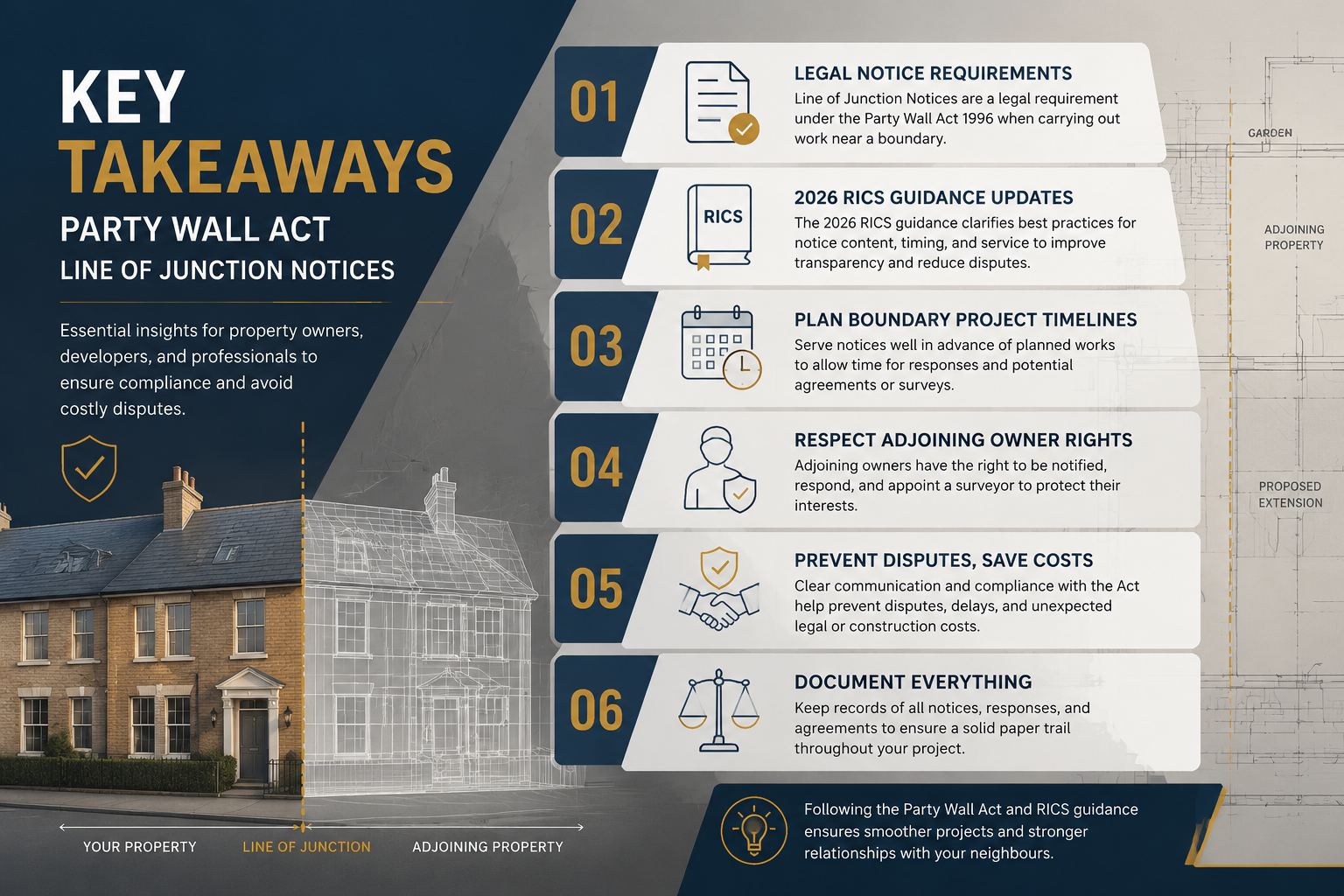
Key Takeaways
- A Line of Junction Notice is a statutory requirement under Section 1 of the Party Wall etc. Act 1996 whenever a new wall is built astride or up to a shared boundary.
- The notice must be served at least one month before work starts and is valid for 12 months from the date of service.
- Adjoining owners have 14 days to respond; silence counts as dissent and triggers a dispute resolution process.
- Failure to serve the notice can render works unlawful, exposing building owners to injunctions and the cost of undoing completed construction.
- The RICS 8th edition guidance, finalised in May 2026, places new emphasis on surveyor independence and procedural accuracy.
What Is a Line of Junction Notice and When Is It Required
The Statutory Basis
A Line of Junction Notice is a formal written notice served under Section 1 of the Party Wall etc. Act 1996. It is required whenever a building owner intends to construct a new wall that will sit either:
- Astride the line of junction (straddling the shared boundary), or
- Up to the line of junction (built wholly on the building owner's own land but directly against the boundary) [1].
The "line of junction" is simply the legal boundary between two adjacent properties — the dividing line where one owner's land ends and the next begins. It is not the same as the physical position of an existing fence or hedge, which may have shifted over time. Confusing the physical boundary with the legal boundary recorded on title plans is one of the most common errors building owners make [1].
For a comprehensive overview of how boundaries interact with party wall law, the guide on boundary wall rules and the difference between party fence walls and boundary walls provides useful context.
Works That Trigger the Notice
The following project types almost always require a Line of Junction Notice in 2026 boundary projects:
| Type of Work | Notice Required? |
|---|---|
| New garden wall astride the boundary | Yes — Section 1 |
| New boundary wall entirely on building owner's land | Yes — Section 1 |
| Extension of an existing party fence wall | Likely yes |
| Replacement of a boundary fence with a masonry wall | Yes — Section 1 |
| New outbuilding wall at the boundary | Yes — Section 1 |
| Works to an existing party wall | No — Section 3 (Party Structure Notice) |
It is worth noting that the Act defines "owner" broadly: anyone entitled to receive rents or profits from land, including freeholders and certain long leaseholders [5]. This means that if the adjoining property is a leasehold flat, the notice may need to be served on both the leaseholder and the freeholder.
For a deeper understanding of how party fence walls are defined under the Act, see what is a party fence wall under the Party Wall Act definition.
How to Serve a Line of Junction Notice: Step-by-Step Process
Step 1: Confirm the Boundary Position
Before drafting the notice, the building owner should confirm the legal boundary position using:
- HM Land Registry title plans
- Original conveyance documents
- A measured survey by a chartered surveyor if there is any ambiguity
This step is critical. Serving a notice based on an incorrect boundary position can invalidate the entire process [1].
Step 2: Draft the Notice
The notice must contain the following information [2]:
- Full name and address of the building owner
- Full name and address of the adjoining owner(s)
- Description of the proposed works — including whether the wall will be built astride or up to the boundary
- Proposed start date of the works
- A statement that the notice is served under Section 1 of the Party Wall etc. Act 1996
There is no prescribed government form for a Line of Junction Notice, but the content requirements are statutory. Many building owners use a solicitor or party wall surveyor to draft the document. For a practical starting point, a free sample party wall agreement template can help illustrate the required structure.
Step 3: Serve the Notice
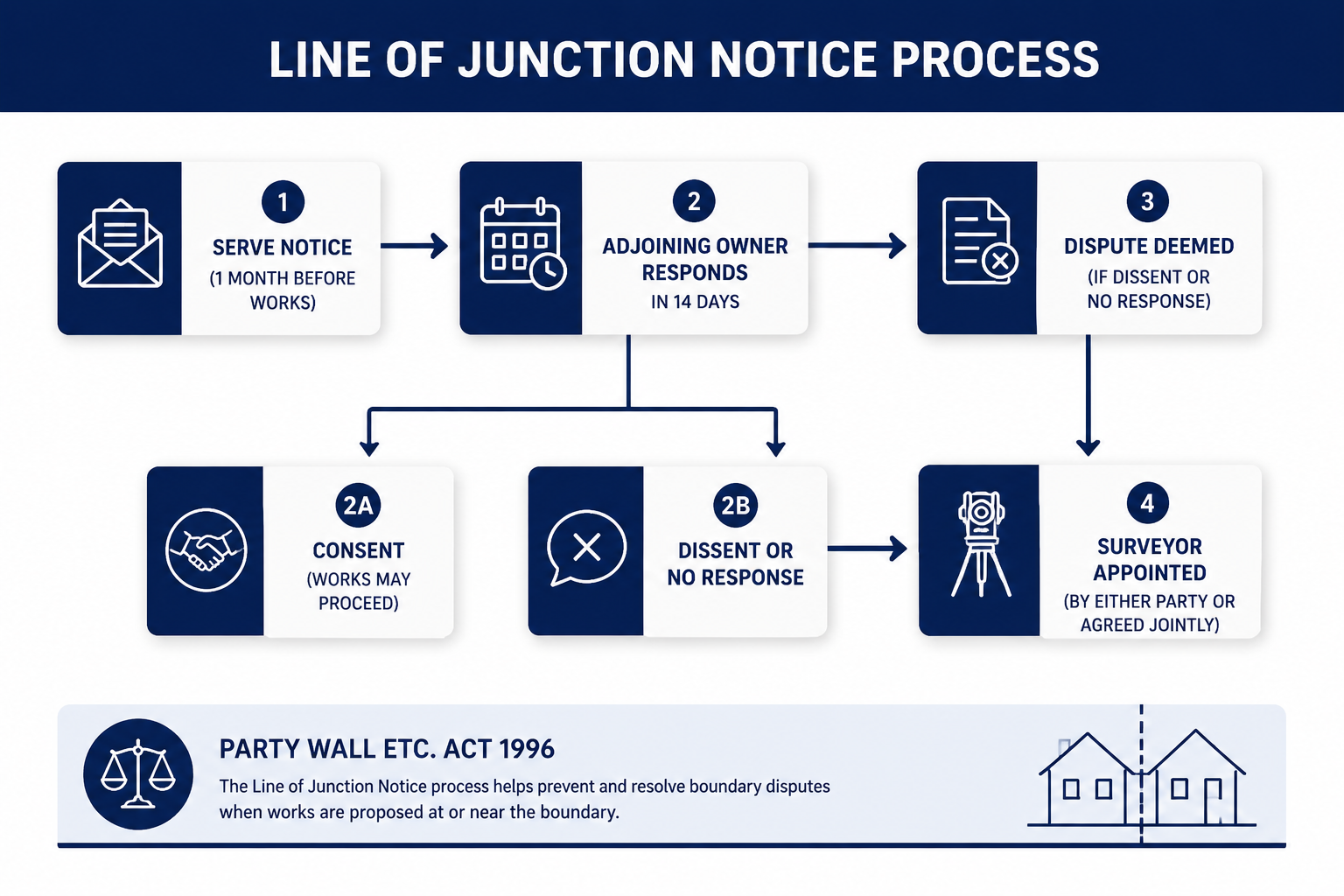
The notice must be served at least one month before the intended start date of construction [2]. It can be served by:
- Personal delivery to the adjoining owner
- Leaving it at the adjoining owner's last known place of abode or business
- Sending it by registered post
Important: All notices under the Act are valid for 12 months from the date of service [6]. If construction does not begin within that window, a fresh notice must be served. Building owners planning phased developments should time service carefully to avoid this.
Step 4: Await the Adjoining Owner's Response
Once the notice is served, the adjoining owner has 14 days to respond [2]. There are three possible outcomes:
- Consent — The adjoining owner agrees to the works. Construction can proceed under the terms agreed.
- Dissent with agreement to appoint a single agreed surveyor — Both parties appoint one surveyor jointly.
- Dissent or no response — A dispute is deemed to exist. Each party must appoint their own surveyor, or agree on a single agreed surveyor, to draw up a Party Wall Award.
"If the adjoining owner does not respond within 14 days, the Act treats silence as dissent — not consent. Building owners who proceed without resolving this are exposed to significant legal risk." [2]
This flowchart summarises the process:
Serve Line of Junction Notice (min. 1 month before works)
        |
        v
Adjoining Owner Responds Within 14 Days?
   |                        |
  YES                       NO
   |                        |
Consent?              Dispute Deemed to Exist
   |                        |
Proceed              Appoint Surveyor(s)
                            |
                     Party Wall Award Issued
                            |
                     Works May Proceed
For a full explanation of how party wall notices work and how to respond, including response timelines, the linked resource covers the process in detail.
Dispute Resolution, Party Wall Awards, and the 2026 RICS Guidance
When a Dispute Arises
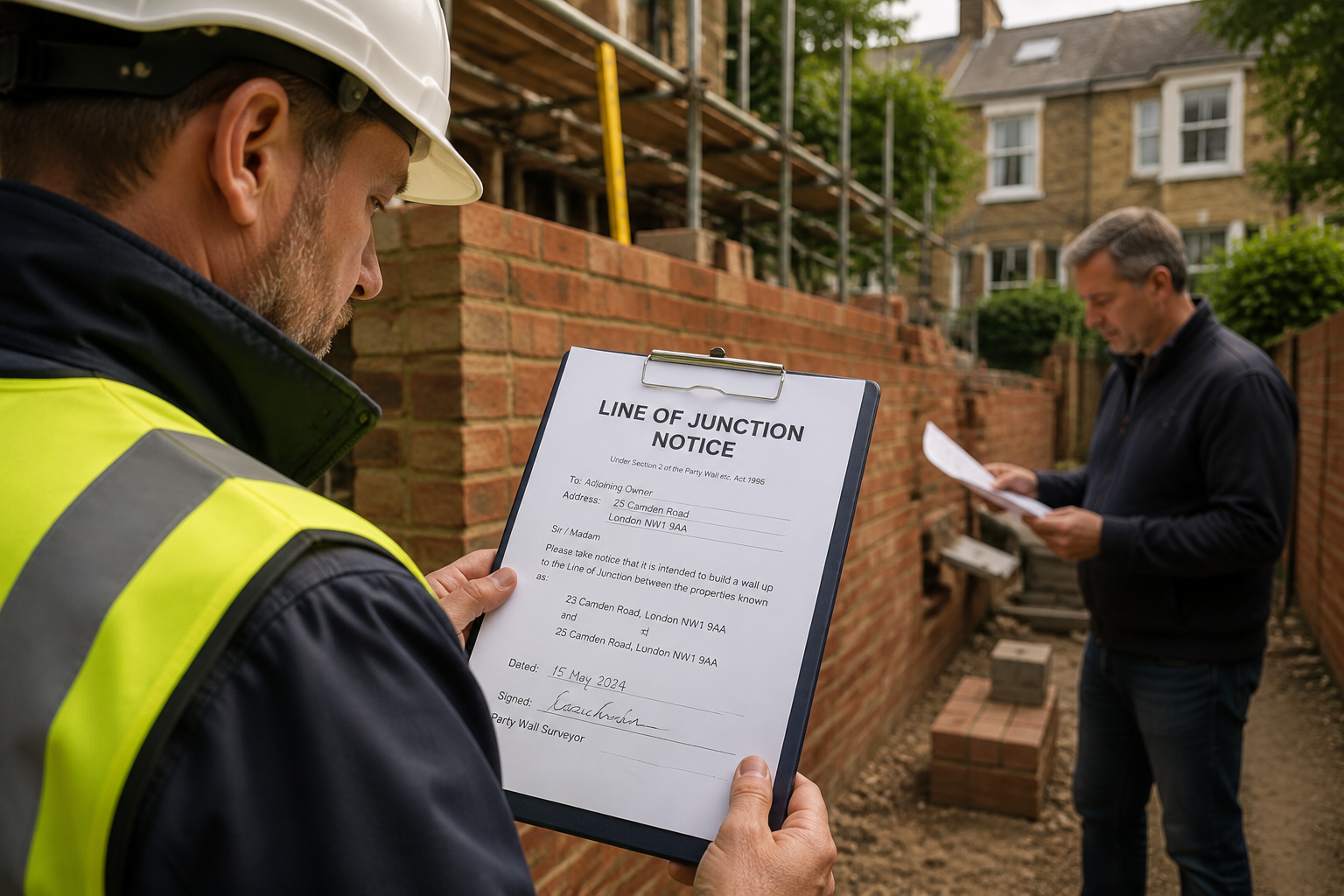
If the adjoining owner dissents or fails to respond, the dispute resolution machinery of the Party Wall etc. Act 1996 is engaged. At this point, both parties must appoint surveyors. The surveyors' role is to produce a Party Wall Award — a legally binding document that sets out:
- The rights and obligations of each party
- The scope and method of the proposed works
- Hours of working
- Measures to protect the adjoining property
- Any compensation provisions
For a detailed breakdown of what a Party Wall Award contains and how it is structured, see the guide on party wall contract templates and party wall awards.
The 2026 RICS 8th Edition Guidance
In April 2026, the Royal Institution of Chartered Surveyors (RICS) launched a consultation on the draft 8th edition of its Party Wall Legislation and Procedure guidance. The finalised edition was published in May 2026 [3][4]. Key changes relevant to Line of Junction Notice projects include:
- Stronger emphasis on surveyor independence — Surveyors must not act in a way that favours the appointing party over procedural correctness [4].
- Clarification of jurisdictional limits — Awards challenged in court have highlighted cases where surveyors acted without proper jurisdiction, often because the underlying notice was defective [4].
- Procedural accuracy requirements — The guidance stresses that a valid, properly served notice is a prerequisite for any Award. An Award made on the back of a defective notice can be set aside by the courts [3].
This last point is particularly significant for 2026 boundary projects. As infill development increases, so does the scrutiny applied to party wall procedures. A Line of Junction Notice that omits required information, is served too late, or is addressed to the wrong person can undermine the entire legal framework protecting both parties.
Common Mistakes in 2026 Boundary Projects
The following errors appear repeatedly in disputed cases [1]:
- Failing to serve the notice at all — especially for garden walls and outbuildings, which building owners often assume fall outside the Act
- Confusing the physical boundary with the legal boundary — leading to notices that describe the wrong location for the proposed wall
- Serving the notice too late — starting works before the one-month notice period has expired
- Serving on the wrong person — missing a freeholder or co-owner who also qualifies as an "owner" under the Act [5]
- Letting the notice expire — beginning works more than 12 months after service without re-serving [6]
What Happens If No Notice Is Served
Failing to serve a Line of Junction Notice when one is required does not simply create an administrative problem — it renders the works unlawful under the Act [1]. The consequences can include:
- An injunction requiring works to stop immediately
- A court order requiring the building owner to demolish or undo completed work at their own expense
- Liability for the adjoining owner's legal costs
- Damage to the relationship with the neighbour, complicating future projects
These risks are not theoretical. Courts have granted injunctions in cases where building owners proceeded without notice, even where the works were otherwise lawful under planning permission. Planning consent and party wall compliance are entirely separate legal regimes.
For building owners who want to understand their full range of obligations, the Party Wall etc. Act 1996 overview sets out the complete statutory framework.
Practical Guidance for Building Owners and Adjoining Owners
For Building Owners
Before starting any boundary project in 2026, take the following steps:
- Check the title plan and confirm the legal boundary position
- Determine whether the proposed wall will be astride or up to the line of junction
- Identify all qualifying adjoining owners — including freeholders and leaseholders
- Serve the Line of Junction Notice at least one month before the intended start date
- Record the date of service and keep a copy of the notice
- Wait for the response period to expire before proceeding
Early consultation with a qualified party wall surveyor is strongly recommended. Surveyors can identify whether a notice is required, draft the notice correctly, and manage the response process. For an understanding of what this involvement costs, the party wall costs and process guide provides a realistic overview.
For those looking to manage costs, there are also practical tips on how to keep party wall costs down without compromising on compliance.
For Adjoining Owners
Receiving a Line of Junction Notice can feel alarming, but the Act exists to protect both parties. Upon receiving a notice, adjoining owners should:
- Read the notice carefully and check that it contains all required information
- Seek professional advice if uncertain about the implications
- Respond within 14 days — either consenting or formally dissenting
- If dissenting, appoint a party wall surveyor to represent their interests
Adjoining owners who consent to works do not waive their right to compensation if damage occurs. The Act preserves that right regardless of the response given to the notice.
For adjoining owners who want to understand their rights in full, the adjoining owners section explains the protections available under the Act.
A Note on Wall Height and Boundary Rules
Line of Junction Notice projects often raise secondary questions about how high a new wall can be and how close it can be built to existing structures. These are governed by a combination of party wall law, planning rules, and permitted development rights. For guidance on wall height limits between neighbours, see tips and advice on how high you can build a wall between neighbours.
Conclusion
Line of Junction Notices are not a bureaucratic formality — they are a statutory safeguard that protects both building owners and their neighbours during boundary construction projects. In 2026, with infill development at record levels and the RICS 8th edition guidance raising the bar for procedural accuracy, getting this step right has never been more important.
Actionable next steps for anyone planning a boundary project in 2026:
- Verify the legal boundary position before drafting any notice
- Serve the Line of Junction Notice at least one month before works begin, addressed to all qualifying owners
- Monitor the 14-day response window and do not start works until the process is resolved
- If a dispute arises, appoint a qualified party wall surveyor promptly
- Keep all documentation — notices, responses, and awards — in a secure file throughout the project
For building owners and adjoining owners across London, professional guidance is available through specialist party wall surveyors who understand both the legal requirements and the practical realities of 2026 boundary projects. Taking the right steps at the outset is far less costly than resolving a dispute after works have begun.
References
[1] Line Of Junction Notice – aylingassociates.com
[2] Party Wall Act Explained – planwatch.co.uk
[3] Party Wall Awards Explained Surveyor Roles Notice Periods And Dispute Resolution Under 2026 Rics Guidance – wimbledonsurveyors.com
[4] Rics 8th Edition Party Wall Guidance 2026 Implementation Challenges And Surveyor Compliance Strategies – wimbledonsurveyors.com
[5] What Notices Do I Need To Serve – partywall.info
[6] Serve A Notice Or Received A Notice – partywall.pro
How Prince Surveyors can help: explore our party wall surveyors or learn about our party wall surveyor costs.