

Nearly one in five UK residential properties is classified as non-standard construction — yet fewer than 40% of buyers purchasing these homes commission the specialist survey they genuinely require. As Q1 2026 unfolds with notable regional divergence and heightened buyer caution, understanding Level 3 RICS Home Surveys for Non-Standard UK Properties: Essential Protocols for 2026 Buyers Navigating Q1 Market Trends has never been more commercially and financially critical.
The Royal Institution of Chartered Surveyors (RICS) is explicit: a Level 3 Home Survey is specifically recommended for properties with unconventional construction methods or unique building characteristics that warrant deeper investigation [2]. For buyers navigating a market shaped by post-pandemic structural shifts, energy efficiency pressures, and tightening mortgage criteria, commissioning the right survey is not a formality — it is a financial safeguard.
Key Takeaways 📋
- Level 3 surveys are the gold standard for non-standard, older, or significantly altered UK properties, offering far greater depth than Level 1 or Level 2 assessments.
- Structural inspection protocols include physical entry into roof spaces, under-floor areas, and drainage chambers — areas a Level 2 survey would not access.
- Hazardous materials, damp, and subsidence are formally assessed, protecting buyers from costly post-purchase surprises.
- Q1 2026 market conditions — particularly regional divergence and cautious lending — make thorough due diligence more important than ever.
- Choosing a RICS-accredited surveyor with specific experience in non-standard construction is essential for a meaningful, actionable report.
What Qualifies as a Non-Standard UK Property?
Before exploring the survey protocols themselves, it is worth defining what "non-standard construction" actually means in the UK context. Lenders and surveyors typically apply this label to properties that deviate from the conventional brick-and-tile construction that dominated British housebuilding from the Victorian era through to the 1980s.
Common Non-Standard Property Types
| Construction Type | Era | Key Risk Factors |
|---|---|---|
| Concrete prefab (e.g., BISF, Airey, Wimpey No-Fines) | 1940s–1960s | Carbonation, structural failure, unmortgageable status |
| Timber-framed construction | 1970s–present | Moisture ingress, fire separation concerns |
| Steel-framed properties | 1940s–1960s | Corrosion, thermal bridging |
| Thatched roof cottages | Pre-1900 | Fire risk, specialist maintenance costs |
| Stone-built rural properties | Pre-1900 | Damp, subsidence, repointing issues |
| Converted commercial buildings | Various | Structural alteration compliance, damp |
| Properties with flat roofs | 1960s–present | Waterproofing failure, insulation deficiencies |
Properties that have undergone significant alterations — extensions, loft conversions, or structural modifications — may also warrant Level 3 inspection even if the original build was conventional. Learn more about what a full building survey covers before committing to a survey type.
Why Level 3 RICS Home Surveys for Non-Standard UK Properties Are the Right Choice in 2026
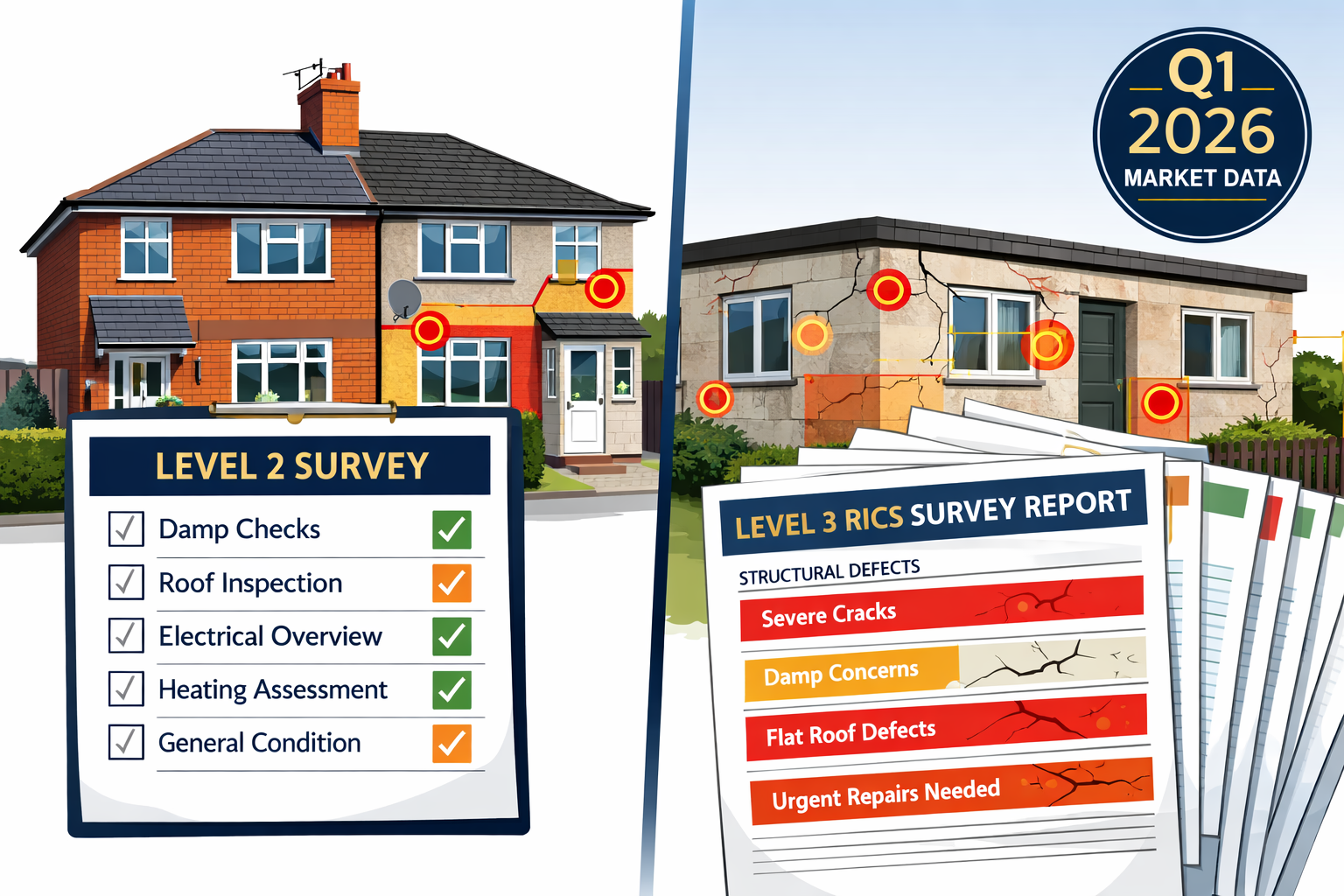
The RICS Home Survey Standard defines three levels of residential inspection. Many buyers default to a Level 2 (HomeBuyer Report) because it is cheaper and faster. For standard, well-maintained properties built after 1950, this can be a reasonable choice. For anything outside that narrow band, it is frequently inadequate.
💬 "A Level 3 survey provides the most detailed inspection available under the RICS Home Survey Standard — it is the only tier that attempts to identify all visible defects and provide remediation guidance." — RICS Home Survey Standard [3]
The Three-Tier Comparison at a Glance
- Level 1 — Condition report only; traffic-light ratings; no advice on repairs.
- Level 2 — HomeBuyer Report; identifies significant defects; limited investigation of concealed areas.
- Level 3 — Full Building Survey; comprehensive inspection; remediation options; maintenance advice; suitable for non-standard properties [2].
For a detailed breakdown of when each tier is appropriate, the Level 2 vs Level 3 survey guide provides practical decision-making criteria.
What Level 3 Delivers That Level 2 Does Not
The critical distinction lies in depth of investigation and reporting. Under RICS protocols, a Level 3 surveyor must [2]:
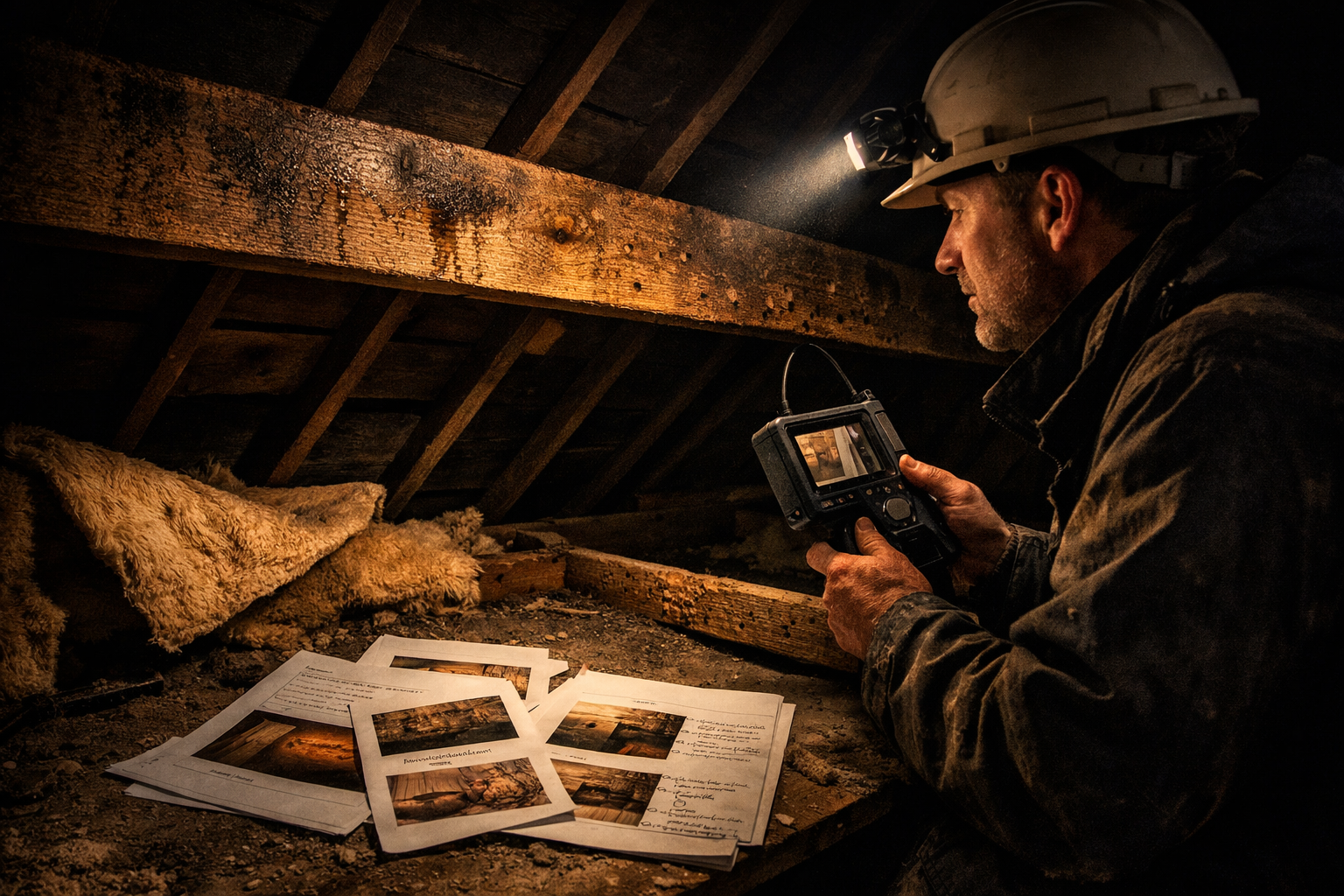
- Physically enter roof spaces and lift insulation corners to inspect timber structure, rafters, and any evidence of water ingress or pest damage.
- Inspect under-floor areas where access exists, assessing joist condition, sub-floor ventilation, and evidence of rising damp.
- Open drainage inspection chambers to assess drainage condition and identify blockages or structural failure.
- Assess all accessible concealed areas used by occupiers, including cupboards, service voids, and cellar spaces.
This level of physical access is simply not required at Level 2. For a stone-built Victorian terrace, a 1950s concrete prefab, or a converted barn, the difference between what these two tiers uncover can translate to tens of thousands of pounds in unbudgeted repair costs.
Core Inspection Protocols: What Surveyors Examine in a Level 3 Assessment
Understanding the inspection methodology helps buyers ask better questions and interpret reports more confidently. The questions to ask during a building survey are particularly valuable when preparing for a Level 3 inspection on a non-standard property.
🏗️ Structural Integrity Assessment
The foundation of any Level 3 survey is a thorough structural evaluation. Surveyors assess:
- Wall construction — identifying the material composition (brick, stone, concrete panel, timber frame) and any evidence of movement, cracking, or delamination.
- Roof structure — checking for sagging, rafter spread, ridge deflection, and evidence of previous repairs.
- Foundations — looking for subsidence indicators including diagonal cracking patterns, door/window distortion, and differential settlement.
- Floor structures — both suspended timber and solid concrete floors are assessed for condition, bounce, and damp penetration.
Defects that could render a property unmortgageable — including active subsidence, severe structural movement, or evidence of non-compliant renovation work — are specifically flagged [1]. This is particularly relevant in Q1 2026, where lenders have tightened criteria for non-standard construction types.
💧 Damp, Moisture, and Drainage Evaluation
Moisture-related defects are among the most common and costly issues in non-standard properties. A Level 3 survey formally assesses [1]:
- Rising damp — the presence and effectiveness of existing damp-proof courses (DPC), evidence of salt crystallisation, and tide marks on internal walls.
- Penetrating damp — particularly relevant for stone-built properties, flat-roofed sections, and properties with parapet walls.
- Condensation — distinguishing between structural damp and condensation-driven moisture, which have very different remediation pathways.
- Drainage systems — visual inspection of gutters, downpipes, gullies, and drainage chambers.
For buyers concerned about moisture in older buildings, understanding what causes moisture in buildings provides essential background before reviewing a survey report.
☣️ Hazardous Materials Screening
Non-standard and older properties carry elevated risk of hazardous material presence. Level 3 surveys include assessment for [1]:
- Asbestos — particularly in properties built or refurbished between 1950 and 1999. Surveyors identify suspected asbestos-containing materials (ACMs) and recommend specialist testing where appropriate.
- Lead paint — common in pre-1970s properties; relevant for renovation planning.
- Contamination and flooding risk — environmental screening flags properties in flood zones or on previously contaminated land.
⚠️ Important: Surveyors identify suspected hazardous materials visually. Confirmation requires specialist laboratory testing, which the Level 3 report will recommend where risk is identified.
⚡ Services and Systems — Visual Inspection Only
Gas, electricity, plumbing, heating, and drainage systems are all visually inspected during normal operation as part of a Level 3 survey. However, a critical protocol caveat applies: these systems are not tested [2]. Surveyors observe visible components and report on apparent condition, but cannot verify performance, safety compliance, or hidden defects within pipework or wiring.
Where concerns are identified — an aging fuse board, corroded pipework, or an elderly boiler — the surveyor will recommend specialist investigations by a Gas Safe engineer, NICEIC-registered electrician, or drainage contractor. Buyers should budget for these additional specialist reports as a matter of course on non-standard properties.
Q1 2026 Market Context: Why Buyer Caution Is Driving Demand for Level 3 Surveys
The residential property market entering Q1 2026 is characterised by two dominant forces: regional divergence and buyer caution. Data from RICS January 2026 survey insights reveals surging buyer enquiries in regions like the North West of England, where affordability relative to London continues to attract first-time buyers and relocating families [4]. Many properties in these high-demand regional markets are older stock — Victorian terraces, interwar semis, and post-war prefabs — precisely the property types that demand Level 3 scrutiny.
Regional Divergence and Non-Standard Property Concentration
The UK's housing stock is not evenly distributed by age or construction type. Older industrial towns in the North West, Yorkshire, and the Midlands have high concentrations of pre-1960s stock, including many non-standard construction types. As buyers increasingly look beyond London and the South East for value, they are encountering properties that require more sophisticated due diligence.
Meanwhile, in London and the South East, the challenge is different: a high proportion of converted properties, extended Victorian and Edwardian terraces, and period buildings with complex alteration histories. Exploring a building surveyor's approach to Edwardian properties illustrates the specific challenges these homes present.
Mortgage Lending Caution and Non-Standard Construction
Lenders in 2026 continue to apply stricter criteria to non-standard construction types. Properties built using PRC (Precast Reinforced Concrete) methods — including Airey, Cornish Unit, and Wimpey No-Fines systems — are frequently declined for standard mortgage products unless they have undergone approved repair schemes. A Level 3 survey is often the first step in establishing whether a property has been repaired to an acceptable standard, making it a prerequisite rather than an option for many buyers.
The RICS Home Survey Standard proposal continues to evolve, with ongoing discussions about how survey tiers should be communicated to consumers and integrated into the conveyancing process [5]. Buyers who understand these developments are better positioned to make informed decisions.
Energy Efficiency as a Compounding Factor
The intersection of non-standard construction and energy performance is increasingly significant. Many older and unusual properties perform poorly against Minimum Energy Efficiency Standards (MEES), and lenders are beginning to factor EPC ratings into mortgage decisions. A Level 3 survey that identifies thermal bridging, inadequate insulation, or single-glazed windows in a non-standard property gives buyers the data needed to assess retrofit costs before exchange. Understanding how EPC and MEES interact with building surveys is valuable context for any 2026 buyer.
Selecting the Right Surveyor for a Non-Standard Property
Not all RICS-accredited surveyors have equal experience with non-standard construction. Choosing the wrong surveyor for an unusual property is a common and costly mistake.
What to Look for in a Level 3 Surveyor 🔍
- ✅ RICS membership — specifically MRICS or FRICS designation with building surveying specialism.
- ✅ Demonstrable experience with the specific construction type (e.g., timber frame, concrete panel, thatched).
- ✅ Local market knowledge — understanding of regional construction trends and common defect patterns.
- ✅ Clear report format — reports should include photographic evidence, condition ratings, and prioritised remediation advice.
- ✅ Willingness to discuss findings — a good surveyor will talk through the report and answer questions post-inspection.
For buyers in specific regions, working with locally experienced chartered surveyors — such as those covering South East London or North London — ensures familiarity with the specific construction types and defect patterns common to those areas.
Questions to Ask Before Commissioning
- How many Level 3 surveys have you conducted on this construction type?
- Will you physically enter the roof space and under-floor areas?
- How long will the inspection take, and when will the report be delivered?
- Does the report include remediation cost estimates or guidance?
- Are specialist investigations (asbestos, drainage, structural engineering) available through your firm?
Understanding the Report: Acting on Level 3 Findings
Receiving a Level 3 report can feel overwhelming — these documents are detailed, technical, and sometimes alarming in their findings. Understanding how to interpret and act on the results is as important as commissioning the survey itself.
The Condition Rating System
RICS Level 3 reports use a standardised condition rating scale [3]:
| Rating | Meaning | Action Required |
|---|---|---|
| 1 — No repair currently needed | Performing as intended | Monitor |
| 2 — Defects that need repairing | Not urgent but should be addressed | Plan and budget |
| 3 — Serious defects | Urgent attention required | Immediate action / renegotiate |
Using Survey Findings in Price Negotiations
A Level 3 survey is not just a due diligence document — it is a negotiating tool. Serious defects identified in the report provide legitimate grounds to:
- Renegotiate the purchase price to reflect remediation costs.
- Request repairs be completed by the vendor before exchange.
- Withdraw from the purchase if defects are too severe or costs too uncertain.
Buyers uncertain about how survey findings affect property value should review what to do if a home valuation comes in below the offer price for practical negotiation strategies.
Conclusion: Actionable Next Steps for 2026 Buyers
Level 3 RICS Home Surveys for Non-Standard UK Properties: Essential Protocols for 2026 Buyers Navigating Q1 Market Trends represent far more than a regulatory checkbox. In a market defined by regional opportunity, mortgage caution, and energy efficiency pressure, the Level 3 survey is the single most powerful tool a buyer of an unusual, older, or altered property can deploy.
Your Action Plan 🎯
- Identify your property type early — establish whether the property is non-standard construction before instructing any survey.
- Commission a Level 3 survey — do not accept a Level 2 report as sufficient for older, altered, or unusual properties.
- Choose a specialist surveyor — verify RICS accreditation and specific experience with your construction type.
- Budget for specialist follow-up — allocate funds for asbestos testing, structural engineering reports, or drainage surveys as recommended.
- Use the report strategically — treat findings as negotiating leverage, not just information.
- Factor in energy efficiency — review EPC implications alongside structural findings before finalising your purchase decision.
The cost of a Level 3 survey — typically £600–£1,500 depending on property size and location — is negligible against the potential cost of discovering serious structural defects after completion. In Q1 2026, with buyer competition intensifying in regional markets and lenders scrutinising non-standard stock more carefully than ever, informed due diligence is the clearest competitive advantage a buyer can have.
References
[1] Building Survey Level 3 – propertysolvers.co.uk
[2] Scope Of Inspection Home Survey Level Three – rics.org
[3] Description Of The Rics Home Survey Level 3 – rics.org
[4] Rics January 2026 Survey Insights Building Survey Protocols For Surging Buyer Enquiries In North West England – nottinghillsurveyors.com
[5] Understanding The Rics Home Survey Standard Proposal – rics.org