

Roughly 1.5 million UK commercial and residential buildings still contain asbestos-containing materials (ACMs), and the majority were constructed before the 1999 ban on the substance came into full effect. For anyone buying, selling, or refurbishing a pre-2000 property in 2026, understanding how Level 3 Building Surveys for Properties with Asbestos-Containing Materials: 2026 Refurbishment Protocols and Valuation Discounts interact with legal obligations, health risks, and market pricing is no longer optional – it is a fundamental part of sound property due diligence.
Key Takeaways
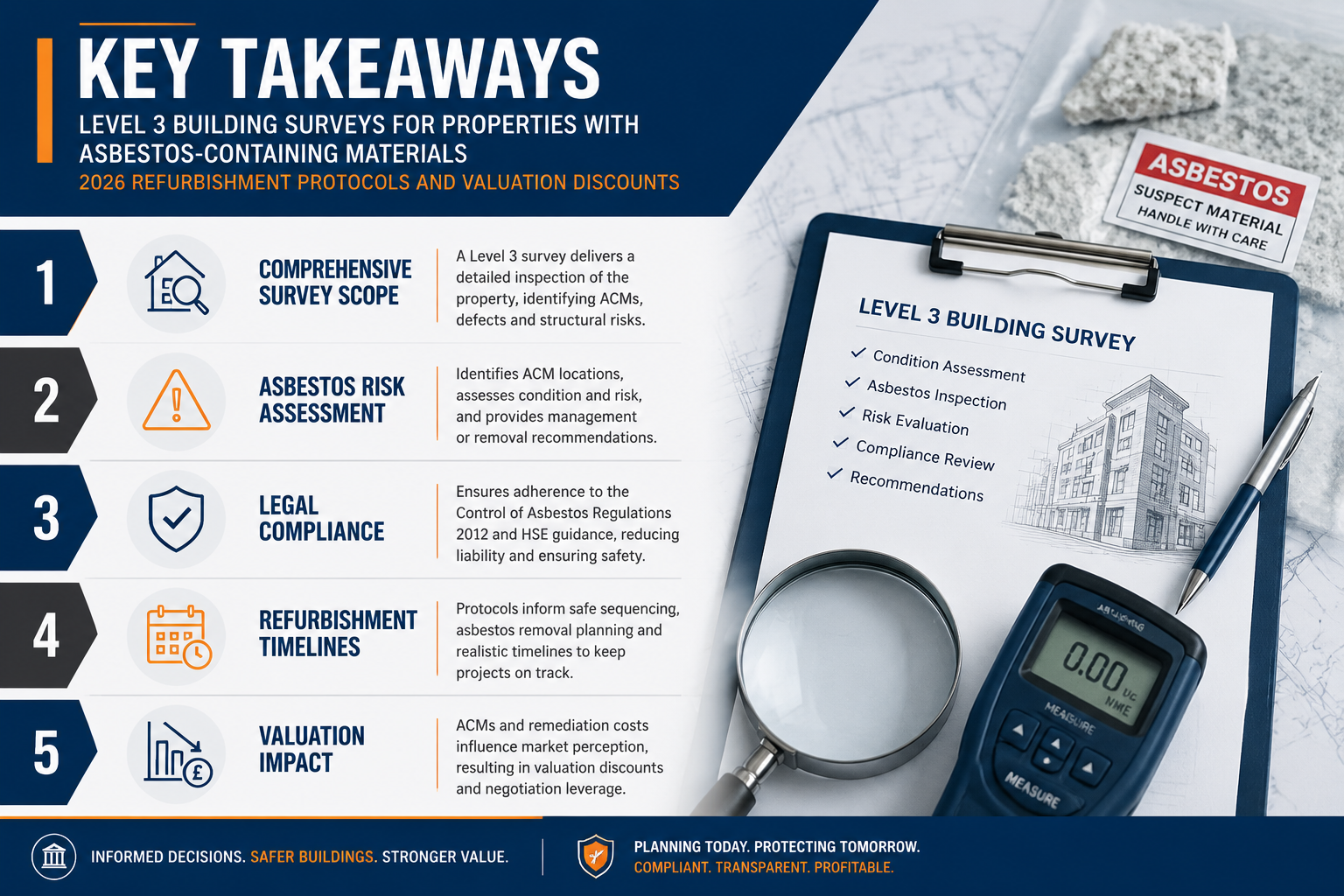
- A Level 3 Building Survey is the most thorough structural inspection available, but it does not include an asbestos inspection; a separate specialist survey is required for pre-2000 properties.
- Three types of asbestos surveys exist – Management, Refurbishment, and Demolition – each serving a distinct legal and practical purpose.
- The Control of Asbestos Regulations 2012 and CDM Regulations 2015 make a pre-refurbishment asbestos survey a legal requirement before any intrusive building work begins.
- Confirmed ACMs can reduce a property's market value by 10-20%, and sometimes more, depending on the extent, condition, and removal costs involved.
- Buyers and investors who commission both a Level 3 Building Survey and a specialist asbestos survey before exchange are significantly better positioned to negotiate price reductions and plan remediation budgets accurately.
What a Level 3 Building Survey Actually Covers – and Where It Stops
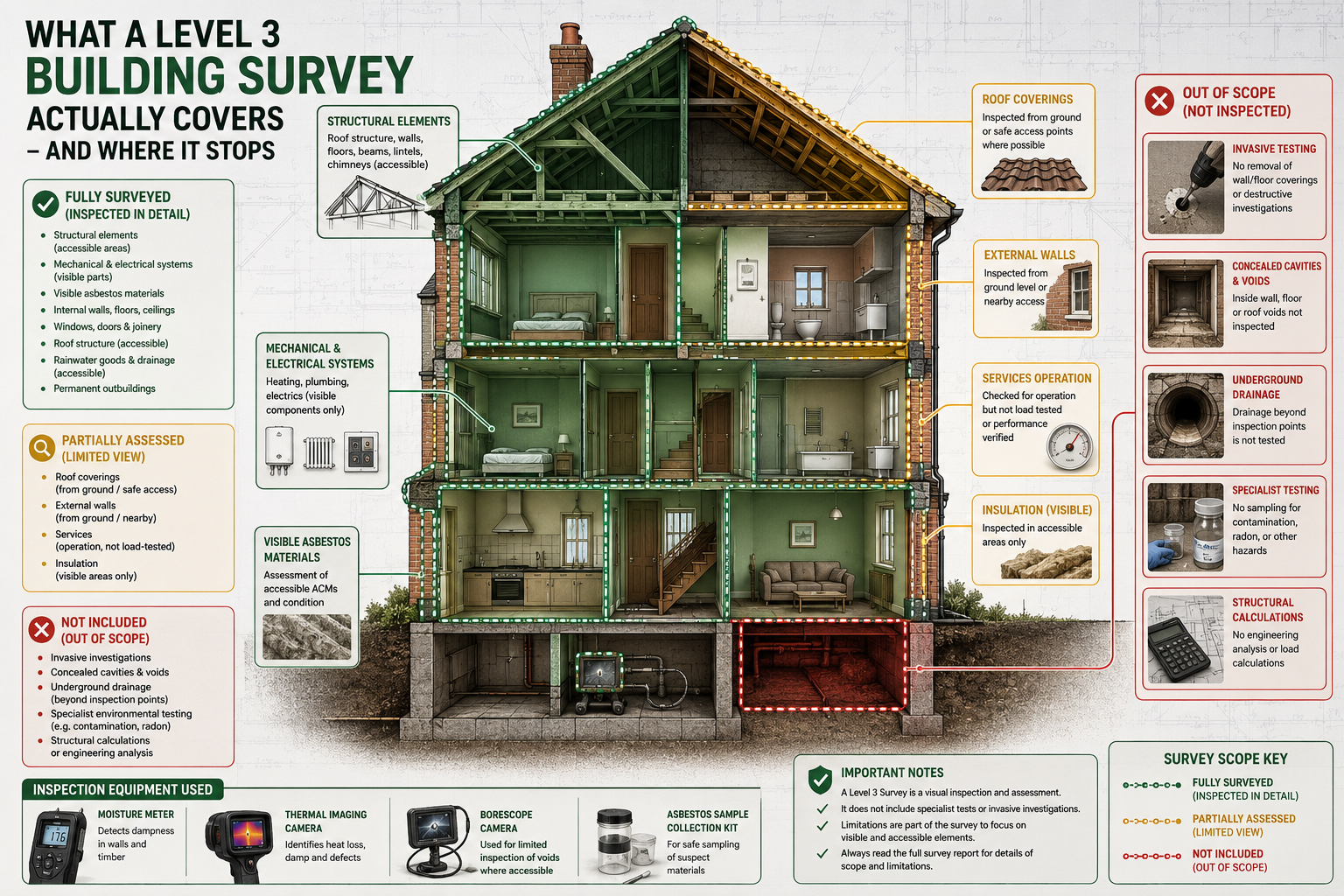
A Level 3 Building Survey (formerly known as a Full Structural Survey) is the most comprehensive inspection a RICS-regulated surveyor can carry out on a residential or commercial property. It examines the structure, fabric, and condition of every accessible part of a building, from the roof timbers to the subfloor, and produces a detailed written report identifying serious defects, maintenance priorities, and repair cost estimates [1].
However, there is a critical boundary that many buyers overlook: a Level 3 Building Survey does not include an asbestos inspection. Under standard RICS terms of engagement, surveyors may note the possible presence of ACMs if they observe materials consistent with asbestos use – such as artex ceilings, floor tiles, pipe lagging, or corrugated roof sheets – but they are not qualified to test, sample, or formally assess those materials [6]. The standard assumption in many survey reports is that no harmful materials are present unless visible evidence suggests otherwise, which means the asbestos risk can go formally unquantified without a separate specialist instruction.
This gap matters enormously. For any property built before 2000, commissioning a standalone asbestos survey alongside the Level 3 inspection is the recommended course of action [1]. Together, these two reports give a buyer or property owner a complete picture of both structural condition and hazardous material risk – two factors that directly influence refurbishment planning and final valuation.
For guidance on choosing the right survey type before purchase, the homebuyer report vs building survey comparison provides a useful starting framework, while those dealing with commercial properties should also consider a commercial building survey in London for a sector-specific approach.
The Three Types of Asbestos Surveys and Their Legal Roles
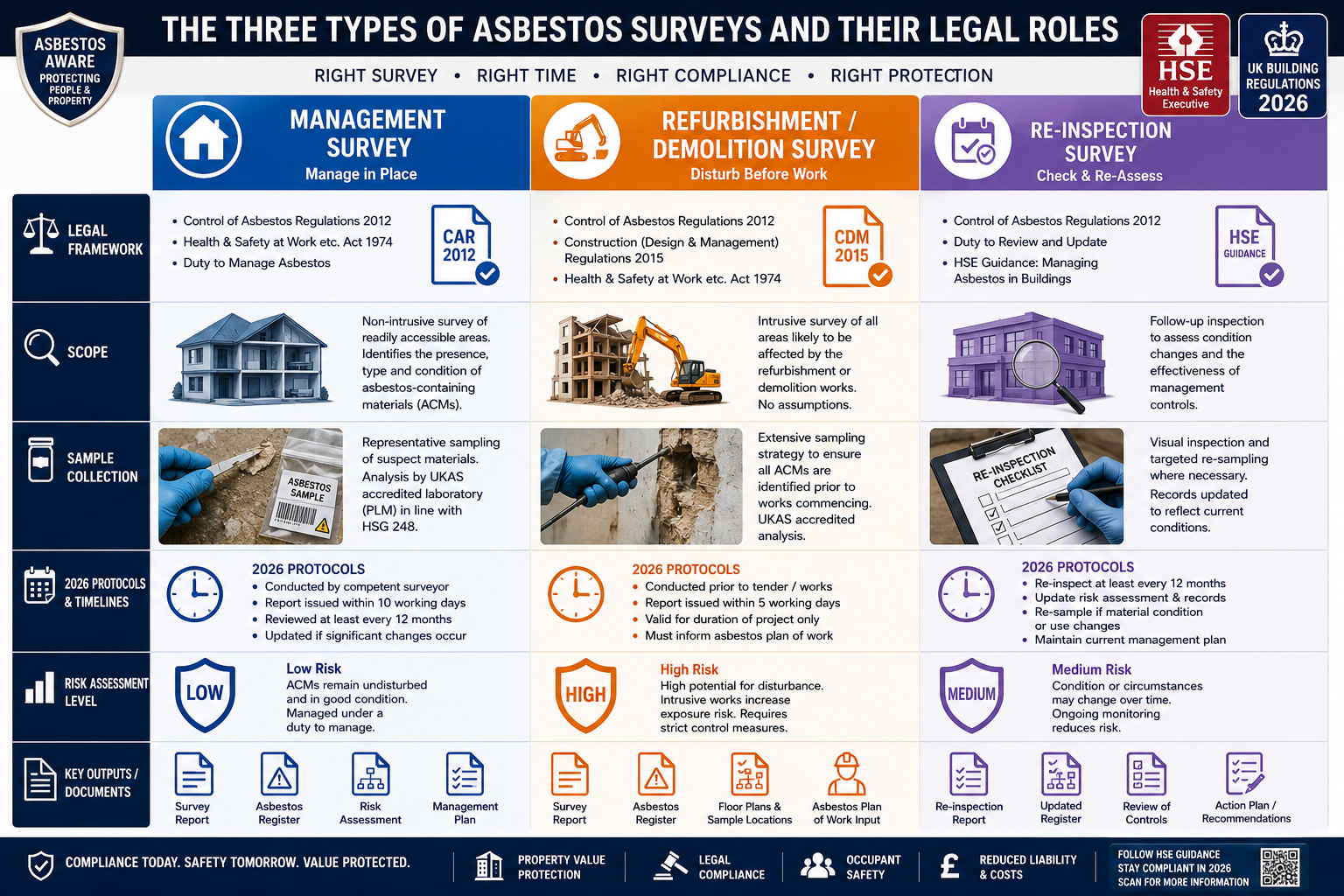
Understanding the distinctions between the three recognised asbestos survey types is essential for anyone navigating Level 3 Building Surveys for Properties with Asbestos-Containing Materials: 2026 Refurbishment Protocols and Valuation Discounts in a practical context [4].
Management Surveys
A Management Survey is a non-intrusive inspection carried out during normal building occupation. Its purpose is to locate ACMs that could be disturbed during routine maintenance or general use, assess their condition, and produce a management plan that keeps them safely in place. This is the baseline survey for occupied buildings and is typically required as part of an ongoing duty-to-manage obligation under the Control of Asbestos Regulations 2012 [2].
Management Surveys do not involve drilling, cutting, or lifting materials. They are appropriate for ongoing compliance monitoring but are insufficient before any refurbishment work begins.
Refurbishment Surveys
A Refurbishment Survey is intrusive by design. It involves physical access to concealed areas – lifting floor coverings, opening ceiling voids, cutting into walls – to locate every ACM that could be disturbed during planned building work [3]. This survey type is legally required before any refurbishment or fit-out project commences, under both the Control of Asbestos Regulations 2012 and the Construction Design and Management (CDM) Regulations 2015 [3].
The Refurbishment Survey must be targeted to the specific areas where work will take place. If a full building refurbishment is planned, the survey must cover the entire structure. Failure to commission this survey before work begins exposes contractors, clients, and principal designers to serious legal liability and potential prosecution by the Health and Safety Executive (HSE) [8].
Demolition Surveys
A Demolition Survey is the most comprehensive of the three. It requires full and unrestricted access to every part of a building, including structural elements, and must be completed before any demolition work begins. The goal is to ensure that every ACM is identified, quantified, and safely removed before the building is brought down [4].
| Survey Type | Intrusive? | Legal Trigger | Typical Cost Range (2026) |
|---|---|---|---|
| Management Survey | No | Ongoing occupation duty | £300 – £800 |
| Refurbishment Survey | Yes | Before any refurbishment work | £500 – £2,500+ |
| Demolition Survey | Yes (full access) | Before demolition | £1,000 – £5,000+ |
Cost ranges vary significantly based on property size, location, and ACM complexity.
2026 Refurbishment Protocols: Legal Requirements and Practical Steps
The regulatory framework governing asbestos management in refurbishment projects has not changed in its core structure, but enforcement scrutiny has intensified in 2026. The HSE continues to treat asbestos exposure as the single largest cause of work-related deaths in the UK, with mesothelioma and asbestos-related lung cancer claiming hundreds of lives annually [8].
For anyone planning refurbishment work on a pre-2000 property, the following protocol sequence applies:
Step 1 – Commission a Level 3 Building Survey
Instruct a RICS-qualified chartered surveyor to carry out a full structural inspection. This identifies all significant defects, repair needs, and any visible indicators of ACMs. A structural survey in London from a qualified team will flag suspected hazardous materials and recommend specialist follow-up.
Step 2 – Commission a Refurbishment Asbestos Survey
Before any contractor enters the property to carry out intrusive work, a licensed asbestos surveyor must complete a Refurbishment Survey covering all areas affected by the planned works. Surveyors conducting this inspection must hold appropriate qualifications; the Royal Society for Public Health offers a Level 3 Award in Asbestos Surveying that covers survey methodology, risk assessment, and safe working practices [7].
Step 3 – Produce an Asbestos Register and Management Plan
The findings of the Refurbishment Survey must be compiled into a formal asbestos register. This document identifies the location, type, condition, and risk rating of every ACM found. A management plan then sets out whether each material will be encapsulated, managed in situ, or removed prior to works commencing [2].
Step 4 – Arrange Licensed Removal Where Required
Certain ACM types – particularly those containing friable or high-risk asbestos such as amosite or crocidolite – must be removed by a licensed asbestos contractor before refurbishment work begins. This is a non-negotiable legal requirement and must be documented with waste transfer certificates [8].
Step 5 – Notify the HSE Where Required
For licensable asbestos removal work, the HSE must be notified at least 14 days before work starts. This notification requirement applies to all licensable work regardless of project scale.
Step 6 – Update the Asbestos Register Post-Works
Once refurbishment is complete, the asbestos register must be updated to reflect any materials removed, encapsulated, or newly identified during the works. This updated register then forms part of the building's ongoing management documentation.
For properties subject to commercial leases, a schedule of dilapidations may also need to address ACM obligations at lease end, particularly where tenants have carried out alterations. Similarly, a licence to alter should always include asbestos survey conditions before any tenant-led works proceed.
Valuation Discounts: How Asbestos Affects Property Prices in 2026
The financial consequences of confirmed ACMs are significant and well-documented. Level 3 Building Surveys for Properties with Asbestos-Containing Materials: 2026 Refurbishment Protocols and Valuation Discounts are directly linked because the survey findings feed directly into the valuation process – and buyers use that information as leverage.
Typical Valuation Discount Ranges
The presence of ACMs does not automatically render a property unsaleable, but it does create measurable downward pressure on market value. The extent of any discount depends on several factors:
- Type of asbestos present: Friable, high-risk types (amosite, crocidolite) command larger discounts than chrysotile in good condition.
- Condition of the ACMs: Materials in poor, deteriorating condition pose greater risk and cost more to remediate.
- Extent and location: ACMs embedded throughout a building's structure are far more expensive to manage than localised materials in a plant room or outbuilding.
- Removal cost estimates: Professional quotes for licensed removal and disposal directly inform the discount negotiated.
In practice, buyers and their advisers typically negotiate reductions equivalent to the estimated remediation cost plus a risk premium. For a standard pre-2000 residential property with moderate ACM presence, this can represent a 10-15% reduction on the agreed price. For commercial properties with extensive ACMs requiring full licensed removal before occupation or refurbishment, discounts of 20% or more are not uncommon [1].
"Buyers who commission both a Level 3 Building Survey and a specialist asbestos survey before exchange are significantly better positioned to negotiate accurately – and to avoid costly surprises after completion."
How Valuers Treat ACMs
RICS-registered valuers are required to reflect the impact of known ACMs in their assessments. A formal RICS valuation for mortgage, investment, or insurance purposes will factor in the cost of management or removal as a deduction from the gross development value or market value of the property [6]. This is particularly relevant for:
- Mortgage valuations: Lenders may decline to lend, or restrict lending, on properties with unmanaged ACMs until a management plan is in place.
- Insurance reinstatement valuations: ACMs can increase reinstatement costs substantially, as demolition and rebuild must account for licensed asbestos removal. See our guide to insurance reinstatement valuation for more detail.
- Commercial investment valuations: Yield-based valuations for commercial properties will reflect the capital expenditure liability associated with ACM management or removal.
For buyers and investors seeking a formal opinion of value that accounts for ACM risk, consulting RICS registered valuers in London ensures the assessment is carried out to the required professional standard.
ASTM Standards and International Context
For properties with cross-border investment interest, the ASTM E2356-10 standard provides a recognised framework for comprehensive building asbestos surveys, covering Baseline Surveys, Project Design Surveys, and Pre-Construction Surveys [5]. While UK practice is governed primarily by HSE and RICS guidance, familiarity with ASTM methodology is useful when dealing with institutional investors or lenders operating under US standards.
Integrating Asbestos Findings into the Broader Survey Process
A well-managed pre-purchase or pre-refurbishment survey process in 2026 treats the Level 3 Building Survey and the asbestos survey as complementary documents, not alternatives. The structural findings from the Level 3 report set the context for refurbishment planning, while the asbestos survey determines whether that refurbishment plan is legally executable and at what cost.
For properties where the scope of works is uncertain, a specific defect report can be used to investigate a targeted concern – such as suspected ACM-containing artex or pipe lagging – before committing to a full refurbishment survey. This staged approach can reduce upfront costs while still generating the evidence needed for informed decision-making.
Where a property has already been partially refurbished, a schedule of condition report can document the current state of ACM management as a baseline for future works or lease negotiations.
Practical checklist for buyers and property owners in 2026:
- Confirm the construction date of the property – if pre-2000, assume ACMs may be present until proven otherwise.
- Instruct a RICS Level 3 Building Survey to assess structural condition and identify any visible ACM indicators.
- Commission a Management Survey for occupied properties or a Refurbishment Survey before any planned works.
- Obtain at least two licensed removal contractor quotes to establish a realistic remediation budget.
- Use survey findings and remediation costs to negotiate a price reduction or request the seller to remediate before exchange.
- Ensure the asbestos register is updated after any works and retained with the building's title documentation.
- Factor ACM management costs into insurance reinstatement valuations and investment appraisals.
Conclusion
The intersection of Level 3 Building Surveys for Properties with Asbestos-Containing Materials: 2026 Refurbishment Protocols and Valuation Discounts represents one of the most consequential areas of property due diligence for buyers, investors, and developers working with the UK's pre-2000 building stock. The core message is straightforward: a Level 3 Building Survey is an essential starting point, but it is not the end of the process for any property where ACMs may be present.
Actionable next steps:
- For any pre-2000 property under consideration, instruct both a Level 3 Building Survey and a specialist asbestos survey before exchange of contracts.
- Ensure the asbestos survey type matches the intended use – Management Survey for occupied properties, Refurbishment Survey before any works begin.
- Obtain formal removal cost estimates and use these to negotiate a documented price reduction or seller remediation commitment.
- Work with RICS-qualified surveyors and valuers who can integrate ACM findings into formal valuations for mortgage, insurance, and investment purposes.
- Maintain and update the asbestos register throughout the property's life, particularly after any refurbishment or maintenance works.
Taking these steps protects health, satisfies legal obligations, and ensures that the financial impact of ACMs is accurately reflected in every transaction and refurbishment budget.
References
[1] Rics Level 3 Building Survey What It Covers And Costs – legalclarity.org
[2] Refurbishment Asbestos Survey – ojhealthandsafety.co.uk
[3] Refurbishment Demolition Survey – gal-asbestos.co.uk
[4] The Different Types Of Asbestos Surveys – ces-asbestos.com
[5] E2356 10 – store.astm.org
[6] Rics Level 3 Building Survey – smreproperty.com
[7] Specification Level 3 Award In Asbestos Surveying – rsph.org.uk
[8] Asbestos Refurbishment Survey Hsg Asbestos Surveys – hsgasbestossurveys.co.uk
How Prince Surveyors can help: explore our independent damp surveys or learn about our Level 3 building survey.