

Heating demand in average new UK homes runs approximately 60% higher than SAP modelling predicts — a performance gap that Passivhaus construction is specifically engineered to eliminate [6]. As certified Passivhaus completions continue rising across England and Wales, the surveying profession faces a clear challenge: standard inspection frameworks were not designed to evaluate the airtightness membranes, mechanical ventilation with heat recovery (MVHR) systems, and thermal-bridge-free junctions that define this building standard. Level 3 Building Surveys for Passivhaus Standard Homes: Valuation Implications in 2026 Energy Performance Certificates sit at the intersection of technical rigour and financial consequence — and getting the assessment wrong can cost buyers and lenders tens of thousands of pounds.
Key Takeaways
- Passivhaus homes command measurable valuation premiums, but only when a Level 3 survey confirms that airtightness and thermal bridging performance is intact and certifiable.
- Defects in Passivhaus fabric — such as a failed airtightness layer — can cost between £5,000 and £15,000 to remediate, directly reducing market value [1].
- 2026 Energy Performance Certificates now carry greater weight in mortgage lending decisions, making EPC-linked survey findings more financially significant than ever.
- Level 3 surveys remain visual and non-destructive; surveyors must use specialist tools such as thermal imaging and blower door test data to compensate for access limitations [3].
- RICS whole-life carbon guidance is increasingly shaping how chartered surveyors frame energy performance defects within formal valuation reports.
What Is a Passivhaus Standard Home and Why Does It Demand a Different Survey Approach
The Passivhaus standard is a rigorous, performance-based building certification developed in Germany and now widely adopted in the UK. Certified buildings must meet strict criteria: a maximum space heating demand of 15 kWh/m² per year, a primary energy demand below 120 kWh/m² per year, and an airtightness result of no more than 0.6 air changes per hour at 50 Pascals pressure [5]. These are not aspirational targets — they are verified through blower door testing and post-completion monitoring before certification is awarded.
This verification-led approach creates a fundamental difference from standard new builds. Passivhaus certification involves strict controls during construction and post-completion testing to confirm energy targets are met [5]. When a surveyor inspects such a property, they are not simply checking for damp, cracks, or roof condition. They are evaluating whether a precisely engineered system — one that depends on every component performing as designed — remains intact.
The components that matter most in a Passivhaus survey include:
- Continuous airtightness layer (typically a membrane or taped board system)
- Thermal-bridge-free wall, floor, and roof junctions
- Triple-glazed window and door installations with correct reveals
- MVHR unit condition, filter maintenance, and duct integrity
- External insulation continuity, particularly at penetrations
A Level 2 survey, which is appropriate for modern standard-construction properties in good condition [4], will not provide the depth of analysis these systems require. For choosing the right survey type, Passivhaus properties almost always fall into Level 3 territory — regardless of age — because their construction method is non-standard and the financial consequences of undetected defects are significant.
How Level 3 Building Surveys for Passivhaus Standard Homes Address Valuation Implications in 2026 Energy Performance Certificates
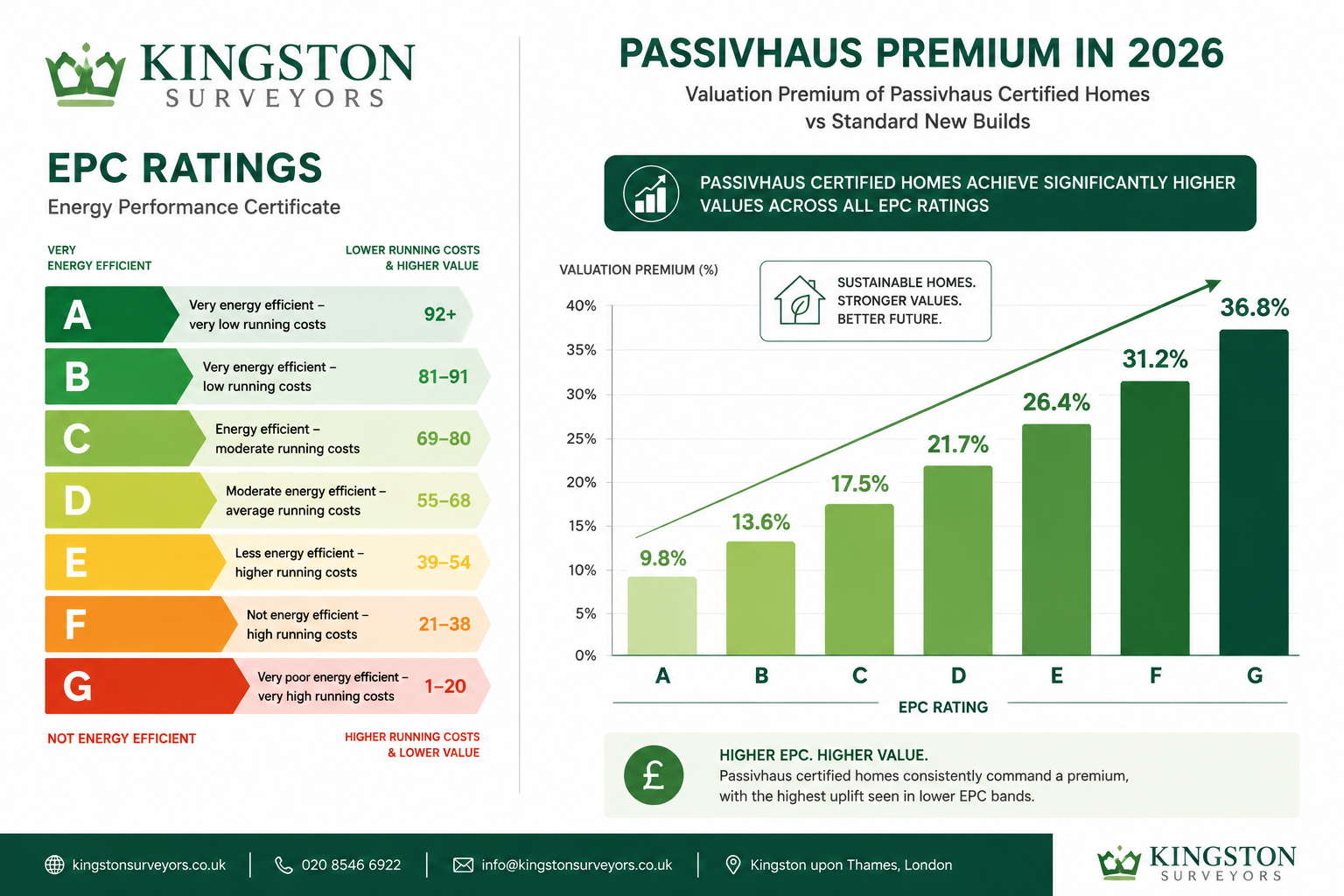
The relationship between EPC ratings and property values has strengthened considerably. In 2026, lenders are applying more rigorous scrutiny to energy performance data when assessing mortgage risk, and buyers are increasingly factoring running costs into purchase decisions. A genuine Passivhaus property — one that achieves an EPC band A rating with verified airtightness — commands a premium over comparable standard-construction homes. However, that premium is contingent on the building performing as certified.
This is where Level 3 Building Surveys for Passivhaus Standard Homes: Valuation Implications in 2026 Energy Performance Certificates become a critical tool. The survey must do two things simultaneously: identify physical defects that compromise performance, and translate those findings into valuation language that lenders, buyers, and RICS registered valuers can act upon.
The EPC Premium and Its Conditions
Research consistently shows that EPC band A and B properties sell at a premium compared to band D equivalents. For a Passivhaus home, this premium is justified by:
- Dramatically lower energy bills (often near-zero space heating costs)
- Superior indoor air quality through MVHR filtration
- Reduced moisture and condensation risk
- Greater thermal comfort without temperature stratification
However, the EPC rating assigned to a Passivhaus home is based on its designed performance. If the airtightness membrane has been breached — by a later electrical installation, a plumbing penetration, or poor workmanship during a renovation — the actual performance will diverge from the certified figure. The EPC will still show band A, but the building will no longer deliver band A performance. This is a material misrepresentation of value.
A Level 3 survey, combined with thermal imaging and a review of any available blower door test records, is the most effective way to detect this divergence before purchase.
Defect Costs and Their Valuation Impact
Remediation costs for Passivhaus fabric defects are not trivial. Redoing a failed airtightness layer on a medium-sized terraced house can cost between £5,000 and £15,000 [1]. More extensive thermal bridging corrections — particularly where insulation continuity has been broken at structural penetrations — can exceed this figure significantly.
In the context of a formal Red Book valuation, these remediation costs are deducted from the market value assessment. A surveyor who identifies a £12,000 airtightness defect on a property marketed at a £30,000 Passivhaus premium has effectively neutralised a substantial portion of that premium. The buyer, lender, and any subsequent valuation report must reflect this.
| Defect Type | Estimated Remediation Cost | Valuation Impact |
|---|---|---|
| Failed airtightness membrane (partial) | £3,000 – £8,000 | Moderate negative |
| Full airtightness layer replacement | £5,000 – £15,000 | Significant negative [1] |
| Thermal bridge at structural penetration | £1,500 – £6,000 | Moderate negative |
| MVHR unit replacement | £2,500 – £5,000 | Moderate negative |
| Window reveal insulation failure | £500 – £3,000 per unit | Minor to moderate |
What Level 3 Surveys Cover — and Where Their Limits Lie
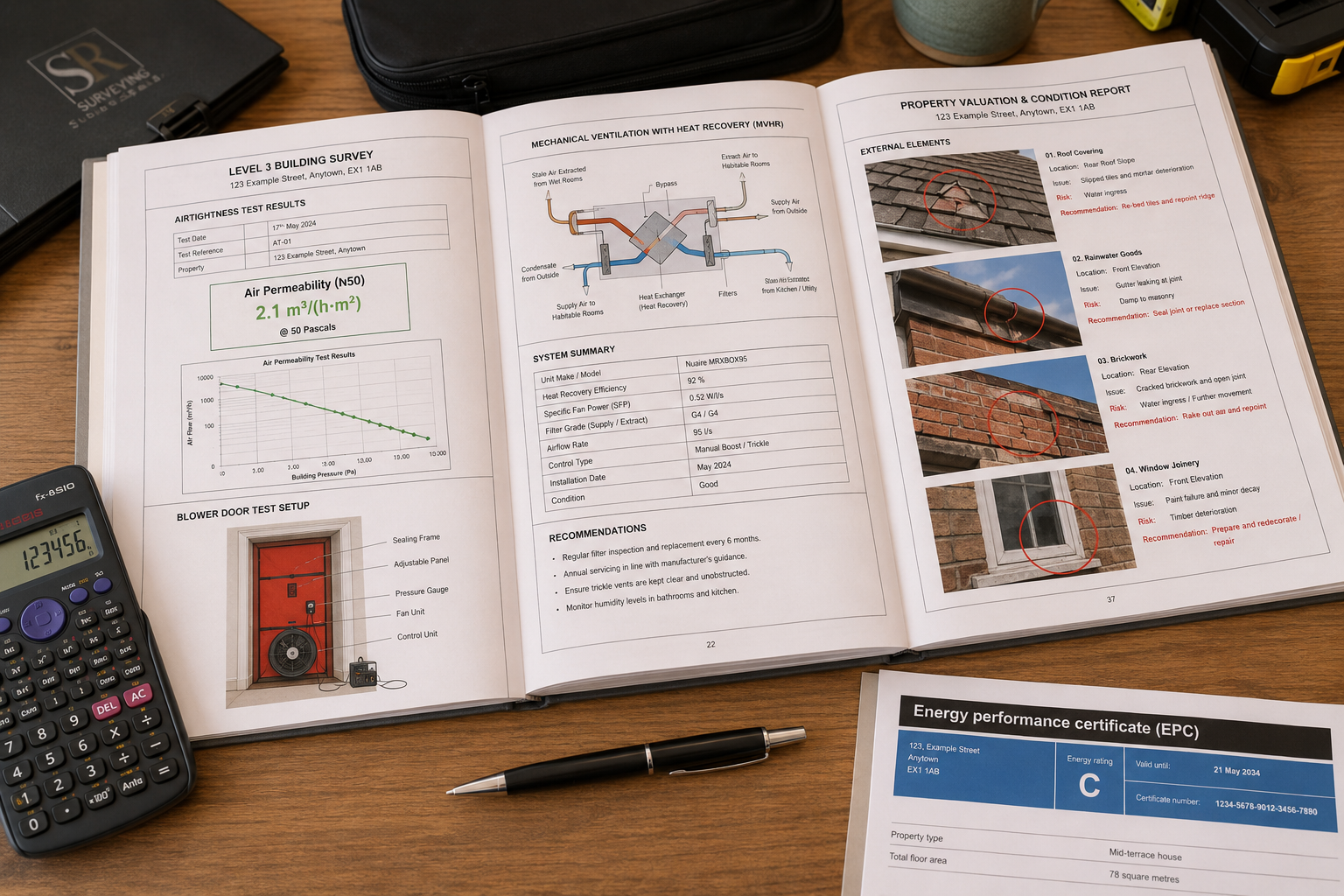
A RICS Level 3 Building Survey provides an in-depth inspection of all accessible areas, detailed analysis of the building's structure, materials, and construction method, commentary on visible defects, likely causes and potential consequences, and repair priorities with practical guidance on next steps [9]. For Passivhaus properties, this framework must be applied with additional technical knowledge.
What Surveyors Should Examine in a Passivhaus Inspection
RICS mandates that chartered surveyors assess energy performance in building surveys. For Level 3 surveys on properties with Passivhaus upgrades, this includes evaluating insulation, airtightness, and ventilation systems, and identifying defects that could affect energy performance [1]. In practice, this means:
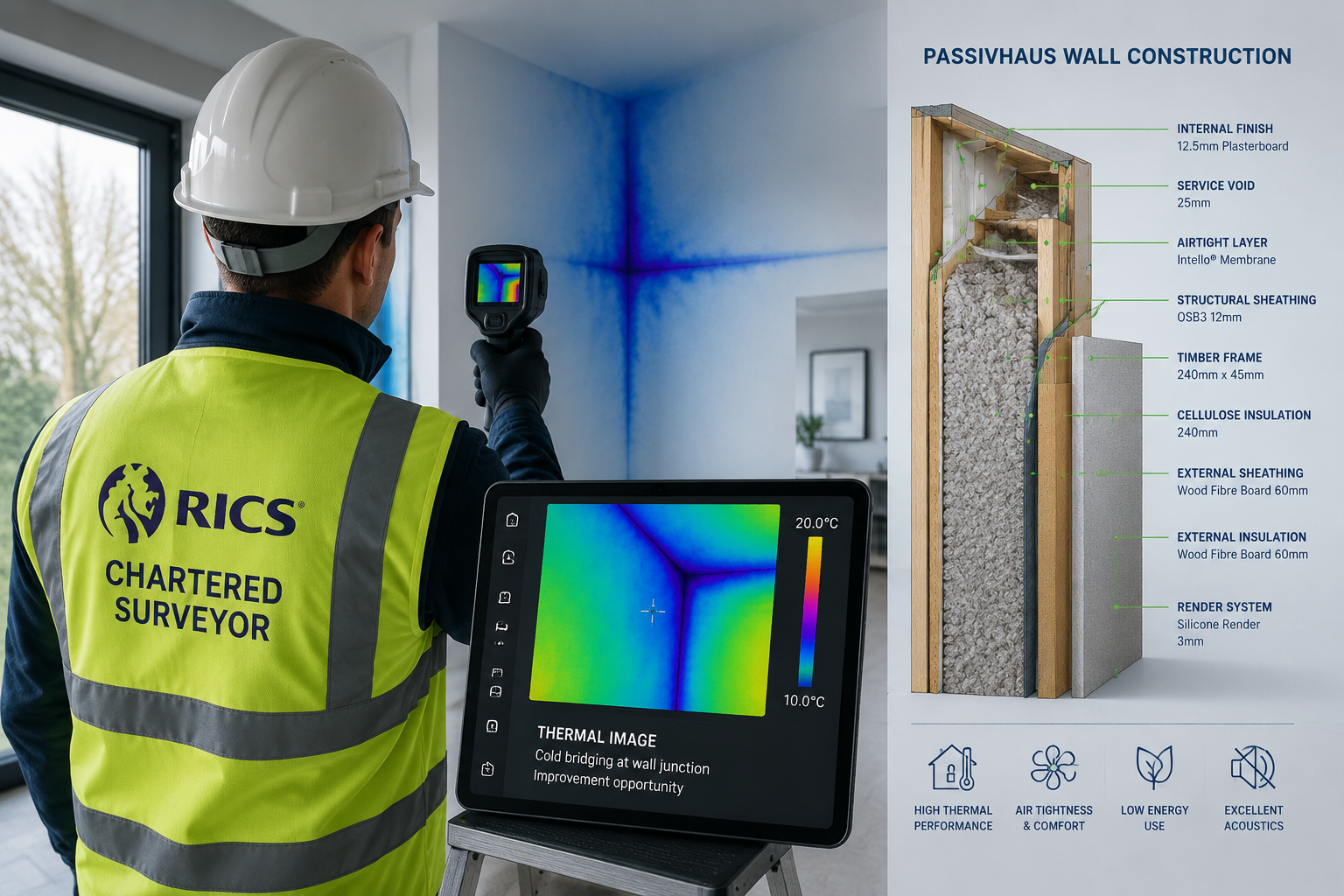
Thermal imaging surveys — A calibrated thermal imaging camera used during cold weather can reveal cold bridging at junctions, gaps in insulation, and areas where the airtightness layer has been compromised. This is not standard equipment for a conventional survey but is increasingly expected for Passivhaus inspections.
MVHR system assessment — The surveyor should inspect the MVHR unit for filter condition, duct connections, and any signs of moisture ingress. A poorly maintained MVHR system not only reduces air quality but can introduce condensation risk into the building fabric.
Documentation review — Original blower door test certificates, Passivhaus certification documents, and any post-construction monitoring data should be requested and reviewed. Gaps in this documentation are themselves a valuation concern.
Penetration integrity — Every pipe, cable, or duct that passes through the airtightness layer is a potential weak point. Surveyors should check that all penetrations are properly sealed with appropriate tape or grommets.
The Limitations That Buyers Must Understand
Level 3 surveys are visual and non-destructive. Surveyors do not open walls, floors, or ceilings, test drainage systems, or carry out electrical testing [3]. They also do not move heavy furniture or personal possessions during the inspection [3]. This means that a surveyor cannot physically verify the continuity of an airtightness membrane concealed behind finished plasterboard — they can only infer its condition from thermal imaging, visible junctions, and available documentation.
Automated valuation models (AVMs) face even greater limitations. They cannot identify structural defects, hidden maintenance issues, or property-specific risks that materially affect value [8]. For a Passivhaus property, where the entire valuation premium depends on invisible performance characteristics, relying on an AVM is particularly risky. A Level 3 survey by a chartered surveyor with specialist knowledge is the only reliable alternative.
Integrating RICS Whole-Life Carbon Guidance with 2026 EPC Valuation Findings
The RICS whole-life carbon guidance, which has gained traction since its formal adoption, requires surveyors to consider not just the operational energy performance of a building but the embodied carbon in its materials and the carbon cost of any remediation works. For Level 3 Building Surveys for Passivhaus Standard Homes: Valuation Implications in 2026 Energy Performance Certificates, this creates a new layer of reporting responsibility.
When a surveyor identifies a defect in a Passivhaus fabric — say, a thermal bridge at a structural steel penetration — the report should now address:
- The immediate remediation cost
- The ongoing energy performance penalty if left unaddressed
- The carbon implications of the remediation materials required
- The impact on the property's EPC rating and certified performance status
This integrated approach aligns with how valuation factors are increasingly being assessed in the London and South East markets, where sustainability credentials carry measurable weight in comparable sales evidence.
The Role of EPC Data in Mortgage Lending Decisions
In 2026, several major UK lenders have formalised green mortgage products that offer preferential rates for EPC band A and B properties. A Passivhaus home that retains its certified performance status can qualify for these products, representing a genuine financial benefit to the buyer. Conversely, a property where survey findings cast doubt on the EPC rating may be excluded from these products or subjected to additional lender scrutiny.
This dynamic means that the findings of a Level 3 survey have a direct impact on the financing options available to a buyer — not just on the purchase price negotiation. Surveyors should be explicit in their reports about whether identified defects are likely to affect the property's EPC band, and whether remediation is required before a green mortgage application would be supportable.
"The EPC is only as reliable as the building performance it describes. A Level 3 survey is the mechanism by which that reliability is tested."
Passivhaus Retrofits vs. New Certified Builds
A growing proportion of Passivhaus-standard properties in the UK are not new builds but rather deep retrofits — existing homes that have been upgraded to Passivhaus EnerPHit standard. These properties present additional complexity for Level 3 surveyors because the original building fabric interacts with the new performance layer in ways that can create unexpected defect patterns.
For retrofit properties, surveyors should pay particular attention to:
- The interface between existing masonry and new external insulation systems
- Interstitial condensation risk at the junction of old and new fabric
- Window replacement quality and reveal insulation
- Any areas where the retrofit was completed in phases, which can create discontinuities in the airtightness layer
A specific defect report may be appropriate as a follow-up to a Level 3 survey if thermal imaging reveals concentrated areas of concern that require more targeted investigation.
Cost, Value, and the Case for Commissioning a Level 3 Survey on a Passivhaus Property
In 2026, Level 3 surveys cost between £600 and £1,500 depending on property size and location [2]. These surveys often uncover structural or fabric issues requiring repairs costing £10,000 to £50,000 or more, making them a cost-effective choice for complex properties [2]. For a Passivhaus home — where the buyer may be paying a premium of £20,000 to £50,000 or more over a comparable standard-construction property — the survey fee represents a modest insurance cost against a very significant financial risk.
The financial case for a Level 3 survey on a Passivhaus home can be summarised as follows:
- Survey cost: £600 – £1,500
- Potential defect remediation costs if undetected: £5,000 – £50,000+
- Potential loss of Passivhaus valuation premium if performance is compromised: £15,000 – £50,000+
- Potential loss of green mortgage eligibility: Variable, but meaningful over a 25-year term
For buyers seeking a comprehensive property valuation report alongside their survey, commissioning both from the same firm allows the valuation to directly incorporate survey findings — creating a coherent picture of market value that accounts for actual rather than assumed performance.
Lenders commissioning valuations on Passivhaus properties should also consider whether their standard valuation instructions are adequate for this building type. A Red Book valuation that does not reference Level 3 survey findings on a Passivhaus property may be providing an incomplete picture of security value.
Conclusion
The intersection of Passivhaus certification, 2026 EPC requirements, and RICS survey standards creates a demanding but navigable landscape for buyers, lenders, and surveyors. The core principle is straightforward: a Passivhaus home's valuation premium is real, but it is conditional on the building performing as certified. Level 3 Building Surveys for Passivhaus Standard Homes, properly executed with thermal imaging, documentation review, and RICS whole-life carbon considerations, are the most reliable mechanism for verifying that condition.
Actionable next steps for buyers, owners, and professionals:
- Always commission a Level 3 survey — not a Level 2 — when purchasing a Passivhaus or EnerPHit retrofit property, regardless of its apparent condition or age.
- Request all original certification documents, blower door test results, and MVHR commissioning records before the survey date, so the surveyor can review them alongside the physical inspection.
- Ensure the surveyor has experience with non-standard construction and, ideally, with Passivhaus-specific fabric systems. Ask directly about their approach to thermal imaging and airtightness assessment.
- Where the survey identifies fabric defects, obtain specialist contractor quotes before exchange of contracts — not after — so remediation costs can be factored into the purchase price negotiation.
- Discuss with your lender whether their valuation instructions are appropriate for a Passivhaus property, and whether a green mortgage product is available subject to EPC verification.
- If the survey raises concentrated concerns about specific junctions or penetrations, commission a specific defect report or thermal imaging survey as a follow-up before proceeding.
The Passivhaus standard represents the most credible pathway to near-zero energy housing in the UK. Protecting the value embedded in that standard requires survey rigour that matches the engineering precision of the buildings themselves.
References
[1] Level 3 Building Surveys For Passivhaus And Fabric First Retrofits Detecting Defects In 2026 Energy Efficiency Upgrades – wimbledonsurveyors.com
[2] Is A Level 3 Survey Worth It Heres When To Choose One – lmsurveyors.co.uk
[3] What Does A Rics Level 3 Building Survey Include – lmsurveyors.co.uk
[4] Choosing Between Level 2 And Level 3 Building Surveys In 2026 A Decision Guide For Buyers – kingstonsurveyors.com
[5] Claiming the Passivhaus Standard v3.0 – passivhaustrust.org.uk
[6] PHT PH Benefits Summary Full Report 5.0 Double Page – passivhaus.uk
[7] Level 3 Building Surveys For EV Charging Retrofit Risks Defect Detection And Valuation Impacts 2026 – canterburysurveyors.com
[8] Defending Level 3 Building Surveys Against Automated Valuation Models Data Driven Arguments For Surveyor Credibility In Cautious Markets – kingstonsurveyors.com
[9] A Beginners Guide To RICS Home Surveys Level 1 2 And 3 Explained – lmsurveyors.co.uk
How Prince Surveyors can help: explore our property valuations or learn about our which survey you need.