

Last updated: July 24, 2026
Quick Answer: The Commonhold and Leasehold Reform Bill 2026 is reshaping how flats are owned in England and Wales, making commonhold the default tenure for new residential blocks and introducing a 50% consent threshold for existing leasehold conversions. Before any block converts, a comprehensive building survey is not optional, it is the single most important step to protect leaseholder finances, establish accurate post-conversion valuations, and avoid inheriting unfunded defects that commonhold owners must collectively repair.
Key Takeaways
- The Draft Commonhold and Leasehold Reform Bill, published January 2026, targets the phasing out of most new residential leasehold flats, with new flat sales potentially ceasing on a leasehold basis from around 2029.
- Existing leasehold blocks can now convert to commonhold with just 50% of qualifying leaseholders agreeing, down from the previous 100% requirement.
- Ground rents on long residential leases will be capped at £250 per year and must fall to a peppercorn after 40 years, directly affecting investment valuations.
- A pre-conversion building survey is essential: it identifies structural defects, fire safety issues, and unfunded maintenance liabilities before leaseholders take collective ownership.
- Common survey findings that can derail or delay conversion include cladding defects, underfunded reserve funds, and non-compliant building services.
- Post-conversion property values can increase where buildings are well-maintained and surveyed, but decrease where major capital works are outstanding.
- Lender approval over both freehold and leasehold interests is still required for conversion, making a clean survey report a practical prerequisite for mortgage lenders.
- Chartered surveyors should now produce "conversion readiness" reports that explicitly address building safety legislation compliance alongside standard condition assessments.
What Is Commonhold and How Does It Differ from Leasehold?
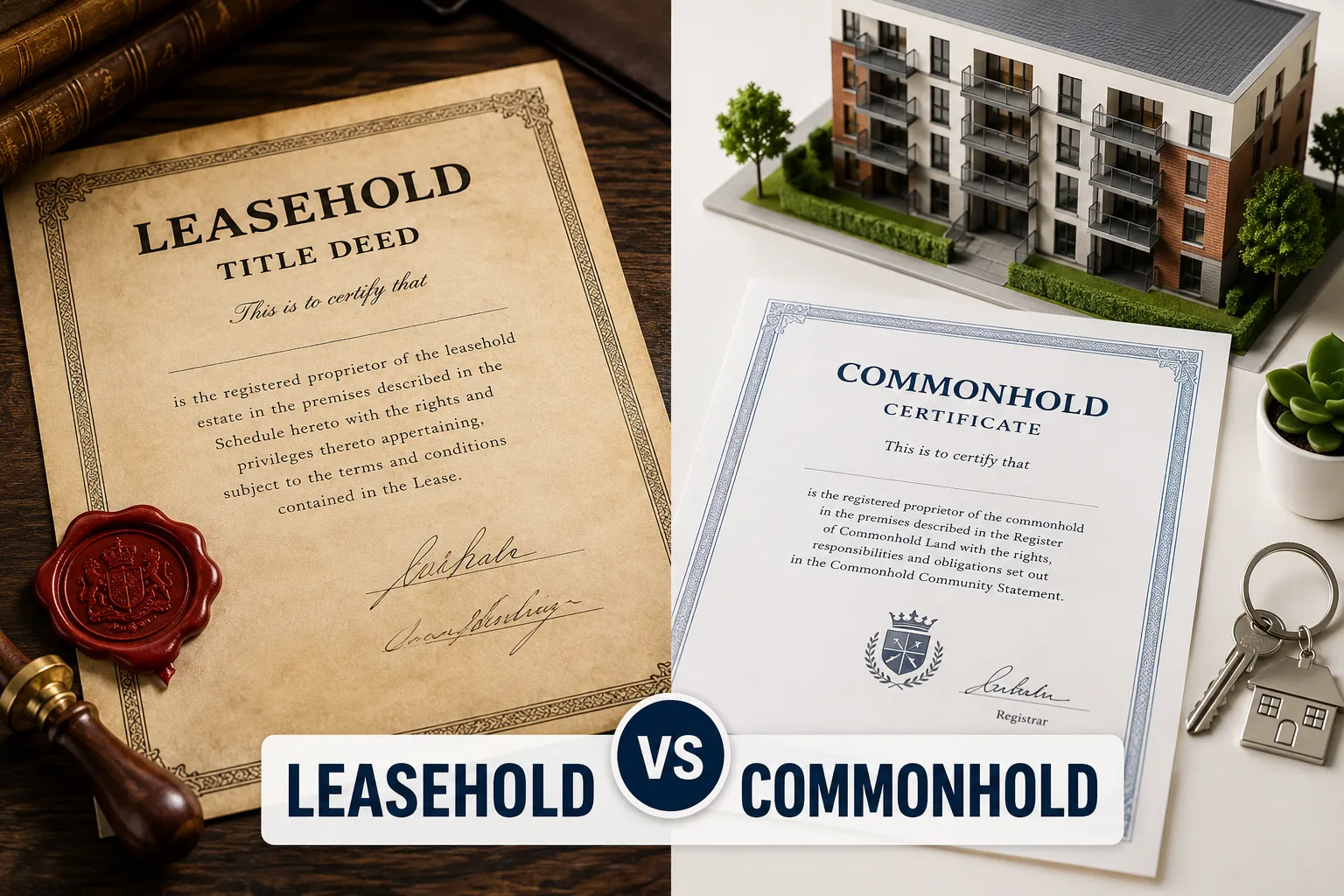
Commonhold is a form of freehold ownership for individual flats within a shared building, where each owner holds their unit outright and collectively manages the common parts through a Commonhold Association. Unlike leasehold, there is no landlord, no ground rent, and no lease that diminishes in value over time.
Under the traditional leasehold model, flat owners hold a time-limited interest, often 99 or 125 years, and pay ground rent and service charges to a freeholder who retains ultimate ownership of the building. This creates a structural imbalance: leaseholders pay for maintenance but have limited control over how it is managed or priced.
The key practical differences:
| Feature | Leasehold | Commonhold |
|---|---|---|
| Ownership type | Time-limited lease | Outright freehold of unit |
| Ground rent | Yes (currently) | None |
| Building management | Freeholder or managing agent | Commonhold Association |
| Lease length concern | Yes, value falls as lease shortens | Not applicable |
| Collective decision-making | Limited | Majority vote of unit owners |
For more on how valuations differ between tenure types, see leasehold extension and enfranchisement valuations.
What Changes Are Coming to Leasehold Law in 2026?
The Draft Commonhold and Leasehold Reform Bill, published on 27 January 2026, is the most significant overhaul of residential property tenure in England and Wales in over two decades. It makes commonhold the default for new residential flats and creates a workable conversion route for existing blocks.
The headline changes include:
- Ban on new leasehold flats: New flats in buildings without existing long residential leases must be sold as commonhold. Sales of new flats on a leasehold basis could cease from around 2029, subject to final legislation.
- Reduced conversion threshold: The consent requirement for existing blocks drops from 100% to 50% of qualifying leaseholders.
- Ground rent cap: Existing ground rents are capped at £250 per year and must reduce to a peppercorn (effectively zero) after 40 years.
- Abolition of forfeiture: The draconian remedy of forfeiture for long residential leases is to be abolished, rebalancing risk between freeholders and leaseholders.
- Estate rentcharge regulation: Charges on freehold estates are brought under tighter control.
These reforms change the risk-return profile of leasehold investment portfolios and require surveyors and valuers to recalibrate their assumptions when assessing affected properties.
Do I Need a Building Survey Before Converting to Commonhold?
Yes, a building survey before commonhold conversion is strongly advisable and, in most cases, practically essential. Once leaseholders become the collective owners of a building through a Commonhold Association, there is no third-party landlord to absorb the cost of undiscovered defects. Every structural problem, fire safety issue, or deferred maintenance item becomes the direct financial responsibility of the unit owners.
A pre-conversion survey serves three specific purposes:
- Risk identification: It surfaces defects, compliance gaps, and capital works liabilities before leaseholders commit to conversion.
- Valuation baseline: Lenders and valuers need an accurate picture of building condition to price units correctly under the new tenure.
- Lender confidence: Mortgage lenders require approval over both freehold and leasehold interests before conversion can proceed. A clean, comprehensive survey report supports that approval process.
For guidance on what a full structural inspection involves, see this complete guide to building surveys.
What Should a Building Survey Checklist Include for Commonhold Conversions?
A conversion-ready building survey goes beyond a standard condition report. It must assess every element that will become the collective responsibility of the Commonhold Association, with explicit commentary on building safety legislation compliance.
Core checklist for Leasehold Reform 2026 commonhold conversion surveys:
Structural integrity
- Foundations, load-bearing walls, and floor structures
- Roof covering, gutters, and drainage
- External facades, including cladding systems and fixings
- Lintels, lintels, balconies, and external staircases
Fire safety and building safety compliance
- Cladding type and ACM/HPL panel identification
- Fire compartmentation between floors and units
- Fire doors, escape routes, and sprinkler systems
- Compliance with the Building Safety Act 2022 and any outstanding remediation notices
Building services
- Condition of communal heating, hot water, and ventilation systems
- Electrical installations in common parts
- Lift condition, certification, and maintenance records
- Drainage and below-ground services
Financial and management review
- Current reserve fund balance versus estimated capital works costs
- Outstanding service charge disputes or arrears
- Planned maintenance schedule and its adequacy
- Any existing Section 20 major works notices
Legal and compliance
- Planning permissions and building regulation approvals for past works
- Any outstanding enforcement notices or building safety orders
- Environmental issues, including asbestos surveys
For a detailed look at what questions to raise during an inspection, see what questions you should ask during a building survey.
What Are the Most Common Issues Found in Surveys Before Commonhold Conversion?
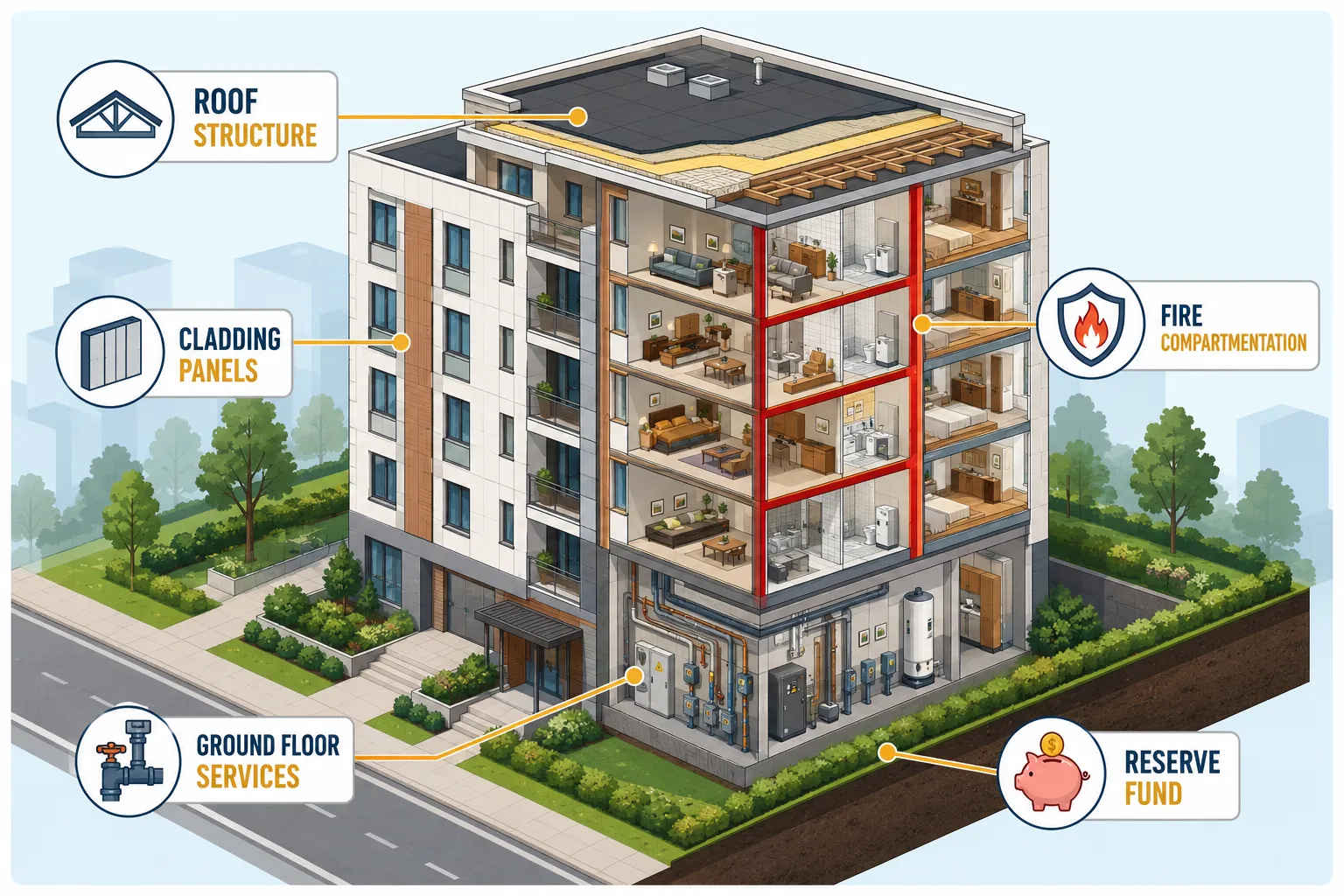
The most frequently identified problems in pre-conversion surveys fall into four categories: cladding and facade defects, underfunded reserve funds, deferred maintenance on building services, and fire safety non-compliance.
Cladding and facades remain the most financially significant risk. Blocks built or re-clad between the 1980s and 2010s may contain combustible panels or inadequate fire barriers. Remediation costs can run into hundreds of thousands of pounds for a mid-sized block, and this liability must be quantified before conversion.
Underfunded reserve funds are extremely common. Many leasehold blocks have historically collected service charges at levels insufficient to cover long-term capital replacement. When leaseholders become the Commonhold Association, a depleted reserve fund means either a large immediate levy or deferred works that erode property values.
Deferred maintenance on lifts, communal heating, and flat roofs frequently appears in surveys of blocks where the freeholder has prioritised low service charges over proactive maintenance. These items have predictable replacement cycles and should be costed explicitly.
Fire safety documentation gaps, missing fire risk assessments, incomplete compartmentation surveys, or absent EWS1 forms, can prevent mortgage lending on individual units and must be resolved before or during the conversion process.
For a deeper look at building defects that commonly arise in surveys, see building defects surveys.
Will Converting to Commonhold Affect My Property Value?
Commonhold conversion can increase, decrease, or have a neutral effect on property value, depending entirely on building condition and the quality of the Commonhold Association's governance. The tenure change itself is not the primary value driver, building condition is.
Where values tend to increase:
- Well-maintained blocks with adequately funded reserves
- Buildings where the removal of ground rent and lease-shortening anxiety adds a measurable premium
- Blocks where leaseholders previously paid above-market service charges to a freeholder
Where values can fall or stagnate:
- Buildings with outstanding major works, particularly cladding remediation
- Blocks where the reserve fund is insufficient to cover known capital liabilities
- Cases where the Commonhold Association lacks clear governance structures
"Building condition and safety will become even more central to value under commonhold, because there is no third-party landlord to absorb management failures."
Valuers assessing post-conversion units should adjust their comparable analysis to reflect the absence of ground rent, the remaining lease concern, and the specific condition of the building's common parts. For professional valuation support, see chartered surveyor valuations.
Can All Leasehold Properties Convert to Commonhold?
Not all leasehold properties qualify for commonhold conversion under the 2026 framework. The Bill targets long residential leases exceeding 21 years in England and Wales, and certain property types and tenure structures fall outside the conversion route.
Properties that can convert:
- Residential flat blocks where at least 50% of qualifying leaseholders consent
- Mixed-use blocks, subject to specific conditions regarding commercial elements
Properties that face additional hurdles or may not qualify:
- Houses held on long leases (the commonhold framework is primarily designed for flats)
- Blocks where the freehold is held by a local authority or housing association, which may require separate statutory processes
- Buildings with complex head lease structures or intermediate landlords, where freeholder consent and lender approval across multiple interests must be secured
Even where conversion is technically possible, collective freehold acquisition may remain a practical precursor in many cases, because freeholder consent is still required alongside the 50% leaseholder threshold.
How Long Does the Commonhold Conversion Process Take?
The commonhold conversion process for an existing block typically takes between 12 and 36 months from initial leaseholder agreement to completion of the legal transfer, depending on building complexity, the number of units, and whether collective freehold acquisition is required first.
Indicative timeline:
- Months 1-3: Leaseholder consultation, appointment of solicitors and surveyors, initial building survey
- Months 3-6: Collective freehold acquisition (if required), lender notifications, drafting of Commonhold Community Statement
- Months 6-12: Regulatory and lender approvals, resolution of any defect or compliance issues identified in the survey
- Months 12-36: Legal completion, registration of Commonhold Association at Companies House, Land Registry registration
Blocks with unresolved building safety issues or significant lender objections can take considerably longer. For information on survey timeframes specifically, see building survey timeframes.
What Happens to Ground Rent in Commonhold Properties?
Ground rent does not exist in commonhold. Once a block converts, the ground rent obligation ceases entirely, there is no freeholder to pay it to. For existing leasehold blocks that have not yet converted, the 2026 reforms cap ground rents at £250 per year and require them to fall to a peppercorn (effectively £0) after 40 years.
This change has a direct and material impact on valuation. Ground rent income streams have historically been capitalised as investment assets, often sold in portfolios at significant multiples. The cap and the peppercorn requirement substantially reduce the long-term value of those income streams, which in turn affects the price at which freeholders may be willing to sell the freehold to leaseholders seeking collective enfranchisement as a precursor to conversion.
Do Leaseholders Have to Pay for the Conversion Survey?
In most cases, yes, leaseholders bear the cost of the pre-conversion building survey, either directly or through the service charge. The survey is commissioned by the leaseholders or their representative body as part of the due diligence process, and the freeholder is not obligated to fund it.
Typical cost considerations:
- A Level 3 full building survey for a mid-sized residential block (10-20 units) in London typically ranges from £2,000 to £5,000 or more, depending on building age, size, and complexity.
- Additional specialist reports, fire safety surveys, asbestos surveys, structural engineer reports, add to this cost.
- These costs are often shared pro-rata across participating leaseholders.
Leaseholders should treat the survey cost as a necessary investment. Discovering a £500,000 cladding remediation liability after conversion is far more expensive than a thorough pre-conversion survey. For a detailed breakdown of survey costs, see cost of a measured building survey.
What Are the Risks of Converting to Commonhold, and How Do You Calculate Post-Conversion Valuation?
The primary risks of commonhold conversion relate to governance, undisclosed liabilities, and lender appetite. The valuation impact flows directly from how well these risks are identified and managed before conversion completes.
Key risks:
- Underfunded reserves: If capital works are needed shortly after conversion, the Commonhold Association must levy special charges on unit owners. This is the single most common post-conversion financial shock.
- Governance failure: A poorly structured Commonhold Community Statement, or low leaseholder engagement, can lead to maintenance disputes and deferred decisions that erode building condition and values.
- Lender restrictions: Some mortgage lenders remain cautious about commonhold, particularly for blocks with complex structures or outstanding safety issues. This can affect resale liquidity.
- Transitional legal complexity: Blocks with multiple intermediate landlords, shared ownership units, or commercial leases require specialist legal and surveying input.
For post-conversion valuation, surveyors typically consider:
- Comparable sales of commonhold units in similar blocks (still limited in the UK market)
- Adjustment for the removal of ground rent and lease-length risk
- Deduction for any known unfunded capital works identified in the survey
- Discount rate adjustments where governance or building safety risk is elevated
For specialist valuation support in complex cases, see property development valuations.
What Mistakes Should You Avoid When Preparing for Commonhold Conversion?
The most costly mistakes in commonhold conversion preparation share a common thread: insufficient due diligence before leaseholders commit.
Avoid these errors:
- Skipping or downgrading the building survey. A Homebuyer Report is not adequate for a conversion. A Level 3 full building survey is the appropriate standard for most blocks.
- Ignoring the reserve fund position. Review at least three years of service charge accounts and compare the reserve fund balance against a realistic long-term maintenance plan.
- Assuming 50% consent is straightforward. Reaching 50% of qualifying leaseholders sounds simple, but absentee owners, investor leaseholders, and shared ownership units can complicate the count significantly.
- Failing to notify lenders early. Mortgage lenders over both freehold and leasehold interests must approve the conversion. Late notification can cause delays of six months or more.
- Not commissioning specialist fire safety or asbestos reports. Standard building surveys may flag concerns but cannot always provide the specialist sign-off that lenders and insurers require. See asbestos building surveys for more.
- Underestimating legal costs. Drafting the Commonhold Community Statement, registering the Association, and managing the Land Registry process requires specialist solicitors alongside surveyors.
Interactive Tool: Commonhold Conversion Readiness Checker
.cg-wrap{font-family:Arial,sans-serif;max-width:560px;margin:0 auto;background:#f8f9fc;border:1px solid #d0d7e3;border-radius:8px;padding:20px}
.cg-title{font-size:1.1rem;font-weight:700;color:#1a2e5a;margin-bottom:4px}
.cg-sub{font-size:.85rem;color:#555;margin-bottom:14px}
.cg-q{margin-bottom:12px}
.cg-q label{display:block;font-size:.9rem;font-weight:600;color:#1a2e5a;margin-bottom:4px}
.cg-q select{width:100%;padding:6px 8px;border:1px solid #b0bcd4;border-radius:5px;font-size:.88rem;background:#fff}
.cg-btn{background:#1a2e5a;color:#fff;border:none;padding:9px 22px;border-radius:5px;font-size:.9rem;font-weight:700;cursor:pointer;margin-top:6px}
.cg-btn:hover{background:#2d4a8a}
.cg-result{margin-top:14px;padding:12px;border-radius:6px;font-size:.9rem;display:none}
.cg-green{background:#e6f4ea;border:1px solid #7dc98a;color:#1a5c2a}
.cg-amber{background:#fff8e1;border:1px solid #f0c040;color:#7a5500}
.cg-red{background:#fdecea;border:1px solid #e57373;color:#7a1a1a}
function cgCheck(){
var qs=[“q1″,”q2″,”q3″,”q4″],score=0,blank=false;
qs.forEach(function(id){var v=document.getElementById(id).value;if(v===””){blank=true;}else{score+=parseInt(v);}});
var r=document.getElementById(“cg-result”);
if(blank){r.className=”cg-result cg-amber”;r.style.display=”block”;r.innerHTML=”Please answer all four questions to see your result.”;return;}
if(score>=7){r.className=”cg-result cg-green”;r.innerHTML=”Good readiness. Your block appears well-placed to begin the conversion process. Instruct a chartered surveyor to confirm condition and commission legal advice on the Commonhold Community Statement.”;}
else if(score>=4){r.className=”cg-result cg-amber”;r.innerHTML=”Moderate readiness. Some issues need resolving before conversion. Commission a Level 3 building survey if not done, address reserve fund shortfalls, and consult lenders early.”;}
else{r.className=”cg-result cg-red”;r.innerHTML=”Low readiness. Significant barriers exist. A full building survey, fire safety assessment, and legal review are needed before proceeding. Conversion may take 2-3 years or more.”;}
r.style.display=”block”;}
Frequently Asked Questions
What is the difference between commonhold and leasehold in simple terms?
Leasehold means you own your flat for a fixed number of years, paying ground rent to a freeholder who owns the building. Commonhold means you own your flat outright as a freehold interest, and you and your neighbours collectively manage the building through a Commonhold Association. There is no ground rent and no lease that runs down.
When will the leasehold ban for new flats come into effect?
Based on the Draft Commonhold and Leasehold Reform Bill published in January 2026, the government's intention is that sales of new flats on a leasehold basis could cease from around 2029, subject to the Bill receiving Royal Assent and transitional provisions being finalised.
Can I be forced to convert to commonhold if my neighbours vote for it?
Under the 2026 proposals, conversion requires 50% of qualifying leaseholders to agree, not 100%. This means a majority can initiate the process. However, freeholder consent and lender approval are also required, so a simple majority vote does not automatically force conversion without those additional steps.
What type of building survey is needed for commonhold conversion?
A Level 3 full building survey is the appropriate standard for most residential blocks. It provides a comprehensive assessment of structure, fabric, services, and condition. Additional specialist reports, fire safety, asbestos, structural engineering, are often needed alongside it. A Homebuyer Report (Level 2) is not sufficient for a whole-block conversion assessment.
Will my mortgage lender accept a commonhold property?
Most major UK mortgage lenders do accept commonhold, but some have specific requirements regarding the Commonhold Community Statement and building condition. Lender approval must be obtained before conversion completes, and blocks with outstanding building safety issues may face restrictions. Always check with your lender early in the process.
Does converting to commonhold automatically increase my property value?
Not automatically. Value increases are most likely where the building is well-maintained, the reserve fund is adequate, and the removal of ground rent and lease-length anxiety represents a genuine saving to buyers. Poorly maintained blocks or those with outstanding capital works may see values fall or stagnate after conversion until defects are remediated.
Who manages the building after commonhold conversion?
The Commonhold Association, a company limited by guarantee, of which all unit owners are members, takes responsibility for managing the common parts. It can appoint a professional managing agent, but ultimate governance rests with the unit owners. The Commonhold Community Statement sets out the rules and obligations in detail.
Conclusion
The Leasehold Reform 2026 agenda represents a structural shift in how residential flats are owned and managed in England and Wales. For leaseholders, landlords, and property professionals, the practical implications are immediate: building condition now matters more than ever, because commonhold removes the freeholder buffer and places maintenance responsibility squarely with unit owners.
Actionable next steps for 2026:
- Commission a Level 3 full building survey on any block where conversion is being considered. Do not rely on older reports, building safety legislation and cladding standards have changed significantly.
- Review the reserve fund against a realistic 10-year capital works plan. If the fund is underfunded, quantify the shortfall before committing to conversion.
- Obtain specialist fire safety and asbestos reports where the building's age or construction type raises any concern.
- Notify mortgage lenders early, both over the freehold and individual leasehold interests, to identify any conditions they will impose.
- Instruct a chartered surveyor with experience in leasehold reform to produce a conversion readiness report that explicitly addresses building safety legislation compliance and post-conversion valuation assumptions.
- Seek legal advice on the Commonhold Community Statement before the 50% consent ballot is launched, so leaseholders understand what they are voting for.
The 2026 reforms offer a genuine opportunity for leaseholders to secure better ownership rights and potentially higher property values. Realising that opportunity depends on thorough professional due diligence before conversion, not after.
Tags: leasehold reform 2026, commonhold conversion, building survey checklist, commonhold valuation, leasehold to commonhold, chartered surveyor, pre-conversion survey, ground rent cap, building safety act, commonhold community statement, leasehold enfranchisement, property valuation UK