

{"cover":"Professional landscape format (1536×1024) hero image with bold text overlay: 'Lease Extensions, Short Leases & Valuation: A Surveyor's Plain-English Guide for Flat Owners' in extra large 70pt white bold sans-serif font with dark semi-transparent overlay box, centered upper third. Background shows an elegant red-brick British apartment block with sash windows, soft morning light, and a suited chartered surveyor holding a clipboard and lease documents in the foreground. Color palette: deep navy blue, white, gold accents. Magazine cover aesthetic, editorial quality, high contrast, RICS-branded professional tone.","content":["Detailed landscape format (1536×1024) editorial illustration showing a split-screen comparison: left side depicts a modern UK flat with a healthy 125-year lease term displayed on a glowing digital timeline bar in green; right side shows the same flat type with a short 72-year lease shown in amber warning tones, with a downward property value arrow. A surveyor's desk with relativity graphs, a calculator, and lease documents sits in the foreground. Clean infographic style, navy and gold color scheme, professional property valuation theme.","Detailed landscape format (1536×1024) concept image showing a large wooden balance scale on a solicitor's desk: one side holds stacked gold coins labeled 'Marriage Value' and the other holds a lease document stamped '79 Years'. Behind the scale, a chalkboard displays the Duff & Phelps relativity graph curve in white chalk. Warm office lighting, mahogany desk, RICS certificates on the wall in background. Photorealistic editorial style, deep brown and gold tones, lease extension valuation theme.","Detailed landscape format (1536×1024) wide-angle image of a formal meeting room where a flat owner and a RICS chartered surveyor review a formal Section 42 notice document spread across a glass conference table. A laptop displays a lease extension premium calculation spreadsheet. Through floor-to-ceiling windows, a row of UK residential apartment blocks is visible. Cool blue and white tones, professional corporate setting, documents clearly labeled 'Lease Extension Notice', sharp editorial photography style."]
Roughly 4.98 million leasehold dwellings exist in England alone, and a significant proportion of their owners are sitting on a ticking clock without realising it. Once a lease drops below 80 years, the cost of extending it can jump sharply — sometimes by tens of thousands of pounds — and mortgage lenders begin to walk away. This guide to Lease Extensions, Short Leases and Valuation: A Surveyor's Plain-English Guide for Flat Owners breaks down exactly how surveyors calculate what a lease extension is worth, why short leases are so damaging to property value, and what the 2026 reform landscape means for anyone planning to sell or remortgage a flat.
Key Takeaways
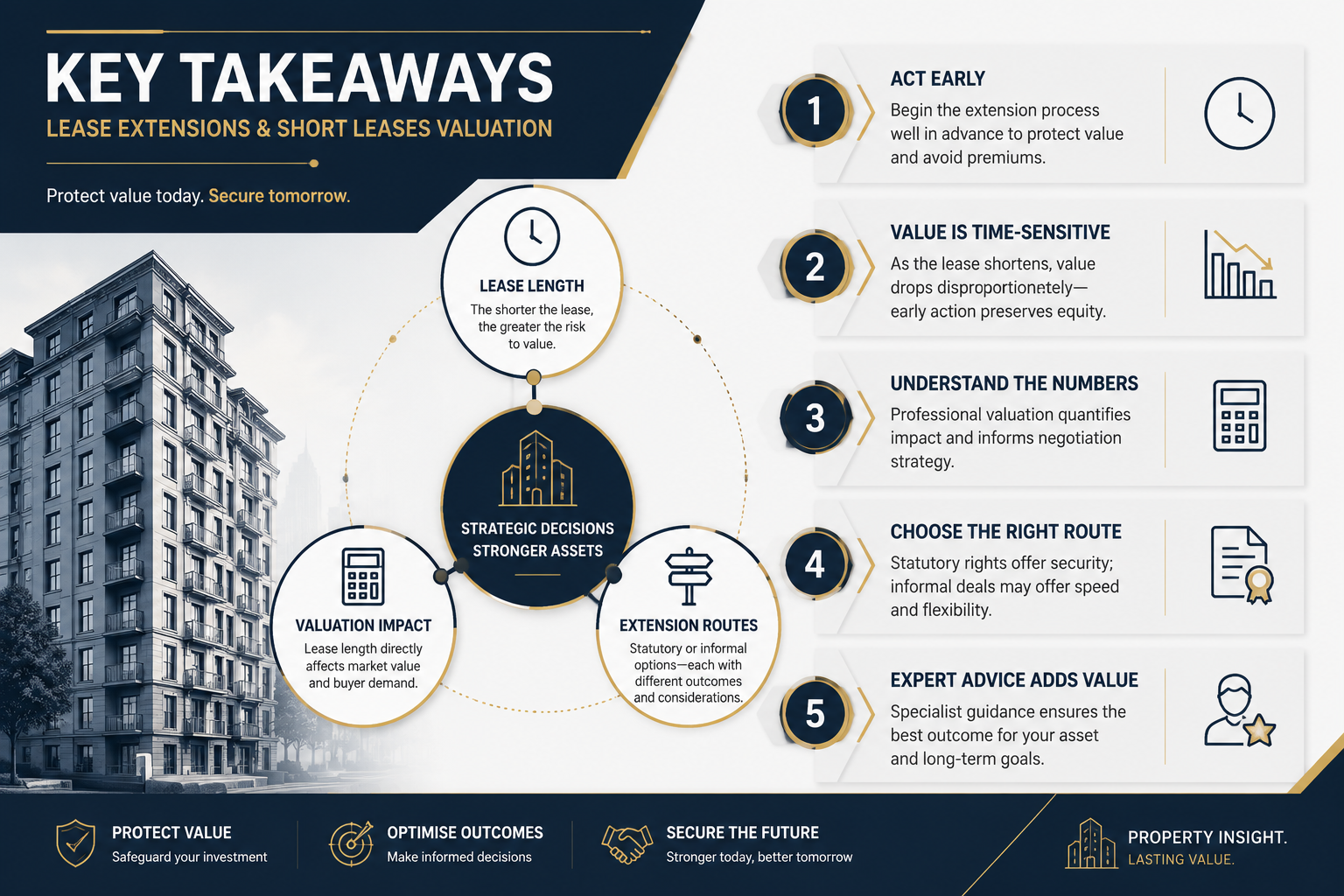
- A lease below 80 years triggers "marriage value," a legally required extra payment that can substantially increase the cost of extending.
- Surveyors use relativity graphs, investment-yield methods, and comparable market evidence to calculate the premium a freeholder is entitled to receive.
- The government announced a £250-per-year ground rent cap in January 2026, but full implementation of central reforms may not arrive until late 2028.
- Both an informal negotiation route and a formal statutory route exist for extending a lease; each carries different risks and cost implications.
- Acting before the 80-year threshold is the single most effective step a flat owner can take to reduce the cost of a lease extension.
Why Lease Length Matters More Than Most Flat Owners Realise
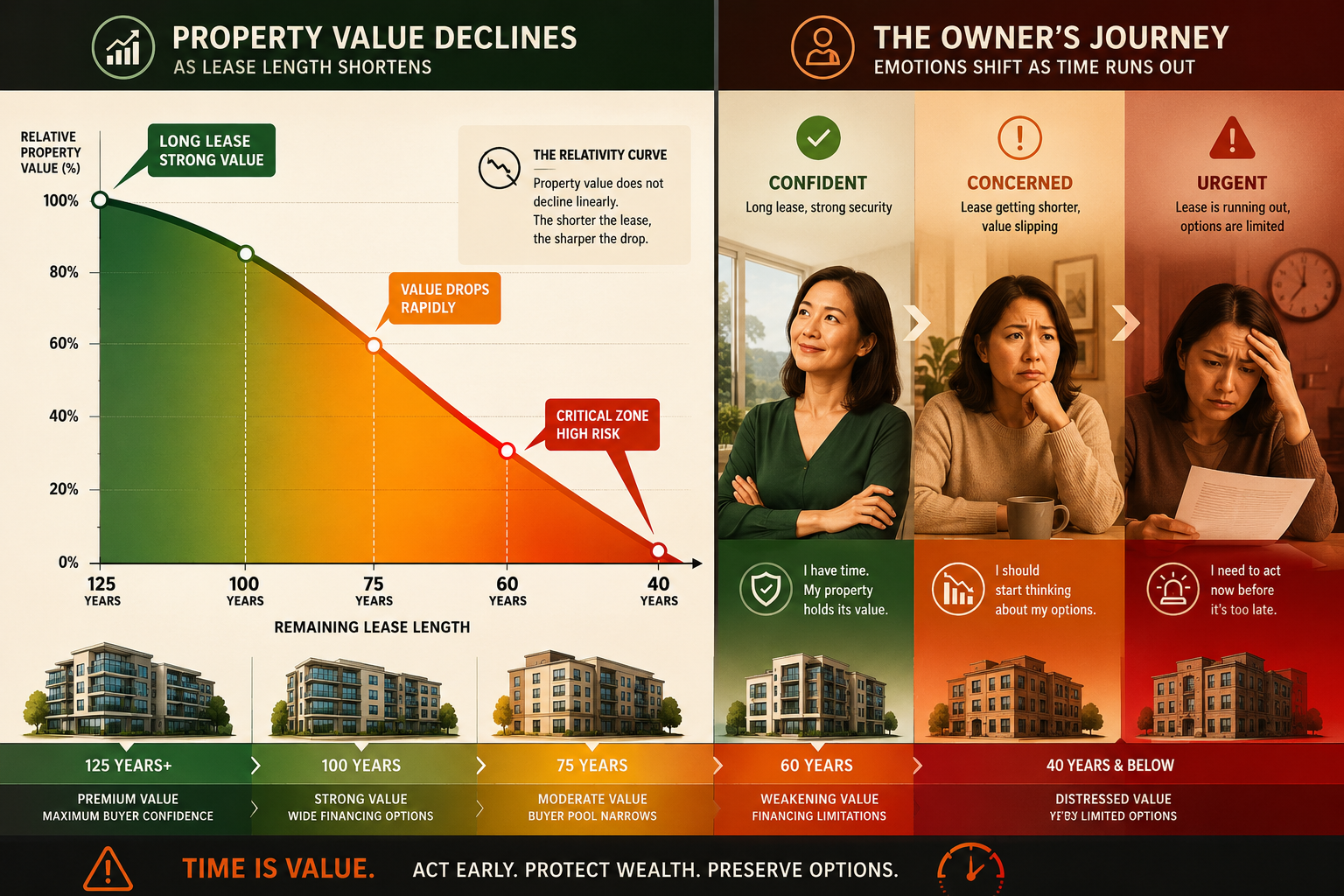
The term "leasehold" means a flat owner holds a time-limited interest in a property. When that time runs low, the interest loses value — and so does the flat itself. Lenders typically require a minimum of 70 to 85 years remaining at the end of a mortgage term, which means a flat with 75 years left today may already be unmortgageable for a buyer taking a 25-year loan.
The 80-year rule is the most critical threshold in leasehold law. Once a lease falls below 80 years, the statutory formula for calculating a lease extension premium introduces marriage value — a concept explained in detail below. The practical effect is that every year a leaseholder delays action below this threshold, the bill grows larger.
Short leases also suppress open-market value. Buyers discount the purchase price to account for the cost they will eventually bear to extend, and some buyers walk away entirely. For flat owners facing remortgaging or sale in 2026's cautious but stabilising market, this creates a real and immediate financial problem.
For a deeper look at how surveyors approach property inspections and valuations in this context, the RICS-certified property inspection guide provides useful background on what professionals examine when assessing a leasehold flat.
How Surveyors Value a Leasehold Interest: The Core Components
Understanding the valuation methodology is central to this guide on Lease Extensions, Short Leases and Valuation: A Surveyor's Plain-English Guide for Flat Owners. The premium a leaseholder pays to extend is not arbitrary — it is calculated using a statutory formula under the Leasehold Reform, Housing and Urban Development Act 1993, and it has three distinct components.
1. Ground Rent Capitalisation
The freeholder currently receives ground rent income. When a lease is extended, that income stream is lost or reduced. The first element of the premium compensates the freeholder for the loss of this income, calculated by capitalising the ground rent at an appropriate yield.
In January 2026, Prime Minister Keir Starmer announced a cap on ground rents at £250 per year in England and Wales, transitioning to a peppercorn rent after 40 years [1]. This reform, if implemented as planned, will reduce the ground rent capitalisation element of future premiums significantly. However, experts have warned that freeholders may mount legal challenges to block the cap [8], and full implementation of central leasehold reforms may not arrive until late 2028 according to Housing Minister Matthew Pennycook [2].
2. Reversion Value
When a lease expires, the flat reverts to the freeholder. The second element of the premium compensates the freeholder for the deferred loss of this reversion. The longer the remaining lease, the further away the reversion date, and therefore the lower this element of the premium. Conversely, a lease with only 60 years remaining has a reversion date that is much closer, making this element more significant.
Surveyors calculate reversion value by taking the freehold vacant possession value of the flat, applying a relativity percentage to derive the current leasehold value, and then discounting the difference back to today using an appropriate yield.
3. Marriage Value
This is the element that causes the most financial shock for flat owners. Marriage value is the increase in the combined value of the leasehold and freehold interests that results from the lease extension itself. In other words, a flat with 78 years remaining is worth less than the same flat with 125 years remaining. The difference in value — the "marriage" of the two interests — must be shared equally between the leaseholder and the freeholder under the 1993 Act.
Marriage value only applies when the lease has fewer than 80 years remaining. Above 80 years, it is legally assumed to be zero. This is why the 80-year threshold matters so much in practice [3].
The Leasehold Advisory Service emphasises that professional valuations are crucial precisely because of the complexity surrounding marriage value and ground rent patterns [3]. A surveyor who underestimates the freeholder's entitlement leaves a leaseholder exposed to a counter-notice dispute; one who overestimates it costs the leaseholder money unnecessarily.
For a detailed breakdown of what a lease extension valuation involves in practice, see this lease extension valuation guide.
Relativity Graphs and Market Evidence: The Surveyor's Toolkit
Calculating the leasehold value as a percentage of freehold value — known as "relativity" — is one of the most contested areas of leasehold valuation. There is no single agreed figure. Instead, surveyors refer to published relativity graphs produced by firms such as Gerald Eve, Savills, and Duff & Phelps, each of which produces slightly different results based on different datasets.
What is relativity? If a flat with a 70-year lease is worth £280,000 on the open market, and the same flat with a long lease (effectively freehold) would be worth £350,000, the relativity is 80% (£280,000 / £350,000). The lower the lease length, the lower the relativity percentage, and the greater the marriage value.
| Remaining Lease (Years) | Approximate Relativity Range |
|---|---|
| 90+ | 95% – 99% |
| 80 – 89 | 90% – 95% |
| 70 – 79 | 80% – 90% |
| 60 – 69 | 70% – 82% |
| 50 – 59 | 60% – 73% |
| Below 50 | Below 65% |
Note: Relativity ranges vary by graph used and location. These figures are indicative only.
Surveyors also use comparable market evidence — actual sales of similar flats with similar lease lengths — to cross-check relativity assumptions. In active urban markets, this evidence can be strong. In quieter or more specialist markets, surveyors may rely more heavily on published graphs.
The investment yield approach is used to capitalise both the ground rent income and the reversion. Yields reflect the risk and return characteristics of the freehold interest. In prime central London, freehold yields may be very low (reflecting high demand and low risk), which increases the capitalised value of the ground rent and therefore the premium. In regional markets, yields are typically higher.
For flat owners seeking a formal Red Book valuation to support a lease extension claim, a RICS Red Book valuation provides the independent, court-admissible evidence needed to negotiate or litigate effectively.
Understanding the factors that influence property valuation more broadly can also help flat owners appreciate why two seemingly identical flats may attract very different lease extension premiums.
The Two Routes to Extending a Lease
Leaseholders in England and Wales have two main routes available to them [7]:
The Informal Route
A leaseholder approaches the freeholder directly and negotiates a premium without invoking statutory rights. This can be quicker and cheaper in professional fees, but carries significant risks. The freeholder is under no obligation to grant an extension on reasonable terms, and without the protection of the statutory process, a leaseholder has limited recourse if negotiations break down. The resulting lease may also be on non-standard terms.
The Formal (Statutory) Route
Under the Leasehold Reform, Housing and Urban Development Act 1993, qualifying leaseholders have the right to a 90-year extension added to the existing term, at a peppercorn ground rent, in exchange for a fair premium. To qualify, a leaseholder must have owned the flat for at least two years.
The process begins with a Section 42 Notice — the tenant's formal offer — served by a solicitor. The freeholder then has two months to respond with a counter-notice. If agreement is not reached within six months of the counter-notice, either party can apply to the First-tier Tribunal (Property Chamber) to determine the premium.
"The statutory route provides a legal floor: the freeholder cannot simply refuse. But the premium is still negotiated, and a surveyor's valuation is the foundation of every negotiation."
The total cost of extending a lease — including the premium, surveyor fees, solicitor fees, and the freeholder's reasonable professional costs — can reach low five-figure sums even for modest flats [6]. For a realistic breakdown of what to budget, the cost of lease extension guide sets out the typical components in plain terms.

The 2026 Reform Landscape: What Flat Owners Need to Know Now
The leasehold reform agenda has moved significantly in 2026, though not as fast as many leaseholders had hoped. The key developments are:
Ground Rent Cap: On 27 January 2026, the government announced a cap on ground rents at £250 per year, moving to peppercorn after 40 years [1]. This directly reduces one element of the lease extension premium calculation. However, former Deputy Prime Minister Angela Rayner has warned that freeholders may seek legal challenges to block the cap [8], meaning leaseholders should not assume immediate relief.
Ban on New Leasehold Flats: The same announcement included a commitment to ban the sale of new leasehold flats, with commonhold promoted as the default tenure going forward [1]. This does not affect existing leaseholders directly, but it signals the direction of travel.
Implementation Delays: Despite the announcements, Housing Minister Matthew Pennycook indicated in April 2026 that central valuation reforms — including changes to the marriage value calculation — may not take effect until late 2028 [2]. The delay reflects the complexity of correcting defects in earlier legislation and the need for further consultation on valuation methodology.
Practical Implication: Flat owners with leases approaching or below 80 years should not wait for reform to reduce their costs. The current statutory formula remains in force, and every year of delay below 80 years increases the marriage value element of the premium.
The Leasehold and Freehold Reform Act 2024 also introduced greater transparency over service charges, allowing leaseholders to challenge unreasonable costs more effectively [5]. While this does not directly affect lease extension premiums, it forms part of a broader shift in the balance of power between leaseholders and freeholders.
For flat owners who are also considering whether to purchase the freehold collectively with other flat owners in their building, the guide to buying a share of freehold explains how collective enfranchisement works and how it compares to individual lease extension.
Common Questions Flat Owners Ask Surveyors
Does extending a lease increase my property's value?
Yes, in most cases. Extending from 75 years to 165 years (90 years added) can recover the full discount applied to a short lease, effectively restoring the flat to its long-leasehold value. The gain in value often exceeds the cost of the premium and professional fees, particularly where the lease is between 70 and 80 years.
Can the freeholder refuse to grant an extension?
Under the statutory route, a qualifying leaseholder cannot be refused. The freeholder can dispute the premium, but not the right itself. Under the informal route, the freeholder can refuse or demand unreasonable terms.
What happens if the freeholder and leaseholder cannot agree on the premium?
Either party can apply to the First-tier Tribunal (Property Chamber). The Tribunal will determine the premium based on the evidence presented by both sides' surveyors. This process can take 12 to 18 months and adds to costs, which is why most cases settle before reaching a hearing.
Is a mortgage valuation sufficient for a lease extension claim?
No. A mortgage valuation is not the same as a survey or a formal valuation for lease extension purposes. A Red Book valuation prepared by a RICS-registered valuer is required to support a statutory claim.
For a comprehensive set of answers to the most frequently asked questions about the process, the lease extension FAQ covers the practical steps in detail.
Conclusion: Actionable Next Steps for Flat Owners in 2026
Lease Extensions, Short Leases and Valuation: A Surveyor's Plain-English Guide for Flat Owners comes down to one central message: time is money, and the 80-year threshold is the line that separates manageable costs from significantly higher ones.
Here are the practical steps every flat owner should take:
- Check the lease length now. The title register at HM Land Registry shows the original lease term and grant date. Calculate the years remaining carefully.
- If the lease is between 82 and 90 years, act within the next 12 months. This provides a buffer above 80 years while the statutory process completes.
- Instruct a RICS-registered surveyor to prepare a formal valuation. This establishes a defensible opening position for negotiations and protects against overpaying.
- Engage a specialist leasehold solicitor alongside the surveyor. The legal and valuation work must proceed in parallel.
- Do not wait for leasehold reform to reduce costs. The current statutory formula remains in force, and the 2028 implementation timeline for valuation reforms means the rules governing marriage value are unchanged for now.
- If the lease is already below 80 years, seek advice immediately. The marriage value element increases with every passing year, and some lenders will already be declining mortgage applications on the property.
The 2026 market is cautious but stable, and lenders remain active in the leasehold sector for properties with adequate lease lengths. Flat owners who address short leases proactively are protecting both their ability to sell or remortgage and the underlying capital value of their most significant asset.
References
[1] PM: We're Capping Ground Rents at £250 – gov.uk
[2] Property Weekly Highlights 2 April 2026 – lexisnexis.com
[3] Professional Valuation – lease-advice.org
[4] Valuing Properties With Short Leases And Service Charge Uncertainty: A Practical Guide For Surveyors And Flat Owners – manchestersurveyors.com
[5] Leasehold Reforms Give More Rights And Protections To Homeowners – gov.uk
[6] Leasehold Extension Calculator – comparemymove.com
[7] Getting Started: Lease Extension for Flats – lease-advice.org
[8] Leaseholders in England and Wales: Ground Rent Cap £250 a Year – theguardian.com
How Prince Surveyors can help: explore our property valuations or learn about our which survey you need.