

Transaction chains in the UK property market collapsed at a rate of roughly one in three in 2023 and 2024 — and the most commonly cited cause was not mortgage refusals or legal disputes, but delays in the survey and due-diligence phase. As the market recovers in 2026, that structural weakness has not disappeared; it has simply become more expensive. With buyer demand rebounding and the Royal Institution of Chartered Surveyors (RICS) introducing accelerated survey protocols to support six-week completions [1], the question facing every professional in a property chain is no longer whether to commission a building survey, but precisely when and how to integrate it so that it accelerates rather than stalls the transaction.
Integrating Building Surveys into Extended Transaction Chains 2026: Mitigating Delays in Recovering Markets is the defining challenge for solicitors, estate agents, mortgage brokers, and surveyors operating in a market that is recovering but remains fragile. This article sets out a practical, evidence-based framework for doing exactly that.
Key Takeaways
- RICS accelerated survey protocols now target six-week completions, making early survey commissioning the single most effective way to prevent chain collapse.
- Extended chains of four or more properties amplify every delay; a survey bottleneck in one link affects every party above and below it.
- Digital reporting and standardised inspection checklists are the two most impactful tools for compressing survey turnaround times without sacrificing quality.
- Supply chain consolidation in 2026 is improving material availability, but structural defects identified late in a transaction still trigger renegotiation and collapse.
- Proactive coordination between surveyors, solicitors, and estate agents — not sequential handoffs — is the model that consistently produces faster, safer completions.
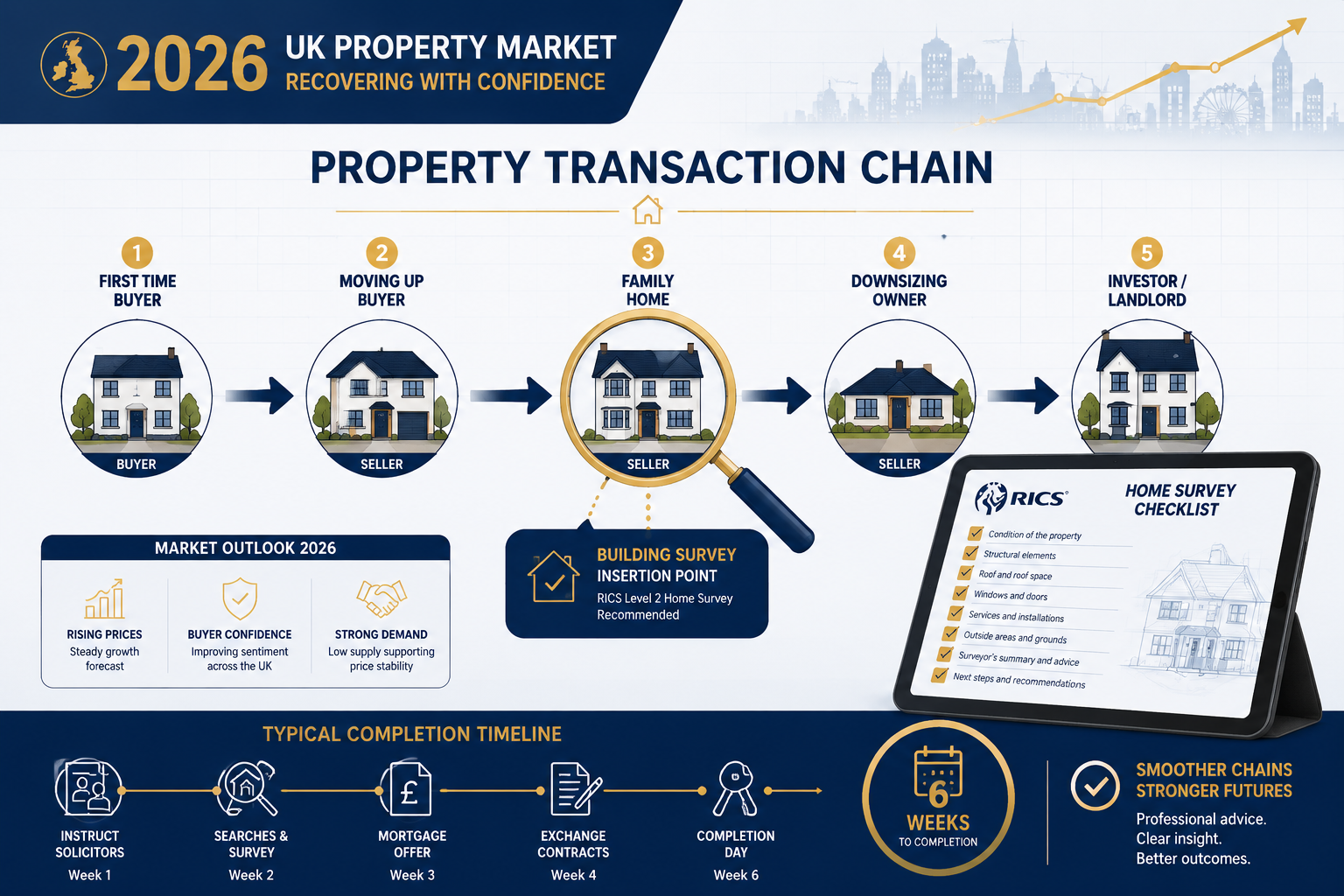
Why Extended Transaction Chains Amplify Survey Delays in 2026
A single-property sale is a relatively contained process. An extended chain of four, five, or six linked transactions is an entirely different organism. Every delay at any point propagates upward and downward through the chain, and the survey phase — typically occurring after an offer is accepted but before exchange of contracts — sits at the most vulnerable junction in the process.
In 2026, the recovering property market has produced a particular set of conditions that make this vulnerability more acute:
- Higher buyer demand is increasing the volume of transactions, stretching surveyor capacity.
- Older housing stock is featuring more prominently as buyers move away from new-build premiums, increasing the likelihood that surveys will identify defects requiring further investigation.
- Cautious lenders are requesting more detailed structural evidence before releasing mortgage offers, adding secondary reporting requirements.
- Tighter legal timescales driven by stamp duty recalibrations are creating artificial deadlines that chains struggle to meet.
The Council on Vertical Urbanism's 2026 Trends and Forecasts report highlighted a broader recalibration across property development pipelines, with selective and cautious approaches becoming the norm [8]. That caution extends to residential transactions: buyers are commissioning more thorough surveys, and surveyors are identifying more issues that require specialist follow-up.
A Level 3 full building survey — the most comprehensive inspection available — is increasingly the survey of choice for period properties, non-standard construction, and any property where the buyer has concerns about condition. The challenge is not the survey itself; it is the timing and sequencing of that survey within a chain that is already under pressure.
The Compounding Effect of Sequential Handoffs
Most transaction chains still operate on a sequential model: offer accepted, solicitors instructed, survey commissioned, report received, issues raised, negotiations concluded, mortgage offer issued, exchange. Each stage waits for the previous one to complete.
In a four-property chain, that sequential model means four surveys, four sets of legal enquiries, and four mortgage processes running — in theory — in parallel, but in practice staggered by days or weeks at every handoff. A single survey that takes three weeks longer than expected because a specialist was needed to assess areas of further investigation can push the entire chain past a mortgage offer expiry date, triggering a cascade of reapplications and renegotiations.
The solution is not to commission less thorough surveys. It is to commission them earlier, report them faster, and coordinate the findings across the chain in real time.
Accelerated Survey Protocols: What RICS Standards Mean for 2026 Transactions
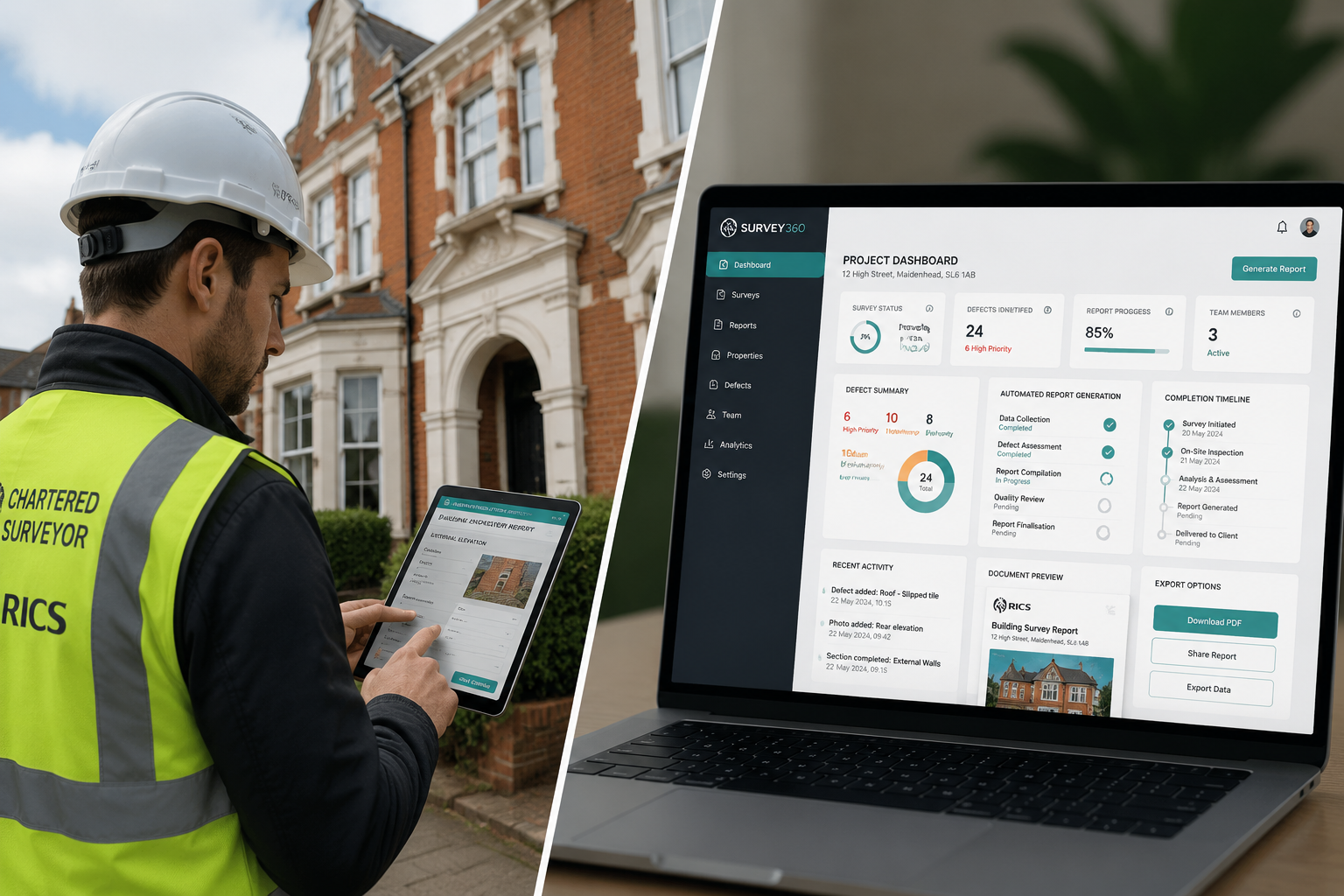
RICS introduced its accelerated building survey protocols specifically in response to the buyer demand surge of 2026, targeting completion-ready survey reports within six weeks of instruction [1]. The protocols rest on two pillars: standardised inspection checklists and digital reporting systems.
Standardised Inspection Checklists
Standardisation does not mean superficiality. A standardised checklist ensures that every surveyor covers the same categories — structure, roof, walls, drainage, services, building regulation compliance, and planning history — in a consistent sequence that allows digital systems to process and flag findings automatically. It also allows solicitors and mortgage lenders to read reports more quickly because the format is familiar.
For extended chains, standardisation delivers an additional benefit: comparability. When all surveys in a chain follow the same format, the estate agent coordinating the chain can identify at a glance which properties have outstanding issues and which are ready to proceed.
Digital Reporting and Automated Flagging
The shift from PDF reports delivered by email to structured digital reports accessible through a shared platform is the most significant operational change in the surveying sector in 2026. Digital reports allow:
- Real-time access for all parties simultaneously, eliminating the delay between report completion and stakeholder review.
- Automated defect flagging that categorises issues by urgency, enabling solicitors to raise enquiries the same day a report is published.
- Audit trails that record when each party reviewed each section, reducing disputes about what was known and when.
S&P Global's work on simplifying restructured processes in financial transactions demonstrates that reducing operational friction through digital platforms can meaningfully accelerate execution timelines [7]. The same principle applies directly to survey reporting: removing manual handoffs compresses the timeline without reducing the quality of the underlying work.
The Updated Standards Framework
While the updated ALTA/NSPS Land Title Survey Standards effective from February 2026 apply primarily to the US market [2], their emphasis on clearer documentation of encroachments and more explicit responsibility allocation reflects a global direction of travel. UK surveyors operating under RICS guidance are moving in the same direction: greater clarity, faster reporting, and explicit assignment of responsibility for follow-up actions.
For buyers and their solicitors, this means that a well-structured survey report in 2026 should arrive with a clear action list, not just a catalogue of observations. Knowing immediately whether a damp issue requires a specialist damp surveyor, a structural engineer, or simply a maintenance contractor is the difference between a one-week delay and a three-week delay.
Practical Strategies for Integrating Building Surveys into Extended Transaction Chains 2026
Mitigating delays in recovering markets requires more than faster survey delivery. It requires a fundamental rethink of when surveys are commissioned, how findings are communicated, and who is responsible for coordinating the chain's response.

Commission Surveys at Offer Acceptance, Not After
The most common source of avoidable delay is waiting for legal searches to return before commissioning a survey. In an extended chain, searches and surveys should run in parallel from the moment an offer is accepted. A buyer who waits for their solicitor's initial enquiries before instructing a surveyor is adding two to four weeks to the process before it has properly begun.
For properties with known complexity — listed buildings, properties near flood zones, or homes with extensions that may not have building regulation approval — early survey commissioning is even more critical. Understanding planning and permitted development history from the outset shapes the legal enquiries that follow, rather than creating a second round of enquiries after exchange is already in sight.
Use Survey Findings to Drive Renegotiation Early
One of the most disruptive patterns in extended chains is late-stage renegotiation triggered by survey findings. A buyer who receives a survey report two weeks before the agreed exchange date and then attempts to renegotiate the price creates a crisis for every other party in the chain.
Early survey commissioning solves this problem structurally. When a survey is completed within the first three weeks of a transaction, any defects identified can be priced and negotiated before the chain has consolidated around a single exchange date. Understanding how to negotiate a house price after a survey — and doing so promptly — protects not just the buyer but every other party in the chain.
The data on post-survey price reductions is instructive: buyers who negotiate based on survey findings typically achieve reductions that more than offset the cost of the survey, but the timing of that negotiation determines whether it strengthens or destabilises the chain.
Coordinate Specialist Follow-Up Proactively
A building survey that identifies issues requiring specialist investigation — structural movement, asbestos, drainage defects, or electrical compliance — is not a problem. It is information. The problem is when that information sits unactioned because no one has been assigned responsibility for commissioning the specialist report.
In a well-managed extended chain, the estate agent or a dedicated transaction coordinator should maintain a live register of outstanding specialist investigations across all properties in the chain. When a Level 3 building survey recommends specialist input, that recommendation should trigger an immediate instruction, not a conversation about whether one is needed.
The Construction Users Roundtable's 2026 guidance on integrated delivery models for capital projects makes the same point at scale: aligning engineering, procurement, and construction phases early — rather than sequentially — is what produces schedule certainty [6]. The residential transaction equivalent is aligning survey, legal, and financial due diligence from day one.
Build Survey Timelines into Chain Agreements
A practical and underused tool is the inclusion of explicit survey milestones in the heads of terms or memorandum of sale. Rather than a single target exchange date, a well-structured chain agreement should specify:
| Milestone | Target Timing from Offer Acceptance |
|---|---|
| Survey instructed | Within 3 working days |
| Survey completed | Within 15 working days |
| Specialist investigations instructed (if required) | Within 5 working days of survey receipt |
| Specialist reports received | Within 10 working days of instruction |
| Price renegotiation concluded (if applicable) | Within 5 working days of specialist reports |
| Legal enquiries substantially resolved | Within 25 working days |
| Exchange of contracts | Within 35-42 working days |
This framework is not legally binding in most residential transactions, but it creates shared expectations and a visible accountability structure. Estate agents who use it consistently report fewer late-stage chain collapses.
Recognise When Urgent Issues Require Immediate Action
Not every survey finding can be managed within a standard timeline. Some defects — structural instability, active water ingress, or fire safety failures — require immediate attention regardless of where the transaction stands. Surveyors operating under RICS protocols are required to flag urgent or dangerous building issues separately and immediately, outside the standard report format.
For chain management purposes, an urgent flag should trigger a chain-wide pause and a coordinated decision about whether to proceed, renegotiate, or withdraw. A chain that presses forward past an urgent structural issue because no one wants to be the party that causes a collapse is a chain that will face far greater costs later.
The Role of Supply Chain Stability in 2026
Survey findings that require remedial work before completion — or that inform post-completion budgets — are directly affected by the availability and cost of building materials and contractors. The first quarter of 2026 saw a rebound in mergers and acquisitions within the building products sector, with 100 announced transactions reflecting improved financing conditions and stabilising market sentiment [3]. QXO's $2.25 billion acquisition of Kodiak Building Partners in April 2026 is expected to enhance supply chain efficiencies and reduce delays in building material availability [4], and by June 2026, over $19 billion had been committed to acquisitions across wholesale distribution including building products [5].
For buyers and surveyors, this consolidation trend is broadly positive: it suggests that the material shortages and contractor availability problems that plagued the market in 2022 and 2023 are easing. Remedial work identified in a survey is more likely to be costed accurately and completed on schedule in 2026 than it was two years ago. That reliability makes post-survey renegotiation more straightforward and reduces the risk that agreed remedial works will overrun and delay completion.
Building a Culture of Survey-First Transaction Management
The technical protocols and practical strategies described above are only effective if the professionals involved in a transaction share a common understanding of why they matter. The shift from survey-as-obstacle to survey-as-accelerator requires a change in culture as much as a change in process.
Estate agents who frame the survey as a bureaucratic hurdle to be cleared as quickly as possible will always produce chains that are vulnerable to late-stage disruption. Estate agents who frame the survey as the transaction's most important risk-management tool — and who coordinate the chain accordingly — will consistently achieve faster, more stable completions.
For buyers, the message is equally clear. A comprehensive building pathology assessment is not an optional extra for older or complex properties. It is the document that determines whether the price agreed is the price that should be paid, and whether the property can be insured, mortgaged, and occupied without immediate remedial expenditure.
In a recovering market where competition for properties is increasing but buyers remain cautious, the survey is the instrument that converts caution into informed confidence — or that prevents an expensive mistake before it becomes irreversible.
Conclusion
Integrating Building Surveys into Extended Transaction Chains 2026: Mitigating Delays in Recovering Markets is not a theoretical aspiration — it is an operational necessity. The RICS accelerated survey protocols, the shift to digital reporting, and the improving supply chain environment all create conditions in which faster, safer completions are achievable. But they only deliver results when professionals across the chain commit to earlier survey commissioning, proactive specialist coordination, and transparent milestone management.
Actionable next steps for professionals in 2026:
- Instruct a Level 3 building survey within three working days of offer acceptance on any property that is not new-build or recently refurbished.
- Request digital report delivery from your surveyor and ensure all parties — solicitor, mortgage broker, and estate agent — have immediate access.
- Establish a chain milestone schedule at the memorandum of sale stage and review it weekly.
- When a survey identifies defects, commission specialist reports within five working days rather than waiting for legal enquiries to prompt action.
- Use post-survey renegotiation as a chain-stabilising tool, not a chain-destabilising one: resolve price adjustments early and document them clearly.
The property market in 2026 is recovering, but recovery is not the same as resilience. Building survey integration, done well, is what converts a recovering market into a stable one — one completed transaction at a time.
References
[1] Building Survey Protocols For Accelerated 6 Week Completions Rics Strategies Amid 2026 Buyer Demand Surge – canterburysurveyors.com
[2] Whats New In The 2026 Alta Nsps Standards – altalandsurvey.com
[3] Building Products Ma And Sector Update – fmicorp.com
[4] Qxo Closes On Kodiak Building Partners Deal – housingwire.com
[5] Distribution Deal Boom Tops 19 Billion As Buyers Race For Scale – distributionstrategy.com
[6] De Risking Large U S Capital Projects Through Integrated Delivery – curt.org
[7] Restructures Simplified Execution Accelerated Liquidity Unlocked – spglobal.com
[8] Council On Vertical Urbanism S 2026 Trends Forecasts Report Signals Recalibration In Global Tall Building Development – globenewswire.com