

A property in Manchester and a near-identical one in South London can carry valuations that differ by six figures — not because of size or age, but because of where the 2026 recovery has reached, what an EPC certificate says, and whether a surveyor found damp behind the kitchen wall. Understanding how UK surveyors assess 'market value' in a patchy 2026 recovery — accounting for regional splits, energy ratings and condition adjustments — is essential for any buyer, seller or lender navigating today's uneven market.
This article explains, in plain terms, how chartered valuers interpret mixed signals when producing a RICS-compliant market value report. It covers the regional divergences shaping comparable evidence, the growing weight of Energy Performance Certificate ratings in valuation calculations, and the systematic deductions surveyors apply for physical defects.
Key Takeaways
- The 2026 UK property market is recovering unevenly: northern cities show resilience while London and the South East remain below 2022 peak values.
- RICS-compliant valuers rely on comparable sales from the past three to six months, tightening that window further in fast-moving or declining markets.
- Properties rated EPC F or G are selling at discounts of up to 20% compared to equivalent C-rated homes in some regions.
- Structural defects — damp, subsidence, outdated services — trigger specific downward adjustments that can materially reduce a valuation figure.
- The incoming Home Energy Model (HEM), confirmed for 2027, is already influencing how surveyors weight retrofit potential in current assessments.

The 2026 Recovery Landscape: Why 'Market Value' Is Not a Single Number
The phrase "market value" has a precise legal and professional definition. Under RICS guidance, it is the estimated amount for which a property should exchange on the date of valuation between a willing buyer and a willing seller in an arm's-length transaction, after proper marketing, where both parties act knowledgeably and without compulsion. That definition sounds clean. The reality of applying it in 2026 is considerably messier.
Savills has forecast a 2% decline in mainstream UK house prices for 2026, citing the continued drag of elevated mortgage costs on buyer affordability [4]. Yet that headline figure masks enormous variation. London experienced a peak-to-trough decline of 8.3% between 2023 and 2024, with average prices in late 2025 still running approximately 12% below their 2022 peaks [1]. Meanwhile, Manchester and Edinburgh have shown modest growth potential heading into 2026, supported by stronger local employment fundamentals and relatively lower entry prices [1].
The RICS January 2026 residential survey captured this divergence directly. New buyer enquiries improved to a net balance of -15% nationally, up from -21% in December 2025. Agreed sales posted a net balance of -9%, the least negative reading since June 2025 [2]. These are stabilisation signals, not recovery signals — and a chartered valuer reading them must decide which direction the local sub-market is actually moving.
Why this matters for valuation: A surveyor cannot simply take a national index figure and apply it to a specific property. They must locate the property within its micro-market and assess whether that market is still falling, stabilising or gently rising. The answer changes the weight given to each comparable sale.
How Regional Divergence Shapes Comparable Selection
Comparable evidence — recent sales of similar properties nearby — is the foundation of every RICS-compliant market value assessment. In a stable market, surveyors typically draw on sales from the past twelve months within a reasonable geographic radius. In 2026, that methodology has been tightened considerably.
London-based surveyors are prioritising comparables from the last three months, given the monthly price softness still visible in prime and outer London markets [7]. In contrast, a valuer working in a northern city with modest upward momentum may extend their search window to six months without distorting the result. The key principle is that comparables must reflect current market sentiment, not historical peaks.
For buyers and sellers in specific areas, working with chartered surveyors in London who understand these micro-market dynamics is not optional — it is the difference between an accurate valuation and one that is materially wrong.
| Region | 2026 Market Direction | Comparable Window Used |
|---|---|---|
| Inner London | Soft / stabilising | 2-3 months |
| Outer London / Surrey | Cautiously stabilising | 3-4 months |
| Manchester / Leeds | Modest growth | 4-6 months |
| Edinburgh / Glasgow | Resilient | 4-6 months |
| South West / East Anglia | Mixed | 3-5 months |
Transaction volumes are also normalising as the interest rate environment becomes more predictable [8], which gives surveyors more comparable evidence to work with than was available during the thin-market conditions of 2023 and early 2024. More comparables mean more reliable adjustments — but only when those comparables are genuinely like-for-like.
Energy Performance Certificates: The Valuation Variable That Has Changed Everything
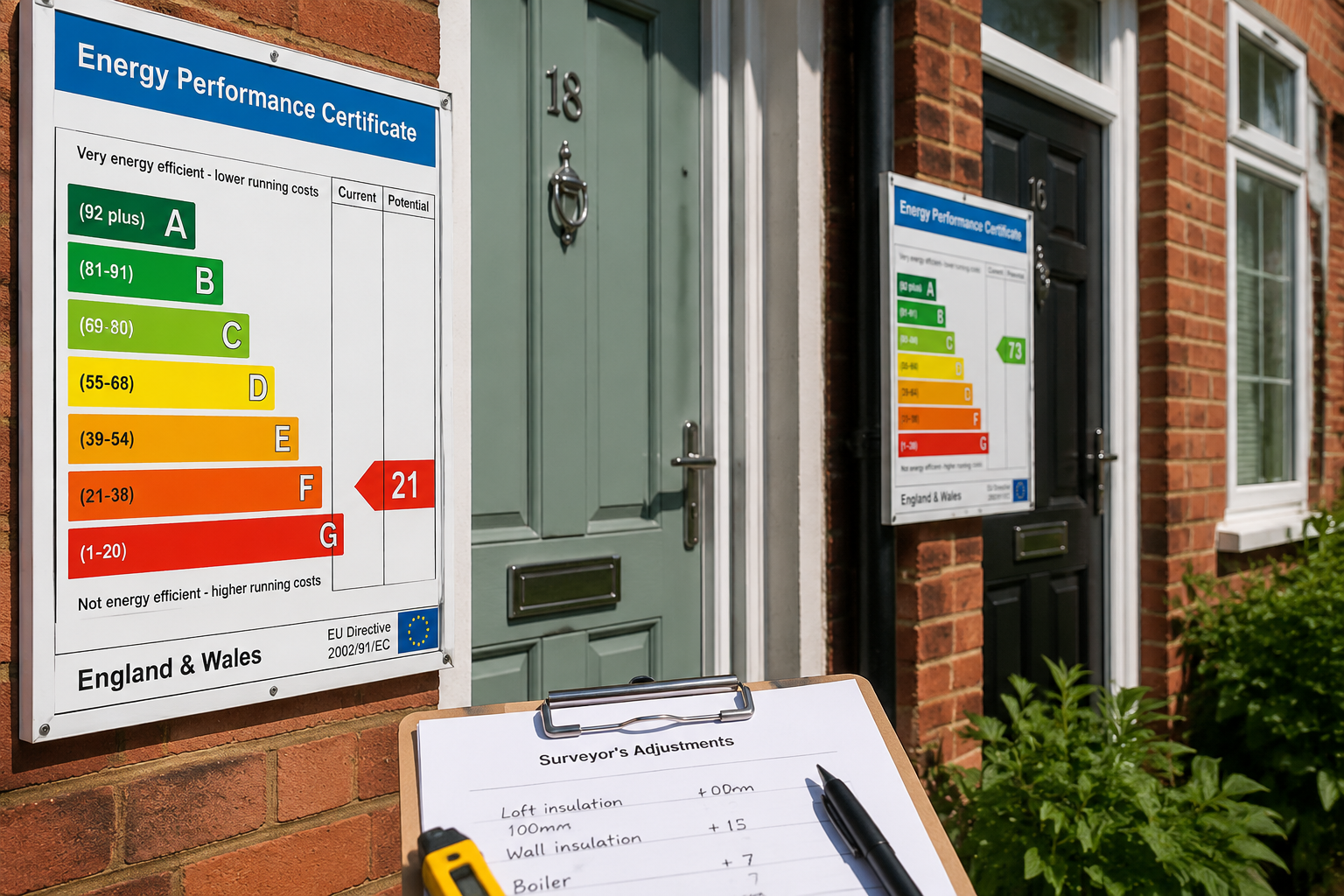
Five years ago, an EPC rating was largely a compliance box to tick. In 2026, it is a material valuation factor that can move a figure by tens of thousands of pounds. Understanding how UK surveyors assess 'market value' in a patchy 2026 recovery — particularly the energy ratings component — requires understanding both the current EPC system and the regulatory changes already on the horizon.
Properties rated F or G are now selling at discounts of up to 20% compared to equivalent C-rated properties in certain UK regions [3]. That is not a marginal adjustment. On a property with a notional value of £350,000, a 20% EPC-related discount represents £70,000 — a figure large enough to determine whether a mortgage lender will fund the purchase at the agreed price.
Why EPC Ratings Create Valuation Adjustments
The mechanism is straightforward. Buyers increasingly factor in the cost of bringing a property up to EPC band C, particularly given the government's stated direction of travel on minimum energy efficiency standards for rental and owner-occupied properties. A surveyor assessing market value must reflect what a willing, informed buyer would actually pay — and informed buyers in 2026 are pricing in retrofit costs.
RICS has introduced tools to help valuers quantify the impact of energy efficiency upgrades on market value, including frameworks for assessing retrofit potential [3]. This means a surveyor is not simply noting the current EPC band; they are also considering what the property could achieve after upgrades, and whether the cost of those upgrades is proportionate to the value gain.
"The growing emphasis on energy efficiency has led to the integration of retrofit potential into property valuations. Surveyors are now expected to assess not just what a property is worth today, but how its energy characteristics affect buyer demand and future saleability."
The UK government confirmed in January 2026 that the current EPC system will be replaced by the Home Energy Model (HEM) in 2027 [6]. HEM will present four separate performance metrics rather than a single A-to-G band, providing a more granular picture of a property's energy performance. Surveyors are already factoring this transition into their assessments, recognising that properties with poor fabric performance — regardless of their current EPC letter — face increasing market headwinds.
Practical EPC Adjustments in a Valuation Report
When a surveyor encounters an EPC F or G property, the adjustment process typically follows this sequence:
- Identify the cost of remediation — insulation, boiler replacement, window upgrades — using recognised cost databases.
- Assess local buyer sensitivity — EPC discounts are larger in markets where buy-to-let investors are active (due to minimum energy efficiency standards) and in areas with high energy costs.
- Apply a market-derived adjustment — not a mechanical cost deduction, but a figure reflecting what comparable sales data shows buyers are actually discounting.
- Document the reasoning — RICS standards require the valuer to explain adjustments transparently in the report.
For properties where energy efficiency is a concern, a RICS specialist defect survey can identify the specific fabric issues driving a poor EPC rating, providing the surveyor with precise cost evidence to support their adjustment.
Condition Adjustments: How Physical Defects Reduce Market Value
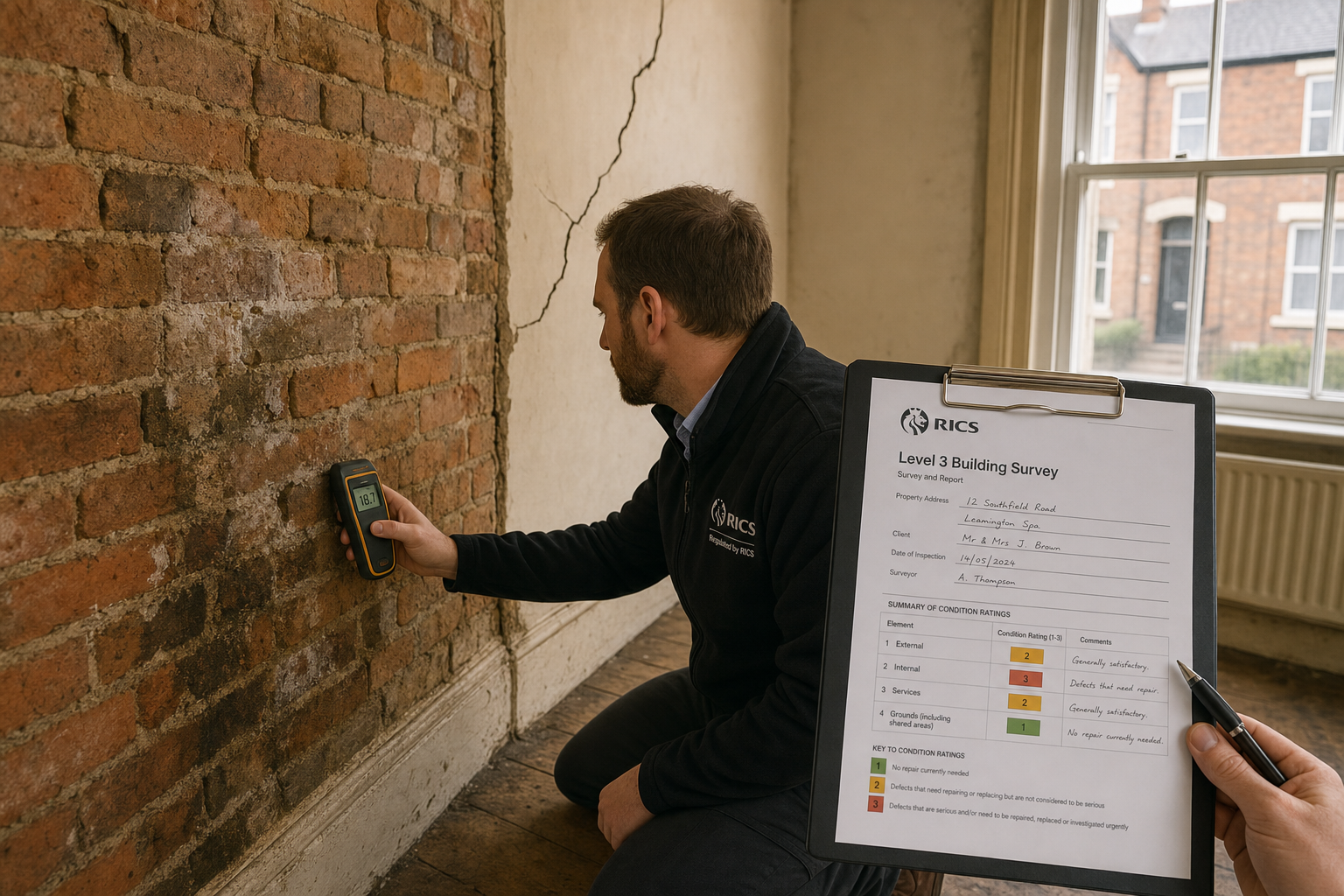
Energy ratings are now a headline valuation variable, but physical condition has always been the most direct driver of downward adjustments. Structural defects such as damp, subsidence, outdated electrical systems, or failing roofs can each trigger material reductions in a RICS-compliant market value assessment [5].
The challenge for a lay reader is understanding why a surveyor's condition adjustment is not simply the cost of repair. The adjustment reflects what the market — specifically, a pool of willing, informed buyers — would discount for the defect. In some cases, the market discount exceeds the repair cost, because buyers factor in disruption, risk, and uncertainty. In others, particularly for cosmetic issues, the market discount may be less than the actual cost of rectification.
Common Condition Factors and Their Valuation Impact
Damp and timber decay: Active rising damp or penetrating damp is one of the most common defects found in UK residential surveys. The valuation impact depends on severity, cause, and whether the damp has caused secondary timber decay. A surveyor will typically obtain or reference specialist contractor quotes and apply a market-derived adjustment that reflects both remediation cost and buyer aversion.
Subsidence and structural movement: Evidence of active subsidence — as opposed to historic, stable movement — can reduce market value significantly and may make a property unmortgageable until remediated. Surveyors will refer to structural engineering evidence and, where necessary, recommend a specialist defect report before finalising the valuation.
Outdated services: A property with a pre-2000 fuse board, lead pipework, or a condemned boiler carries measurable market risk. Buyers and lenders are increasingly aware of these issues, and surveyors adjust accordingly.
Non-standard construction: Properties built with non-standard materials — concrete panels, timber frame, steel frame — require specific assessment. Lenders often apply additional conditions or refuse to lend entirely, which directly affects market value by restricting the pool of potential buyers. A non-standard construction survey provides the detailed evidence a valuer needs to support their figure.
The Condition Rating System in RICS Reports
RICS Level 2 and Level 3 surveys use a standardised condition rating system:
| Condition Rating | Description | Valuation Impact |
|---|---|---|
| 1 | No repair currently needed | Neutral |
| 2 | Defects requiring attention but not urgent | Minor downward adjustment |
| 3 | Serious defects requiring urgent attention | Material downward adjustment |
A property with multiple Condition 3 ratings will almost always receive a valuation below the agreed purchase price — what is commonly called a "down valuation." This is not the surveyor being obstructive; it is the surveyor reflecting what the market would actually pay for a property in that condition [5].
Buyers who receive a down-valued report should understand that the surveyor's figure is the professional's best estimate of what the property would fetch on the open market in its current state. The RICS Home Survey provides both the condition assessment and the market value figure in a single integrated report, making it easier to understand how defects have influenced the final number.
How UK Surveyors Assess 'Market Value' in a Patchy 2026 Recovery: Bringing It All Together
The process of arriving at a RICS-compliant market value in 2026 is best understood as a structured reconciliation of three evidence streams: regional market data, energy performance characteristics, and physical condition. None of these operates in isolation.
A surveyor working on a Victorian terrace in Battersea, for example, might find:
- Comparable sales from the past three months showing a 3% softening in the immediate postcode
- An EPC rating of E, with a notional upgrade cost of £12,000 to reach band C
- A Condition 3 rating for damp in the lower ground floor
Each element requires a separate, documented adjustment. The regional market data sets the base level. The EPC adjustment reflects buyer sensitivity to energy costs and forthcoming regulatory requirements. The condition adjustment reflects the cost and risk associated with the damp. The final figure is the surveyor's professional judgement of what a willing, informed buyer would pay for that specific property on that specific date.
This is also why understanding valuation factors in detail matters for anyone commissioning or receiving a valuation report. The headline number is the output of a complex, evidence-based process — and knowing what drove it helps buyers negotiate, sellers price realistically, and lenders make informed lending decisions.
The Role of Registered RICS Valuers
Not every surveyor is qualified to produce a RICS-compliant market value report. Formal valuations for mortgage, tax, legal, or dispute purposes must be produced by registered RICS valuers who are bound by the RICS Red Book Global Standards. These standards require valuers to document their comparable evidence, explain their adjustments, and declare any conflicts of interest.
In the patchy 2026 recovery, the quality of that documentation matters more than ever. A valuation produced with thin comparable evidence, no EPC adjustment, and no condition analysis is not just professionally inadequate — it exposes lenders and buyers to real financial risk.
Conclusion
The 2026 UK property market is not one market — it is dozens of overlapping sub-markets, each at a different point in a slow and uneven recovery. For chartered surveyors, this complexity demands rigorous methodology: tighter comparable windows, explicit EPC adjustments, and transparent condition-based deductions, all documented to RICS Red Book standards.
Actionable next steps for buyers and sellers:
- Commission a survey before exchanging contracts. A RICS Home Survey or Level 3 Building Survey will identify condition issues before they become post-exchange surprises.
- Check the EPC rating early. If a property is rated E, F or G, obtain retrofit cost estimates before making an offer — these costs should inform your bid, not emerge as a shock after valuation.
- Understand regional context. A valuation in Surrey operates under different market conditions than one in East London. Use a surveyor with genuine local knowledge.
- Do not confuse asking price with market value. If a surveyor down-values a property, treat that as evidence, not an obstacle. Use it to renegotiate or walk away.
- Prepare for HEM. The Home Energy Model arrives in 2027. Properties with poor fabric performance will face growing buyer resistance. Sellers who invest in energy upgrades now are protecting future saleability.
The gap between what a seller hopes to achieve and what a RICS valuer confirms as market value is, in 2026, often explained by three things: where the property sits in a regionally divergent recovery, what its EPC certificate says, and what a surveyor found when they looked behind the walls.
References
[1] Uk Property Market 2026 Navigating Post Rate Cycle Recovery And Regional Diverge Dbfa26aa – propertybird.io
[2] Uk Resi Survey Jan 2026 Report Shows Early Signs Market Recovery Despite Caution – rics.org
[3] Valuing Retrofit Potential In Cautious Spring 2026 Markets Rics Tools For Epc C Upgrades – kingstonsurveyors.com
[4] Savills Revises Its Five Year House Price Forecast – bebeez.eu
[5] Down Valuations Explained How Surveyors Justify Market Value In A Volatile Uk Housing Market – manchestersurveyors.com
[6] Epc Reform 2026 New Rating System – epcadvisor.co.uk
[7] Valuation Adjustments In Regional Divergences Rics February 2026 Data For Surveyors In London Vs North – canterburysurveyors.com
[8] Uk Property Market Metrics 2026 Analyzing Price Stabilization And Listing Liquidity – anuto.net
How Prince Surveyors can help: explore our property valuations or learn about our which survey you need.