

Last updated: July 24, 2026
Quick Answer: Fixing rising damp requires identifying and repairing the root cause, whether that is a failed damp proof course, bridged DPC, or a drainage issue, before applying any treatment. Chemical injection is the most widely used remedial method in the UK, but many cases diagnosed as rising damp are actually condensation or penetrating damp. A professional survey should always come first.
Key Takeaways
- Rising damp is caused by groundwater moving upward through masonry when a damp proof course (DPC) is absent, failed, or bridged.
- Most cases of wall dampness in UK homes are condensation or penetrating damp, not rising damp. Misdiagnosis is extremely common.
- A professional damp survey is the most reliable way to confirm rising damp before spending money on treatment.
- Chemical DPC injection is the standard remedial treatment, but it must be paired with replastering using renovating plaster.
- Costs typically range from £800 to £3,000 for a standard treatment, depending on the extent of the problem and property size.
- Ignoring rising damp leads to structural damage, timber rot, and serious health risks from mould.
- Painting over rising damp without treating the cause will fail within months.
- Landlords in England and Wales are legally responsible for fixing rising damp in rental properties.
What Is Rising Damp and How Does It Happen?
Rising damp occurs when groundwater travels upward through the pores and capillaries of masonry walls or floors. It happens because all masonry is porous, and without a functioning damp proof course (a horizontal barrier built into the wall), moisture from the ground has an unobstructed path upward.
In practice, true rising damp is less common than many damp-proofing companies suggest. It typically affects:
- Pre-1875 properties built without a DPC
- Properties where the original DPC has failed or cracked
- Walls where external ground levels, render, or paving have been raised above the DPC (known as "bridging")
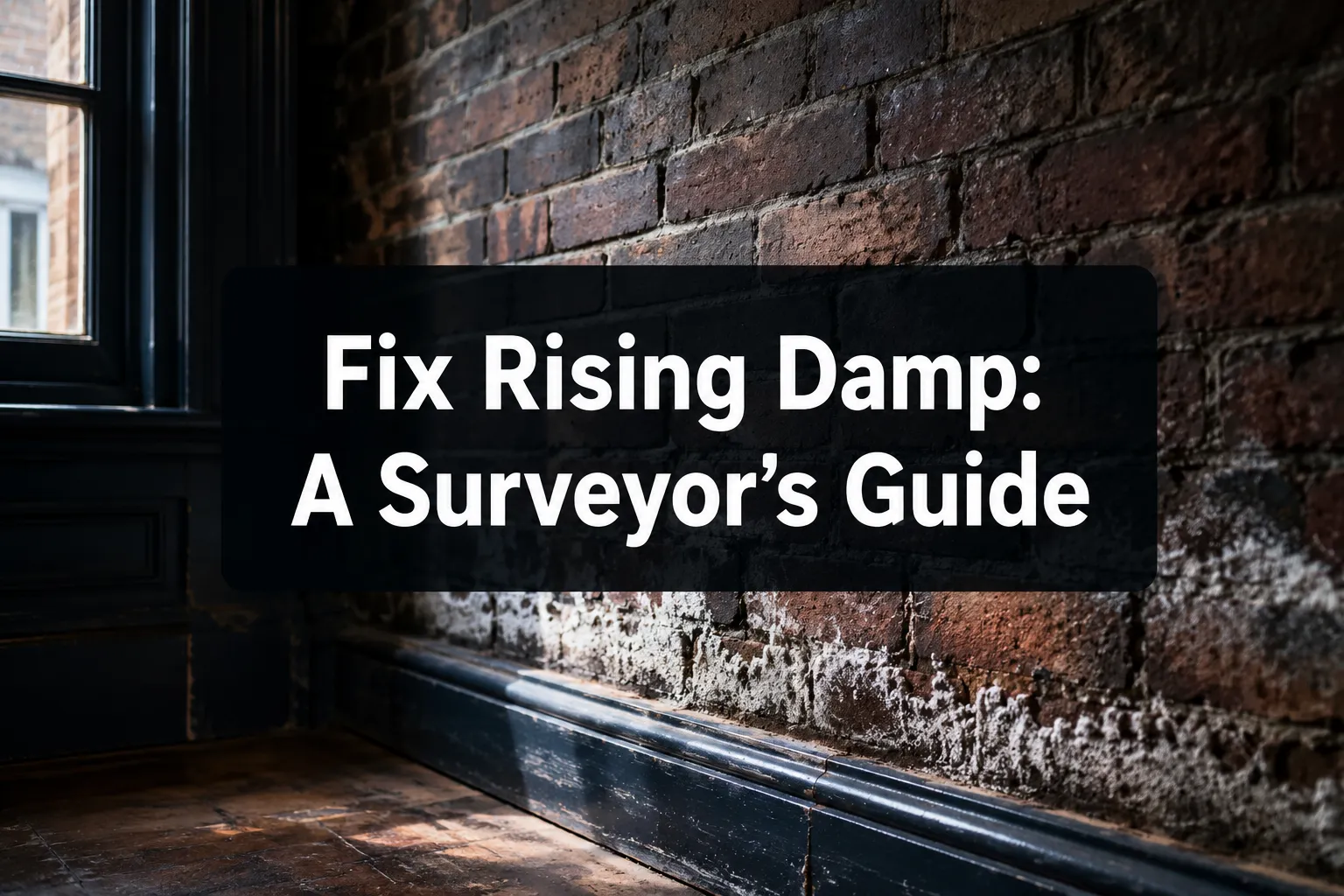
The classic signs are a tide mark on the wall (usually no higher than 1 metre), damp patches that worsen in wet weather, salt deposits (efflorescence) on plaster, and peeling wallpaper at low level.
Signs of Rising Damp in Walls and How to Spot It Early
The earliest sign of rising damp is a damp patch at skirting board level that does not dry out, even in summer. Unlike condensation, rising damp tends to be worse at the base of walls and shows a distinct upper boundary (the tide mark).
Key indicators to look for:
- Tide mark: A horizontal stain, typically between 300mm and 1,000mm above floor level
- Salt deposits: White crystalline staining on plaster or brickwork
- Damp or rotten skirting boards: Timber in contact with damp masonry deteriorates quickly
- Peeling or bubbling wallpaper: Especially at low level near external walls
- Musty smell: Persistent even after ventilation
Early detection matters. A small area of rising damp caught before it saturates the plaster is far cheaper to treat than a wall requiring full re-plaster.
For a professional assessment, a damp survey from a qualified surveyor will use a calibrated moisture meter alongside visual inspection to distinguish rising damp from other moisture sources.
Rising Damp vs Condensation: What Is the Difference?
This is the most important question before spending anything on treatment. The majority of damp complaints in UK homes are condensation, not rising damp. Treating the wrong problem wastes money and leaves the real issue unresolved.
| Feature | Rising Damp | Condensation |
|---|---|---|
| Location | Base of walls, floors | Upper walls, ceilings, cold corners |
| Pattern | Tide mark, consistent height | Patchy, follows cold surfaces |
| Season | Worse in winter and wet weather | Worse in winter (heating on) |
| Salt staining | Common | Rare |
| Mould type | Rare on its own | Black mould very common |
| Timber damage | Yes (skirting boards) | Possible on window frames |
Penetrating damp is another common misdiagnosis. It enters horizontally through cracks, failed pointing, or defective gutters, and can appear anywhere on a wall, not just at the base.
If there is any doubt, do not commission treatment until a proper diagnosis has been made. A Level 3 full building survey will assess all moisture sources in context.
Can You Fix Rising Damp Yourself or Do You Need a Professional?
Some minor contributing factors can be addressed as DIY, but the core treatment for rising damp requires professional installation to be effective and to carry a guarantee.
What you can do yourself:
- Lower external ground levels that are bridging the DPC (if safe to do so)
- Clear debris from airbricks and ensure subfloor ventilation is adequate
- Improve drainage around the property perimeter
- Replace damaged pointing on external walls
What requires a professional:
- Chemical DPC injection (requires specialist equipment and correct product selection)
- Replastering with salt-resistant renovating plaster
- Installation of a new physical DPC (rare, used in specific circumstances)
- Diagnosis using calibrated instruments
Attempting to inject a chemical DPC without proper training typically results in poor chemical distribution and treatment failure. Most reputable contractors offer a 20-year guarantee on chemical injection work, which is only valid with professional installation.
Rising Damp Treatment Options and Which One Works Best
The right treatment depends on the confirmed cause. There is no single solution that suits every property.
1. Chemical DPC injection
The most common remedial treatment. A silane or siloxane-based fluid is injected into a series of holes drilled at regular intervals along the mortar course. The chemical cures to form a water-repellent barrier. This is followed by replastering with renovating plaster, which is essential because old plaster retains salts that will continue to cause staining even after the damp source is removed.
2. Physical DPC insertion
A new physical barrier (slate, lead, or plastic membrane) is inserted by cutting through the mortar course. This is rarely used in modern remediation because it is disruptive and expensive, but it is appropriate in some heritage properties.
3. Electro-osmotic DPC
A low-voltage system that claims to reverse the flow of moisture. Evidence for its effectiveness is limited and contested. It is not widely recommended by RICS-registered surveyors.
4. Drainage and ground-level correction
In many cases where DPC bridging is the cause, lowering external ground levels or improving drainage solves the problem without any chemical treatment at all. This should always be investigated first.
When is chemical injection genuinely needed? Chemical injection is appropriate when the DPC is confirmed absent or failed, the wall is structurally sound, and ground-level correction alone is insufficient.
How to Fix Rising Damp: Step-by-Step Process
For UK homeowners dealing with confirmed rising damp, the standard remediation process follows these stages:
- Commission an independent damp survey to confirm the diagnosis and identify all contributing factors.
- Address external causes first: lower bridged ground levels, fix drainage, repair pointing.
- Drill injection holes along the mortar course at 120mm intervals, typically at 150mm above floor level.
- Inject chemical DPC fluid under low pressure and allow to cure (usually 24-48 hours).
- Hack off old plaster to a height of at least 300mm above the highest damp reading.
- Apply salt-resistant renovating plaster in two coats, allowing adequate drying time between coats.
- Redecorate only after the wall has fully dried, which can take several months in older properties.
How Much Does It Cost to Fix Rising Damp?
Costs vary significantly based on wall length, property type, and the extent of replastering required. The figures below are estimates for England and Wales as of 2026.
- Chemical DPC injection only (per linear metre): approximately £50-£100
- Full treatment including replastering (single room): typically £800-£2,000
- Whole-house treatment: commonly £2,000-£5,000 or more
- Independent damp survey: typically £200-£400 (see damp survey cost guide for a full breakdown)
Important: Always obtain at least three quotes from contractors who are members of the Property Care Association (PCA) or hold CSRT/CSSW qualifications. Be cautious of free surveys offered by damp-proofing companies, as these have a commercial incentive to recommend treatment.
How Long Does Rising Damp Treatment Take to Work?
Chemical injection cures within 24-48 hours, but the wall itself will not be dry for considerably longer. Masonry that has been saturated for years holds a large reservoir of moisture that must evaporate naturally.
- Plaster application: can begin 1-2 days after injection
- Wall drying time: typically 1 month per 25mm of wall thickness, so a 225mm solid brick wall may take 9 months or more to fully dry
- Redecoration: should wait until moisture readings are consistently below 20% on a wood-scale meter
Rushing redecoration is one of the most common reasons treatment appears to fail.
Does Rising Damp Treatment Really Work or Is It a Scam?
Chemical DPC injection, when correctly diagnosed and properly installed, does work. The controversy arises because rising damp is frequently misdiagnosed, and treatment is sold for problems that are actually condensation or penetrating damp. In those cases, the treatment will appear to fail because it never addressed the real issue.
The PCA and RICS both acknowledge that over-diagnosis of rising damp is a genuine industry problem. An independent survey from a surveyor with no financial interest in selling treatment is the best protection against unnecessary work.
Can You Paint Over Rising Damp or Will It Come Back?
Painting over rising damp without treating the cause will fail. Moisture vapour will push through even specialist damp-proof paints within months, causing blistering and staining.
Damp-proof paint (also called damp seal or tanking paint) can be used as part of a managed solution in specific circumstances, such as basements, but it is not a substitute for addressing the moisture source. On a rising damp wall, it acts as a temporary cosmetic fix at best.
Rising Damp in Old Houses vs New Builds: Why the Difference?
Pre-1875 properties were built without a DPC, relying on thick walls and natural evaporation. Modern buildings (post-1965) are required by building regulations to include a physical DPC, making true rising damp rare in new builds.
In new builds, damp at low level is almost always condensation, a construction defect such as a bridged DPC, or a plumbing leak. In older solid-wall properties, the picture is more complex, and a thorough survey is essential before any treatment.
Rising Damp in Concrete Floors: How to Fix It
Rising damp in concrete floors presents differently from wall damp. It typically appears as a damp or wet floor surface, lifting floor coverings, or a persistent musty smell at ground level.
The standard fix is to install a damp proof membrane (DPM):
- Liquid-applied DPM: painted onto the existing slab before a new screed or floor covering
- Sheet DPM: a heavy-duty polythene membrane laid under a new screed
- Epoxy resin coating: used in commercial settings and some domestic applications
The floor must be clean and structurally sound before any membrane is applied. If the slab is cracked or heaving, structural repair comes first.
What Happens If You Ignore Rising Damp?
Ignoring rising damp causes progressive and expensive damage. The consequences worsen over time:
- Plaster failure: Salt crystallisation destroys plaster from within
- Timber rot: Skirting boards, floor joists, and door frames in contact with damp masonry will rot
- Structural damage: In severe, long-term cases, freeze-thaw action can spall brickwork
- Health risks: Persistent damp creates conditions for mould growth, which is linked to respiratory problems
- Property value: Damp is one of the most common reasons for a reduced mortgage valuation or a failed sale
Rising Damp in Rental Property: Who Is Responsible?
In England and Wales, landlords are legally responsible for fixing rising damp under the Landlord and Tenant Act 1985 and the Homes (Fitness for Human Habitation) Act 2018. Rising damp that makes a property damp, unsafe, or unhealthy is a breach of the landlord's repairing obligation.
Tenants should report damp in writing and allow reasonable access for inspection and repair. If a landlord fails to act, tenants can report the issue to the local authority's environmental health department, which has powers to issue improvement notices.
FAQ
Q: Is rising damp always visible?
Rising damp is not always visible in its early stages. It may be hidden behind wallpaper, fitted furniture, or skirting boards. A moisture meter survey will detect elevated readings before visible damage appears.
Q: How do I know if my DPC has failed?
A calibrated moisture meter reading above 20% (wood-scale) at low level on an external wall, combined with a tide mark and salt staining, suggests a failed or absent DPC. Confirmation requires a professional survey.
Q: Can rising damp cause black mould?
Rising damp alone rarely causes black mould. Black mould (Cladosporium or Aspergillus) typically indicates condensation. If black mould is present alongside a tide mark, there may be two separate moisture problems.
Q: How long does a chemical DPC last?
A correctly installed chemical DPC should last 20-25 years. Most PCA-registered contractors offer a 20-year guarantee. The guarantee is typically linked to the contractor, so check whether it is transferable on sale.
Q: Do I need planning permission to fix rising damp?
No planning permission is required for standard rising damp treatment. However, if the property is listed, consent from the local planning authority may be needed before any works that affect the historic fabric.
Q: Will fixing rising damp increase my property value?
Resolving confirmed rising damp and providing a guarantee from a PCA-registered contractor can remove a significant obstacle to sale and mortgage valuation. The value uplift depends on the property and market, but removing a known defect always improves saleability.
Interactive Rising Damp Diagnostic Tool
.cg-damp-wrap{font-family:Arial,sans-serif;max-width:520px;margin:0 auto;background:#f4f7fb;border-radius:10px;padding:20px;border:1px solid #d0dce8}
.cg-damp-wrap h3{margin:0 0 14px;color:#1a3a5c;font-size:1.05rem}
.cg-damp-q{margin-bottom:12px;font-size:.92rem;color:#2c2c2c}
.cg-damp-q label{display:block;margin:4px 0;cursor:pointer}
.cg-damp-btn{background:#1a3a5c;color:#fff;border:none;padding:10px 22px;border-radius:6px;cursor:pointer;font-size:.95rem;margin-top:6px}
.cg-damp-btn:hover{background:#2a5a8c}
.cg-result{margin-top:14px;padding:12px;border-radius:7px;font-size:.92rem;line-height:1.5}
.cg-result.rising{background:#fff3cd;border:1px solid #f0c040;color:#5a3e00}
.cg-result.condensation{background:#d4edda;border:1px solid #7bc47f;color:#1a4a1f}
.cg-result.penetrating{background:#fde8e8;border:1px solid #e07070;color:#5a1a1a}
.cg-result.unclear{background:#e8eaf6;border:1px solid #9fa8da;color:#1a237e}
.cg-result strong{display:block;margin-bottom:4px;font-size:1rem}
Rising Damp Quick Diagnostic
function cgCheckDamp(){
var q1=document.querySelector(‘input[name=”q1″]:checked’);
var q2=document.querySelector(‘input[name=”q2″]:checked’);
var q3=document.querySelector(‘input[name=”q3″]:checked’);
var q4=document.querySelector(‘input[name=”q4″]:checked’);
if(!q1||!q2||!q3||!q4){document.getElementById(‘cg-result-box’).innerHTML=’
‘;return;}
var box=document.getElementById(‘cg-result-box’);
if(q1.value===’low’&&q2.value===’yes’&&q3.value===’yes’){
box.innerHTML=’
‘;
} else if(q1.value===’high’&&q4.value===’yes’){
box.innerHTML=’
‘;
} else if(q1.value===’mid’){
box.innerHTML=’
‘;
} else {
box.innerHTML=’
‘;
}
}
Conclusion
Understanding how to fix rising damp starts with getting the diagnosis right. The majority of money wasted on damp treatment in the UK goes on solving the wrong problem. Before commissioning any work, confirm that rising damp is actually present using a calibrated moisture meter survey, check for bridged DPC and drainage issues that can be resolved cheaply, and obtain quotes only from PCA-registered contractors.
Actionable next steps:
- Use the diagnostic tool above to assess your symptoms.
- Commission an independent survey before agreeing to any treatment.
- Address external ground levels and drainage before chemical injection.
- Ensure replastering with renovating plaster is included in any treatment quote.
- Wait for walls to fully dry before redecorating.
Book an independent damp survey – 0204 579 8270
References
- Property Care Association (PCA). Remedial Damp-Proofing: Guidance for Practitioners. 2019. property-care.org
- RICS. Damp in Buildings: Guidance Note. 2nd edition. 2014. rics.org
- Homes (Fitness for Human Habitation) Act 2018. UK Parliament. legislation.gov.uk
- Landlord and Tenant Act 1985. UK Parliament. legislation.gov.uk
- BRE (Building Research Establishment). Recognising Wood Rot and Insect Damage in Buildings. 2002. bregroup.com
Tags: rising damp, how to fix rising damp, damp proof course, rising damp treatment, damp proofing cost, damp survey, penetrating damp, condensation vs rising damp, chemical DPC injection, rising damp in old houses, damp proof membrane, property damp