

Near-term price expectations among UK surveyors dropped sharply to a net balance of -18% in February 2026, down from -6% just one month earlier. That single data point tells a story of rapidly shifting sentiment — one driven not only by domestic market forces but by geopolitical pressures that have, for the first time, overtaken climate risk as the primary concern among European property professionals. The RICS February 2026 residential survey makes clear that Geopolitical Uncertainty and Short-Term Valuation Adjustments: RICS February 2026 Insights are now inseparable concepts for anyone operating in the UK property market.
This article examines what the February 2026 RICS data reveals, how geopolitical forces are reshaping valuation practice, and what property owners, investors, and surveyors should do in response.
Key Takeaways
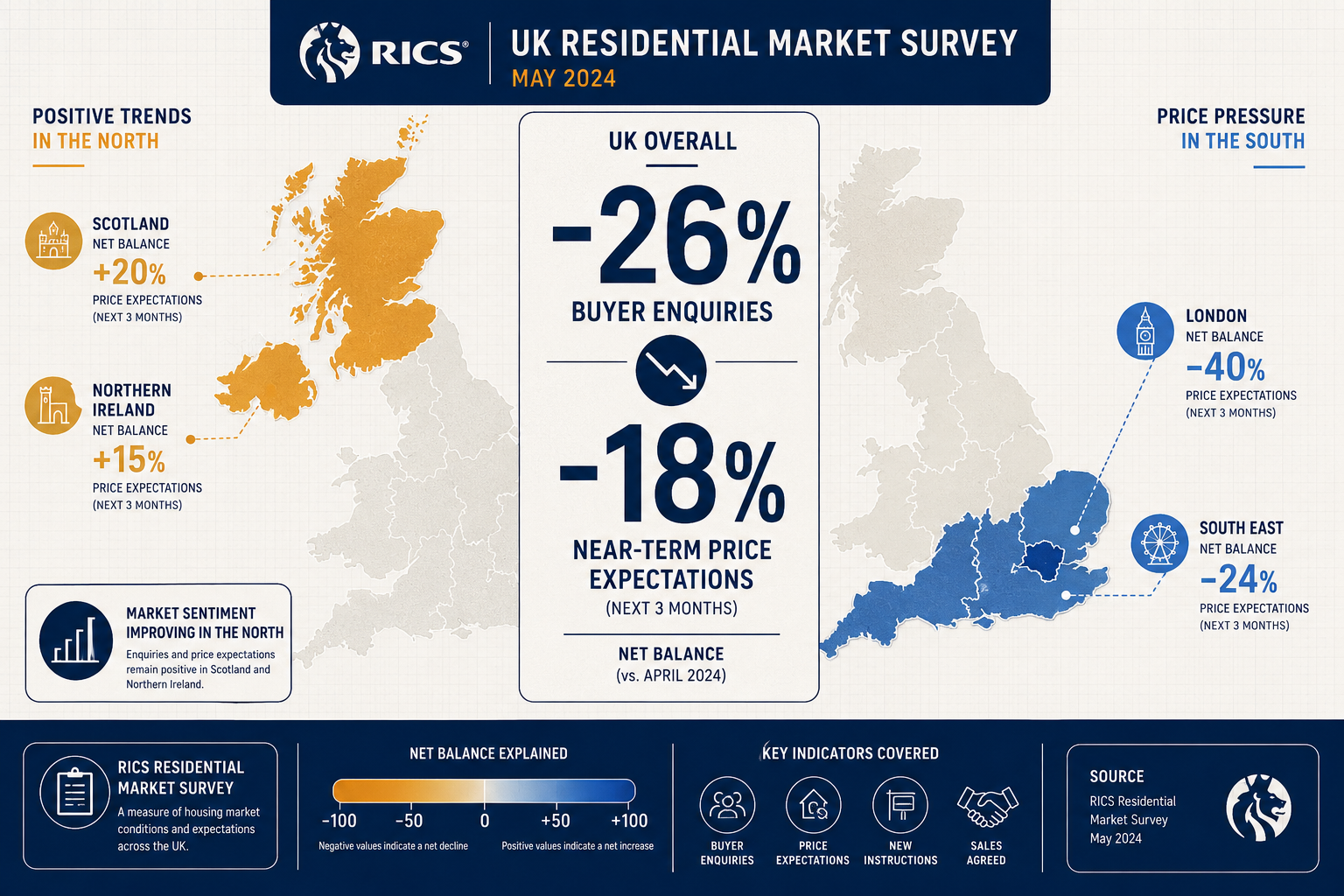
- New buyer enquiries fell to a net balance of -26% in February 2026, signalling renewed demand weakness driven partly by geopolitical uncertainty and rising borrowing costs.
- National house prices remained broadly flat at -12%, but London, the South East, and East Anglia faced meaningful downward pressure, while Northern regions held firmer.
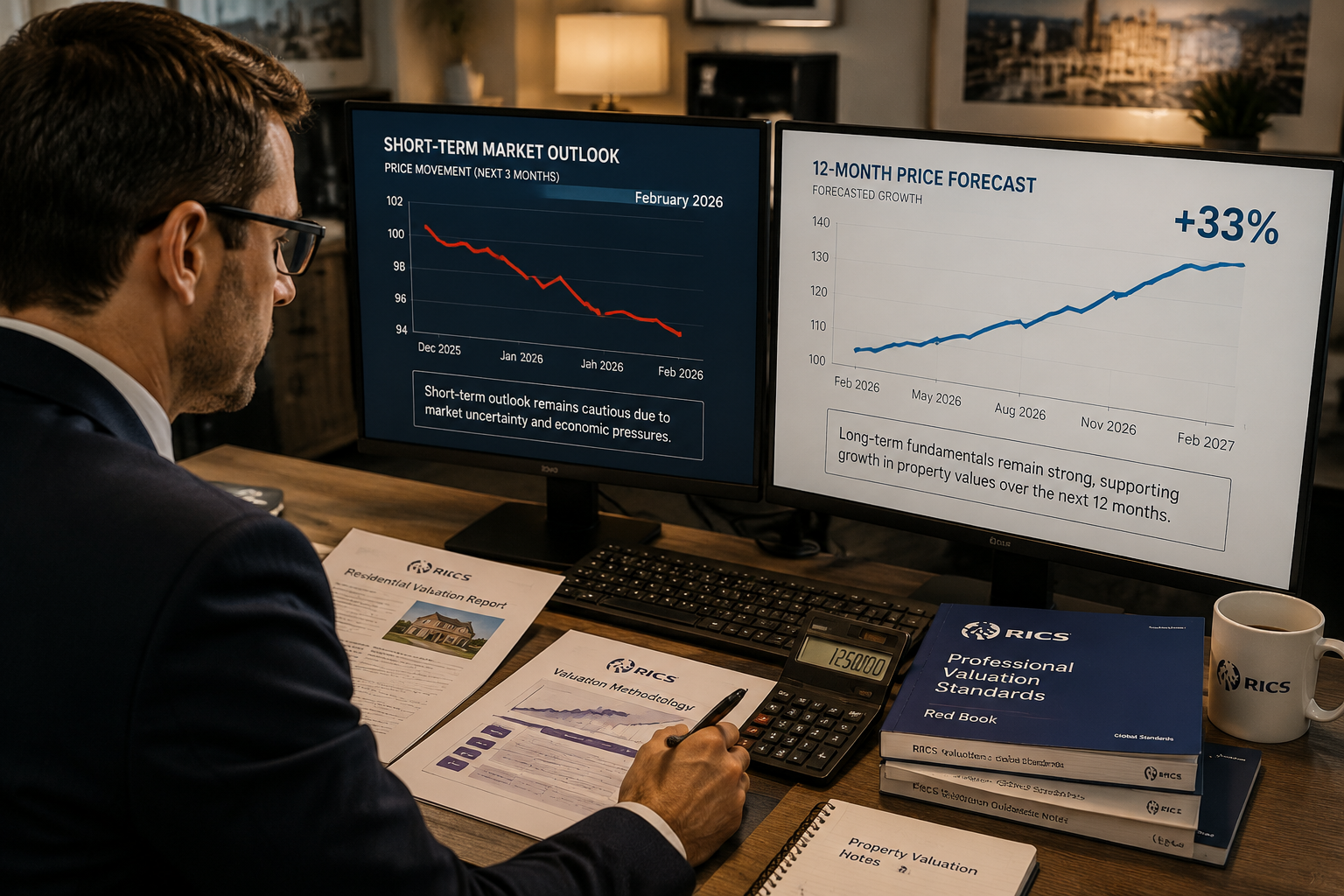
- Near-term price expectations collapsed to -18%, yet 12-month expectations stayed positive at +33%, creating a clear dual-horizon challenge for valuers.
- Geopolitical risk has emerged as the top concern in European property markets, requiring surveyors to embed scenario-based and dual-horizon methods into their valuations.
- Commercial property credit conditions deteriorated sharply in Q1 2026, with the indicator falling to -44%, its weakest reading since Q3 2023.
What the RICS February 2026 Data Actually Shows
Buyer Demand and Price Trends
The headline figures from the RICS UK Residential Survey for February 2026 paint a picture of a market under pressure [1]. New buyer enquiries fell to a net balance of -26%, a notable deterioration from -15% in January. Agreed sales also weakened, reflecting the same cautious mood among prospective purchasers.
On prices, the national picture was broadly flat at a net balance of -12%. However, the regional breakdown tells a more nuanced story:
| Region | Net Balance (Price Trend) |
|---|---|
| London | -40% |
| South East | -24% |
| East Anglia | -26% |
| North West | Positive |
| Scotland | Positive |
| Northern Ireland | Positive |
This divergence matters enormously for valuation practice. A single national figure masks very different realities depending on location. Surveyors working in London face a fundamentally different task from those operating in Belfast or Manchester [1].
Supply and the Rental Market
New instructions entering the sales market were broadly stable at +2%, meaning supply has not tightened in response to weaker demand. That combination — stable supply, falling demand — typically exerts further downward pressure on prices, particularly in already-softening regions.
The rental market presents its own structural problem. Tenant demand held steady at +2%, but landlord instructions remained deeply negative at -27% [1]. The result is a rental market where supply continues to shrink even as demand holds. For those considering commercial valuations or investment decisions based on rental yield, this imbalance is a critical input.
The Long-Term vs Short-Term Divide
Perhaps the most striking feature of the February 2026 data is the gap between near-term and longer-term expectations. While near-term price expectations fell sharply to -18%, 12-month price expectations remained firmly positive at +33% [1]. This is not a market in structural collapse — it is a market experiencing a confidence shock, with professionals broadly expecting conditions to improve over the next year.
"The February 2026 RICS data captures a market caught between short-term fear and long-term faith — a gap that demands more sophisticated valuation methodology, not less."
How Geopolitical Uncertainty Is Reshaping Valuation Practice
Geopolitical Risk as the New Primary Concern
The Geopolitical Uncertainty and Short-Term Valuation Adjustments: RICS February 2026 Insights framework reflects a structural shift in how risk is categorised. For the first time, geopolitical factors have surpassed climate-related risks as the primary concern among European property professionals [5]. The ongoing Middle East conflict has contributed directly to rising borrowing costs, which in turn has dampened buyer demand and reduced transaction volumes in the UK [2].
This is not a temporary blip. When geopolitical tension feeds into global bond markets, it affects mortgage pricing, investor appetite, and ultimately the evidence base that surveyors rely upon to justify valuations. Fewer transactions mean thinner comparable evidence — and thinner evidence means greater uncertainty in any valuation figure.
For those who need a thorough understanding of what factors are examined during a property valuation, the addition of geopolitical risk as a formal input marks a genuine evolution in professional practice.
Dual-Horizon Valuation Methods
Given the sharp divergence between short-term caution and longer-term optimism, surveyors are increasingly advised to adopt dual-horizon valuation methods [4]. Rather than presenting a single point estimate, this approach involves:
- Current Market Value (CMV): A figure reflecting conditions as they stand today, incorporating the subdued demand and cautious sentiment evident in the February 2026 data.
- 12-Month Indicative Range: A forward-looking range that acknowledges the +33% positive price expectation balance and the likelihood of market recovery once geopolitical pressures ease.
This dual presentation gives clients — whether lenders, buyers, or asset managers — a more honest picture of the valuation landscape. It also protects surveyors professionally by making the basis of their assessment transparent.
For capital gains valuations, where the timing of a disposal can significantly affect tax liability, this kind of forward-looking context is particularly valuable.
Scenario-Based Approaches
Beyond dual-horizon methods, the most rigorous response to current conditions involves scenario-based valuation [6]. This means preparing three distinct assessments:
- Pessimistic scenario: Assumes geopolitical tensions persist or worsen, borrowing costs remain elevated, and demand continues to fall.
- Base case scenario: Assumes gradual stabilisation, modest rate relief, and a slow recovery in buyer confidence.
- Optimistic scenario: Assumes a meaningful de-escalation of geopolitical risk, rate cuts materialise as anticipated, and the +33% 12-month expectation balance proves accurate.
Each scenario should be grounded in specific market evidence and clearly labelled as such. This is not about hedging — it is about giving decision-makers the information they need to act appropriately under uncertainty.
Prioritising Recent Market Evidence
With transaction volumes subdued, the comparable evidence available to surveyors is thinner than usual. The professional response is to prioritise very recent transactions — specifically those completed in January and February 2026 — and to apply explicit downward time adjustments in regions where price pressure is most acute [7].
In London, where the net balance on prices has reached -40%, a comparable from late 2025 may no longer accurately reflect current market conditions. Surveyors who do not adjust for this risk producing valuations that overstate value — with potential consequences for lenders, buyers, and the professionals themselves.
Understanding the consequences of failing to act on survey findings applies equally to valuation decisions: inaction or outdated assumptions carry real financial and legal risk.
Commercial Property: A Separate but Related Crisis

Credit Conditions Deteriorate Sharply
The residential market is not alone in feeling geopolitical pressure. The RICS UK Commercial Property Monitor for Q1 2026 reported a dramatic deterioration in credit conditions, with the indicator falling to -44% from +9% in Q4 2025 [3]. That is the weakest reading since Q3 2023, and it reflects how quickly lender confidence can reverse when global uncertainty spikes.
For commercial property owners and investors, this shift has practical consequences. Financing that was available on reasonable terms in late 2025 may now be harder to secure or more expensive. Valuations prepared for loan security purposes need to reflect this tightening, not just the underlying asset value.
Those holding or acquiring commercial assets should ensure their commercial property valuations are conducted by professionals who understand both the current credit environment and the geopolitical factors driving it.
Insurance Reinstatement Values Under Pressure
One area of commercial and residential valuation that often receives insufficient attention during periods of market volatility is insurance reinstatement cost. While market values fluctuate with sentiment, reinstatement costs are driven by construction material prices and labour costs — both of which have been affected by supply chain disruptions linked to ongoing geopolitical instability.
Owners who have not reviewed their insurance reinstatement cost valuations recently may find themselves underinsured if construction costs have risen faster than their policy has been updated.
SIPP and Pension Fund Implications
For pension funds holding commercial property assets, the Q1 2026 credit deterioration and geopolitical uncertainty create a specific challenge. SIPP trustees are required to hold assets at accurate valuations, and a market where credit conditions have swung from +9% to -44% in a single quarter demands fresh professional assessment.
Outdated SIPP pension valuations carry regulatory risk as well as financial risk. Trustees should treat the Q1 2026 commercial property data as a prompt to review whether their current valuations remain fit for purpose.
Practical Guidance for Property Owners and Investors
What This Means for Buyers
The February 2026 data does not suggest a market in freefall. It suggests a market where near-term caution is rational but where those with a 12-month horizon have reason for measured optimism. Buyers who can tolerate short-term uncertainty may find that current conditions offer negotiating room that was absent in 2024 and early 2025.
That said, any purchase decision should be supported by a thorough professional survey. Understanding what to look for when buying an older property is especially important when transaction volumes are low and the pool of comparable evidence is thin — physical condition defects can have an outsized impact on value in a cautious market.
What This Means for Sellers
Sellers in London, the South East, and East Anglia face the most challenging conditions. A net balance of -40% in London means that a significant majority of surveyors are reporting falling prices in that market. Sellers who need to transact quickly should price realistically from the outset rather than testing the market at optimistic levels.
Those with flexibility on timing may benefit from waiting for the geopolitical picture to stabilise. The +33% 12-month expectation balance suggests that professionals broadly anticipate improved conditions by early 2027.
What This Means for Valuers and Surveyors
The Geopolitical Uncertainty and Short-Term Valuation Adjustments: RICS February 2026 Insights framework places new demands on valuation professionals. Key practical steps include:
- Document the geopolitical context explicitly in valuation reports, referencing the RICS February 2026 survey data as evidence of current market sentiment.
- Apply dual-horizon presentation where the instruction allows, separating current market value from a 12-month indicative range.
- Use only the most recent comparable evidence, applying time adjustments where necessary in regions under price pressure.
- Prepare scenario analyses for clients making significant investment or lending decisions.
- Review comparable evidence critically, recognising that thin transaction volumes increase the risk of outlier comparables distorting valuations.
For surveyors who may face expert witness situations arising from valuation disputes in a volatile market, thorough documentation of methodology is essential [5].
Conclusion
The RICS February 2026 data presents a market defined by a sharp but potentially temporary confidence shock. Buyer enquiries have fallen, near-term price expectations have weakened significantly, and commercial credit conditions have deteriorated to their worst level in over two years. Geopolitical uncertainty — particularly the ongoing Middle East conflict — is now the primary risk factor in European property markets, and its effects are visible in both residential and commercial data.
Yet the 12-month outlook remains positive at +33%, and supply has not surged to compound demand weakness. This is a market that rewards careful, evidence-based decision-making rather than either panic or complacency.
Actionable next steps:
- Property owners should commission updated valuations that explicitly account for current geopolitical conditions and regional price trends.
- Buyers should use the current period of reduced competition to negotiate effectively, supported by thorough professional surveys.
- Sellers in softening regions should price realistically and avoid anchoring to 2025 peak values.
- Valuers should adopt dual-horizon and scenario-based methods, document their geopolitical risk assessment clearly, and prioritise January-February 2026 comparable evidence.
- Commercial property holders and SIPP trustees should treat the Q1 2026 credit deterioration as a direct prompt to review current valuations.
For professional valuation advice tailored to the current market, contact a chartered surveyor who understands both the RICS February 2026 data and the geopolitical forces shaping it.
References
[1] UK Residential Survey February 2026 – rics.org
[2] UK Housing Market Slows As Ongoing Middle East Conflict Raises Borrowing Costs – rics.org
[3] RICS UK Commercial Property Monitor Q1 2026 – rics.org
[4] Valuation Adjustments Post RICS February 2026 Survey: Strategies For Cautious Buyer Demand And Regional Price Shifts – wimbledonsurveyors.com
[5] Geopolitical Uncertainty In RICS February 2026 Survey: Expert Witness Preparation For Valuation Volatility Disputes – canterburysurveyors.com
[6] Valuation Adjustments For RICS February 2026 Market Survey Insights: Navigating Mixed Regional Signals – canterburysurveyors.com
[7] Valuation Adjustments For Cautious Spring 2026 Housing Market: RICS February Insights On Buyer Demand Dips And Regional Price Flatness – nottinghillsurveyors.com