

In the North West of England, rents on flats and maisonettes have climbed 55.2% over the past decade. Prices in the same region rose by less than half that amount. This is not a one-off anomaly. According to a new Brickview analysis of ten years of HM Land Registry and ONS data, reported by Landlord Today on 16 October 2026, rents have outpaced purchase prices in every single region of England and Wales. That single fact is quietly rewriting the rules for flat rents vs prices valuation 2026, and anyone buying, selling, lending against, or inheriting a flat needs to understand why.
For a decade, flat valuations leaned almost entirely on comparable sales: what did the flat next door fetch last year. That method still matters, but when rental income grows faster than capital value in every region, the income a flat generates deserves equal weight in the valuation conversation. This article explains what Brickview found, what it means alongside fresh Rightmove and ONS figures, and what questions buyers, landlords, lenders and executors should put to a RICS chartered valuer.
Key Takeaways
- Brickview's decade-long study found rents for flats and maisonettes rose faster than prices in every region of England and Wales.
- The North West posted the strongest flat price growth of any region (+20.6%) and the sharpest rent rise (+55.2%).
- London was the only region where flat prices fell (−6.9%) over the decade, even though rents there still climbed 36.5%.
- The North East now has the highest gross yield nationally at 6.68%, up from 5.15% a decade ago, reinforcing that flats are more cash-generative today than at any point in ten years.
- For flat rents vs prices valuation 2026, this shift means income-based evidence deserves more weight alongside traditional comparable sales, especially for leasehold flats with service charge and safety considerations.
The Brickview Data: A Decade of Flat Rents vs Prices Valuation 2026 Across England and Wales
Brickview's study compared ten years of land registry sales data against ONS rental records, region by region. The headline finding is stark: in every region of England and Wales, rental growth for flats and maisonettes has outpaced price growth. That is a consistent, nationwide pattern rather than a pocket of London or a single northern city doing the heavy lifting.
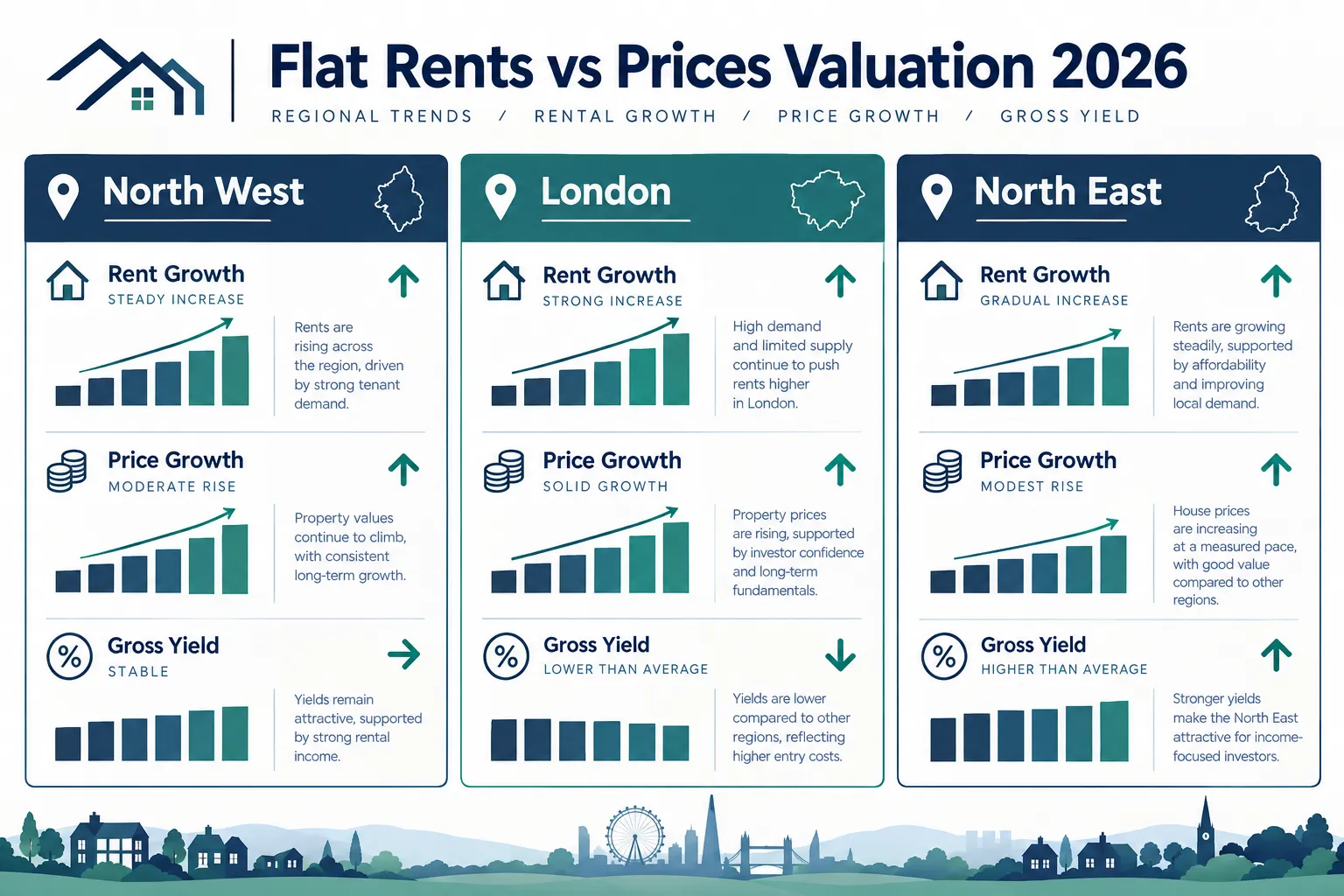
Three regions stand out in the data:
| Region | Flat Price Growth (10 yrs) | Rent Growth (10 yrs) | Gross Yield (current) |
|---|---|---|---|
| North West | +20.6% | +55.2% | Not specified |
| London | -6.9% | +36.5% | Not specified |
| North East | Not specified | Not specified | 6.68% (up from 5.15%) |
The North West had the strongest flat price growth of any region at 20.6%, yet rents there still rose 55.2%, nearly three times faster. London is the outlier for the opposite reason: it is the only region where flat prices actually fell over the decade, down 6.9%, while rents still managed to climb 36.5%. Put plainly, London flat owners have watched capital values shrink while tenants have paid steadily more to live in them.
The North East, meanwhile, now boasts the highest gross yield of any region in England and Wales at 6.68%, up from 5.15% ten years ago. Brickview's own conclusion is blunt: rising yields mean flats are arguably more cash-generative today than at any point in the past decade. For flat rents vs prices valuation 2026, that is the sentence every investor and valuer should underline.
Why Yields Are Rising: What Rightmove and ONS Add to the Picture
Brickview's decade-long trend is not an isolated dataset point. It lines up closely with two separate sources published within days of each other in October 2026. Rightmove's Q3 2026 rental tracker, released 15 October 2026, recorded the average landlord yield across Great Britain at 6.6%, up 0.3 percentage points over the year. Regionally, the North East led the country at 8.3% and the North West followed at 7.4%, while London trailed at 6.1%. Rightmove also recorded average advertised rent outside London hitting a record £1,418 a month, up 2.4% annually, and noted that 13% of homes currently for sale were previously rented out.
The Office for National Statistics added further context on 16 September 2026. UK average house prices stood at £273,000 in July 2026, up just 1.4% annually, with London prices down 3.3% to an average of £569,000. Meanwhile UK private rents rose 3.8% to £1,400 in August 2026. Lay these figures next to Brickview's ten-year trend and the direction of travel is unmistakable: rental income is growing steadily even where capital values are flat or falling. That combination is precisely why flat rents vs prices valuation 2026 cannot rely on sales comparables alone.
Flat Rents vs Prices Valuation 2026: Income Approach or Comparable Sales?
Traditional residential valuation leans heavily on the comparable sales method: find similar flats sold nearby in the last six to twelve months and adjust for size, condition and lease terms. That approach works well in a stable market where prices and rents move together. It is less reliable when, as Brickview shows, rents and prices have been diverging for ten straight years in every region.
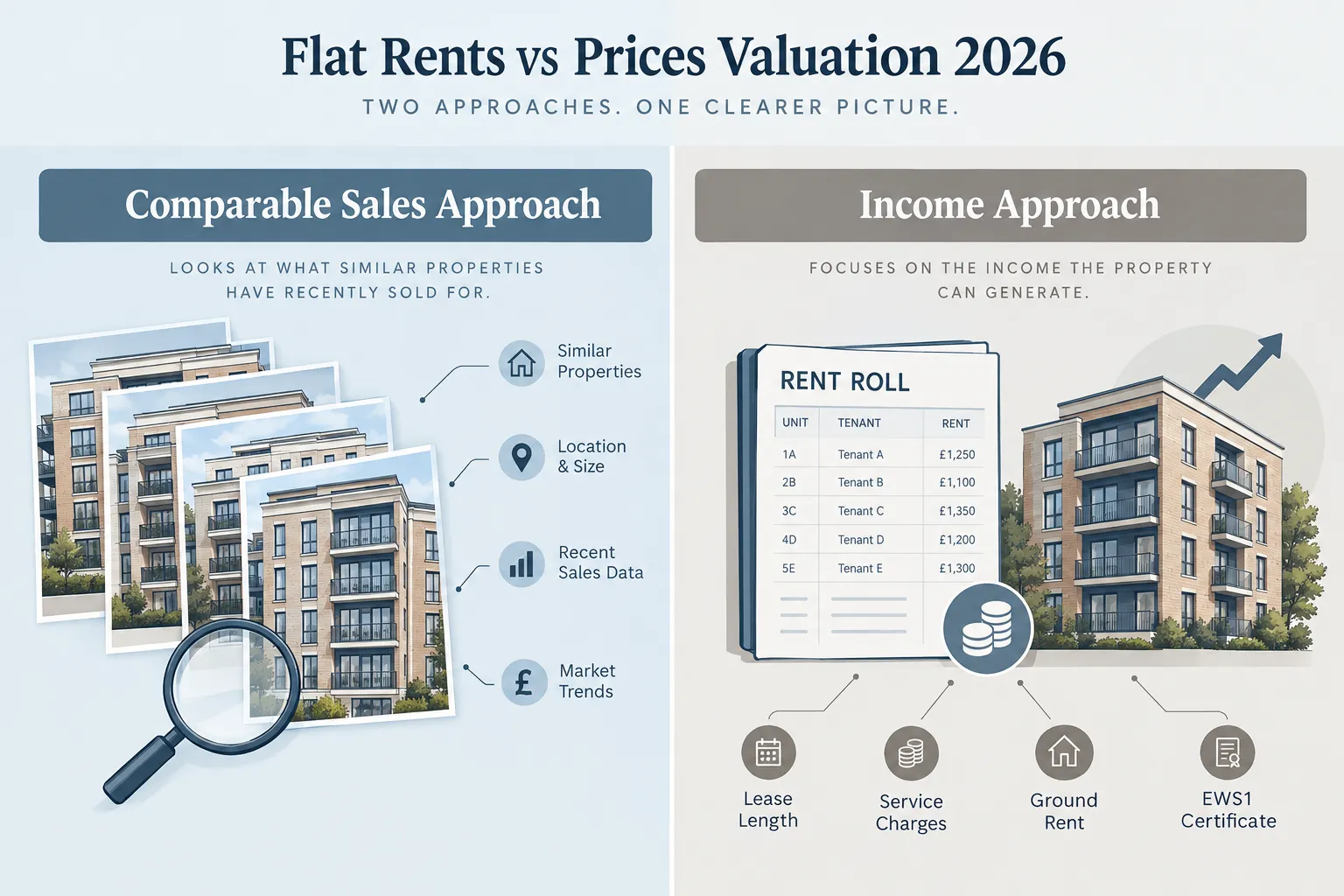
The income approach, long used for commercial property, values an asset based on the rent it can realistically generate, divided by an appropriate yield. With gross yields now ranging from roughly 6.1% in London to 8.3% in the North East according to Rightmove, a RICS valuer applying both methods side by side can flag where a flat's sale price looks disconnected from its earning potential. That matters most for:
- Buy-to-let purchasers weighing a flat purely as an income asset.
- Lenders assessing affordability for mortgage or remortgage applications.
- Executors and probate valuers needing a defensible, evidence-based figure for HMRC.
- Divorcing couples where one party argues the flat is worth more as a rental than its recent sale comparables suggest.
Lease Length, Ground Rent and Service Charges
A rising yield does not automatically mean a flat is a sound investment. Lease length, ground rent terms and service charge levels can all erode net income even when gross rent is strong. A short lease under 80 years can trigger costly extension premiums, while escalating service charges in blocks with lifts, communal heating or concierge services quietly reduce the real return. Any flat rents vs prices valuation 2026 exercise should separate gross yield from net yield once these costs are deducted.
Cladding, EWS1 and Building Safety Costs
Post-Grenfell building safety rules remain a live valuation issue for many flats, particularly in blocks over 11 metres. An EWS1 form, remediation cost estimates, or waking watch charges can materially affect both saleability and mortgage availability, regardless of how attractive the rental yield looks on paper. A RICS valuer will factor these costs into the final figure, sometimes applying a discount even where rental demand is strong.
What Buyers, Landlords, Lenders and Executors Should Ask a RICS Valuer
Given the gap between rent growth and price growth, it pays to ask direct questions before relying on a valuation:
- Has the valuer considered both comparable sales and an income-based cross-check?
- What is the net yield after ground rent, service charge and insurance, not just the gross figure?
- Is there a valid EWS1 certificate or known remediation liability attached to the building?
- How many years remain on the lease, and what would extension currently cost?
- How does the local rent trend compare with the regional and national averages cited by Rightmove and ONS?
FAQ: Flat Rents vs Prices Valuation 2026
Why have flat rents risen faster than prices everywhere?
Brickview's data shows tenant demand and rental inflation have been more consistent than price growth over the past decade, partly because fewer new flats have entered some markets while rental demand has stayed strong.
Does a high yield always mean a flat is a good investment?
No. Gross yield ignores service charges, ground rent, lease length and building safety costs, all of which can significantly reduce net return.
Why did London flat prices fall while rents rose?
London prices dropped 6.9% over the decade and were down 3.3% annually as of July 2026 per ONS, reflecting affordability pressures and oversupply at the top end, while tenant demand kept pushing rents up 36.5% over the same ten years.
Should a valuation rely only on comparable sales?
Not necessarily. Where rental growth consistently outpaces price growth, as Brickview found nationwide, an income-based cross-check gives a fuller picture, particularly for leasehold flats bought as rental investments.
What should executors handling a flat for probate consider?
Executors should request a RICS valuation that reflects both market sale evidence and current rental income potential, since HMRC can challenge figures that ignore either side of the picture.
Conclusion
Brickview's decade of data delivers a clear message: rental income on flats has grown faster than capital value in every region of England and Wales, and yields are now higher than at any point in ten years. That shift means flat rents vs prices valuation 2026 cannot be treated as a simple sales-comparable exercise anymore. Buyers, landlords, lenders and executors should insist on a valuation that weighs both rental income and sale evidence, accounts for lease length, service charges and building safety costs, and reflects current regional yield data. Anyone buying, selling, remortgaging or settling an estate involving a flat should commission a RICS chartered valuation that explicitly addresses both methods before relying on a single figure.
References
- Landlord Today, "Rents outstrip price rises for flats and maisonettes," 16 October 2026. landlordtoday.co.uk
- Rightmove, Q3 2026 Rental Tracker, 15 October 2026.
- Office for National Statistics, UK House Price Index and Private Rent and House Prices release, 16 September 2026.
flat rents vs prices valuation 2026, RICS valuation, leasehold flats, buy-to-let yields, property investment UK, flat valuation methods, rental yield trends, London property prices, probate valuation, EWS1 cladding, house price index, Brickview data