

Last updated: July 24, 2026
Quick Answer: Expert witness valuations in Right to Buy disputes involve a qualified chartered surveyor providing independent, court-admissible evidence on a property's open market value when a council tenant and their local authority cannot agree. The 2026 council housing reforms have substantially changed discount levels, eligibility periods, and the financial context in which these disputes arise, making specialist expert evidence more consequential than ever.
Key Takeaways
- The 2026 reforms cut the maximum Right to Buy discount to 15% of property value, with cash caps of £16,000 to £38,000 depending on location.
- Eligibility now requires 10 years as a secure tenant, up from the previous threshold, which reduces the volume of applications but raises the stakes for those who do qualify.
- Newly built social homes are exempt from Right to Buy for 35 years under the 2026 rules, reshaping which properties enter the valuation process.
- The HMRC District Valuer remains the statutory arbiter when buyer and seller cannot agree on value; an expert witness report strengthens either party's position in that process.
- An expert witness is not the same as a standard surveyor: the role carries specific legal duties to the court, not to the instructing party.
- Costs for an expert witness valuation typically range from £1,500 to £5,000 or more, depending on complexity and the stage of dispute.
- The most common mistake in Right to Buy disputes is failing to instruct a qualified expert early enough, before the District Valuer's determination becomes entrenched.
- Extended cost-floor rules under the 2026 reforms mean councils can recover more recent build costs, directly affecting the net discount available and the figures an expert must address.
What Is Right to Buy and How Does It Work in the UK
Right to Buy gives eligible secure council tenants in England the legal right to purchase their home at a discount below open market value. The scheme was introduced under the Housing Act 1980 and remains one of the most significant routes to homeownership for social housing tenants.
The process works as follows:
- A qualifying tenant submits a Right to Buy application (RTB1 form) to their council landlord.
- The council has eight weeks (for a freehold) or twelve weeks (for a leasehold) to respond with a formal offer notice (Section 125 notice), which includes the council's assessed open market value and the calculated discount.
- If the tenant accepts, they proceed to purchase. If they dispute the valuation, a formal challenge process begins.
- The tenant has the right to request an independent valuation from the HMRC District Valuer.
For a detailed breakdown of how the valuation stage works in practice, the Right to Buy valuations service from Prince Chartered Surveyors provides useful context on what councils and tenants can expect.
What Are the 2026 Council Housing Reforms Changing About Right to Buy
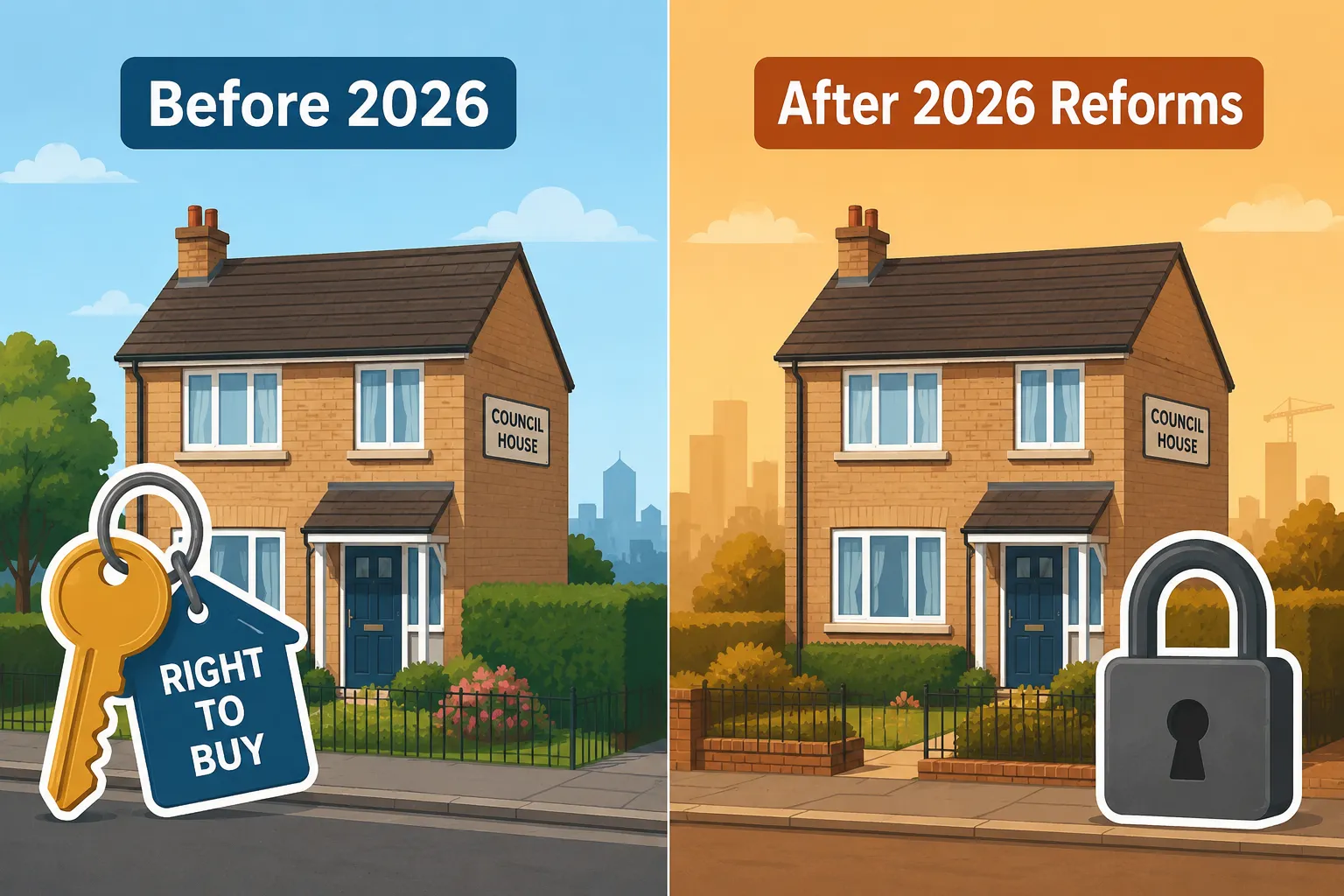
The 2026 reforms represent the most significant restructuring of Right to Buy in over four decades. The core changes affect eligibility, discount levels, and the financial protections available to councils.
Key changes in 2026:
| Reform Area | Previous Position | 2026 Position |
|---|---|---|
| Minimum tenancy to qualify | 3 years (as of 2012 rules) | 10 years |
| Maximum discount (percentage) | Up to 70% (houses) / 50% (flats) | 15% of property value |
| Cash discount cap (London) | Approx. £96,000 | £38,000 |
| Cash discount cap (outside London) | Approx. £64,900 | £16,000 |
| New social homes exemption | 5-year moratorium | 35-year exemption |
| Council receipt retention | Partial | Full retention allowed |
The extended cost-floor rule means councils can now offset recent build and refurbishment costs against the discount for a longer period. This directly affects the net discount a tenant receives and, in turn, the figures an expert witness must account for when preparing valuation evidence.
For broader context on how legislative shifts affect property markets, see this overview of property market legislation changes.
How Do Expert Witnesses Value Properties in Right to Buy Disputes
Expert witness valuations in Right to Buy disputes follow the same core methodology as any open market valuation, but the evidence is prepared to a higher standard because it may be tested in tribunal or court proceedings.
The valuation approach typically involves:
- Comparable sales analysis: Identifying genuinely comparable properties sold close to the valuation date, adjusting for differences in size, condition, location, and tenure.
- Inspection of the subject property: A physical inspection to assess condition, layout, and any features that affect value positively or negatively.
- Review of the Section 125 notice: Scrutinising the council's stated assumptions, including any discount reductions applied under cost-floor rules.
- Assessment of tenure: Freehold houses and leasehold flats are valued differently, and the length of any lease is a critical variable.
- Written report to CPR standards: The Civil Procedure Rules (CPR Part 35) govern how expert evidence is presented in English courts. The report must be addressed to the court, not the client.
"An expert witness's overriding duty is to the court, not to the party who instructs and pays them. This is a legal obligation, not a professional preference."
This distinction matters enormously in Right to Buy disputes, where both the tenant and the council may have instructed their own valuers. A report that reads as advocacy rather than independent analysis will carry little weight with the District Valuer or a tribunal.
What Qualifications Does an Expert Witness Need for Right to Buy Valuations
An expert witness in a Right to Buy valuation dispute should hold RICS membership (MRICS or FRICS), have demonstrable experience in residential property valuation, and be familiar with the legal framework governing expert evidence.
Specifically, look for:
- RICS Registered Valuer status: This is the professional benchmark for valuation work in the UK and is required for Red Book-compliant valuations.
- Experience with dispute resolution: Familiarity with the HMRC District Valuer process, First-tier Tribunal (Property Chamber), and CPR Part 35 requirements.
- Local market knowledge: Comparable evidence is only as good as the expert's understanding of the local market. An expert who regularly values property in the relevant area carries more credibility.
- No conflict of interest: The expert must have no financial or personal interest in the outcome.
The expert witness reports service from Prince Chartered Surveyors outlines what a properly constituted expert witness report contains and the standards it must meet.
What Is the Difference Between a Surveyor Valuation and an Expert Witness Valuation
A standard surveyor's valuation and an expert witness valuation serve different purposes, even if the underlying methodology is similar.
| Aspect | Standard Valuation | Expert Witness Valuation |
|---|---|---|
| Primary duty | To the instructing client | To the court or tribunal |
| Purpose | Mortgage, sale, tax, insurance | Dispute resolution, legal proceedings |
| Report format | Client-facing advice | CPR Part 35 compliant |
| Advocacy | Can reflect client's interests | Must be independent and impartial |
| Use in proceedings | Not directly admissible | Admissible as expert evidence |
A standard independent property valuation is appropriate for understanding market value before entering a dispute. Once a dispute is formally underway, the valuation evidence needs to meet the higher expert witness standard to carry weight.
How Do You Challenge a Right to Buy Valuation in Court

Challenging a Right to Buy valuation follows a defined statutory process, and expert witness valuations in Right to Buy disputes are central to making that challenge effective.
Step-by-step process:
- Receive the Section 125 notice from the council, which states the open market value and the calculated discount.
- Instruct an independent RICS Registered Valuer to review the council's figures and prepare a counter-valuation.
- Apply to the HMRC District Valuer within three months of the Section 125 notice. This is the statutory route for disputing the valuation.
- The District Valuer inspects the property and issues a determination. Both parties are bound by this figure.
- If the dispute extends to other terms (not just value), the First-tier Tribunal (Property Chamber) has jurisdiction.
Common grounds for challenge include: incorrect comparable evidence, failure to account for condition defects, wrong tenure assumptions, or misapplication of the cost-floor rules under the 2026 reforms.
Can You Appeal a Right to Buy Valuation Decision
Yes, but the options narrow once the District Valuer has issued a determination. The District Valuer's valuation is final on the question of open market value under the statutory process. However, a tenant can:
- Challenge the methodology used by the District Valuer if there is evidence of a material error.
- Refer other disputed terms in the Section 125 notice (such as service charge estimates or lease terms) to the First-tier Tribunal (Property Chamber).
- Seek judicial review in exceptional cases where the process itself was unlawful, though this is rare and costly.
The practical lesson: invest in strong expert evidence before the District Valuer's determination, not after. Once the District Valuer has decided, reversing that decision is very difficult.
What Happens If Buyer and Seller Disagree on Property Value in Right to Buy
When a council tenant and their local authority disagree on the open market value stated in the Section 125 notice, the tenant's primary recourse is the HMRC District Valuer. This is not an optional step, it is the statutory mechanism specifically designed for this purpose.
The District Valuer is an independent government valuer who inspects the property, reviews evidence from both sides, and issues a binding determination. Crucially, the District Valuer's figure can go up as well as down from the council's original assessment. Tenants who instruct an expert witness to prepare a formal counter-valuation are better placed to present comparable evidence and condition-related arguments to the District Valuer.
What Common Mistakes Do People Make in Right to Buy Disputes
The most frequent errors that undermine a tenant's or council's position in a Right to Buy valuation dispute are avoidable with proper preparation.
Mistakes tenants make:
- Waiting too long to instruct an expert, missing the three-month window to apply to the District Valuer.
- Using a general estate agent's opinion rather than a RICS Registered Valuer's formal report.
- Assuming the District Valuer will automatically reduce the council's figure.
- Not disclosing relevant condition issues (damp, structural defects, disrepair) that would reduce value.
Mistakes councils make:
- Overstating value using comparables that are not genuinely comparable.
- Misapplying the 2026 cost-floor rules, either overclaiming or underclaiming recoverable costs.
- Failing to account for the property's actual condition at the valuation date.
For related guidance on how condition affects valuation, the top three things looked at during a property valuation is a useful reference.
Who Needs an Expert Witness for Right to Buy Disputes
Not every Right to Buy applicant needs a full expert witness report. The decision depends on the size of the dispute and the stage it has reached.
You likely need an expert witness if:
- The difference between the council's valuation and your own estimate is significant (broadly, more than £10,000,£15,000 given the 2026 discount caps).
- The dispute has reached or is approaching the District Valuer stage.
- The matter is proceeding to the First-tier Tribunal.
- The council has applied cost-floor deductions that you believe are incorrect.
A standard independent valuation may be sufficient if:
- You want an early-stage sense check before formally challenging the Section 125 notice.
- The gap between your view and the council's is small relative to the discount involved.
Given the 2026 reforms have reduced maximum cash discounts to between £16,000 and £38,000, the financial stakes in any individual dispute are lower than they were under the previous regime. However, for many tenants, even a £5,000 difference in the assessed value translates directly into a £750 change in their discount at the 15% rate, which can still justify professional expert evidence.
What Documents Does an Expert Witness Need for Right to Buy Valuations
A well-prepared expert witness needs access to specific documents to produce reliable, defensible valuation evidence.
Core documents:
- The Section 125 notice (including the council's stated open market value and discount calculation)
- Title register and plan from HM Land Registry
- Any tenancy agreement or secure tenancy documentation
- Planning history and any building regulations certificates
- Evidence of disrepair, condition defects, or improvement works (photographs, schedules, contractor reports)
- Comparable sales data for the local area around the valuation date
- Any previous valuation reports on the property
Under the 2026 rules, cost-floor documentation is also relevant: the council should provide evidence of build or refurbishment costs if it is applying a cost-floor reduction to the discount. An expert witness should review this material and, where appropriate, challenge its application.
How Long Does a Right to Buy Valuation Process Take
The timeline for a Right to Buy dispute depends on which stage the disagreement has reached.
- Council's Section 125 notice: Issued within 8 to 12 weeks of the RTB1 application.
- Tenant's challenge window: 3 months from the Section 125 notice to apply to the District Valuer.
- District Valuer determination: Typically 4 to 12 weeks from the date of application, depending on workload and property complexity.
- First-tier Tribunal (if required): Several months, depending on the tribunal's caseload and the complexity of the issues.
Total elapsed time from application to completion of a disputed purchase can run to 12 to 18 months in contested cases. Instructing an expert witness early shortens this timeline by ensuring the District Valuer receives well-prepared evidence at the first opportunity, rather than requiring multiple rounds of correspondence.
How Much Does an Expert Witness Cost for a Right to Buy Case
Expert witness costs for Right to Buy valuation disputes vary depending on the complexity of the case, the property type, and the stage of proceedings.
Typical cost ranges (2026 estimates):
- Initial independent valuation (pre-dispute): £300 to £700
- Full expert witness report (CPR Part 35 compliant): £1,500 to £3,500 for a standard residential property
- Complex cases or tribunal attendance: £3,500 to £5,000 or more, including preparation and hearing time
Given the 2026 discount caps (maximum £38,000 in London, £16,000 elsewhere), the cost of expert evidence should be weighed against the likely financial benefit. In most cases, a well-prepared expert report that successfully shifts the District Valuer's determination by even a modest amount will recover its cost many times over through a higher discount.
For context on how professional valuation services are structured, the full range of chartered surveyor valuation services provides a useful overview.
What Are the New Rules for Right to Buy Discounts in 2026
The 2026 reforms fundamentally restructure how discounts are calculated, capped, and protected.
Under the 2026 rules:
- The maximum discount is 15% of the open market value for all property types (houses and flats are no longer differentiated by percentage).
- Cash caps are £38,000 in London and £16,000 outside London, a dramatic reduction from the previous regime.
- The cost-floor rule is extended, meaning councils can recover recent build and refurbishment costs over a longer period, further reducing the net discount available.
- Newly built social homes are exempt from Right to Buy for 35 years from the date of construction.
- Councils retain 100% of the receipts from Right to Buy sales, removing a previous central government clawback.
These changes mean that for many tenants, the financial benefit of Right to Buy is substantially smaller than it was before 2026. The accuracy of the open market valuation is therefore more important than ever: a £10,000 overstatement of value by the council now reduces the tenant's discount by £1,500 (at 15%), compared to up to £7,000 under the old 70% maximum.
For those also considering the tax implications of acquiring property through Right to Buy, the capital gains tax valuation service and inheritance tax valuation guidance may be relevant for future planning.
Right to Buy Dispute Valuation Checklist
<div style="font-family:Arial,sans-serif;max-width:640px;margin:2em auto;border:2px solid #1a3c6e;border-radius:8px;overflow:hidden;">
  <div style="background:#1a3c6e;color:#fff;padding:14px 20px;">
    <strong style="font-size:1.05em;">Right to Buy Dispute: Expert Witness Readiness Checker</strong>
  </div>
  <div style="padding:16px 20px;" id="rtb-checklist">
    <p style="margin:0 0 12px;font-size:0.92em;color:#444;">Tick each item you have in place before instructing an expert witness.</p>
    <div id="rtb-items"></div>
    <div style="margin-top:14px;padding:10px 14px;background:#f0f4fa;border-radius:6px;font-size:0.9em;">
      <strong>Progress: </strong><span id="rtb-score">0 / 6 complete</span>
    </div>
  </div>
  <script>
    var items=["Section 125 notice received from council","Valuation date confirmed (date of RTB1 application)","Title register and plan obtained from HMRC Land Registry","Condition evidence gathered (photos, defect reports)","Three-month challenge window confirmed (not yet expired)","RICS Registered Valuer identified for instruction"];
    var wrap=document.getElementById("rtb-items");
    items.forEach(function(t,i){
      var d=document.createElement("div");
      d.style.cssText="display:flex;align-items:center;padding:7px 0;border-bottom:1px solid #e2e8f0;";
      d.innerHTML='<input type="checkbox" id="cb'+i+'" style="width:18px;height:18px;margin-right:12px;accent-color:#1a3c6e;" onchange="updateScore()"><label for="cb'+i+'" style="font-size:0.9em;color:#333;cursor:pointer;">'+t+'</label>';
      wrap.appendChild(d);
    });
    function updateScore(){
      var n=document.querySelectorAll("#rtb-items input:checked").length;
      document.getElementById("rtb-score").textContent=n+" / "+items.length+" complete";
      document.getElementById("rtb-score").style.color=n===items.length?"#1a7a3c":"#1a3c6e";
    }
  </script>
</div>
Frequently Asked Questions
What is the role of the HMRC District Valuer in a Right to Buy dispute?
The HMRC District Valuer is the statutory independent valuer appointed to resolve disagreements about the open market value in a Right to Buy case. Their determination is binding on both the tenant and the council under the Housing Act 1985. A tenant must apply to the District Valuer within three months of receiving the Section 125 notice.
Can a tenant instruct their own expert witness even if the District Valuer is involved?
Yes. A tenant can instruct an independent RICS Registered Valuer to prepare a counter-valuation and submit it as evidence to the District Valuer. This is not only permitted but strongly advisable, as the District Valuer will consider all evidence presented before issuing a determination.
Does the 2026 discount cap apply to all properties in England?
Yes. The 2026 reforms apply across England. The cash cap is £38,000 for properties in London boroughs and £16,000 for properties outside London. The 15% percentage cap applies uniformly regardless of property type.
What happens if a property is a leasehold flat under Right to Buy?
Leasehold flats are valued on the basis of the lease that will be granted, typically 125 years. The valuation must account for the lease length, any service charge obligations, and the ground rent terms. These factors can significantly affect open market value and are common sources of dispute.
How does the 35-year exemption for new social homes affect existing tenants?
Tenants living in newly built social housing completed after the 2026 reforms will not be able to exercise Right to Buy for 35 years from the construction date. This applies to the property, not the tenancy, so a tenant who moves into an exempt property cannot exercise Right to Buy regardless of how long they have lived there.
Is an expert witness report confidential before it is submitted to the District Valuer?
An expert witness report prepared under CPR Part 35 is addressed to the court or tribunal and is not confidential in the same way as legal advice. Once submitted in proceedings, it can be seen by all parties. A preliminary advice note (not a formal expert report) can be prepared on a confidential basis before a decision is made to proceed.
Conclusion
Expert witness valuations in Right to Buy disputes have always required precision and independence, but the 2026 council housing reforms have raised the stakes considerably. With maximum discounts capped at 15% of value and cash limits set at £16,000 to £38,000, every pound of open market value matters more than it did under the previous regime. The extended cost-floor rules and 35-year exemption for new social homes add further layers of complexity that only a properly qualified expert can address with authority.
Actionable next steps:
- If you have received a Section 125 notice and believe the council's valuation is too high, act within the three-month window and instruct a RICS Registered Valuer immediately.
- Ask any expert you instruct to confirm their experience with CPR Part 35 and the District Valuer process specifically.
- Gather condition evidence (photographs, maintenance records, defect reports) before the expert inspection, as this directly affects the valuation.
- Review the council's cost-floor deductions carefully under the 2026 rules; errors in this calculation are a common and challengeable ground.
- For tax planning after a Right to Buy purchase, consider obtaining a formal valuation for capital gains or inheritance tax purposes from the outset.
For professional expert witness valuation support, the expert witness reports service and Right to Buy valuation specialists at Prince Chartered Surveyors can provide the independent, court-admissible evidence needed to protect your position.
Tags: right to buy disputes, expert witness valuations, council housing reforms 2026, RICS chartered surveyor, District Valuer, right to buy discount, property valuation dispute, social housing valuation, CPR Part 35 expert, right to buy eligibility, housing tribunal, property expert witness