

Buy-to-let mortgage lending surged 18.2% year-on-year in the final quarter of 2025, reaching £11.2 billion — and that financial momentum is now flowing directly into UK courtrooms [2]. As institutional investors re-enter the market and portfolio landlords reassess valuations under new regulatory frameworks, the volume of contested BTL valuations is rising sharply. Expert Witness Valuations in Buy-to-Let Disputes: Leveraging 2026 BTL Resilience for Courtroom Wins is no longer a niche concern for specialist surveyors; it is a front-line discipline that determines financial outcomes in disputes worth millions of pounds. For surveyors considering litigation support roles, understanding the standards, pitfalls, and strategic opportunities of this environment in 2026 is essential.
Key Takeaways
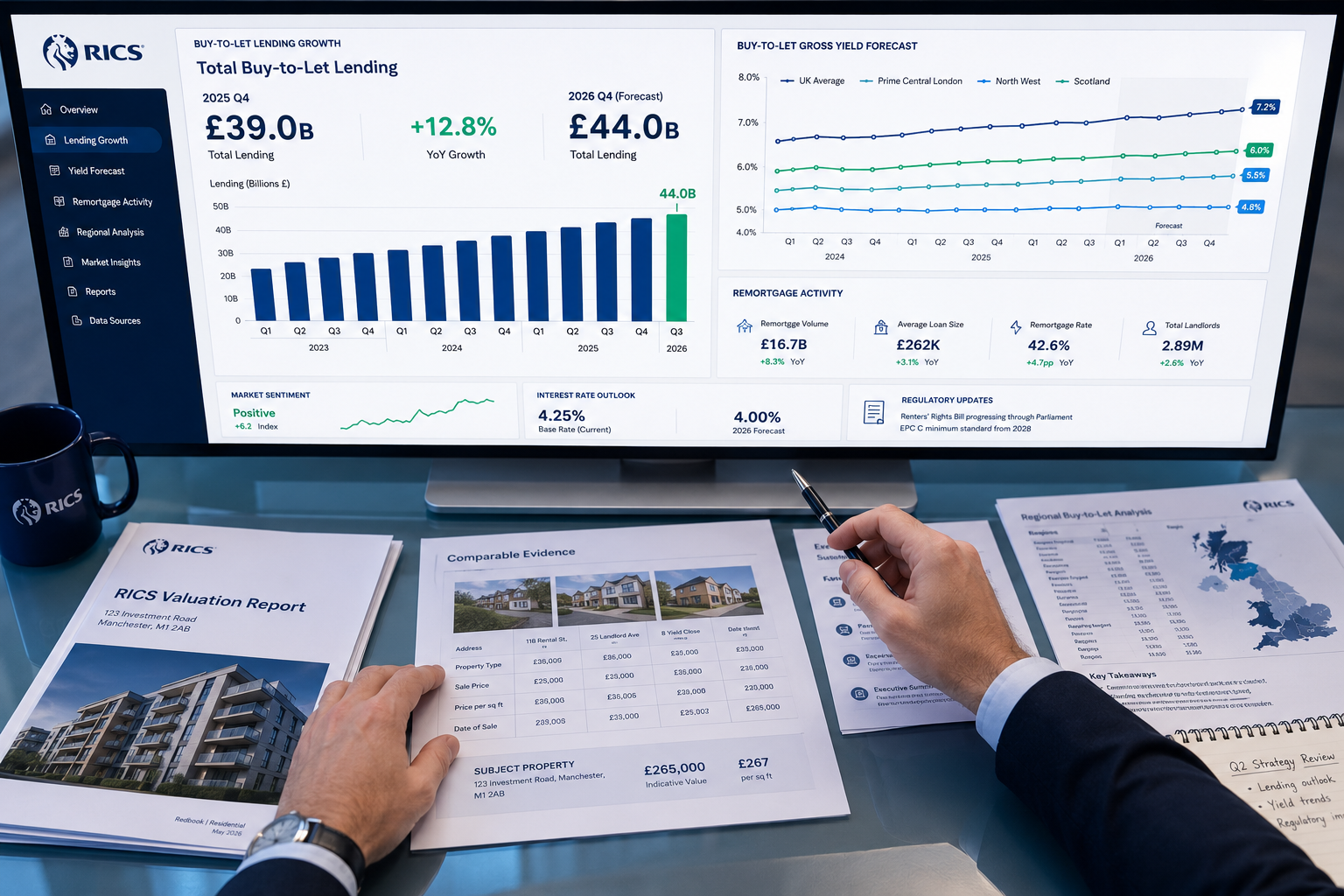
- Buy-to-let lending is forecast to grow from £39 billion in 2025 to £44 billion in 2026, driving a parallel rise in valuation disputes requiring credible expert testimony.
- RICS launched a major consultation on its fifth edition expert witness standard in April 2026, with new guidance on AI use, conditional fees, and the expert's overriding duty to the tribunal.
- The Renters' Rights Act, effective May 2026, has reshaped landlord strategies and introduced new grounds for dispute, particularly around yield forecasts and portfolio valuations.
- Defensible expert witness reports must combine robust comparable evidence, structured yield analysis, and thorough cross-examination preparation.
- RICS accreditation through the Expert Witness Accreditation Service (EWAS) has become a near-mandatory credibility marker in contested BTL litigation.

The 2026 BTL Market: Why Disputes Are Rising Alongside Lending
The Intermediary Mortgage Lenders Association (IMLA) forecasts buy-to-let lending will grow from approximately £39 billion in 2025 to £44 billion in 2026 and £48 billion in 2027 [4]. This recovery is not uniform. Remortgaging activity is driving the bulk of growth rather than new acquisitions, which means a large cohort of landlords is refinancing existing portfolios at valuations that may differ significantly from original purchase prices [2].
That gap between historic and current valuation is fertile ground for disputes. Common triggers in 2026 include:
- Divorce and matrimonial proceedings involving jointly held BTL portfolios
- Probate disputes where rental income and capital value are contested by beneficiaries
- Capital gains tax challenges following HMRC reassessments of disposal values
- Lender disputes arising from alleged overvaluation at the point of mortgage advance
- Institutional investor claims where yield forecasts underpinning acquisition prices are challenged
The shift toward institutional participation is particularly significant. Larger investors entering the BTL space bring sophisticated legal teams and higher-value claims. Their cases frequently hinge on projected rental yields, vacancy rates, and the impact of regulatory costs — all areas where a well-prepared expert witness can make or break an argument [6].
"The buy-to-let market in 2026 is defined by strategy over speculation. That same discipline now applies to how valuations are defended in court."
The Renters' Rights Act, which came into effect in May 2026, removed no-fault evictions and introduced enhanced tenant protections [3]. This legislation has directly altered the risk profile of BTL assets. Landlords who purchased properties under assumptions about vacant possession or rental uplift on re-letting now face a changed legal landscape — one that expert witnesses must understand and articulate clearly when presenting valuations to tribunals [5].
For surveyors providing expert witness services, the implication is clear: market knowledge alone is insufficient. The ability to translate regulatory change into defensible valuation adjustments is what separates credible testimony from contested opinion.
RICS Standards in 2026: What Expert Witnesses Must Know
In April 2026, RICS initiated a consultation on the fifth edition of its expert witness standard — the first substantive update since 2014 [1]. The revision addresses three areas that directly affect BTL dispute work:
The Expert's Overriding Duty to the Tribunal
The proposed fifth edition reinforces that an expert witness's primary obligation is to the court or tribunal, not to the instructing client. This principle, long established in case law, is now being codified more explicitly in RICS guidance. For surveyors new to litigation support, this distinction is critical. Advocacy disguised as expert opinion is one of the most common reasons expert evidence is rejected or given reduced weight by judges.
Artificial Intelligence and Valuation Evidence
The consultation addresses the use of AI tools in preparing valuation reports. While AI-assisted comparable analysis and automated valuation models (AVMs) can support evidence gathering, the expert remains personally responsible for every opinion expressed. Courts will scrutinize whether AI-generated data has been independently verified. Surveyors must be prepared to explain their methodology in plain terms under cross-examination.
Conditional Fees and Independence
The fifth edition consultation proposes clearer restrictions on conditional fee arrangements for expert witnesses, reinforcing that financial interest in the outcome of a case undermines independence. This is especially relevant in high-value BTL disputes where instructing solicitors may suggest fee structures tied to outcomes [1].
RICS Expert Witness Accreditation Service (EWAS)
RICS accreditation through EWAS has become a near-mandatory credibility marker in 2026 [1]. Judges and opposing counsel routinely examine whether an expert holds EWAS accreditation. Surveyors without it face immediate challenges to their standing. The accreditation process requires demonstrated competence in report writing, cross-examination readiness, and knowledge of Civil Procedure Rules (CPR) Part 35.
Understanding valuation factors that courts consider relevant — including location, condition, comparable transactions, and rental income evidence — forms the technical foundation of any credible expert report.
Leveraging 2026 BTL Resilience: Building Courtroom-Ready Valuations
Expert Witness Valuations in Buy-to-Let Disputes: Leveraging 2026 BTL Resilience for Courtroom Wins requires more than sound methodology. It demands a structured approach to evidence assembly, report construction, and testimony delivery.
Comparable Evidence: The Foundation of Defensible Opinions
In BTL disputes, comparable evidence must reflect the specific characteristics of investment property rather than owner-occupied residential transactions. Key considerations include:
| Evidence Type | What Courts Expect | Common Pitfalls |
|---|---|---|
| Rental comparables | Recent lettings within 0.5 miles, similar specification | Using asking rents rather than achieved rents |
| Capital value comparables | Sales of tenanted investment properties | Mixing vacant possession sales with tenanted sales |
| Yield evidence | Market yield ranges from agent data and auction results | Applying gross yields without adjusting for voids and costs |
| Regulatory cost adjustments | Post-Renters' Rights Act compliance costs | Ignoring legislative impact on net yield |
The distinction between gross and net yield is frequently contested. Institutional investor cases in 2026 often turn on whether the expert has properly accounted for management fees, maintenance reserves, void periods, and the compliance costs introduced by the Renters' Rights Act [3]. Regulatory costs remain a significant factor influencing landlord decisions and asset valuations [7].
Yield Forecasts: Opportunity and Risk in Expert Testimony
Yield forecasts are increasingly central to high-value BTL disputes. When an institutional investor claims a property was overvalued at acquisition, the argument often rests on whether the projected yield was achievable given market conditions at the valuation date.
Expert witnesses must:
- Anchor forecasts to contemporaneous market data — what was known or knowable at the valuation date, not what subsequently occurred
- Reference published benchmarks from RICS, lenders, and reputable property data providers
- Distinguish between reversionary yield (based on estimated rental value) and initial yield (based on passing rent)
- Address the impact of the Renters' Rights Act on future rental growth assumptions for properties valued before May 2026
For surveyors offering matrimonial valuation services, yield-based arguments also arise in divorce proceedings where one party challenges the income-generating capacity of a jointly owned BTL portfolio.
Structural and Physical Evidence
Physical condition directly affects both capital value and achievable rent. Expert witnesses in BTL disputes should ensure that any valuation opinion is supported by appropriate survey evidence. A property with undisclosed structural defects may have been overvalued at the point of mortgage advance — a claim that requires both valuation expertise and building survey knowledge.
Surveyors should be familiar with RICS Level 3 building surveys as a source of condition evidence that can support or challenge valuation opinions in litigation. Similarly, dilapidations surveys are relevant in commercial BTL disputes where tenant obligations affect the net value of the investment.
Report Writing Templates and Cross-Examination Preparation
The Expert Witness Report: A Practical Template
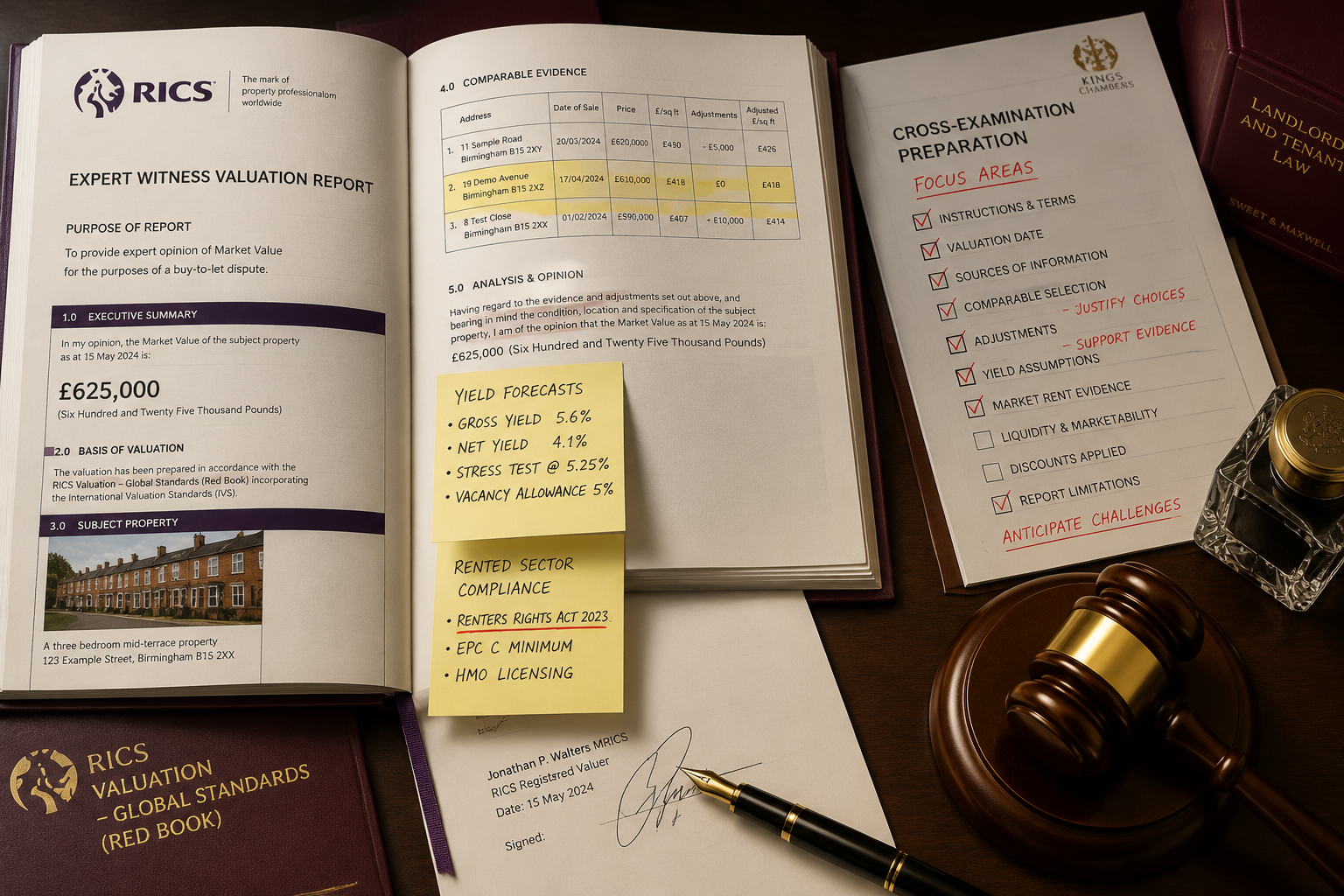
A well-structured expert witness report for a BTL valuation dispute should follow this framework:
- Introduction and instructions — the expert's identity, qualifications, and the questions posed
- Statement of truth — compliance with CPR Part 35 and RICS expert witness standards
- Summary of opinion — a concise statement of the expert's conclusions, placed early
- Factual background — description of the subject property, tenure, and tenancy details
- Methodology — the valuation approach adopted and reasons for its selection
- Comparable evidence — detailed analysis of rental and capital comparables with adjustments explained
- Yield analysis — gross and net yield calculations with regulatory cost adjustments
- Opinion on value — the expert's concluded opinion with sensitivity analysis where appropriate
- Matters outside expertise — explicit acknowledgment of any issues beyond the expert's competence
- Declaration of independence — confirmation that the opinion is not influenced by the instructing party
Bold point: The summary of opinion should appear on page one. Judges read hundreds of expert reports. A buried conclusion is a credibility risk.
Preparing for Cross-Examination
Cross-examination in BTL valuation disputes typically focuses on three areas:
- Comparables selection — why certain transactions were included or excluded
- Yield assumptions — the basis for void rate, management cost, and rental growth projections
- Regulatory impact — whether the expert properly accounted for the Renters' Rights Act and other legislative changes
Preparation should include a detailed review of the opposing expert's report, identification of factual disagreements versus opinion differences, and practice in explaining technical valuation concepts in plain language. Courts expect experts to assist the tribunal, not to perform for their instructing solicitor.
For surveyors new to litigation support, reviewing RICS guidance on party wall disputes provides useful context on how professional standards apply in adversarial legal settings — skills that transfer directly to expert witness work.
Common Pitfalls for Surveyors Entering Litigation Support
- Overstating certainty — valuation is an opinion, not a precise science; courts distrust experts who present ranges as absolutes
- Failing to update opinions — if market conditions change between instruction and hearing, the expert must address this
- Ignoring the opposing report — joint statements between experts are now standard practice; surveyors who refuse to engage constructively damage their credibility
- Inadequate comparable analysis — thin comparable evidence in a recovering market is a known weakness; surveyors must work harder to source robust data
- Advocacy tone — language that reads as partisan undermines the expert's standing with the tribunal
Expert Witness Valuations in Buy-to-Let Disputes: Practical Steps for Surveyors in 2026
The combination of a recovering BTL market, rising institutional investor activity, and significant regulatory change has created a sustained increase in demand for credible expert witness valuations [5]. Surveyors looking to build a litigation support practice in 2026 should take the following steps:
1. Obtain EWAS accreditation. This is the single most important credibility investment a surveyor can make before accepting expert witness instructions in contested cases.
2. Build a BTL-specific comparable database. General residential comparables are insufficient. Surveyors need access to tenanted investment sales, auction results, and rental data from lettings agents operating in the relevant market.
3. Understand the Renters' Rights Act in depth. The removal of Section 21 no-fault evictions, changes to tenancy structures, and enhanced tenant protections all affect BTL asset values. Expert witnesses who cannot explain these changes under cross-examination will lose credibility quickly.
4. Develop a clear methodology for yield analysis. Courts expect experts to show their working. A transparent, step-by-step yield calculation — from gross rent to net yield after all costs — is more persuasive than a headline figure.
5. Engage with the RICS fifth edition consultation. The proposed changes to expert witness standards will shape best practice for the next decade. Surveyors who engage now will be better positioned when the new standard is published.
6. Collaborate with legal professionals early. Understanding the specific legal questions in dispute allows the expert to focus their report on the issues that matter. Surveyors who understand how valuation types differ — market value, investment value, and fair value — can frame their opinions more precisely for the tribunal.
7. Consider the cost of valuation services. Instructing solicitors and their clients need to understand what expert witness work involves. Transparent communication about the cost of valuation services, including the time required for report preparation and court attendance, avoids misaligned expectations.
Conclusion
The 2026 BTL market presents a paradox: rising lending volumes and improving investor confidence are generating both wealth and litigation in equal measure. Expert Witness Valuations in Buy-to-Let Disputes: Leveraging 2026 BTL Resilience for Courtroom Wins is a discipline that demands technical precision, regulatory literacy, and procedural integrity in equal measure.
The actionable priorities for surveyors are clear. Pursue EWAS accreditation before accepting contested instructions. Build BTL-specific comparable evidence databases that reflect the tenanted investment market rather than the owner-occupied sector. Understand the Renters' Rights Act well enough to explain its valuation impact under cross-examination. Structure reports with the tribunal's needs — not the client's preferences — as the primary consideration.
For instructing solicitors and their clients, the message is equally direct: the quality of expert witness evidence in BTL disputes is not a commodity. A credible, RICS-accredited surveyor with a transparent methodology and deep market knowledge is a strategic asset. In a recovering market where valuations are genuinely contested, that expertise is what turns a well-argued claim into a courtroom win.
References
[1] Expert Witness Preparation For 2026 UK Valuation Disputes RICS Standards In A Recovering Market – canterburysurveyors.com
[2] Buy To Let Lending Rises 18 As Remortgaging Dominates – propertywire.com
[3] Buy To Lets In 2026 A Market In Transition – legalandgeneral.com
[4] Buy To Let Lending Set To Recover Through 2026 And 2027 – compareyields.com
[5] Expert Witness Valuations In 2026s Stabilizing Market RICS Standards For Mortgage Disputes And Property Disagreements – nottinghillsurveyors.com
[6] Strategy Over Speculation Resilience Is Reshaping Buy To Let Investment – gbbank.co.uk
[7] UK Buy To Let Lending Outlook 2026 2027 Market Trends Mortgages Propmatch Investor Analysis – propmatch.uk
How Prince Surveyors can help: explore our expert witness surveyors or learn about our RICS valuations.