


Last updated: July 24, 2026
Quick Answer: An expert witness valuation for divorce is a formal, court-admissible property valuation prepared by a RICS-accredited chartered surveyor, compliant with the Red Book Global Standards, and submitted as evidence in financial remedy proceedings. In 2026, with UK property markets moving at sharply different speeds across regions, getting this valuation right, and getting it from the right professional, can directly affect the size of a divorce settlement.
Key Takeaways
- Expert witness valuations must comply with RICS Red Book Global Standards to be admissible as evidence in UK family courts.
- "Market Value" at the agreed valuation date is the legally relevant figure, not the original purchase price or a future estimate.
- UK property markets in 2026 are performing unevenly: prime London and commuter belt values differ significantly from many northern and coastal markets, making localised comparable evidence essential.
- A fully compliant expert witness report typically takes 5-10 working days after inspection to complete.
- Valuations generally have a 90-day validity window before courts expect an update.
- Retrospective valuations are now routine in divorce cases to separate pre-marital equity from matrimonial growth.
- Even when both parties agree on a figure, a formal valuation protects against future legal challenge.
- The expert witness's duty is to the court, not to either party, this is a legal requirement, not a preference.
What Is an Expert Witness Valuation in Divorce Cases?
An expert witness valuation is a formal written report prepared by a qualified chartered surveyor that gives an independent, court-admissible opinion of a property's market value. It differs from a standard estate agent appraisal or mortgage valuation because the surveyor is appointed as an expert under Civil Procedure Rules Part 35, with a primary duty to the court rather than to either spouse.
In divorce financial remedy proceedings, the valuation is typically submitted alongside Form E, the financial disclosure document each party must complete. The court uses the figure to determine how matrimonial assets should be divided.
Key characteristics of a valid expert witness valuation:
- Prepared by a RICS-accredited Member or Fellow (MRICS or FRICS)
- Compliant with RICS Red Book Global Standards (the professional benchmark for formal valuations)
- States the valuation date clearly, with "Market Value" as the basis
- Includes comparable evidence localised to the subject property's market
- Contains a signed declaration confirming the expert's independence and duty to the court
For a detailed overview of what this service involves, see expert witness reports from Prince Chartered Surveyors.
What Are RICS Standards and Why Do They Matter in Divorce Valuations?
RICS Red Book Global Standards set the professional rules for how formal property valuations must be conducted, documented, and presented. In divorce proceedings, Red Book compliance is not optional, it is the benchmark courts and solicitors expect.
A Red Book-compliant valuation provides:
- A defined basis of value: "Market Value", the estimated amount for which a property would exchange between a willing buyer and seller on the valuation date.
- Transparency of methodology: The surveyor must explain how comparable sales evidence was selected and applied.
- Independence assurance: The report must confirm no conflict of interest exists.
- Liability framework: The surveyor accepts professional responsibility for the opinion given.
Without Red Book compliance, a valuation report risks being challenged or rejected by the opposing party's legal team. In contested cases, this can cause costly delays and adjournments.
"The expert's overriding duty is to the court and not to the party instructing them.", Civil Procedure Rules Part 35.3
For context on how independent property valuations are structured, the independent property valuation guide provides useful background.
How Do Two-Speed UK Property Markets Affect Divorce Settlements in 2026?
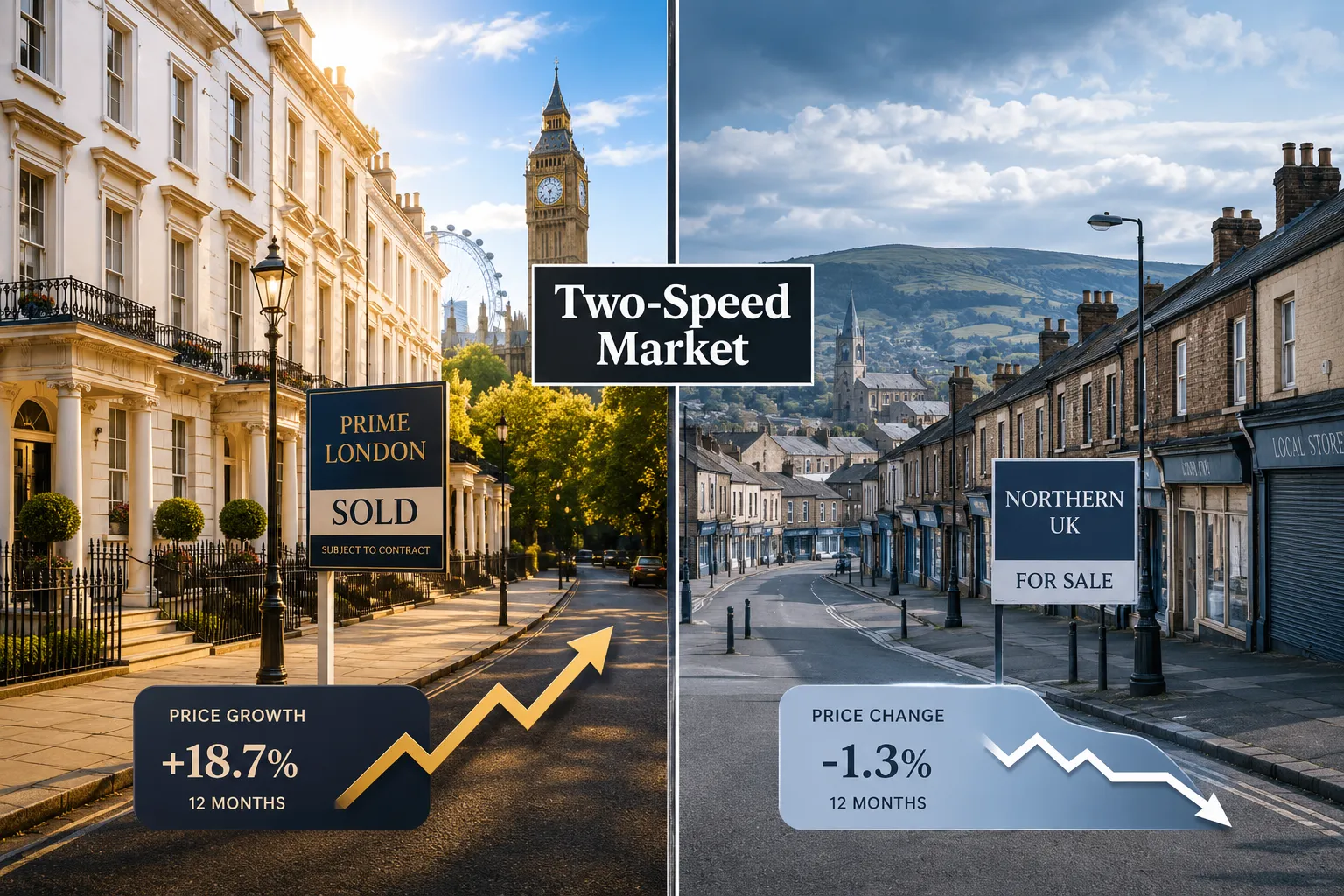
In 2026, the UK property market is not one market, it is several, moving at different speeds. Prime London boroughs, parts of the South East, and select commuter towns have seen continued value growth, while many northern cities, coastal towns, and secondary retail locations have experienced flat or declining values. This divergence has a direct and material impact on divorce settlements.
Why this matters for valuations:
- A property valued using comparable sales from the wrong micro-market can be overstated or understated by tens of thousands of pounds.
- Courts expect comparable evidence to be genuinely local, ideally within the same postcode district and sold within the past three to six months.
- In fast-moving markets, a valuation dated even two months ago may no longer reflect current market conditions, which is why the 90-day validity window is enforced.
Regional divergence in practice:
| Market Type | 2026 Trend | Valuation Risk |
|---|---|---|
| Prime Central London | Moderate growth | Overuse of outdated comparables |
| Outer London / Commuter Belt | Mixed, area-dependent | Comparable selection critical |
| Major Northern Cities | Flat to modest growth | Undervaluation if London data used |
| Coastal / Rural Markets | Highly variable | Thin comparable evidence |
For landlords and property investors navigating these regional differences, the property market legislation changes overview is also worth reviewing alongside any valuation instruction.
What Is the Difference Between a Surveyor Valuation and an Expert Witness Valuation?
A standard surveyor valuation and an expert witness valuation are not the same thing, and using the wrong one in divorce proceedings is a common and costly mistake.
| Feature | Standard Valuation | Expert Witness Valuation |
|---|---|---|
| Purpose | Mortgage, insurance, sale | Court proceedings |
| Duty of care | To instructing client | Primarily to the court |
| Format | Variable | Strictly Red Book compliant |
| Admissibility | Not guaranteed | Designed for court use |
| Comparable evidence | Summary level | Detailed and documented |
A standard chartered surveyor valuation is appropriate for most commercial purposes. For divorce proceedings, however, the expert witness format is required because the surveyor must be able to defend their opinion under cross-examination if the case is contested.
Can You Use a Basic Property Valuation Instead of an Expert Witness Report for Divorce?
In uncontested cases where both parties genuinely agree on a value and their solicitors accept a less formal approach, some courts have accepted simpler valuations. However, this is the exception rather than the rule, and relying on it carries significant risk.
When a basic valuation is not sufficient:
- Either party disputes the figure
- The property is high-value, unusual, or difficult to compare
- There is a significant gap between the parties' own estimates
- The case involves commercial property, development land, or mixed-use assets
- A retrospective valuation is needed to establish pre-marital value
Bottom line: If there is any chance of dispute, or if the property represents a substantial share of the matrimonial assets, commission a full expert witness report from the outset. Retrofitting a compliant report after a dispute arises is more expensive and more disruptive than doing it correctly the first time.
Do You Need an Expert Witness Valuation If Both Parties Agree on the Property Value?
Even when both spouses agree on a figure, a formal expert witness valuation is still strongly advisable. Verbal or informal agreements about property value are not binding and can be revisited if either party changes their legal representation or if circumstances change before the final order is sealed.
A formal valuation protects both parties by:
- Creating a documented, professionally verified figure that is difficult to challenge later
- Satisfying the court's expectation of proper financial disclosure
- Providing a clear audit trail if the settlement is reviewed in future (for example, if one party applies to vary a periodical payments order)
The cost of a single valuation is almost always less than the legal fees generated by a subsequent dispute over the same figure.
How Long Does an Expert Witness Valuation Take for Divorce Proceedings?
A fully compliant expert witness valuation report typically takes 5-10 working days after the physical inspection of the property to complete. The inspection itself is usually arranged within a few days of instruction, depending on access and the cooperation of both parties.
Factors that can extend the timeline:
- Restricted access (for example, if one spouse is uncooperative about allowing entry)
- Complex or unusual properties requiring additional research
- Thin comparable evidence in the local market requiring a wider search
- Retrospective valuations, which require historical sales data and additional analysis
Validity period: Once issued, a valuation is generally considered current for 90 days. If divorce proceedings extend beyond that window, an updated valuation or a formal confirmation of continued relevance will be needed. Courts take this seriously, particularly in markets that have moved since the original report date.

Who Can Be an Expert Witness for Property Valuation in UK Divorce Cases?
An expert witness for property valuation in UK divorce must be a chartered surveyor holding MRICS or FRICS status with the Royal Institution of Chartered Surveyors. Membership alone is not sufficient, the surveyor must also have relevant experience in the type of property being valued and must be able to demonstrate independence from both parties.
Checklist for selecting the right expert:
- MRICS or FRICS qualification confirmed
- Registered valuer status (RICS Valuer Registration scheme)
- Experience with litigation support and court report preparation
- No prior relationship with either party or their solicitors
- Local market knowledge relevant to the subject property
- Professional indemnity insurance in place
Courts have the power to appoint a single joint expert (SJE) if the parties cannot agree on a valuer. In that case, both parties share the cost and are bound by the expert's opinion unless they can demonstrate a material error.
How Are Commercial and Residential Properties Valued Differently in Divorce?
Residential and commercial properties require different valuation methodologies, and mixing them up produces unreliable results.
Residential properties are primarily valued using the comparative method, analysing recent sales of similar properties in the same area and adjusting for differences in size, condition, and location.
Commercial properties are typically valued using the investment method (capitalising the passing or estimated rental income) or the profits method (for trading properties such as hotels or care homes). See commercial property valuations for a detailed explanation of how this works in practice.
Key differences in divorce contexts:
- Commercial valuations are more sensitive to lease terms, tenant covenant strength, and void risk
- A business operating from a commercial property may need to be valued separately from the property itself
- Development land requires a residual valuation, which involves assumptions about planning permission and build costs, see property development valuations for more detail
- Mixed-use properties (for example, a flat above a shop) require both methods to be applied to their respective parts
What Happens If Your Ex Disagrees with the Expert Witness Valuation?
If one party disputes the expert witness valuation, they have several options, each with different cost and time implications.
Options when a valuation is disputed:
- Request a written explanation from the expert of how the figure was reached and which comparables were used.
- Commission a second opinion from an independent RICS-registered valuer. If the two figures differ significantly, the court may appoint a single joint expert.
- Instruct solicitors to challenge the methodology, for example, if the comparables used are genuinely inappropriate or if the inspection was inadequate.
- Apply to the court for a single joint expert to be appointed, whose opinion both parties must accept unless a material error can be demonstrated.
The most common source of genuine dispute is not the surveyor's competence but the selection of comparable evidence, particularly in two-speed markets where one party argues that a more favourable set of comparables should have been used.
What Mistakes Do People Make When Getting Valuations for Divorce?
These are the most frequent and costly errors seen in divorce property valuation instructions:
- Using an estate agent's appraisal instead of a RICS valuation. Estate agent figures are marketing tools, not expert evidence.
- Failing to agree a valuation date. Without a fixed date, both parties can argue for the date most favourable to them.
- Ignoring the 90-day validity rule. A valuation that has expired before the final hearing may need to be redone at additional cost.
- Not commissioning a retrospective valuation. If one spouse owned the property before the marriage, failing to establish its pre-marital value means the court cannot separate pre-marital equity from matrimonial growth.
- Choosing a surveyor without local market knowledge. In two-speed markets, a surveyor unfamiliar with the specific area may select inappropriate comparables.
- Assuming agreement means no formal report is needed. Informal agreements on value are not binding and can unravel.
For additional context on what factors surveyors assess during a valuation, the top things looked at during a property valuation article is a useful reference.
How Much Does an Expert Witness Valuation Cost for Divorce?
Expert witness valuation fees vary depending on property type, location, complexity, and whether a retrospective element is required. As a general guide for 2026:
- Standard residential property: Fees typically range from approximately £500 to £1,500 for a single property in most UK regions.
- Prime London or high-value property: Fees can range from £1,500 to £3,000 or more, reflecting the complexity of the comparable evidence required.
- Commercial property: Fees are generally higher, starting from around £1,500 and rising significantly for complex assets.
- Retrospective valuations: An additional fee applies, typically 30-50% above the standard residential rate, depending on how far back the historic date falls and the availability of comparable evidence.
- Single joint expert (SJE) appointments: Costs are shared between both parties, which can reduce the individual outlay.
These are indicative ranges only. Always obtain a written fee proposal before instructing a surveyor, and confirm whether VAT is included and whether court attendance fees are covered separately.
Are Expert Witness Valuations Admissible in Family Court?
Yes, a properly prepared RICS Red Book-compliant expert witness valuation is admissible as evidence in UK family court financial remedy proceedings. Admissibility depends on the report meeting the requirements of Civil Procedure Rules Part 35 and the Family Procedure Rules 2010 (Part 25).
For a report to be admissible, it must:
- Be prepared by a suitably qualified expert
- Include a declaration of the expert's duty to the court
- State the instructions received and the basis of the valuation
- Be served on all parties and the court within the timetable set by the judge
A report that lacks any of these elements can be challenged on admissibility grounds, which wastes time and money for both parties.
Frequently Asked Questions
What is the difference between a matrimonial valuation and an expert witness valuation?
A matrimonial valuation is a broad term for any property valuation used in divorce proceedings. An expert witness valuation is a specific, court-compliant format prepared under Civil Procedure Rules Part 35, with the surveyor's primary duty to the court. All expert witness valuations for divorce are matrimonial valuations, but not all matrimonial valuations meet the expert witness standard. See matrimonial valuations for more detail.
Can a single joint expert valuation be challenged?
Yes, but the threshold is high. A party must demonstrate a material error in the methodology, a factual mistake, or a conflict of interest. Courts are reluctant to allow challenges based purely on disagreement with the figure.
How far back can a retrospective valuation go?
Retrospective valuations can go back to the date of marriage or any other agreed historic date. The further back the date, the more reliance is placed on archived comparable evidence, which can be less detailed. Most surveyors can reliably produce retrospective valuations going back 10-15 years with adequate evidence.
Does the property need to be vacant for the inspection?
No. The surveyor can inspect an occupied property. However, both parties should ideally agree to allow access, and the surveyor should note any limitations on inspection in the report.
What happens if the property is sold before the divorce is finalised?
If the property has already been sold, a retrospective valuation to the sale date or another agreed date will be required. The actual sale price is relevant evidence but is not automatically treated as the market value, the court may still require an independent opinion if the sale was not conducted at arm's length.
Is a RICS HomeBuyer Report the same as an expert witness valuation?
No. A RICS HomeBuyer Report includes a valuation section but is designed for mortgage and purchase purposes, not court proceedings. It does not meet the Civil Procedure Rules Part 35 requirements for expert witness evidence.
Can the same surveyor value the property for both parties?
Yes, this is the single joint expert model, which courts often encourage to reduce cost and conflict. The surveyor must confirm independence from both parties before accepting the instruction.
What if the property has been recently extended or renovated?
The surveyor will take improvements into account when selecting comparables and may adjust the valuation accordingly. Parties should provide planning permissions, building regulations sign-offs, and any receipts or contracts for the works to ensure the report reflects the full value accurately.
Conclusion
Expert Witness Valuations for Divorce Settlements 2026: Navigating Two-Speed UK Markets with RICS Standards is not a niche technical concern, it is a practical and financial priority for anyone going through divorce proceedings involving UK property. The divergence between regional markets in 2026 makes localised, Red Book-compliant valuations more important than ever, because a figure drawn from the wrong comparables can misrepresent a property's true value by a material amount.
Actionable next steps:
- Instruct a RICS-registered valuer early, before positions become entrenched and before the 90-day validity clock becomes a problem.
- Agree a valuation date with your solicitor before commissioning the report.
- Consider whether a retrospective valuation is needed to establish pre-marital equity, particularly if one party owned the property before the marriage.
- Use a single joint expert where possible to reduce cost and avoid duplication.
- Check the surveyor's local market knowledge, in a two-speed market, this is not a minor consideration.
- Do not rely on estate agent appraisals as a substitute for a formal expert witness report.
For professional, court-admissible expert witness valuations across London and the wider UK, Prince Chartered Surveyors' expert witness report service provides RICS-compliant reports prepared by experienced chartered surveyors with litigation support experience.
.cg-checker{font-family:Arial,sans-serif;max-width:480px;margin:2rem auto;padding:1.5rem;border:2px solid #1a3a5c;border-radius:8px;background:#f8fafc}
.cg-checker h3{color:#1a3a5c;margin:0 0 1rem;font-size:1.1rem}
.cg-checker label{display:block;font-size:.9rem;color:#333;margin-bottom:.3rem}
.cg-checker input[type=date]{width:100%;padding:.5rem;border:1px solid #aac;border-radius:4px;font-size:.95rem;box-sizing:border-box;margin-bottom:1rem}
.cg-checker button{background:#1a3a5c;color:#fff;border:none;padding:.6rem 1.4rem;border-radius:4px;cursor:pointer;font-size:.95rem}
.cg-checker button:hover{background:#2a5a8c}
.cg-result{margin-top:1rem;padding:.8rem;border-radius:4px;font-size:.9rem;display:none}
.cg-valid{background:#e6f4ea;border:1px solid #4caf50;color:#2e7d32}
.cg-warning{background:#fff8e1;border:1px solid #ffc107;color:#7a5800}
.cg-expired{background:#fdecea;border:1px solid #f44336;color:#b71c1c}
Divorce Valuation Validity Checker
function cgCheck(){
var vd=document.getElementById(‘cg-val-date’).value;
var hd=document.getElementById(‘cg-hearing-date’).value;
var res=document.getElementById(‘cg-result’);
if(!vd||!hd){res.className=’cg-result cg-warning’;res.style.display=’block’;res.textContent=’Please enter both dates.’;return;}
var v=new Date(vd),h=new Date(hd),diff=Math.round((h-v)/(1000*60*60*24));
res.style.display=’block’;
if(diff<0){res.className='cg-result cg-warning';res.textContent='Hearing date is before valuation date. Please check your entries.';}
else if(diff<=90){res.className='cg-result cg-valid';res.textContent='Valid: '+diff+' days between valuation and hearing. Within the 90-day RICS window.';}
else if(diff<=120){res.className='cg-result cg-warning';res.textContent='Caution: '+diff+' days, approaching or exceeding the 90-day validity window. Consider an update.';}
else{res.className='cg-result cg-expired';res.textContent='Expired: '+diff+' days, valuation likely needs to be updated before the hearing.';}
}
Tags: expert witness valuation, divorce property settlement, RICS Red Book, matrimonial valuation, UK property market 2026, chartered surveyor divorce, two-speed property market, Form E valuation, single joint expert, retrospective valuation, family court property evidence, Red Book compliance