


Last updated: July 24, 2026
Quick Answer: Expert witness valuations for construction defect claims are formal, court-compliant assessments prepared by chartered surveyors to quantify how much a property's market value has fallen because of building defects, and to evaluate the financial risk attached to remediation. These reports must comply with Part 35 of the Civil Procedure Rules (CPR) in England and Wales, and courts expect them to be objective, methodology-driven, and supported by market evidence rather than opinion alone.
Key Takeaways
- Expert witness valuations for construction defect claims address two distinct financial losses: diminution in value and repair risk, and courts treat them differently.
- Chartered surveyors acting as expert witnesses owe their primary duty to the court, not to the party instructing them.
- Diminution in value is the difference between what a property is worth without defects and what it is actually worth in its defective state, including any residual stigma after repairs.
- Repair cost evidence alone is rarely sufficient; surveyors must also demonstrate market impact using comparable sales data.
- CPR Part 35 compliance is mandatory in England and Wales; reports that fail this standard are routinely challenged and sometimes excluded.
- Common defects affecting value include structural movement, cladding failures, drainage defects, roof failures, and damp penetration.
- Expert witness reports typically take four to twelve weeks to prepare, depending on complexity and access.
- Instructing a general valuer without construction defect experience is one of the most common and costly mistakes in these claims.
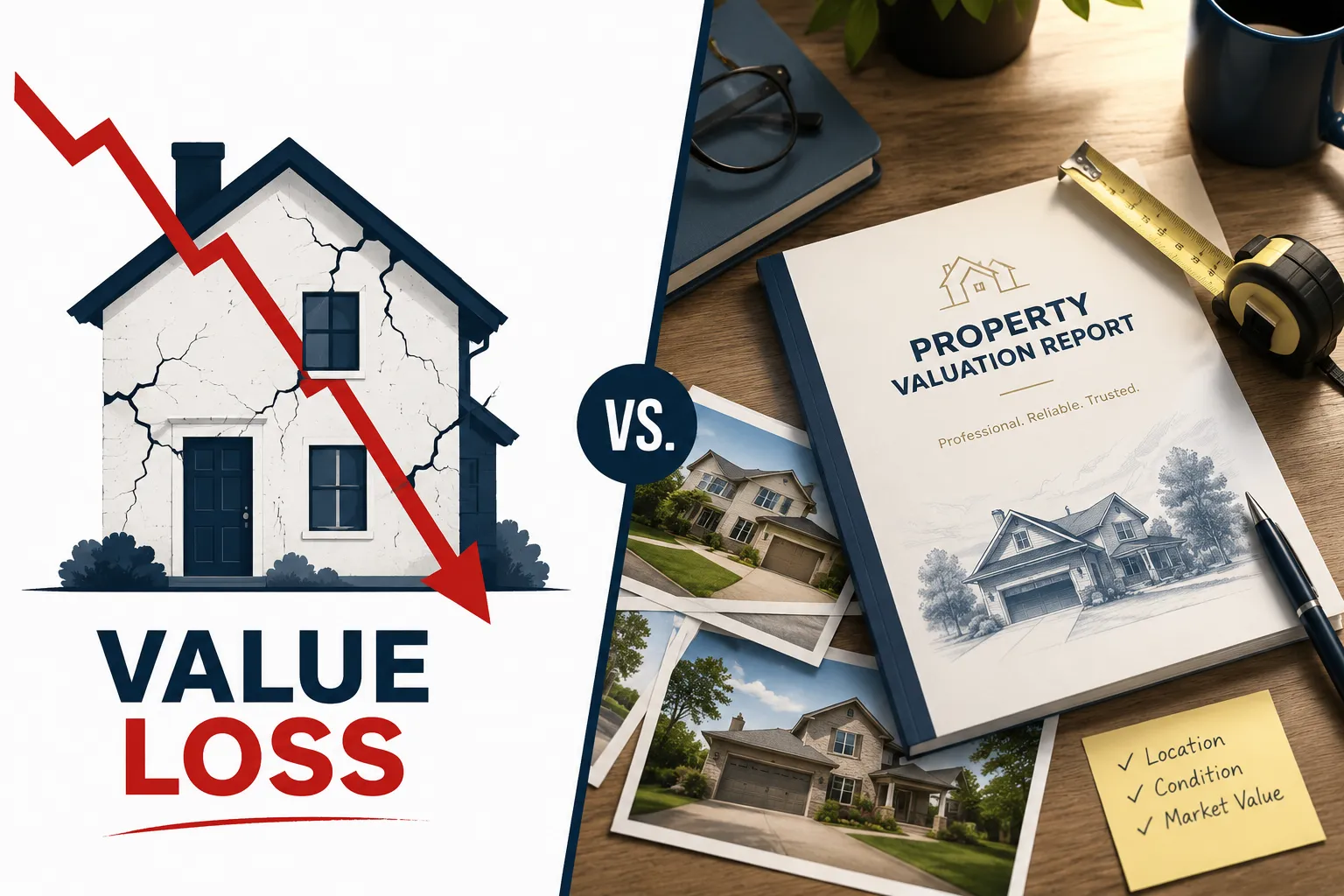
What Is Diminution in Value in Construction Defect Claims?
Diminution in value is the measurable reduction in a property's open market value caused directly by a construction defect or series of defects. In practical terms, it is the difference between what a buyer would pay for the property in sound condition and what they would actually pay knowing the defects exist.
This concept is central to expert witness valuations for construction defect claims because it separates the financial harm suffered by the owner from the theoretical cost of fixing the problem. Legal precedents, including Perry v Sidney Phillips & Son [1982] and Watts v Morrow [1991], established that damages in negligent survey cases are calculated on this basis: the gap between the price paid and the property's true value in its defective state at the date of purchase.
Key points to understand:
- Diminution in value can exist even where defects are fully repairable, because market perception affects buyer behaviour.
- Residual stigma, the lingering price discount buyers apply even after repairs are complete, must be quantified using actual market evidence, not assertion.
- The figure is property-specific and location-specific; comparable sales in the same market are essential evidence.
What Is the Difference Between Repair Costs and Diminution in Value?
Repair costs and diminution in value are related but legally distinct measures of loss, and choosing the wrong one can undermine a claim entirely.
Repair costs (sometimes called the cost-to-cure) represent the expenditure needed to restore the property to the condition it should have been in. Diminution in value represents the actual market impact, what a willing buyer would discount the price by because of the defect.
| Measure | What it captures | When courts prefer it |
|---|---|---|
| Cost to cure | Labour and materials to fix defects | Where repair is proportionate and restores full value |
| Diminution in value | Market price reduction, including stigma | Where repair cost exceeds value loss, or stigma persists |
| Hybrid approach | Both, with reconciliation | Complex or multi-defect claims |
Courts will not automatically award repair costs if those costs exceed the diminution in value, a principle confirmed in Ruxley Electronics v Forsyth [1995]. A skilled surveyor presenting expert witness valuations for construction defect claims must address both figures and explain which better reflects the claimant's actual loss.
What Types of Construction Defects Most Affect Property Value?
Not all defects carry equal weight in the market. The defects that most consistently reduce property values are those that affect structural integrity, safety, or mortgageability.
The highest-impact categories include:
- Structural movement and subsidence, cracks in foundations or load-bearing walls trigger significant buyer concern and can make properties unmortgageable. See our guide on building defects surveys for how these are identified.
- Cladding and fire safety failures, since the Building Safety Act 2022, cladding defects on mid-rise residential buildings carry severe value impacts, often rendering properties unsaleable without remediation.
- Roof defects, widespread failure of roof coverings, flat roof membranes, or structural timbers affects both habitability and insurance. Our building pathology service covers these in depth.
- Damp penetration and drainage failures, persistent rising damp or defective drainage causes progressive damage and deters buyers.
- Non-compliant building works, extensions or conversions built without building regulations approval create legal and financial risk for purchasers. Our building regulation compliance testing service addresses this directly.
Common defects in older homes, including timber decay and original drainage failures, are also frequently the subject of construction defect claims. The 11 common defects in older homes guide provides a useful reference for homeowners assessing their position.
Who Qualifies as an Expert Witness for Construction Disputes?
An expert witness in a construction defect valuation must hold recognised professional qualifications, have demonstrable experience in the specific type of defect and property involved, and be able to demonstrate independence from the instructing party.
In England and Wales, the most relevant qualifications are:
- MRICS or FRICS (Member or Fellow of the Royal Institution of Chartered Surveyors), essential for valuation evidence.
- Registered Valuer status under the RICS Valuer Registration scheme, required for any formal Red Book valuation.
- Specialist experience in building surveying, construction pathology, or the defect type in question (for example, fire safety or structural engineering).
Courts scrutinise expert qualifications closely. A general residential valuer without construction defect experience will face challenge if they attempt to opine on the technical cause of defects or the adequacy of a remediation specification. Complex claims often require a multi-disciplinary team: a chartered building surveyor to assess the defect, a structural engineer to confirm causation, and a registered valuer to quantify the market impact.
The expert witness reports service at Prince Chartered Surveyors provides CPR Part 35-compliant reports prepared by RICS-registered professionals with court experience.
How Do Surveyors Calculate Property Value Loss from Construction Defects?
Surveyors use three primary valuation methodologies when preparing expert witness valuations for construction defect claims, selecting the approach, or combination of approaches, best suited to the evidence available.
1. Diminution in value method
The surveyor establishes the unaffected open market value using comparable sales, then applies a market-supported discount reflecting the defect. The discount must be evidenced by sales of comparable properties with similar issues, not estimated by the surveyor alone.
2. Cost-to-cure method
The surveyor quantifies the reasonable cost of remediation, including professional fees, contingency, and any decant costs. This figure is then tested against the market: if full repair restores the property to its unaffected value, the repair cost approximates the loss.
3. Hybrid method
Where repair restores structural integrity but not full market confidence, the surveyor combines a repair cost assessment with a residual stigma allowance. This is increasingly common in cladding and fire safety claims.
Supporting evidence in all cases must include:
- Comparable sales data from the same locality and property type
- Photographic documentation of defects (wide, medium, and close-up shots with scale references)
- Repair cost schedules from qualified contractors or quantity surveyors
- Market commentary from local agents or auction data where stigma is argued
What Evidence Do Surveyors Use to Prove Construction Defects?
Strong expert witness evidence for construction defect claims is built on a combination of physical inspection findings, documented comparables, and technical analysis, not opinion alone.
A court-ready report will typically include:
- Site inspection notes and photographs, systematic wide, medium, and close-up images with scale references and consistent lighting are now standard practice. Courts treat photographic evidence as a primary tool for establishing the existence and extent of defects.
- Defect schedules, itemised descriptions of each defect, its location, probable cause, and severity.
- Repair specifications and cost estimates, prepared or reviewed by a suitably qualified contractor or quantity surveyor.
- Comparable market evidence, sales of properties with and without similar defects to support the valuation differential.
- Technical reports from specialists, structural engineers, damp surveyors, or fire safety consultants where causation is disputed.
- Building regulations and planning records, to establish whether works were lawfully carried out.
A construction and condition survey provides the technical foundation on which an expert witness valuation is built, particularly in cases involving disputed workmanship or specification compliance.
How Do You Quantify Repair Risk in Property Valuations?
Repair risk is the financial uncertainty attached to a remediation programme, the possibility that actual costs will exceed estimates, that works will take longer than planned, or that further defects will be uncovered during repair. Surveyors must address this explicitly in expert witness valuations for construction defect claims because courts need to understand not just the headline repair cost but the range of possible outcomes.
Repair risk is quantified through:
- Contingency allowances, typically 10-20% on top of base repair costs for residential claims, higher where access is restricted or the defect is progressive.
- Scenario analysis, presenting a best-case, central, and worst-case repair cost range, with assumptions clearly stated.
- Phasing risk, identifying whether defects are likely to worsen during the period before repair, increasing the ultimate cost.
- Mortgageability and insurability risk, quantifying the period during which the property cannot be sold or refinanced, and the carrying costs this creates.
The budgeting for repairs and restoration service addresses repair cost assessment in detail, which is directly relevant to this stage of the expert witness process.
Can I Use a General Appraiser, or Do I Need a Construction Expert?
For straightforward diminution claims where the defect is undisputed and the only question is market impact, a Registered Valuer with experience in the relevant property type may suffice. However, where causation is contested, the repair specification is disputed, or the defect involves specialist systems (fire safety, structural engineering, drainage), a general valuer alone will not be adequate.
Choose a specialist construction expert if:
- The defendant disputes that a defect exists or that it was caused by their work.
- The claim involves cladding, fire safety systems, or structural movement.
- The repair cost is itself in dispute.
- The case is proceeding to the Technology and Construction Court (TCC) or a higher court.
A general Registered Valuer may be sufficient if:
- The defect is agreed by both parties and only the market impact is in dispute.
- The claim is proceeding through a lower-value track where proportionality limits expert costs.
In practice, most construction defect claims of any substance benefit from a chartered building surveyor and a Registered Valuer working together, either as a joint instruction or as separate party experts.
Common Mistakes in Construction Defect Valuation Reports
Expert witness reports in construction defect claims are frequently challenged, and sometimes excluded, because of avoidable errors. The most damaging include:
- Relying solely on repair costs as a proxy for value loss without testing whether the market actually discounts the property by that amount.
- Failing to establish causation, asserting that a defect reduces value without linking it to the defendant's specific act or omission.
- Using unqualified comparables, citing sales that differ in location, property type, or condition without adjustment.
- Breaching expert independence, allowing the instructing party's preferred outcome to influence the report's conclusions, which is a direct breach of CPR Part 35.
- Ignoring residual stigma, concluding that full repair restores full value without market evidence to support that assumption.
- Inadequate photographic documentation, submitting low-quality or undated images that cannot be reliably attributed to the inspection.
Courts have become increasingly rigorous in scrutinising expert methodology. A report that does not address these issues transparently will face cross-examination that undermines its credibility, regardless of the underlying merits of the claim.
When Is a Diminution in Value Claim Better Than a Repair Cost Claim?
A diminution in value claim is the stronger approach when repair costs would exceed the actual market impact of the defect, when repairs cannot fully restore buyer confidence, or when the property has already been sold at a loss.
Specific situations where diminution is preferable:
- The repair cost is disproportionately high relative to the property's value (for example, foundation underpinning on a low-value flat).
- The defect has caused the property to be sold at a provable discount before repair was possible.
- Residual stigma means that even after repair, the property will not achieve its pre-defect value.
- The defendant argues that the claimant should have mitigated loss by carrying out cheap repairs, but those repairs would not have restored market value.
Conversely, a repair cost claim is preferable where the defect is hidden (so no market discount has yet materialised), where the property has not been sold, and where full repair genuinely restores the property to its unaffected value.
How Long Does a Construction Defect Valuation Take, and What Does It Cost?
The timeframe for expert witness valuations for construction defect claims depends on the complexity of the defects, the availability of access, and whether multi-disciplinary input is required.
Typical timeframes:
- Simple single-defect residential claim: 4-6 weeks from instruction to draft report.
- Multi-defect or multi-property claim: 8-12 weeks.
- Cladding or fire safety claims requiring specialist sub-reports: 10-16 weeks.
Cost considerations:
Expert witness fees vary significantly by seniority, location, and complexity. As a general guide (estimates only, based on market observation in 2026):
- Single residential property report: from approximately £1,500 to £4,000 plus VAT.
- Complex multi-defect or commercial property report: £5,000 to £15,000 plus VAT or more.
- Court attendance and cross-examination: charged separately, typically at an hourly or daily rate.
Proportionality matters: courts may limit recoverable expert costs on lower-value claims, so the cost of instruction should be weighed against the likely quantum of the claim before proceeding.
Can Expert Witness Valuations Be Challenged in Court?
Yes, and they frequently are. Expert witness valuations in construction defect claims are subject to cross-examination, and courts have wide powers to reject or limit expert evidence that does not meet the required standard.
The most common grounds for challenge include:
- Lack of independence, evidence that the expert has tailored their conclusions to the instructing party's case.
- Methodological weakness, failure to use recognised valuation approaches or to explain departures from standard practice.
- Inadequate comparables, using sales that do not genuinely reflect the subject property's market.
- Overreach, a valuer opining on structural causation, or a structural engineer opining on market value, outside their area of expertise.
- CPR Part 35 non-compliance, omitting the required expert's declaration or failing to address the court's specific questions.
Where both parties instruct experts, the court may direct a without-prejudice meeting between them to identify areas of agreement and disagreement. A well-prepared expert who can defend their methodology under cross-examination is far more valuable than one who produces an impressive-looking report that collapses under scrutiny.

How Much Does an Expert Witness Cost for Construction Defect Cases?
Expert witness costs in construction defect cases are not fixed, and the final figure depends on the scope of instruction, the number of site visits required, whether the expert is required to attend court, and whether specialist sub-consultants are needed.
The key cost components are:
- Initial report preparation, the largest single cost, covering site inspection, research, comparable analysis, and drafting.
- Responses to Part 35 questions, written questions from the opposing party's solicitors, which require considered written responses.
- Joint statement preparation, where directed by the court, the expert must meet with the opposing expert and produce an agreed schedule of issues.
- Court attendance, charged at a daily rate; a contested hearing may require one to three days of attendance.
Clients should request a clear fee estimate at the outset and agree a cap or staged billing arrangement where possible. Costs that are not proportionate to the claim value will not be recoverable even if the claim succeeds.
Frequently Asked Questions
What is the difference between a party-appointed expert and a single joint expert?
A party-appointed expert is instructed by one side and advocates for that party's position within the bounds of their duty to the court. A single joint expert (SJE) is instructed by both parties jointly and reports to the court without allegiance to either side. Courts on lower-value tracks often direct SJE appointments to control costs.
Does CPR Part 35 apply to all construction defect claims?
CPR Part 35 applies to all civil litigation in England and Wales where expert evidence is used. It requires experts to declare their overriding duty to the court, disclose any conflicts of interest, and confirm that their report contains their genuine professional opinion. Claims proceeding through arbitration or adjudication have their own procedural rules, but similar independence standards apply.
Can a surveyor who carried out the original building survey act as an expert witness in a claim against themselves?
No. A surveyor who is a defendant or potential defendant in a negligence claim cannot act as an independent expert witness in that same matter. The duty of independence under CPR Part 35 makes this a direct conflict of interest.
What is residual stigma, and how is it calculated?
Residual stigma is the market discount that persists after a defect has been fully repaired, because buyers remain wary of the property's history. It is calculated by comparing sales of repaired properties with known defect histories against comparable properties without such histories, in the same market and time period. It cannot be assumed, it must be evidenced.
Is diminution in value recoverable on a buy-to-let property?
Yes. Diminution in value applies to investment properties as well as owner-occupied homes. For landlords, the claim may also include loss of rental income during the period of defect or repair, and any impact on the property's yield-based capital value.
What happens if the two parties' experts cannot agree?
Where party-appointed experts cannot agree, the court will hear evidence from both and make its own determination on the balance of probabilities. The quality of each expert's methodology, their ability to withstand cross-examination, and their compliance with CPR Part 35 all influence which expert's evidence the court prefers.
Conclusion
Expert witness valuations for construction defect claims sit at the intersection of technical building knowledge, market valuation expertise, and legal procedure. Getting this combination right matters enormously: a report that is technically sound but methodologically weak will be challenged; one that is commercially persuasive but lacks independence will be discredited.
Actionable next steps for property owners and professionals:
- Identify the type of defect and whether causation is agreed or disputed, this determines whether you need a building surveyor, a valuer, or both.
- Instruct a chartered surveyor with RICS Registered Valuer status and demonstrable experience in construction defect claims, not a general residential valuer.
- Confirm from the outset that the instruction will produce a CPR Part 35-compliant report, including the required expert's declaration.
- Request a fee estimate that covers the full scope: report preparation, Part 35 questions, joint statement, and court attendance if required.
- Preserve all evidence, photographs, correspondence with builders, planning and building regulations documents, before instructing the expert.
For property owners and professionals across the UK, Prince Chartered Surveyors provides expert witness reports and chartered surveyor valuations prepared to the standard courts expect. Whether the claim involves a residential property, a leasehold flat with cladding issues, or a commercial building with structural defects, the quality of the expert evidence is often the deciding factor in the outcome.
.cdv-wrap{font-family:Arial,sans-serif;max-width:620px;margin:2rem auto;border:1px solid #d0d7e3;border-radius:8px;overflow:hidden;background:#fff}
.cdv-header{background:#1a3560;color:#fff;padding:16px 20px;font-size:1.05rem;font-weight:700}
.cdv-body{padding:18px 20px}
.cdv-q{font-size:.9rem;font-weight:600;color:#1a3560;margin-bottom:6px}
.cdv-options{display:flex;flex-wrap:wrap;gap:8px;margin-bottom:14px}
.cdv-btn{padding:7px 13px;border:2px solid #1a3560;border-radius:5px;background:#fff;color:#1a3560;font-size:.82rem;cursor:pointer;transition:background .2s}
.cdv-btn.active,.cdv-btn:hover{background:#1a3560;color:#fff}
.cdv-result{display:none;background:#f0f4fb;border-left:4px solid #1a3560;padding:12px 14px;border-radius:0 5px 5px 0;font-size:.88rem;color:#222;line-height:1.5}
.cdv-result.show{display:block}
.cdv-result strong{color:#1a3560}
.cdv-reset{margin-top:10px;font-size:.8rem;color:#1a3560;cursor:pointer;text-decoration:underline;background:none;border:none;padding:0}
var picks=[];
function pick(v){
picks.push(v);
var r=document.getElementById(‘cdv-result’);
var msg=”;
if(picks.includes(‘sold’)||picks.includes(‘highcost’)||picks.includes(‘cladding’)){
msg=’Recommended: Diminution in Value
Your circumstances suggest the market impact approach is strongest. A Registered Valuer with construction defect experience should quantify the price reduction using comparable sales, including any residual stigma after repair.’;
} else if(picks.includes(‘notsold’)&&picks.includes(‘lowcost’)&&picks.includes(‘nocladding’)){
msg=’Recommended: Cost-to-Cure
Where repair is proportionate and likely to restore full market value, a repair cost schedule supported by contractor quotes is the most direct evidence. Confirm with a valuer that repair genuinely restores value.’;
} else if(picks.length>=2){
msg=’Consider a Hybrid Approach
Your answers suggest elements of both methods apply. A chartered surveyor can prepare a combined report addressing repair costs and residual market impact, with reconciliation between the two figures.’;
}
if(msg){r.innerHTML=msg;r.classList.add(‘show’);}
}
function resetTool(){picks=[];var r=document.getElementById(‘cdv-result’);r.innerHTML=”;r.classList.remove(‘show’);document.querySelectorAll(‘.cdv-btn’).forEach(function(b){b.classList.remove(‘active’);});}
Tags: expert witness valuations, construction defect claims, diminution in value, repair risk, chartered surveyor, CPR Part 35, building defects, RICS valuation, property value loss, construction law, building surveyor, expert witness report