

Over 1,000 properties were affected by compulsory purchase orders linked to HS2 Phase One alone — and that figure represents only a fraction of the total displacement caused by UK infrastructure schemes over the past decade. As the Planning and Infrastructure Act 2025 began reshaping the legal landscape from February 2026, the demand for rigorous, court-ready expert witness valuations for compulsory purchase orders has never been more acute [1]. For landowners, acquiring authorities, and their legal teams, understanding how these valuations work — and what makes them withstand tribunal scrutiny — is now a matter of financial survival.
This article examines the full scope of expert witness valuations for compulsory purchase orders: navigating 2026 infrastructure projects, with particular focus on CPR Part 35 obligations, lessons drawn from HS2, RICS hope value metrics, and the procedural reforms reshaping compensation claims this year.
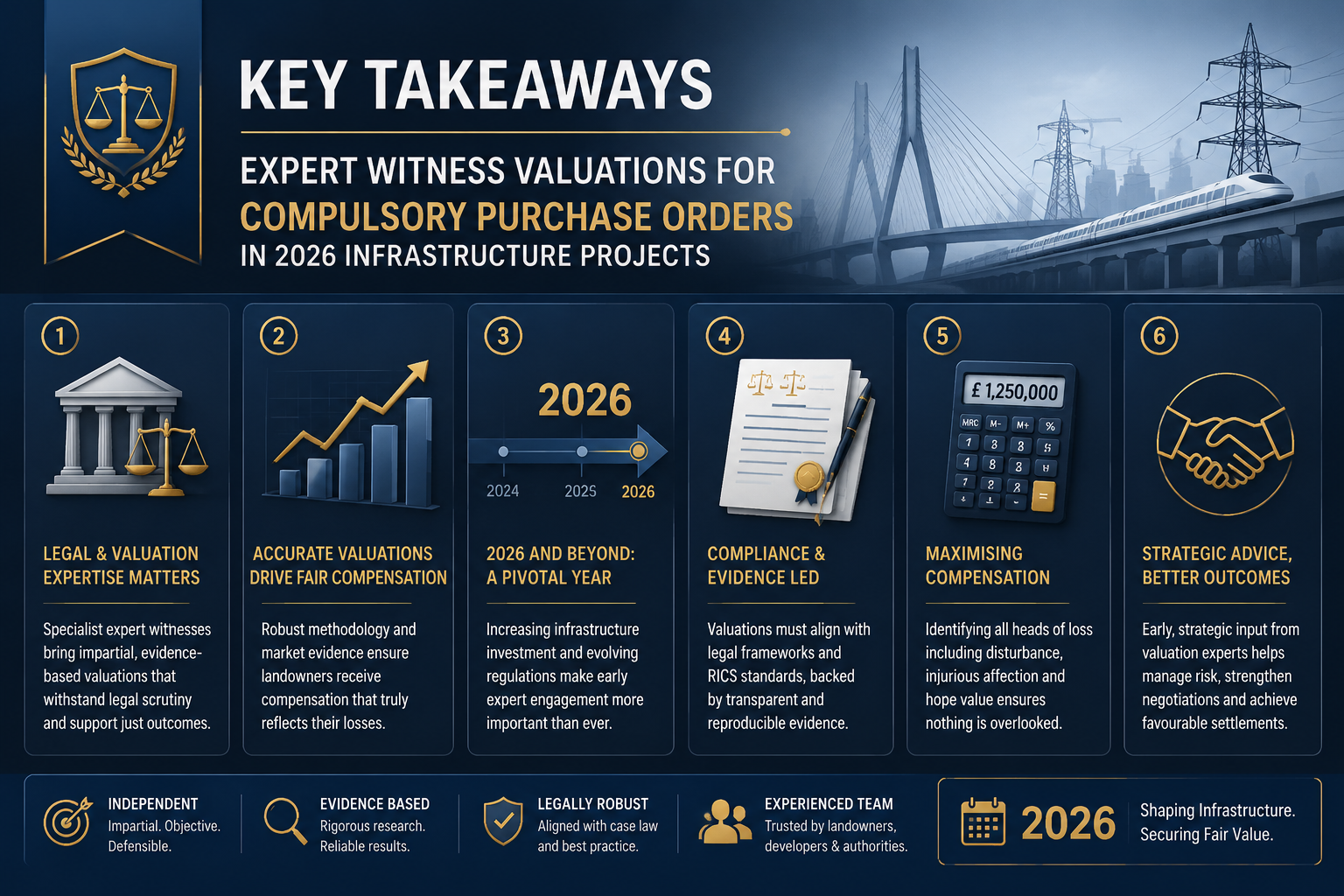
Key Takeaways
- The Planning and Infrastructure Act 2025, effective February 2026, significantly streamlines CPO procedures and raises the stakes for accurate expert witness valuations.
- Expert witnesses in CPO cases must comply strictly with CPR Part 35, which governs their overriding duty to the court rather than to the instructing party.
- RICS Red Book standards and hope value metrics are central to determining fair compensation, especially for properties near development corridors.
- Forensic accountants and chartered surveyors often work together in complex CPO claims to cover both land value and business loss.
- Early instruction of a qualified, RICS-registered expert witness can significantly improve compensation outcomes for affected property owners.
The Legal Framework: CPR Part 35 and the Expert Witness Duty
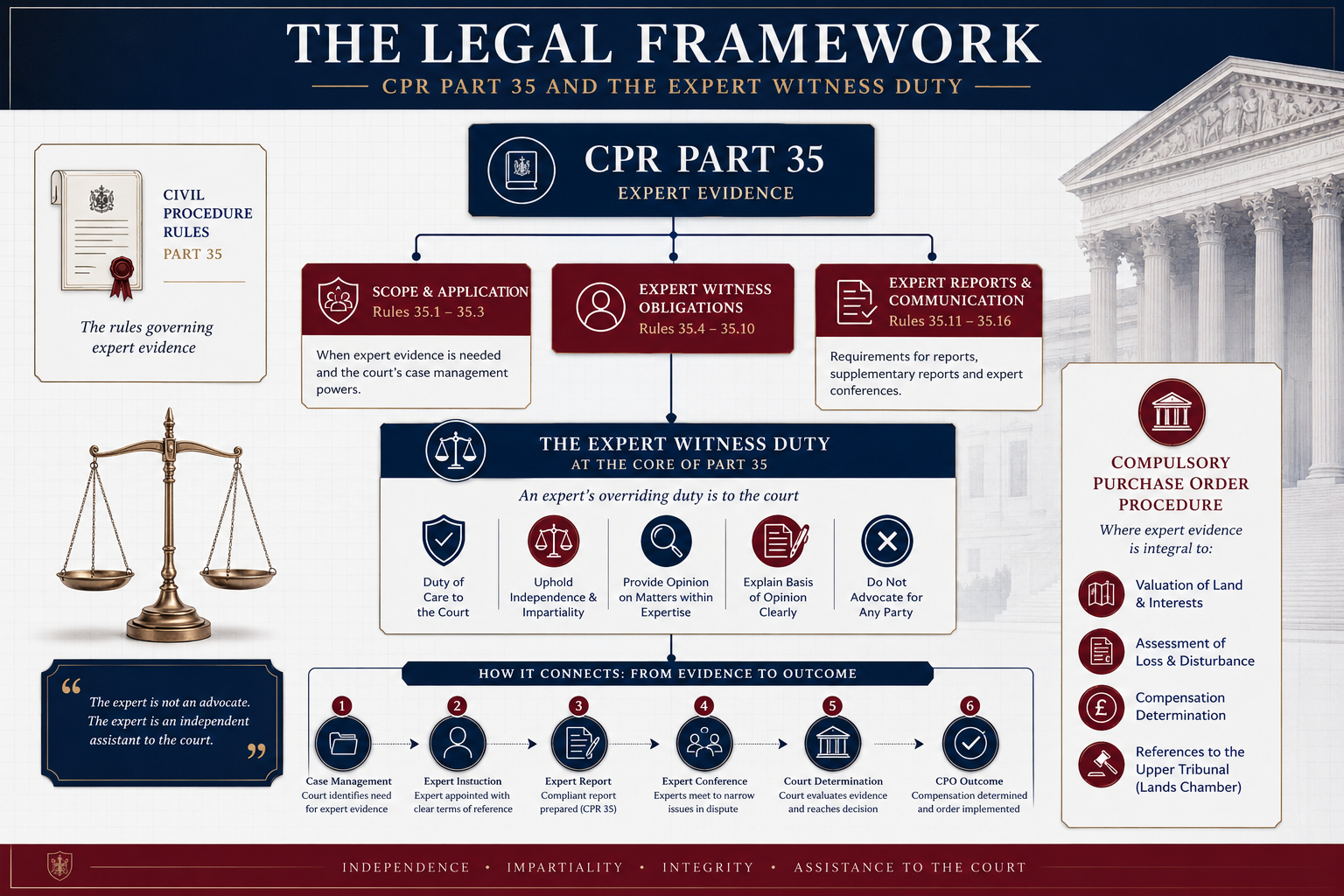
When a compulsory purchase order is confirmed, the dispute over compensation frequently reaches the Upper Tribunal (Lands Chamber). At that point, the rules governing expert evidence shift from informal advice to strict procedural requirements. CPR Part 35 — the Civil Procedure Rules governing expert witnesses — establishes that an expert's primary duty is to the court, not to the party that instructed them.
This is not a technicality. In CPO proceedings, an expert witness who appears to advocate for their client rather than provide objective analysis risks having their evidence disregarded entirely. The Upper Tribunal has repeatedly criticised partisan valuation reports, and in several post-HS2 cases, compensation awards were reduced because expert evidence failed to meet the objectivity standard.
What CPR Part 35 Requires in Practice
A compliant CPR Part 35 report for a CPO valuation must include:
- A signed statement of truth confirming the expert understands their duty to the court
- A clear statement of the expert's qualifications and experience
- Full disclosure of the facts, assumptions, and data relied upon
- Acknowledgement of any material facts that contradict the expert's conclusions
- A statement that the report is complete and accurate to the best of the expert's knowledge
For property valuations specifically, this means the expert must transparently document their comparable evidence, explain any adjustments made to comparable transactions, and address counter-arguments raised by the opposing party's expert. Where two expert witnesses disagree, joint statements identifying areas of agreement and disagreement are standard practice before the hearing.
Working with RICS registered valuers in London who are experienced in tribunal proceedings ensures that reports are structured to meet these exacting standards from the outset.
Valuation Methodology: RICS Standards, Hope Value, and the Compensation Code
The RICS Red Book as the Foundation
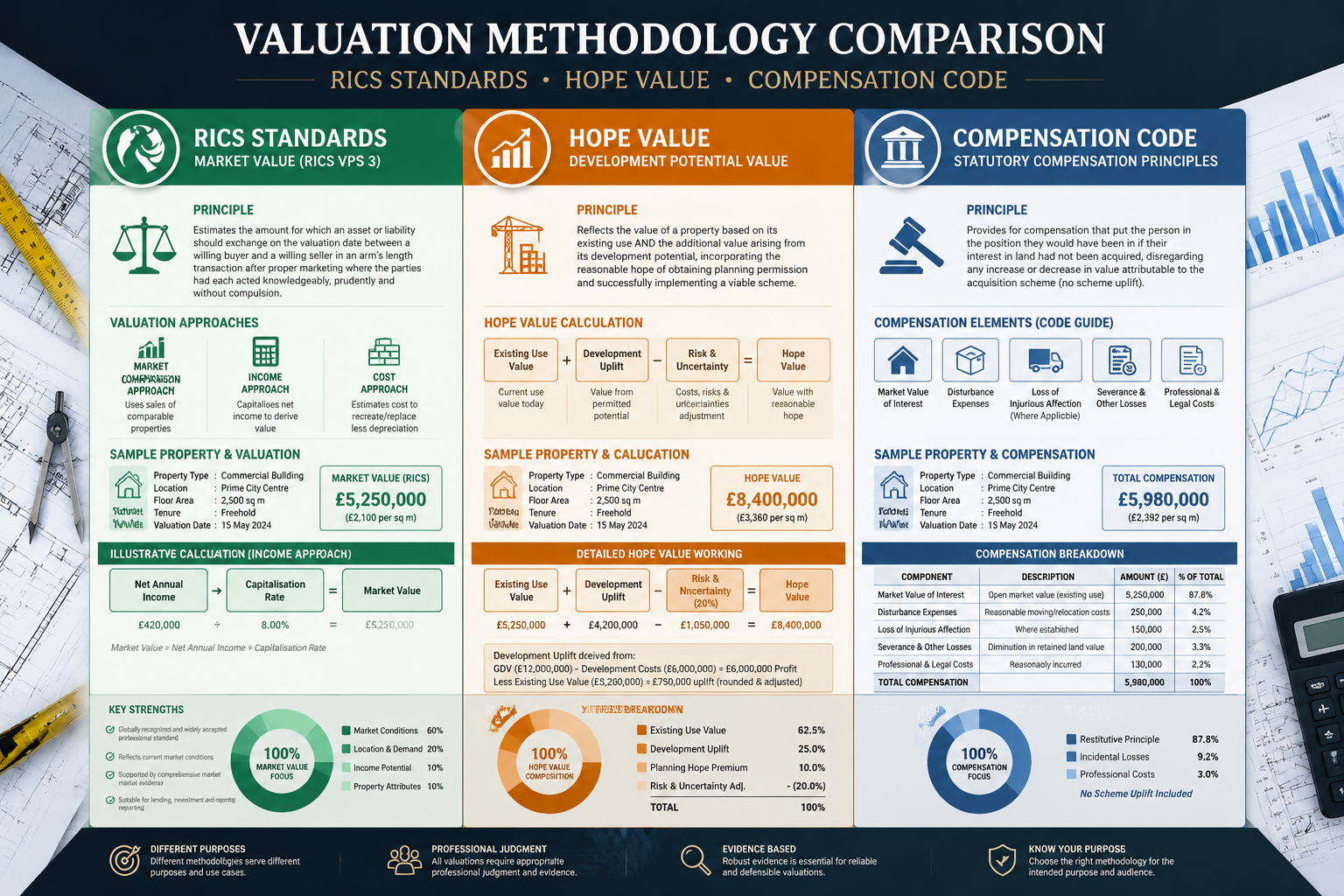
All expert witness valuations for compulsory purchase orders must be grounded in the RICS Valuation — Global Standards (commonly called the Red Book). The Red Book defines market value as the estimated amount for which an asset should exchange on the valuation date between a willing buyer and a willing seller [9]. In CPO cases, this definition is modified by statute: the claimant is not a willing seller, and the acquiring authority is not a voluntary buyer.
This statutory departure from pure market value is where CPO valuations become technically complex. The RICS Red Book valuation process requires the expert to apply the "no-scheme world" assumption — that is, the property must be valued as if the infrastructure project causing the acquisition did not exist. This prevents acquiring authorities from benefiting from any increase or decrease in value that their own scheme has generated.
Hope Value and Its Role in 2026 Claims
Hope value refers to the additional value a property commands because of the reasonable prospect of obtaining planning permission for a more valuable use. In the context of major infrastructure corridors — road expansions, rail upgrades, energy substations — adjacent land often carries hope value linked to development potential unlocked by the scheme itself.
The Planning and Infrastructure Act 2025 introduced provisions directly addressing hope value in CPO compensation, building on earlier reforms that had already restricted acquiring authorities from stripping out hope value simply because the scheme itself generated it [1]. Expert witnesses must now carefully assess:
- Whether planning permission for an alternative use was reasonably achievable absent the scheme
- The probability and timing of that permission being granted
- The discount rate applied to reflect planning uncertainty
Getting hope value calculations wrong is one of the most common sources of under-compensation. A properly instructed expert will use comparable land transactions, planning history, and local development plan evidence to construct a defensible hope value figure.
Severance and Injurious Affection
Beyond the value of the land taken, claimants are entitled to compensation for severance (where the retained land is diminished in value by being separated from the acquired part) and injurious affection (where the retained land suffers from the physical effects of the works). Both heads of claim require separate expert analysis and are frequently underestimated in initial compensation offers.
For commercial property owners, the complexity increases further. A commercial property surveyor in London with CPO experience will assess not only the physical value of the land but also disturbance compensation, which covers reasonable costs of relocation, loss of goodwill, and temporary business disruption.
Lessons from HS2 and the 2026 Infrastructure Pipeline
What HS2 Taught Expert Witnesses
HS2 generated more CPO compensation claims than any previous UK infrastructure project, and the lessons from that process are now embedded in best practice for expert witness valuations for compulsory purchase orders: navigating 2026 infrastructure projects.
Several recurring issues emerged from HS2 proceedings:
Inadequate comparable evidence. Many claimants' experts relied on comparable sales that were themselves affected by the HS2 scheme, violating the no-scheme world assumption. The Upper Tribunal required extensive adjustments, and in some cases rejected comparables entirely.
Failure to address business loss separately. Forensic accountants play a crucial role in CPO cases by quantifying financial losses for affected businesses [6]. Where surveyors attempted to bundle business loss into land value without forensic accounting support, the evidence was routinely challenged.
Delayed instruction. Claimants who instructed expert witnesses late in the process — after the acquiring authority had already made a formal offer — found themselves at a significant disadvantage. Early instruction allows the expert to gather time-sensitive evidence, including pre-scheme planning assessments and business accounts.
The 2026 Infrastructure Pipeline
The infrastructure pipeline in 2026 is substantial. On 30 April 2026, the Department for Energy Security and Net Zero confirmed the Compulsory Purchase Order for National Grid's Birkhill Wood 400kV Substation Project, underscoring the continued use of CPOs in energy infrastructure [3]. Plymouth City Council initiated CPOs for properties along the A386 Tavistock Road in May and June 2026, illustrating how urban road schemes continue to generate significant compensation claims [4].
Internationally, Skanska's $454 million New Jersey Surface Alignment Project, secured in June 2026, demonstrates that the scale of infrastructure investment requiring compulsory acquisition is a global phenomenon [5]. While UK and US legal frameworks differ, the valuation principles — fair market value, business disturbance, and professional expert testimony — are broadly consistent.
The updated government guidance on the compulsory purchase process, released on 17 June 2026, provides detailed instructions on procedural requirements and compensation rules [2]. Expert witnesses are expected to be familiar with this guidance, as acquiring authorities and tribunals will reference it when assessing the reasonableness of compensation claims.
The Role of Forensic Accountants Alongside Surveyors
For business occupiers facing CPO, the financial impact extends well beyond the value of the bricks and mortar. Forensic accountants specialising in CPO matters can quantify:
- Loss of profits during the period of disturbance
- Increased operating costs at a new location
- Loss of goodwill where a business cannot be relocated
- Redundancy costs and staff retention expenses [6] [7]
The most effective CPO claims combine a RICS-accredited surveyor's land and property valuation with a forensic accountant's business loss assessment, presented as a coordinated package of expert evidence. Firms with experience across more than 50 CPO cases have demonstrated that this integrated approach consistently produces better outcomes for claimants [7].
For commercial landlords and tenants, a commercial building survey in London conducted before the acquisition date can also establish the condition and value of improvements, supporting higher disturbance claims.
Procedural Reforms Under the Planning and Infrastructure Act 2025
Key Changes Effective February 2026
The Planning and Infrastructure Act 2025 received Royal Assent on 18 December 2025, with key provisions taking effect on 18 February 2026 [1]. The reforms aim to accelerate infrastructure delivery by streamlining CPO confirmation procedures, but they also introduce changes that directly affect how expert witness valuations are prepared and presented.
Notable procedural changes include:
| Reform Area | Previous Position | Post-February 2026 |
|---|---|---|
| CPO confirmation timelines | Variable, often 18-24 months | Targeted reduction to 12 months |
| Written representations procedure | Limited use | Expanded eligibility |
| Advance payments | Discretionary | Strengthened entitlement |
| Hope value provisions | Case-by-case | Clearer statutory framework |
The tighter timelines mean that claimants and their expert witnesses have less time to prepare comprehensive valuation evidence. Early instruction is now more important than ever. An expert who is brought in after the acquiring authority has submitted its valuation will be working against the clock.
Updated Government Guidance and Its Implications
The June 2026 government guidance update clarifies several areas that had generated inconsistent practice [2]:
- The basis for calculating equivalent reinstatement where market value does not reflect the true cost of replacing a specialist property
- The treatment of disturbance claims for residential occupiers
- The procedure for claiming compensation for temporary possession
Expert witnesses must now demonstrate familiarity with this guidance in their reports. Tribunals will expect references to the updated guidance where it is relevant to the heads of claim being advanced.
For properties with specialist characteristics — such as those requiring a reinstatement cost valuation — the updated guidance provides clearer parameters for when the statutory basis of equivalent reinstatement applies, which can significantly increase the compensation payable compared to open market value.
Selecting and Instructing the Right Expert Witness
Qualifications and Independence
Not every chartered surveyor is equipped to act as an expert witness in CPO proceedings. The role requires a specific combination of:
- RICS membership and adherence to Red Book standards
- Tribunal experience or at minimum, experience preparing expert reports for contested claims
- Sector knowledge relevant to the type of property being acquired (residential, commercial, agricultural, or mixed-use)
- Independence — the expert must have no financial interest in the outcome beyond their professional fee
The chartered surveyors in London most effective in CPO matters are those who can demonstrate a track record of tribunal appearances and a clear understanding of CPR Part 35 obligations.
The Valuation Date and Retrospective Evidence
One technical issue that frequently arises in CPO claims is the valuation date. Compensation is assessed as at the date of entry (when the acquiring authority takes possession) or the date of the notice to treat, depending on the circumstances. In a rising or falling market, the choice of valuation date can make a material difference to the compensation figure.
Expert witnesses must be capable of providing retrospective property valuations that accurately reflect market conditions at the relevant date, supported by contemporaneous comparable evidence rather than current market data.
Working with Acquiring Authorities
Cushman & Wakefield's Infrastructure Practice Group, which provides eminent domain and right-of-way valuation services including expert witness testimony, has noted that acquiring authorities and claimants both benefit from early engagement with qualified valuers [8]. Where both parties instruct experienced experts, the scope of dispute narrows, joint statements are more productive, and tribunal hearings are shorter and less costly.
Ardent Management, which advises compensating authorities on land compensation risks and settlements, emphasises that specialist valuation services in complex infrastructure projects are essential for managing financial exposure on both sides of the CPO process [10].
Practical Steps for Affected Property Owners in 2026
If a property is within the scope of a CPO linked to a 2026 infrastructure project, the following steps are strongly recommended:
- Seek specialist advice immediately upon receiving a notice to treat, general vesting declaration, or preliminary notification. Do not wait for a formal offer.
- Instruct a RICS-accredited expert witness with CPO experience, not simply a general valuer.
- Document the property's condition and use thoroughly, including photographs, planning applications, business accounts, and any pre-scheme development proposals.
- Do not accept the acquiring authority's initial offer without independent valuation advice. Initial offers are frequently below the compensation to which claimants are entitled.
- Consider all heads of claim — land value, hope value, severance, injurious affection, disturbance, and business loss — rather than focusing solely on the market value of the land taken.
- Review the June 2026 government guidance with your expert to ensure all relevant provisions are addressed in the claim [2].
For those seeking expert surveyor guidance on navigating complex property matters, the expert surveyor advice resources available through specialist firms provide a useful starting point for understanding the scope of professional support available.
Conclusion
Expert witness valuations for compulsory purchase orders: navigating 2026 infrastructure projects demand a level of technical precision, procedural knowledge, and professional independence that goes well beyond standard property valuation work. The combination of the Planning and Infrastructure Act 2025 reforms, updated government guidance, and a substantial live infrastructure pipeline means that the stakes — and the complexity — are higher in 2026 than at any point in recent years.
Actionable next steps for property owners and legal teams:
- Instruct a CPR Part 35-compliant RICS expert witness at the earliest opportunity, ideally before the acquiring authority submits its formal valuation.
- Ensure the expert's report addresses the no-scheme world assumption, hope value, and all applicable heads of claim under the Compensation Code.
- Engage a forensic accountant alongside the surveyor where business loss is a significant element of the claim.
- Reference the June 2026 government guidance and the Planning and Infrastructure Act 2025 provisions in all expert reports and correspondence with the acquiring authority.
- Do not treat the acquiring authority's initial offer as a ceiling — it is a starting point for negotiation, not a final determination.
The difference between an adequate compensation settlement and a fair one frequently comes down to the quality of the expert evidence. In 2026, that quality is defined by CPR Part 35 compliance, RICS Red Book rigour, and hard-won experience in the Upper Tribunal.
References
[1] Planning And Infrastructure Act 2025 – holmes-hills.co.uk
[2] Guidance On The Compulsory Purchase Process – gov.uk
[3] Birkhill Wood – nationalgrid.com
[4] Compulsory Purchase Orders – plymouth.gov.uk
[5] Skanska Selected For New Jersey Surface Alignment Project In New Jersey Usa For Usd 454m About Sek 4.3 Billion – skanska.com
[6] Counting Cost Compulsory Purchase Orders – quantuma.com
[7] Compulsory Purchase – quantuma.com
[8] Infrastructure – cushmanwakefield.com
[9] Compulsory Purchase Valuations The Ultimate Authority Guide To Rics Market Valuation Early Buyback Valuation And Compulsory Purchase Valuation In London – res-prop.com
[10] Compensation – ardent-management.com
How Prince Surveyors can help: explore our expert witness surveyors or learn about our RICS valuations.