

A net balance of -39% in new buyer enquiries recorded in March 2026 — the sharpest single-month deterioration since mid-2023 — created a valuation landscape that left many expert witnesses scrambling for defensible benchmarks. [1] Yet by mid-2026, that same RICS net balance had recovered to -15%, a 14-point improvement from the February reading of -29%. This trajectory is not merely a market footnote. For surveyors preparing expert witness reports, it is the analytical spine of every credible valuation opinion submitted to the courts this year.
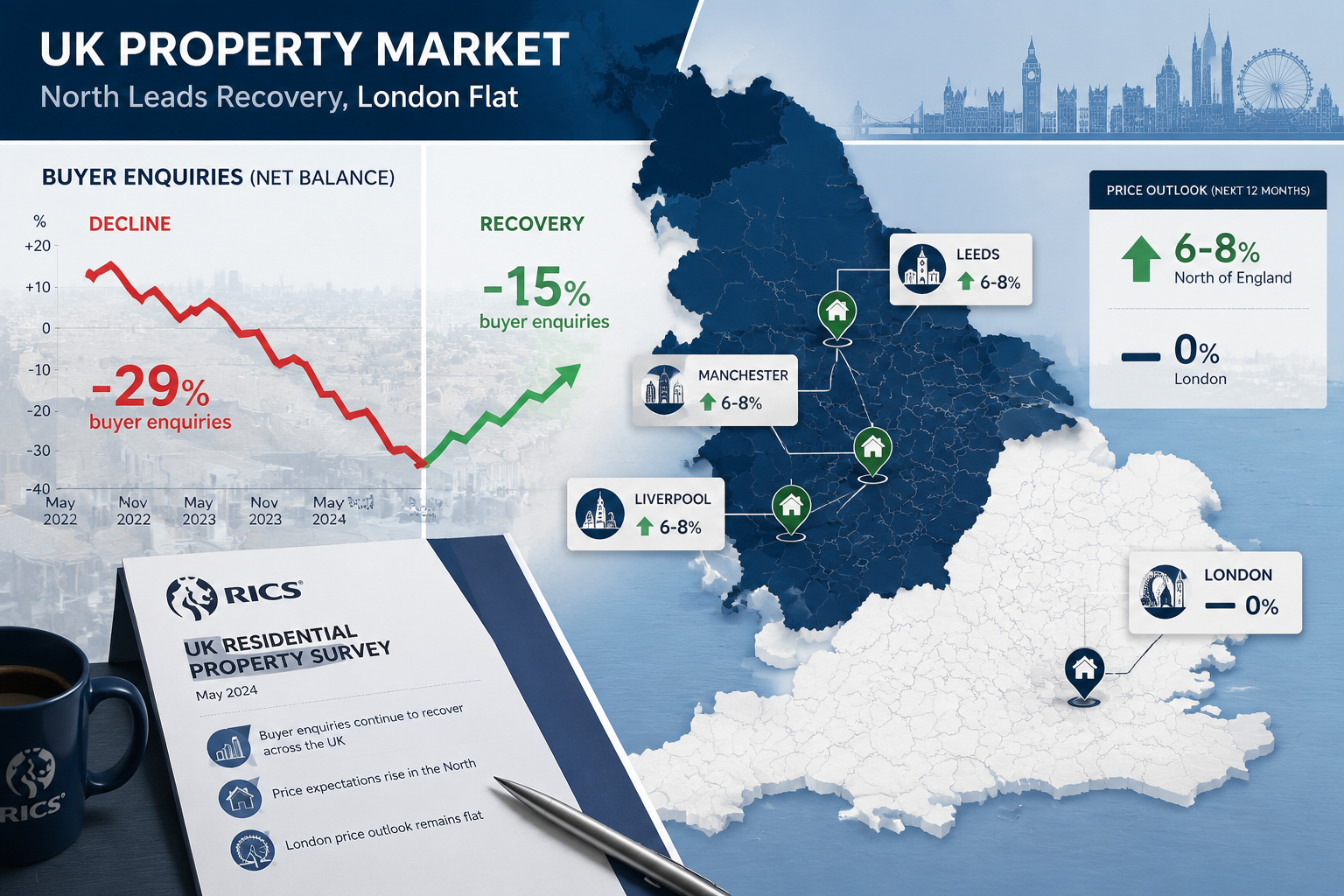
Understanding Expert Witness Valuations Amid 2026 Buyer Enquiry Rebound: From -29% to -15% and What It Means for Disputes requires more than reading headline figures. It demands a structured approach to translating RICS net balance data into legally robust, court-ready testimony that can withstand challenge from automated valuation models (AVMs), opposing counsel, and tribunal scrutiny.
Key Takeaways
- Buyer enquiry net balances moved from -29% in February 2026 to -15% by mid-2026, signalling a partial but meaningful market stabilisation.
- Regional divergence remains stark: northern cities such as Manchester, Leeds, and Liverpool recorded annual price growth of 6-8%, while London's 12-month price expectations collapsed from +56% to +7% in a single month. [2]
- Short-term price expectations turned negative at -18% in February 2026, but 12-month expectations held positive at +33%, providing expert witnesses with a credible forward-looking anchor. [1]
- Automated valuation models have failed to capture this regional and temporal nuance, making professionally reasoned expert witness reports more critical than ever. [3]
- RICS Expert Witness Accreditation Scheme (EWAS) credentialing has become the recognised benchmark for credibility in 2026 dispute proceedings. [1]
The Market Context Behind the Numbers
How Buyer Enquiries Fell — and Why the Rebound Matters
The deterioration in buyer sentiment during early 2026 did not occur in isolation. Geopolitical instability, including ongoing conflicts in the Middle East, pushed borrowing costs higher and suppressed consumer confidence across the UK housing market. [3] Estate agents reported a sharp pullback in viewings and offers through February and March, with the RICS residential survey capturing a net balance of -26% in February, worsening to -39% by March. [1]
However, the picture shifted meaningfully as Q2 2026 progressed. Several estate agents reported a genuine uptick in buyer enquiries, viewings, and offers in the early months of 2026, suggesting the market was finding a floor. [4] By mid-2026, the net balance had recovered to approximately -15% — still negative, but representing a significant directional change that carries weight in any valuation dispute.
For expert witnesses, this rebound is not simply good news for the market. It is evidence of stabilisation that must be carefully contextualised. A valuation conducted at the trough in March 2026 should reflect the conditions of that specific date. A valuation conducted in June 2026 operates in a measurably different environment. Conflating the two is a common source of dispute — and a vulnerability that opposing parties will exploit.
Regional Divergence: The Complication No AVM Can Solve
One of the most consequential features of the 2026 market is the scale of regional price divergence. London experienced a dramatic correction in sentiment, with 12-month price expectations falling from +56% in January 2026 to just +7% in February — a 49-point collapse in a single reporting period. [2]
Northern regions told a different story entirely. Greater Manchester, Leeds, and Liverpool recorded annual price growth of 6-8% over the same period, driven by sustained demand, relative affordability, and ongoing regeneration investment. [2]
| Region | 12-Month Price Expectation (Jan 2026) | 12-Month Price Expectation (Feb 2026) | Annual Price Growth |
|---|---|---|---|
| London | +56% | +7% | Flat to negative |
| Greater Manchester | Positive | Positive | +6-8% |
| Leeds | Positive | Positive | +6-8% |
| Liverpool | Positive | Positive | +6-8% |
This divergence creates a direct problem for any dispute in which a national or regional AVM figure is applied to a specific property without local adjustment. Expert witnesses who understand the factors that drive property valuation are better placed to explain why a blanket national figure is inadequate and potentially misleading in court.
How Expert Witness Valuations Amid 2026 Buyer Enquiry Rebound: From -29% to -15% and What It Means for Disputes Should Be Structured
Anchoring Opinions to RICS Net Balance Data
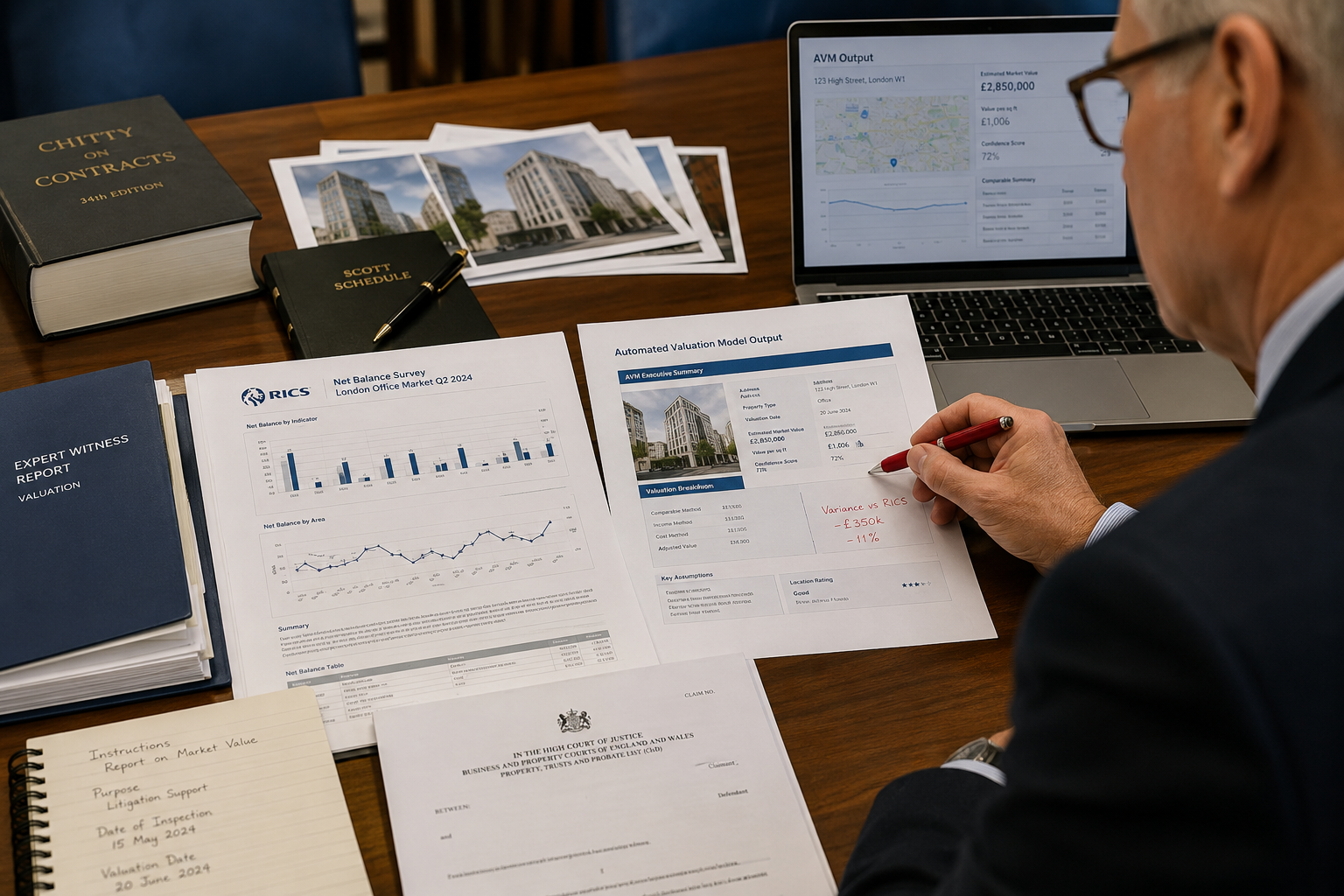
The single most effective strategy available to expert witnesses in 2026 is anchoring their valuation opinion explicitly to RICS survey data. This approach does three things simultaneously: it grounds the opinion in independently published, professionally recognised evidence; it provides a time-stamped market condition baseline; and it demonstrates methodological rigour to the tribunal.
When presenting testimony, expert witnesses should reference the specific net balance reading that applied at the valuation date. For a property valued in February 2026, the -29% buyer enquiry figure and the -18% short-term price expectation are directly relevant. [1] For a property valued in mid-2026, the recovery to -15% and the sustained positive 12-month expectation of +33% provide a different but equally defensible baseline. [1]
"The 12-month price expectation of +33% recorded in February 2026 is a critical data point for expert witnesses. It demonstrates that even at the market's weakest point, professional sentiment about medium-term recovery remained firmly positive — a fact that directly informs any forward-looking valuation."
This distinction matters enormously in disputes involving matrimonial valuations, probate valuations, and lease extension disputes, where the precise date of valuation can determine the outcome of the entire case.
Countering AVM Challenges with Professional Judgment
Automated valuation models have been widely used by mortgage lenders and opposing parties to challenge expert witness opinions. Their appeal is obvious: they are fast, cheap, and produce a figure with apparent precision. Their weakness is equally clear: they cannot account for the demand collapse and regional divergence that defined the first half of 2026. [3]
When an AVM produces a figure that conflicts with an expert witness opinion, the expert's response should follow a structured framework:
- Identify the AVM's data vintage. Most AVMs rely on transaction data that lags the market by three to six months. A model trained on late 2025 data will not reflect the February-March 2026 demand collapse.
- Highlight regional granularity failures. A national or regional AVM cannot distinguish between a Manchester suburb experiencing 7% annual growth and a London borough facing flat or negative conditions.
- Document comparable evidence. Court-ready comparable analysis, drawn from properties sold within the relevant time window and geographic area, provides the empirical counterweight to AVM outputs.
- Reference RICS methodology. A RICS Red Book valuation follows a defined, auditable process. Expert witnesses should make this process explicit in their reports, contrasting it with the opaque algorithms underpinning most AVMs.
For complex commercial disputes, the same principles apply. Surveyors handling commercial property valuations face additional layers of complexity, including yield movement and occupier demand data, but the core strategy of anchoring to published market evidence remains consistent.
The Importance of the Valuation Date in Dispute Proceedings
A recurring source of conflict in 2026 valuation disputes is the mismatch between the date a valuation was instructed, the date it was carried out, and the date at which market conditions are assessed. In a market that moved from -39% to -15% in buyer enquiry net balance over a matter of months, a difference of even six to eight weeks can produce a materially different defensible figure.
Expert witnesses should:
- State the valuation date explicitly and prominently in every report.
- Document the market conditions prevailing on that specific date using RICS survey data, Land Registry transaction volumes, and local comparable evidence.
- Avoid retrospective adjustment of valuations to reflect conditions that did not exist at the valuation date — a practice that courts have consistently criticised.
This discipline is particularly important in shared ownership valuations and lease extension valuations, where statutory timetables often mean that the valuation date and the dispute date are separated by a significant period.
What the Rebound From -29% to -15% Means for Ongoing and Future Disputes
Stabilising Prices and the Expert Witness's Forward-Looking Obligation
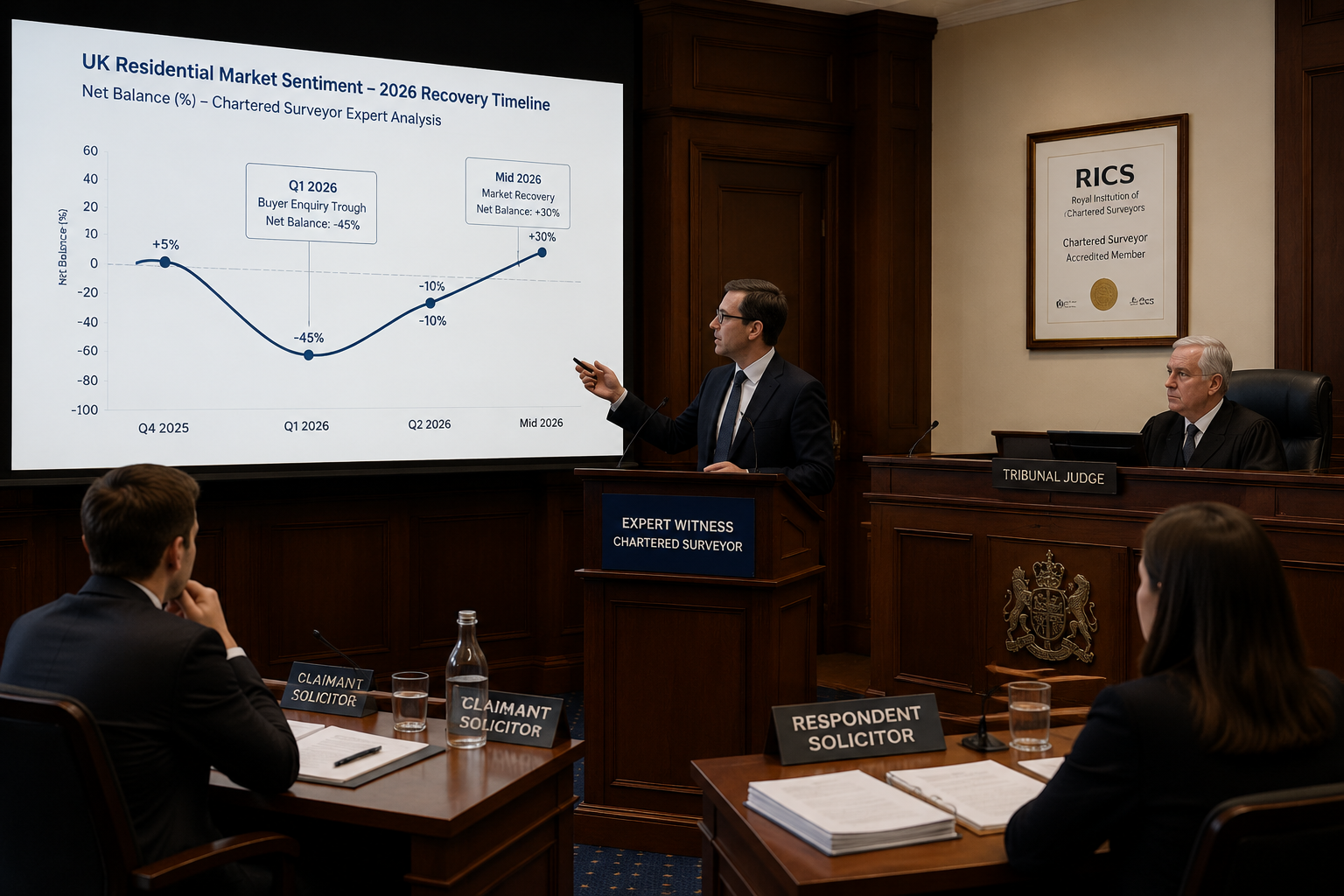
The recovery in buyer enquiry net balance from -29% to -15% does not mean the market has returned to pre-2026 conditions. It means the rate of deterioration has slowed and, in some indicators, reversed. For expert witnesses, this distinction is crucial.
In disputes where a party argues that a valuation was too conservative, the rebound provides partial support for that argument — but only if the valuation date falls within the recovery period. Expert witnesses must resist the temptation to use post-valuation-date data to justify a figure that was correct at the time it was given. Courts are alert to this form of hindsight bias.
Conversely, where a party argues that a valuation was too optimistic — perhaps in a case involving a property valued in January 2026 before the demand collapse — the February-March deterioration data provides strong support for a downward revision. The 49-point collapse in London's 12-month price expectations is particularly powerful evidence in this context. [2]
The 12-month expectation of +33% recorded even at the February trough [1] gives expert witnesses a legitimate basis for arguing that medium-term values should not be written down as severely as short-term sentiment might suggest. This is a nuanced but legally significant point in disputes involving long-term asset valuations, development appraisals, and compulsory purchase cases.
Professional Standards and RICS Accreditation in 2026
The credibility of an expert witness in 2026 rests heavily on professional standing. The RICS Expert Witness Accreditation Scheme (EWAS) has become the recognised benchmark in dispute proceedings, and tribunals are increasingly scrutinising whether the expert holds this accreditation. [1]
Beyond accreditation, RICS guidelines are unambiguous on one critical point: expert witness fees must never be success-based. Any arrangement that ties remuneration to the outcome of the dispute — whether explicitly or implicitly — constitutes a breach of professional standards and exposes the surveyor to both disciplinary and legal consequences. [1] This rule exists to preserve the independence that gives expert witness testimony its value.
Surveyors who wish to strengthen their position in dispute proceedings should consider the full scope of services available through a comprehensive expert witness report, which documents methodology, evidence base, and professional reasoning in a format designed to withstand cross-examination.
Practical Checklist for Expert Witnesses Navigating 2026 Disputes
The following checklist summarises the key actions for surveyors preparing valuation evidence in the current market:
- Confirm and document the precise valuation date before any analysis begins.
- Source the RICS net balance figures applicable to that specific date and region.
- Gather a minimum of three to five directly comparable transactions within a three-month window of the valuation date.
- Assess whether an AVM has been used by the opposing party and identify its data vintage and geographic granularity.
- Prepare a written explanation of how regional divergence affects the subject property's value relative to national benchmarks.
- Confirm RICS EWAS accreditation is current and referenced in the report.
- Ensure fee arrangements comply fully with RICS independence requirements.
- Where the dispute involves a property inspection, ensure the inspection methodology is documented in accordance with RICS chartered surveyor standards.
For disputes involving dilapidations, the same principles of market-condition documentation apply. Surveyors handling schedule of dilapidations cases should ensure that any reinstatement cost estimates reflect 2026 build cost data rather than pre-rebound figures.
Conclusion
The movement in buyer enquiry net balance from -29% to -15% across 2026 is more than a market statistic. It is a structured evidential resource that expert witnesses can use to defend, challenge, or contextualise property valuations in dispute proceedings. The key is precision: matching the data to the valuation date, accounting for regional divergence, and presenting the evidence in a format that courts can evaluate against AVM-based challenges.
Actionable next steps for surveyors:
- Review all current expert witness instructions and confirm the valuation date is explicitly documented alongside the relevant RICS net balance data.
- Audit any AVM figures provided by opposing parties for data vintage and regional granularity failures.
- Ensure RICS EWAS accreditation is current and referenced prominently in all expert witness reports.
- Where instructions involve northern English properties, prepare specific evidence of the 6-8% annual price growth recorded in Manchester, Leeds, and Liverpool to counter any nationally averaged figures.
- For valuations conducted during the February-March 2026 trough, prepare a clear narrative explaining why short-term sentiment data (-18% price expectations) does not override the 12-month positive outlook (+33%), and how this affects the defensible value range.
The 2026 buyer enquiry rebound has given expert witnesses both a challenge and a tool. Those who use it with precision and professional rigour will produce testimony that stands up. Those who ignore it will find their opinions increasingly difficult to defend.
References
[1] Valuation Challenges From Rics February 2026 Survey Expert Witness Strategies For 26 Buyer Enquiry Dip Disputes – wimbledonsurveyors.com
[2] Expert Witness Valuations Amid Cautious Spring 2026 Housing Market Rics Insights On Interest Rates And Regional Recovery – manchestersurveyors.com
[3] Defending Cautious Q2 2026 Valuations As Expert Witness Leveraging Rics February Data Against Avm Challenges – wimbledonsurveyors.com
[4] Estate Agents Start 2026 Strong As Buyer Enquiries Viewings And Offers Rise – propertyindustryeye.com
How Prince Surveyors can help: explore our expert witness surveyors or learn about our RICS valuations.