

Last updated: July 24, 2026
Quick Answer: Expert witness testimonies in post-budget property disputes provide courts and tribunals with independent, professionally reasoned valuations that account for the specific tax changes introduced in a given budget cycle. In 2026, UK property owners, landlords, and buyers are increasingly relying on chartered surveyors to deliver these valuations as SDLT thresholds, capital gains tax rates, and inheritance tax rules continue to shift. A qualified expert witness does not simply state a property's value, they explain how budget-driven tax changes materially affect that value, and they defend that position under cross-examination.
Key Takeaways
- Expert witnesses in property disputes must hold recognised professional qualifications, typically MRICS or FRICS, and comply with Civil Procedure Rules Part 35 in England and Wales.
- Post-budget property disputes in 2026 often hinge on how tax changes, particularly to capital gains tax, inheritance tax, and stamp duty, affect assessed market value at a specific date.
- An expert witness valuation is legally distinct from a standard appraisal: it carries a duty to the court, not to the instructing party.
- Costs for expert witness reports in property cases typically range from £1,500 to £6,000 or more, depending on complexity and whether oral testimony is required.
- Expert witnesses can be challenged on methodology, comparable evidence used, and whether they have properly accounted for post-budget tax legislation.
- Using the same expert witness across multiple disputes is permissible but must be disclosed; perceived bias can undermine credibility.
- Disagreements between an expert witness and a separate appraiser are common and are resolved through a "without prejudice" meeting of experts or a joint statement.
- Even small property disputes can benefit from expert witness input if a tax liability is contested, though a single joint expert may be more cost-proportionate.
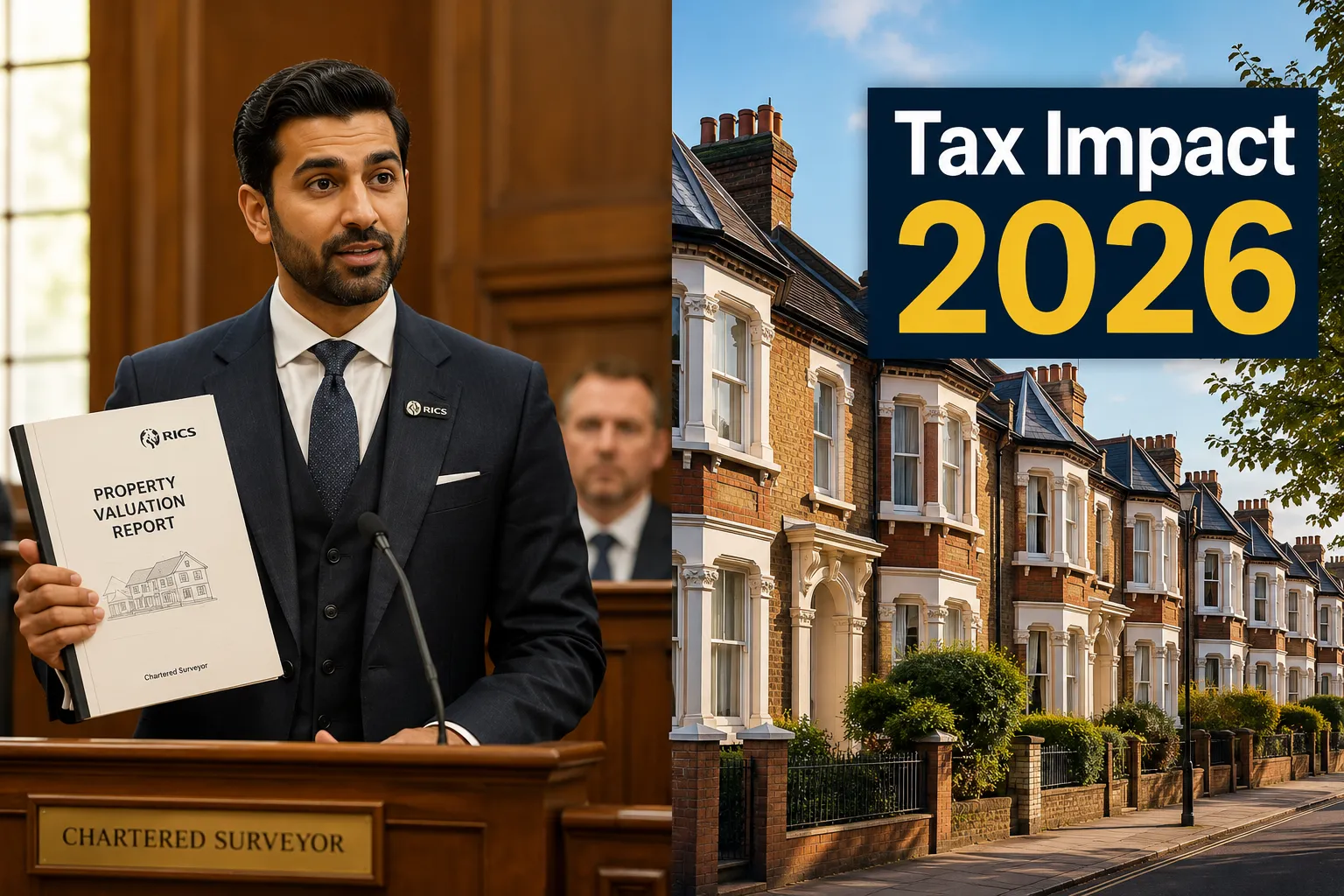
What Is an Expert Witness in Property Disputes?
An expert witness in a property dispute is an independent professional appointed to provide the court or tribunal with an objective, evidence-based opinion on a specialist matter, in this context, the value of a property and the tax implications attached to it. Unlike a factual witness who reports what they observed, an expert witness offers a professional opinion that the court could not reasonably form on its own.
In UK property cases, expert witnesses are most commonly chartered surveyors registered with the Royal Institution of Chartered Surveyors (RICS). Their duty runs to the court, not to the party who instructs and pays them. This independence is not optional, it is a legal requirement under Civil Procedure Rules (CPR) Part 35, which governs expert evidence in civil proceedings in England and Wales.
When is an expert witness needed?
- Disputes over inheritance tax valuations following a death (see our guide on what happens to a property when the owner passes away)
- Capital gains tax challenges where HMRC disputes a declared disposal value
- Matrimonial proceedings requiring an independent property value
- Boundary and party wall disputes with a financial damages element
- Landlord-tenant disagreements over dilapidations or rent review
How Expert Witnesses Value Property for Tax Purposes
Expert witnesses establish a property's market value at a specific date using a combination of comparable market evidence, inspection findings, and professional judgement. For tax purposes, that date is critical, it is usually the date of disposal, death, or assessment, not the date of the dispute itself.
The core methodology follows RICS Valuation, Global Standards (the "Red Book"), which sets out the definition of market value as the estimated amount for which an asset should exchange on the date of valuation between a willing buyer and a willing seller in an arm's length transaction. This standard applies whether the valuation is for capital gains tax, inheritance tax, or annual tax on enveloped dwellings.
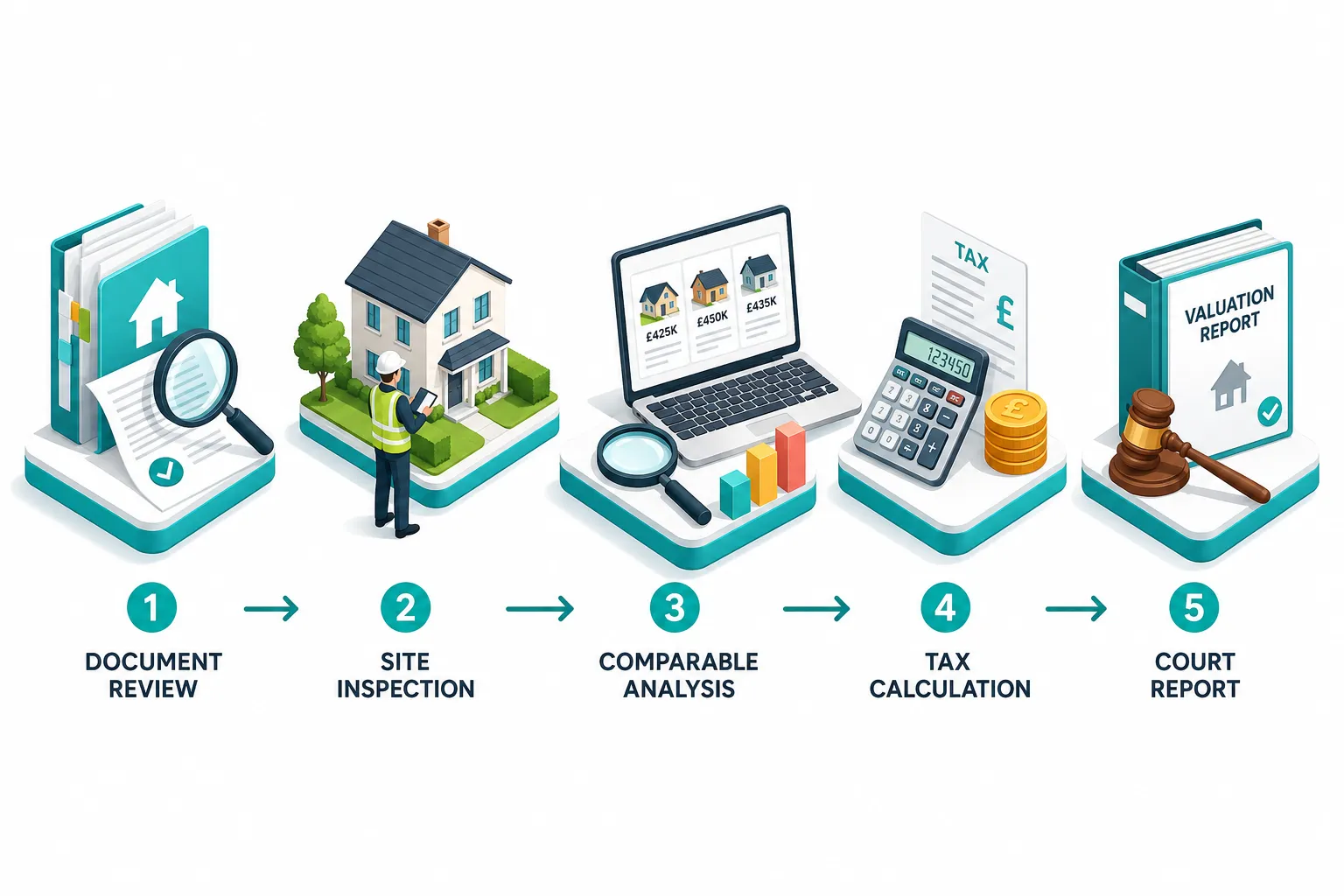
The valuation process typically involves:
- Reviewing title documents, planning history, and lease terms
- Inspecting the property (or reviewing prior inspection records if the valuation date is historic)
- Analysing comparable sales from the relevant period
- Adjusting for condition, location, tenure, and any tax-specific factors
- Producing a written report that explains the reasoning and supports the figure
A key distinction from a standard valuation: the expert witness report must anticipate challenge. Every assumption must be stated, every comparable must be justified, and the surveyor must be prepared to defend the methodology in a written question-and-answer process or in oral evidence.
What Changed in 2026 Tax Laws for Property Valuations
The 2026 tax environment has introduced several changes that directly affect how expert witnesses frame their valuations in post-budget property disputes.
Capital gains tax on residential property has seen its rates adjusted following the Autumn 2024 Budget, with the higher rate for residential property disposals now sitting at 24% for higher-rate taxpayers. This change means that the precise market value assigned to a property at the date of disposal carries greater financial weight than in previous years, a difference of even £20,000 in assessed value can translate to a £4,800 swing in tax liability.
Inheritance tax remains a flashpoint. The freeze on nil-rate band thresholds, combined with the extension of IHT to certain pension assets from April 2027, has prompted more estates to contest HMRC's valuations. Expert witness testimonies in post-budget property disputes involving 2026 tax impact valuations are therefore increasingly focused on establishing defensible historic values for properties held within estates.
Stamp duty land tax (SDLT) thresholds reverted in April 2025, ending the temporary relief that had been in place. For buyers who completed transactions near the threshold, disputes over whether a property was correctly valued, and therefore correctly taxed, are now reaching tribunals.
"The value assigned to a property is never just a number. In a post-budget dispute, it is the foundation on which an entire tax liability is calculated. Getting it wrong in either direction carries real financial consequences."
For landlords navigating these changes, understanding annual tax on enveloped dwellings and how expert valuations interact with ATED bands is equally important.
What Qualifications Do Expert Witnesses Need for Property Valuation?
A credible expert witness for a UK property valuation dispute must hold a recognised professional qualification and demonstrate specialist experience in the relevant property type and market.
Minimum qualifications expected by courts:
- MRICS (Member of the Royal Institution of Chartered Surveyors) or FRICS (Fellow)
- Current registration with RICS and compliance with their professional standards
- Specific experience in the type of property and dispute at hand (residential, commercial, leasehold, etc.)
- Familiarity with CPR Part 35 and the RICS guidance note on expert witnesses
Courts also look favourably on surveyors who have completed the RICS Expert Witness Certificate or equivalent CPD training. An expert who cannot explain the legal framework governing their role, not just the valuation methodology, will struggle under cross-examination.
Instructing a generalist surveyor for a specialist dispute (for example, using a residential valuer for a complex commercial dilapidations case) is a common and costly mistake. Always confirm that the expert's experience directly matches the dispute type. You can explore professional chartered surveyor valuation services to understand the range of specialisms available.
How Much Does an Expert Witness Cost for Property Disputes?
Expert witness costs in UK property disputes vary considerably based on the complexity of the case, the seniority of the surveyor, and whether the instruction extends to oral evidence at a hearing.
| Stage | Typical Cost Range (2026) |
|---|---|
| Initial written report | £1,500, £3,500 |
| Complex or high-value case report | £3,500, £6,000+ |
| Attendance at hearing (per day) | £1,500, £3,000 |
| Joint statement / meeting of experts | £500, £1,500 |
| Written questions and responses | £300, £800 |
Note: These are indicative ranges based on market norms for England and Wales. Actual fees depend on property type, geographic location, and the expert's seniority. Always obtain a written fee estimate before instructing.
Cost proportionality matters. In lower-value disputes, courts may direct parties to use a single joint expert (SJE) rather than each appointing their own. An SJE is instructed jointly, costs are shared, and their report carries significant weight, though either party can still challenge it.
What Documents Do Expert Witnesses Need to Review for Property Cases?
Expert witnesses need access to a defined set of documents before they can produce a reliable valuation. Missing documentation is one of the most common reasons expert reports are challenged or delayed.
Core documents for a residential property valuation:
- Title register and title plan (from HM Land Registry)
- Any existing surveys, valuations, or condition reports
- Planning permissions, building regulations approvals, and completion certificates
- Lease documents (for leasehold properties), including service charge accounts
- Tenancy agreements and rent history (for investment properties)
- HMRC correspondence or prior tax assessments in dispute
- Comparable sales evidence from the relevant valuation date period
For inheritance tax disputes specifically, the date of death valuation requires evidence of what the market looked like at that precise point, not at the time of instruction. This is why retaining contemporaneous sales evidence is important, and why instructing an expert early (before evidence becomes harder to source) is advisable. Our guide on independent property valuations covers what to expect from the process.
What Is the Difference Between an Appraisal and an Expert Witness Valuation?
An appraisal and an expert witness valuation may produce similar figures, but they serve fundamentally different purposes and carry different legal weight.
| Factor | Standard Appraisal | Expert Witness Valuation |
|---|---|---|
| Primary duty | To the client | To the court |
| Purpose | Inform a decision | Provide evidence in proceedings |
| Methodology disclosure | Not always required | Fully disclosed and justified |
| Challengeable in court | Rarely used in proceedings | Specifically designed for challenge |
| Regulatory framework | RICS Red Book | RICS Red Book + CPR Part 35 |
A standard appraisal, such as one obtained for a mortgage or for matrimonial valuations, is a useful starting point but cannot simply be repackaged as expert evidence. The surveyor must re-examine the valuation through the lens of their overriding duty to the court, disclose all assumptions, and confirm they understand the legal obligations of an expert witness.
Can Expert Witness Testimony Be Challenged in Court?
Yes, and it frequently is. Expert witness testimony in property disputes can be challenged on several grounds, and understanding these helps both parties prepare more effectively.
Common grounds for challenge:
- Methodology: Did the expert use appropriate comparable evidence? Were adjustments properly reasoned?
- Independence: Does the expert have a prior relationship with the instructing party that could suggest bias?
- Scope creep: Has the expert strayed outside their area of expertise?
- Failure to address contrary evidence: An expert who ignores inconvenient comparables will be pressed on this in cross-examination.
- Compliance with CPR Part 35: Has the report included the required declaration of independence and confirmation of understanding of the expert's duty?
Challenges are made through written questions under CPR Part 35.6, through a joint meeting of experts, or through cross-examination at the hearing. A well-prepared expert will have anticipated the likely challenges and addressed them in the body of the report itself.
How Do Expert Witnesses Handle Disagreements About Property Value?
When two experts disagree on value, the court does not simply split the difference. The process is more structured and designed to narrow the issues before they reach a hearing.
The standard process:
- Each party's expert produces their own report.
- The court directs a "without prejudice" meeting of experts.
- Experts produce a joint statement identifying agreed points and the precise areas of disagreement.
- The joint statement is filed with the court and used to focus the hearing.
- At the hearing, the judge hears oral evidence and cross-examination before deciding which expert's reasoning is more persuasive.
The joint statement is often where disputes are resolved or significantly narrowed. Experts who approach this meeting constructively, rather than defensively, tend to produce more useful outcomes for the court and for their respective clients.
Can I Use the Same Expert Witness for Multiple Property Disputes?
Using the same expert witness across multiple disputes is permissible but requires careful management. There is no rule preventing a surveyor from acting as an expert in more than one case, but repeated instruction by the same party can raise questions about independence.
Practical guidance:
- Disclose any prior instructions from the same party in the expert's report.
- Ensure the expert's opinion in each case is formed independently on its own facts.
- Avoid situations where the expert's findings in one case could be seen to support a predetermined position in another.
For tax-related disputes, where the same landlord or estate may have multiple properties under challenge, a single expert with deep knowledge of the portfolio can actually add value, provided independence is clearly maintained and disclosed.
Do I Need an Expert Witness for a Small Property Dispute?
Not always. For lower-value disputes, the cost of a full expert witness report may outweigh the financial benefit, and courts actively discourage disproportionate expenditure on expert evidence.
Decision rule:
- If the disputed tax or damages amount is below approximately £10,000, consider whether a single joint expert (cost shared between parties) or a desktop valuation would be sufficient.
- If the dispute involves a contested HMRC valuation, a complex leasehold, or a high-value asset, a full expert witness report is almost always justified.
- If you are unsure, seek early legal advice, solicitors can advise on whether the court is likely to permit separate experts or will direct a joint appointment.
For boundary disputes with a financial element, our article on the average cost of a boundary dispute provides useful context on proportionality.
Are There Common Mistakes People Make With Expert Witness Valuations?
Several recurring errors undermine expert witness valuations in property disputes, and most are avoidable with proper preparation.
The most common mistakes:
- Instructing too late: Leaving expert instruction until shortly before a hearing limits the time available for document review and report preparation.
- Providing incomplete documentation: Missing lease terms, planning history, or comparable evidence forces the expert to make assumptions that can be challenged.
- Confusing a mortgage valuation with expert evidence: A lender's valuation is not prepared for litigation and will not withstand the scrutiny of cross-examination.
- Choosing an expert based on the figure they produce: Courts penalise advocacy disguised as expertise. An expert who simply supports the instructing party's preferred value will lose credibility quickly.
- Failing to update the report when new evidence emerges: Expert reports must reflect the current state of the evidence. An outdated report that ignores new comparables is a liability.
Understanding what surveyors look at during a property valuation can help property owners prepare more effectively before instructing an expert.
How Long Does Expert Witness Testimony Usually Take?
The timeline for expert witness involvement in a property dispute depends on the complexity of the case and the court's timetabling directions.
Typical timeline:
- Initial instruction to draft report: 4 to 8 weeks for a standard residential case; 8 to 16 weeks for complex commercial or multi-property matters.
- Written questions and responses: 28 days is the standard CPR timeframe for written questions following receipt of a report.
- Meeting of experts and joint statement: Usually directed by the court within a set period before the hearing, typically 4 to 6 weeks before the trial date.
- Oral evidence at hearing: Most property valuation experts give evidence for between half a day and two days, depending on the complexity of the dispute.
Planning ahead is essential. Expert witnesses in post-budget property disputes dealing with 2026 tax impact valuations are in increasing demand as more cases reach tribunal stage, so early instruction is advisable to secure an expert with the right specialism and availability.
.ew-calc{font-family:Arial,sans-serif;max-width:480px;margin:2em auto;background:#f8f9fb;border:1px solid #dde3ec;border-radius:8px;padding:24px}
.ew-calc h3{margin:0 0 16px;font-size:1.1rem;color:#1a2e4a}
.ew-calc label{display:block;font-size:.9rem;color:#333;margin-bottom:4px}
.ew-calc select,.ew-calc input{width:100%;padding:8px 10px;border:1px solid #c5cdd8;border-radius:5px;font-size:.95rem;margin-bottom:14px;box-sizing:border-box}
.ew-calc button{background:#1a2e4a;color:#fff;border:none;padding:10px 20px;border-radius:5px;font-size:.95rem;cursor:pointer;width:100%}
.ew-calc button:hover{background:#2a4a72}
.ew-result{margin-top:16px;background:#fff;border:1px solid #c5cdd8;border-radius:6px;padding:14px;display:none}
.ew-result p{margin:4px 0;font-size:.92rem;color:#222}
.ew-result strong{color:#1a2e4a}
Expert Witness Cost Estimator (2026)
function ewCalc(){
var t=document.getElementById(‘ew-type’).value;
var c=document.getElementById(‘ew-complexity’).value;
var o=document.getElementById(‘ew-oral’).value;
var base={low:1800,med:3200,high:5500};
var oral={no:0,yes:2000};
var low=base[c]+oral[o];
var high=Math.round(low*1.5/100)*100;
var r=document.getElementById(‘ew-result’);
r.style.display=’block’;
r.innerHTML=’
Estimated Range: £’+low.toLocaleString()+’, £’+high.toLocaleString()+’
‘
+’
Includes: Report preparation’+(o===’yes’?’, hearing attendance’:”)+’
‘
+’
Indicative only. Actual fees depend on surveyor seniority, location, and case specifics. Always obtain a written fee agreement.
‘;
}
Conclusion
Expert witness testimonies in post-budget property disputes represent one of the most technically demanding areas of property law, and the 2026 tax impact valuations landscape has made them more consequential than ever. With capital gains tax rates adjusted, inheritance tax thresholds frozen, and SDLT reliefs withdrawn, the precise value assigned to a property at a specific date can determine a tax liability running into tens of thousands of pounds.
Actionable next steps for property owners, landlords, and professionals:
- Instruct early. Do not wait until a dispute reaches tribunal before engaging a qualified chartered surveyor. Early instruction allows time for thorough document review and a well-reasoned report.
- Choose the right expert. Match the surveyor's specialism to the dispute type, residential, commercial, leasehold, or mixed-use. Verify RICS membership and familiarity with CPR Part 35.
- Gather documentation now. Title documents, historic comparables, planning records, and any prior HMRC correspondence should be assembled before the expert is instructed.
- Understand the cost-benefit. For lower-value disputes, a single joint expert may be proportionate. For contested HMRC valuations or high-value estates, a full expert witness report is a sound investment.
- Do not conflate appraisals with expert evidence. A mortgage valuation or estate agent's opinion is not a substitute for a court-compliant expert witness report.
For professional expert witness report services from a qualified chartered surveyor, or to understand how post-budget tax changes affect your specific property situation, seek advice from an RICS-registered firm with direct experience in litigation support and tax-related valuations.
Frequently Asked Questions
What is the difference between an expert witness and a valuer in a property dispute?
A valuer produces a market value opinion for a client's use. An expert witness produces a valuation for the court, with an overriding duty to the court rather than the instructing party. The report format, disclosure requirements, and legal obligations are different.
Can HMRC challenge an expert witness valuation?
Yes. HMRC has its own Valuation Office Agency (VOA) and can appoint its own expert to dispute a taxpayer's declared value. Both experts may then be required to produce a joint statement of agreed and disputed points before any tribunal hearing.
How is a 2026 post-budget valuation different from a standard one?
A 2026 post-budget valuation must account for the specific tax rates and thresholds that apply following the most recent budget changes, including the 24% CGT rate on residential property disposals for higher-rate taxpayers and the frozen IHT nil-rate band. The expert must demonstrate that these factors have been properly reflected in the valuation methodology.
What happens if I disagree with the single joint expert's figure?
You can submit written questions to the SJE under CPR Part 35.6. If the answer is unsatisfactory, you may apply to the court for permission to appoint your own expert, though courts grant this sparingly. Demonstrating a clear methodological error is the strongest basis for such an application.
Is an expert witness report confidential?
Once filed with the court, expert witness reports are generally part of the court record and are not confidential between the parties. However, draft reports and without-prejudice communications between experts are protected from disclosure.
How do I find a qualified expert witness for a property tax dispute?
Look for RICS-registered chartered surveyors with specific experience in the relevant dispute type. The RICS Expert Witness Register and the Academy of Experts are useful starting points. Always confirm the surveyor's familiarity with CPR Part 35 and their experience of giving oral evidence before instructing them.
Do expert witnesses ever change their opinion during a case?
Yes, and this is not necessarily a sign of weakness. If new evidence emerges, such as additional comparable sales, an expert has a duty to update their opinion. What courts look for is that any change is driven by evidence, not by pressure from the instructing party.