

Boundary disputes cost UK homeowners an average of £12,000 to £35,000 when they reach full trial — yet the majority are resolved long before a judge delivers a verdict. Understanding how Expert Witness Surveyors in Neighbour and Boundary Disputes operate, what they produce, and what the process costs can mean the difference between a negotiated settlement and years of expensive litigation. This guide explains, in plain English, exactly what homeowners should expect before going to court.
Key Takeaways
- Expert witness surveyors owe their primary duty to the court, not to the party that appoints them — this independence is non-negotiable under Civil Procedure Rules (CPR) Part 35.
- Reports must follow a strict structure and comply with CPR Part 35 before they are admissible as evidence.
- Typical costs in 2026 range from £2,500 for an initial report to over £9,500 when drone surveys and court attendance are included.
- Courts frequently direct lower-value disputes to use a Single Joint Expert (SJE), which reduces costs significantly.
- Most boundary and neighbour disputes settle at the expert report stage or during mediation — a full trial is the exception, not the rule.
What an Expert Witness Surveyor Actually Does
Many homeowners confuse a boundary adviser with an expert witness. They are not the same role, and the distinction matters enormously once legal proceedings begin.
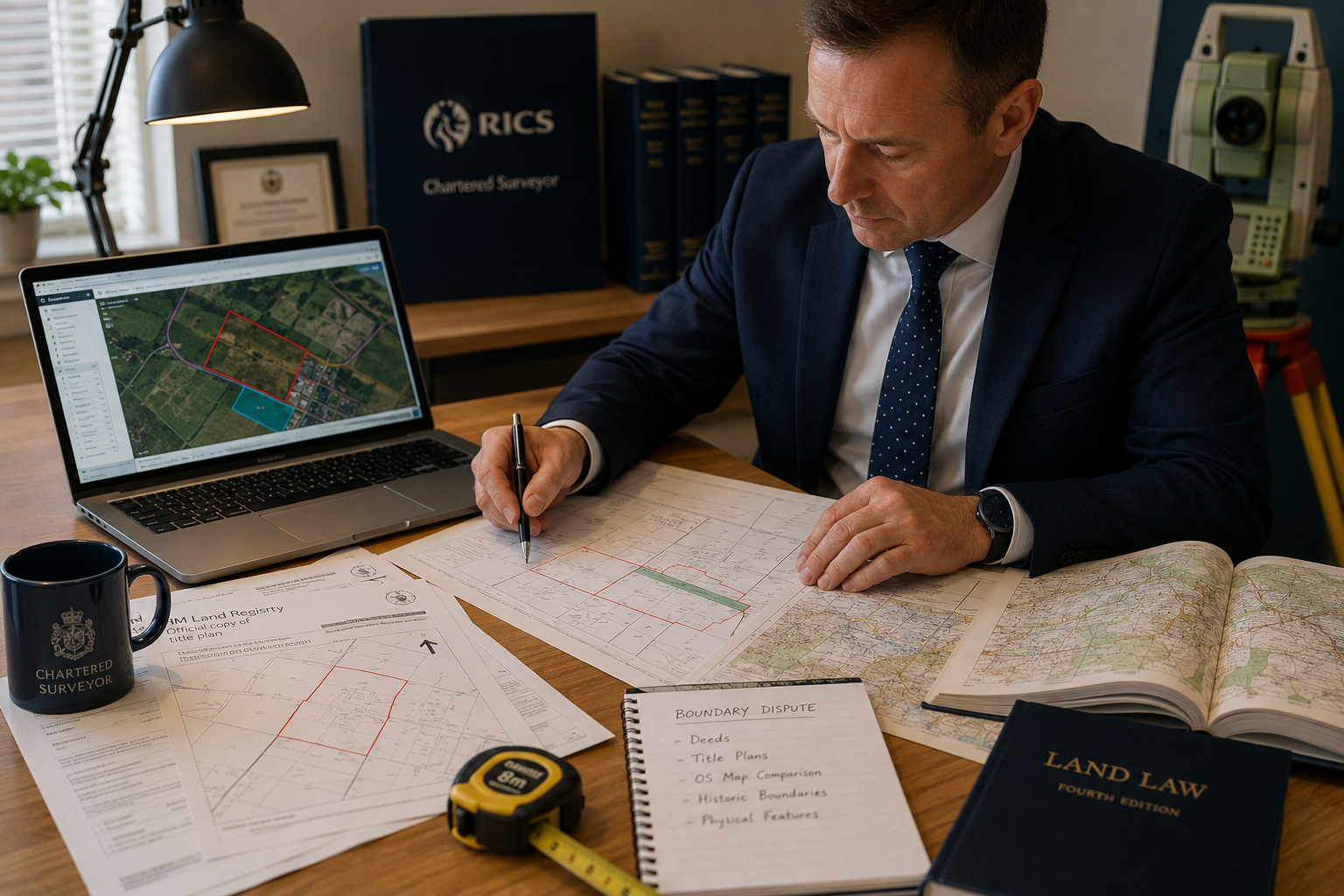
A boundary adviser helps a homeowner understand where their boundary probably lies. They review title deeds, Land Registry plans, and historical maps, then offer an opinion — but that opinion is given in the client's interest.
An expert witness surveyor, by contrast, owes an overriding duty to the court. The Royal Institution of Chartered Surveyors (RICS) updated its professional standards in 2026 to reinforce this distinction, making clear that a surveyor cannot simultaneously act as a partisan adviser and a court-appointed expert witness in the same dispute [2]. Once appointed in an expert witness capacity, the surveyor must present findings impartially, even if those findings do not favour the instructing party.
This independence is not just an ethical nicety. Under CPR Part 35, expert evidence that appears partial or advocacy-driven can be struck out entirely, leaving the party without admissible technical support at trial.
The Two Appointment Routes
Homeowners approaching litigation will encounter two appointment structures:
| Appointment Type | How It Works | Best For |
|---|---|---|
| Party-Appointed Expert | Each side instructs their own surveyor | Higher-value or complex disputes |
| Single Joint Expert (SJE) | One surveyor is jointly instructed by both parties | Lower-value disputes; court-directed cases |
In lower-value boundary disputes, courts increasingly direct parties toward an SJE to reduce costs and avoid a "battle of experts" [2]. The SJE answers questions from both sides and reports to the court — neither party controls the outcome of the report.
For disputes involving party wall matters or basement excavations near shared boundaries, the distinction between a party wall surveyor and an expert witness surveyor also needs careful consideration, since these are separate statutory and procedural frameworks.
The Report Stages: From Site Visit to Admissible Evidence
Understanding the stages of an expert witness report helps homeowners manage expectations and avoid costly surprises.
Stage 1 — Instructions and Preliminary Review
The process begins when solicitors formally instruct the expert. The surveyor reviews the letter of instruction, confirms the scope of the report, and carries out a desk-based review of:
- Land Registry title plans and registered title documents
- Ordnance Survey large-scale mapping
- Historical conveyances and pre-registration title deeds
- Aerial photographs from multiple time periods
- Planning records and building regulation approvals
Land Registry title plans are drawn at 1:1250 scale, which means a line on the plan represents roughly 1.25 metres on the ground. This inherent imprecision is one reason why physical site evidence almost always carries more weight than the plan alone [3].
Stage 2 — Site Investigation
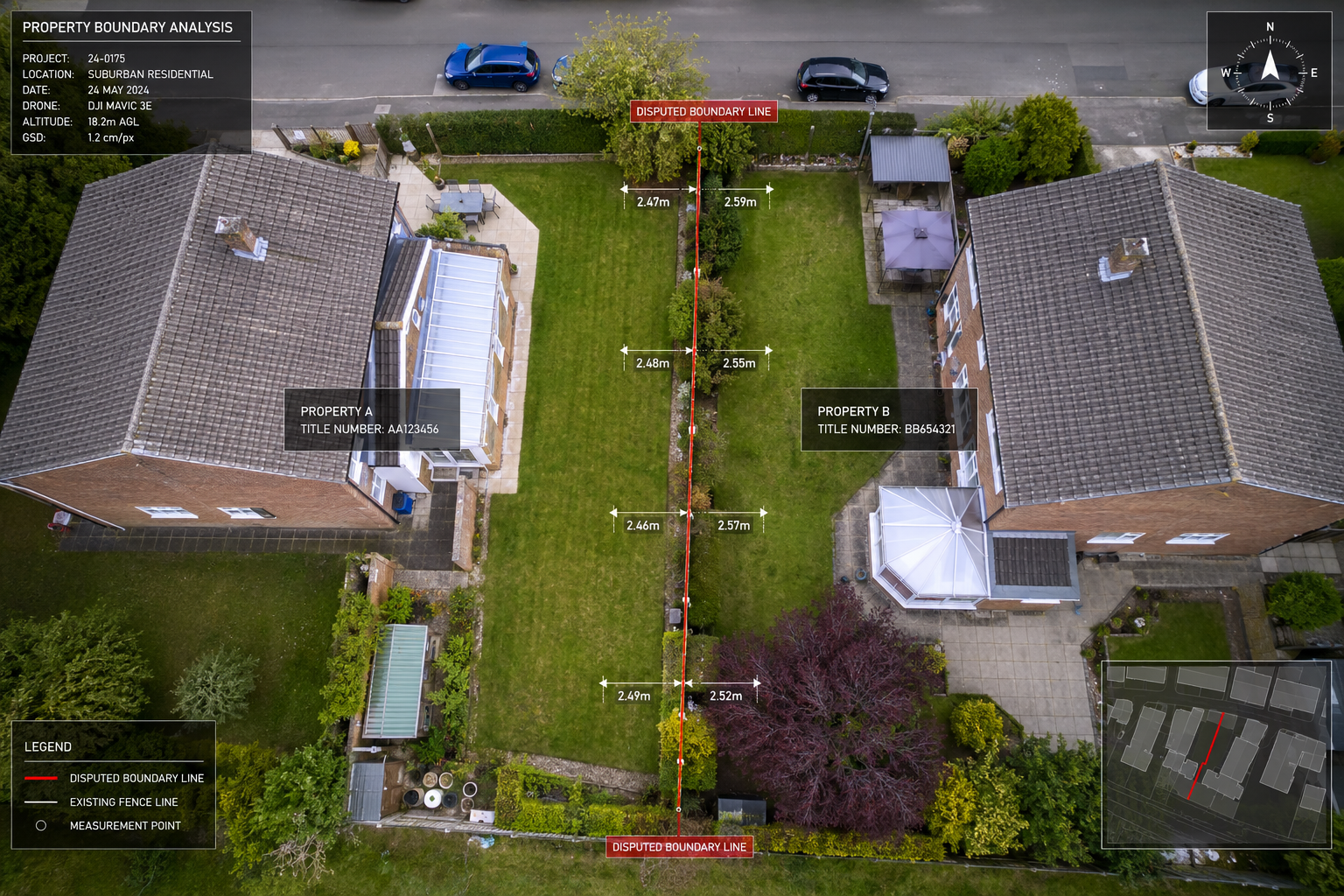
A thorough site visit is the backbone of any credible expert witness report. Modern site investigations combine several methods [1]:
- Physical measurements using total station or GPS equipment
- Drone surveys where access is restricted or where overhead imagery adds clarity
- Photographic records of all boundary features — walls, fences, hedges, ditches, and any encroachments
- Examination of physical features that may indicate the historical boundary position
The integration of drone technology has significantly improved the accuracy of boundary assessments in recent years. High-resolution aerial imagery can reveal encroachments, reveal the line of original structures, and provide measurements that are difficult or impossible to obtain from ground level alone [1]. For an overview of how modern drone technology is applied in property surveys, the premium drone survey service offered by chartered surveyors illustrates the practical capability now available.
"Boundary evidence is rarely conclusive. An expert who claims absolute certainty where the evidence is genuinely ambiguous will face serious difficulties under cross-examination." [2]
This point deserves emphasis. A credible expert witness acknowledges uncertainty where it exists and presents a range of opinion rather than a single definitive answer. Overstating certainty is one of the most common errors that undermines expert credibility at trial [2].
Stage 3 — Report Preparation
The expert witness report must comply with CPR Part 35 to be admissible. A compliant report includes [1]:
- The expert's qualifications and relevant experience
- A summary of instructions received
- A statement of the facts relied upon
- The expert's opinion and the reasoning behind it
- A range of opinion where the evidence supports more than one conclusion
- A CPR Part 35 declaration confirming the expert's overriding duty to the court
- Relevant appendices — plans, photographs, historical documents
The structured approach to report writing — introduction, background, evidence analysis, opinion, and conclusions — ensures that a judge can follow the expert's reasoning without specialist knowledge [3].
Stage 4 — Questions and Expert Discussions
Once reports are exchanged, solicitors may submit written questions to the opposing expert under CPR Part 35.6. In multi-track cases, the court may also direct a without-prejudice meeting of experts, sometimes called a "hot tub" session, where both surveyors identify points of agreement and narrow the issues in dispute. This meeting often produces a joint statement that significantly reduces the scope of the trial.
Costs, Qualifications, and What to Look for in an Expert
What Expert Witness Services Cost in 2026
Cost is a major concern for homeowners, and the figures can be substantial. Based on current market rates, typical costs break down as follows [1]:
| Service Component | Typical Cost Range (2026) |
|---|---|
| Initial expert witness report | £2,500 to £6,000 |
| Drone survey integration | £800 to £2,500 (additional) |
| Court attendance (per day) | £1,500 to £3,500 |
| Expert discussion / joint statement | £500 to £1,500 |
These figures illustrate why settlement before trial is almost always the financially rational outcome. A two-day trial with two party-appointed experts could add £10,000 or more to each side's costs before solicitor fees are counted.
It is also worth noting that courts have wide discretion over costs orders. A party who unreasonably refuses to engage with mediation or who ignores a favourable expert report may find that the court penalises them in costs, even if they ultimately succeed on the substantive issue.
Qualifications That Matter
Not every chartered surveyor is equipped to act as an expert witness. Effective expert witness work requires specialised skills beyond professional licensing [3]:
- Chartered status — MRICS or FRICS — with a demonstrable specialism in boundary disputes
- A minimum of 10 to 15 years of practical experience in boundary determinations
- Proficiency with modern surveying technology, including GIS systems and GPS equipment
- The ability to explain complex technical concepts in accessible language
- Experience presenting evidence under cross-examination
That last point is often underestimated. A surveyor who produces an excellent written report but struggles to defend their methodology under robust cross-examination can cause serious damage to a client's case. When selecting an expert, homeowners and their solicitors should ask directly about courtroom experience.
For homeowners who are still at the early stage of understanding their property and its boundaries, commissioning a Level 3 full building survey or reviewing what is covered in a Level 2 survey can provide useful baseline information about the physical condition and extent of the property before any formal dispute process begins.
Valuation Evidence in Financial Disputes
Some boundary disputes carry a direct financial dimension — for example, where a neighbour has built a structure that encroaches onto disputed land, or where an access right has been blocked. In these cases, the expert witness surveyor may also need to provide valuation evidence [1].
RICS Red Book methodology applies to this valuation work. The surveyor quantifies:
- Diminution in value — the reduction in market value caused by the encroachment or loss of amenity
- Cost of reinstatement — the cost of removing an unlawful structure and restoring the boundary
- Market value impact — how the dispute affects the affected property's saleability
This overlap between surveying expertise and valuation work is one reason why chartered surveyor valuations play an important role in boundary dispute cases that have a financial remedy at their core.
Common Outcomes Short of a Full Trial
The vast majority of boundary and neighbour disputes do not end in a courtroom. Understanding the realistic range of outcomes helps homeowners approach the process with appropriate expectations.
Negotiated Settlement
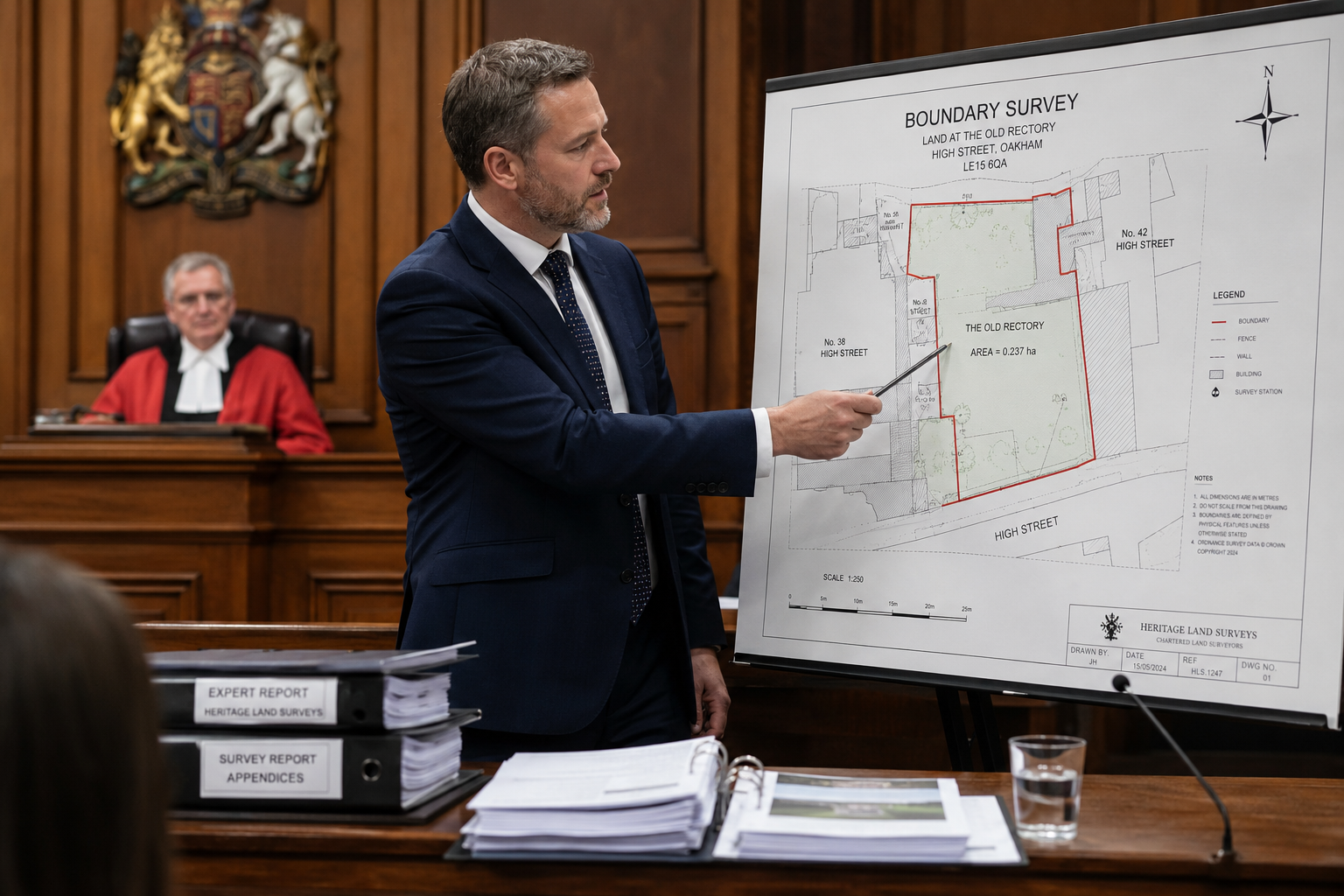
Once both parties have received expert reports, the gap between positions often narrows considerably. Solicitors use the reports as a basis for negotiation, and many disputes settle with a boundary agreement — a formal document registered at Land Registry — supported by a plan prepared by the expert surveyor.
Mediation
Mediation is strongly encouraged by the courts and can be ordered in some circumstances. A mediator facilitates a structured negotiation between the parties. The expert witness surveyor may attend to answer technical questions, but the mediator drives the process toward a mutually acceptable resolution. Mediation is typically far cheaper than trial and preserves the parties' ability to remain neighbours without the lasting bitterness that litigation often produces.
First-tier Tribunal (Property Chamber)
For boundary disputes involving registered land, the First-tier Tribunal (Property Chamber) — formerly the Lands Tribunal — is the specialist forum. Expert witness evidence is central to these proceedings, and the Tribunal's judges are experienced in evaluating competing survey evidence. The Tribunal can determine the exact boundary position and order rectification of the Land Registry title.
County Court Proceedings
Lower-value disputes, trespass claims, and injunction applications typically proceed in the County Court. The court's case management powers include directing the parties to use an SJE, ordering expert discussions, and — where a party has behaved unreasonably — making adverse costs orders.
It is also worth considering what party wall rights apply to the situation, since some disputes that appear to be pure boundary disagreements also engage the Party Wall etc. Act 1996, which has its own dispute resolution mechanism separate from court proceedings.
The Role of Party Wall Surveyors
Where construction work near or on a shared boundary is the root cause of the dispute, a party wall surveyor operates under a distinct statutory framework. The agreed surveyor approach in party wall disputes can resolve many construction-related neighbour disagreements without any court involvement at all. However, if the dispute escalates beyond the party wall framework — for example, into a claim for damages or a contested boundary determination — an expert witness surveyor operating under CPR Part 35 becomes necessary.
Practical Steps for Homeowners Before Instructing an Expert
Before spending money on expert witness services, homeowners should take several practical steps:
- Gather all title documents — the original conveyance, Land Registry title plan, and any deed of covenant or boundary agreement already registered.
- Commission a measured survey — a measured survey of the property provides accurate dimensions that can be compared against title plan dimensions before any formal dispute process begins.
- Obtain legal advice — a solicitor specialising in property disputes can assess whether the claim has sufficient merit to justify expert witness costs.
- Consider mediation first — many disputes can be resolved without expert reports if both parties are willing to engage early.
- Check insurance — some home insurance policies include legal expenses cover that may fund expert witness costs. Reviewing what is covered under home insurance before incurring costs is a sensible precaution.
Conclusion
Expert Witness Surveyors in Neighbour and Boundary Disputes: What Homeowners Should Expect Before Going to Court is a topic that rewards careful preparation. The process is structured, the costs are significant, and the outcomes are rarely as binary as homeowners initially expect.
The key actionable steps are straightforward:
- Gather title documents and commission a measured survey before taking any legal steps.
- Understand the difference between a boundary adviser and a court-compliant expert witness — and ensure any surveyor instructed in a formal capacity has the qualifications and courtroom experience the role demands.
- Treat the expert's report as a tool for settlement, not just for trial. The majority of disputes resolve once both parties have independent, impartial technical evidence in front of them.
- Explore mediation and the SJE route before committing to the cost of two party-appointed experts.
- Check legal expenses insurance early — it may cover more of the process than expected.
Boundary and neighbour disputes are stressful, but they are rarely unresolvable. A well-qualified expert witness surveyor, operating transparently within the CPR Part 35 framework, gives homeowners the best possible foundation for a fair and cost-effective outcome — whether that outcome is reached across a negotiating table or in front of a judge.
References
[1] Expert Witness Valuations In Neighbour Boundary Disputes Rics Standards And Drone Survey Integration For 2026 Cases – wimbledonsurveyors.com
[2] Expert Witness Roles In Boundary Feature Disputes Turning Land Registry Plans Into Admissible Survey Evidence – kingstonsurveyors.com
[3] Boundary Disputes In 2026 When Expert Witness Surveyors Turn Land Registry Data Into Court Evidence – kingstonsurveyors.com