

Last updated: July 24, 2026
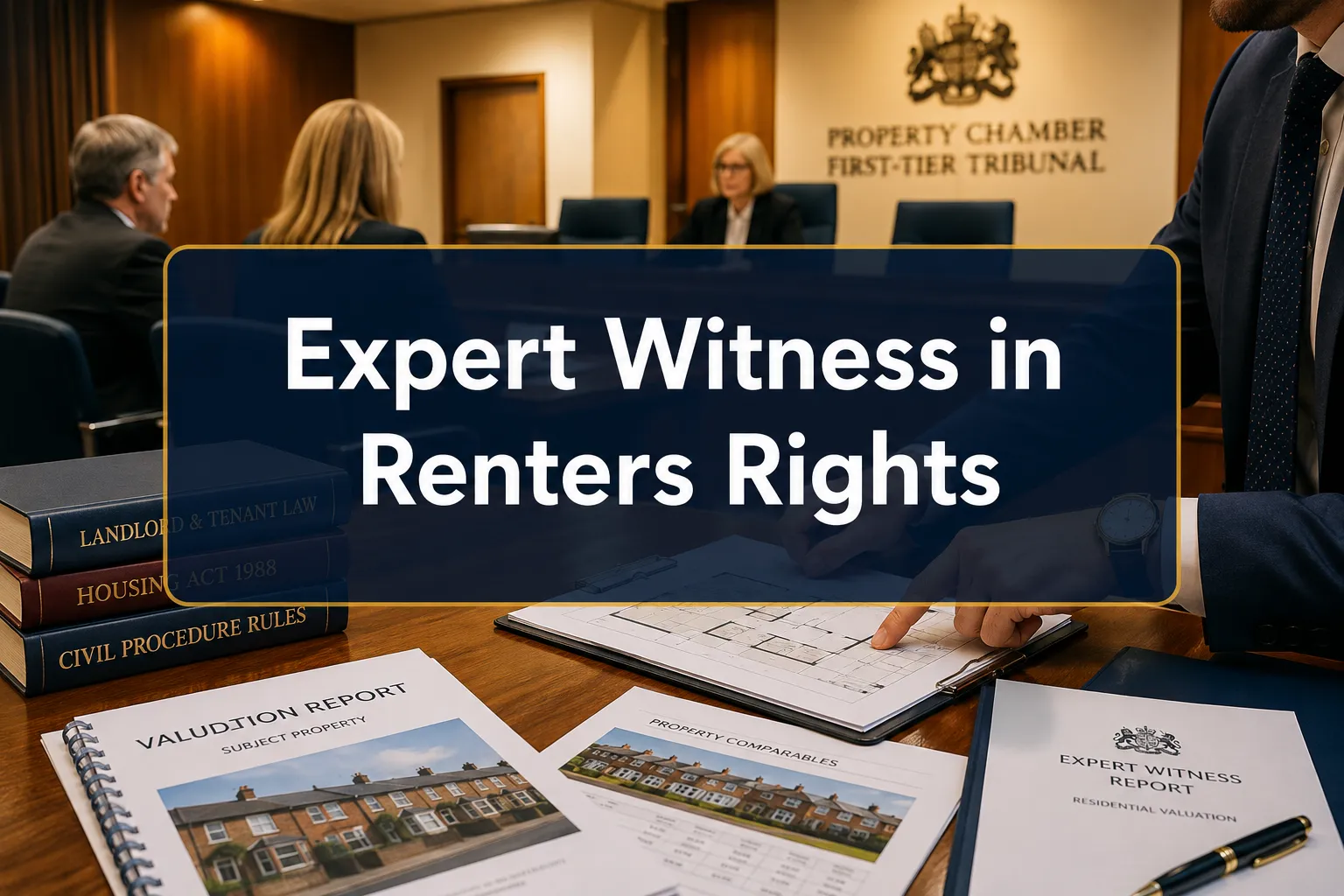
Quick Answer: From May 2026, the Renters' Rights Act 2025 began reshaping how property disputes are handled in the private rented sector. Expert witnesses in Renters' Rights Ombudsman disputes must now meet Civil Procedure Rules (CPR) standards when providing valuation evidence, because ombudsman decisions carry legal weight and landlords face binding outcomes. Chartered surveyors who understand both CPR obligations and the new ombudsman framework are essential for any valuation challenge.
Key Takeaways
- The Renters' Rights Act 2025 received Royal Assent on 27 October 2025; Phase 1 began on 1 May 2026, with the PRS Landlord Ombudsman expected in Phase 2 (late 2026 onward).
- Expert witnesses in ombudsman valuation disputes must comply with CPR Part 35, which requires impartiality, a duty to the tribunal rather than the instructing party, and a signed declaration of truth.
- Ombudsman decisions will be legally binding for all registered landlords, making the quality of expert valuation evidence directly consequential.
- A qualified expert witness for renters' rights cases should hold RICS membership, have demonstrable experience in residential valuation, and ideally hold an Expert Witness accreditation.
- Expert witness fees for ombudsman disputes typically range from around £500 to £2,500 depending on report complexity, property type, and the surveyor's seniority (estimate based on current market rates for RICS-qualified experts).
- Not all ombudsman cases require an expert witness; straightforward disputes about deposits or minor repairs may be resolved without one.
- The most common expert witness mistakes include overstepping the impartiality boundary, failing to address the specific questions posed, and producing reports that do not meet CPR formatting standards.
- Rejected expert testimony can delay proceedings and undermine a party's case, but the ombudsman retains discretion to request supplementary evidence.
What Is an Expert Witness in Renters' Rights Disputes?
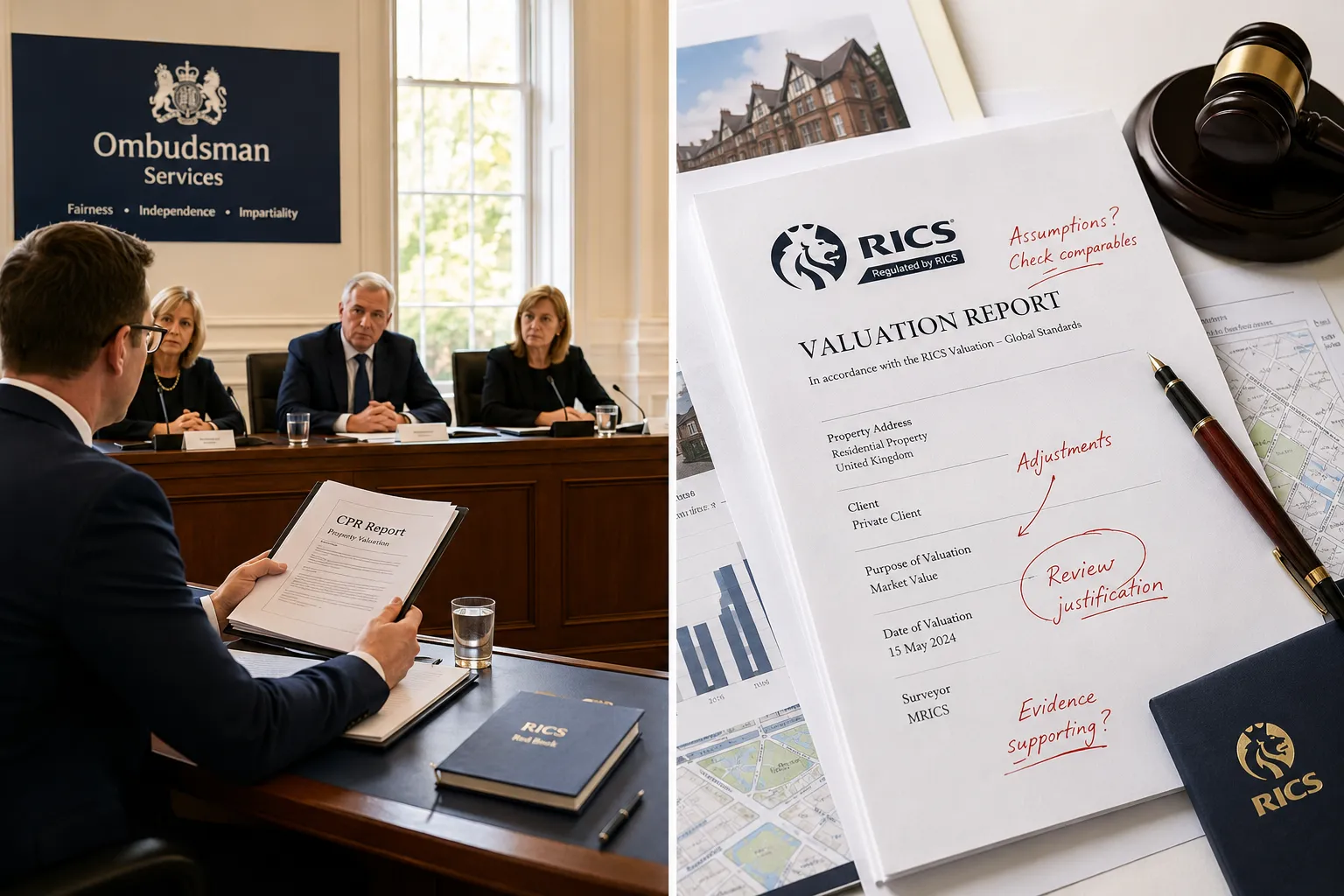
An expert witness in a renters' rights dispute is an independent professional, usually a chartered surveyor or valuer, appointed to provide objective technical evidence on matters beyond the knowledge of the decision-maker. Their role is not to advocate for either landlord or tenant but to assist the ombudsman or tribunal in understanding complex valuation or property condition questions.
In the context of Expert Witness Roles in Renters' Rights Ombudsman Disputes, this means the expert must:
- Provide a written report that addresses specific questions posed by the parties or the ombudsman.
- Declare that their duty is to the tribunal, not to whoever instructed them.
- Sign a statement of truth confirming the report is accurate and compliant with CPR Part 35.
- Be prepared to attend hearings and answer questions on their findings.
Who needs one: Landlords or tenants disputing rent levels, property valuations for deposit deductions, or the market rent used to justify a rent increase notice under the new periodic tenancy regime.
Who does not: Parties in straightforward disputes about minor repairs, communication failures, or administrative complaints where no technical valuation is in question.
How Do CPR Standards Apply to Ombudsman Valuation Cases?
CPR Part 35 governs expert evidence in civil proceedings in England and Wales. While the PRS Landlord Ombudsman is not a court, its decisions are legally binding, and the ombudsman scheme is expected to adopt CPR-aligned standards for technical evidence to ensure consistency and fairness.
In practice, this means valuation reports submitted to the ombudsman should:
- Be addressed to the tribunal or ombudsman, not to the instructing party.
- Contain a clear summary of the expert's qualifications and the basis for their opinion.
- Distinguish between facts, assumptions, and professional opinion.
- Include a CPR Part 35 compliant declaration confirming independence.
- Avoid advocacy language or conclusions that go beyond the expert's area of expertise.
Why this matters post-May 2026: Under the new tenancy framework, landlords can only increase rent through a formal Section 13 notice process, and tenants can challenge that increase at the First-tier Tribunal (Property Chamber). Expert valuation evidence is central to those challenges, and the ombudsman's own dispute resolution process is expected to mirror tribunal standards for technical submissions.
For a detailed understanding of what goes into a credible valuation, see this guide on what to look for during a property valuation.
What Changed in Renters' Rights Expert Witness Rules After May 2026?
The Renters' Rights Act 2025 introduced several structural changes that directly affect how expert witnesses operate in the private rented sector from May 2026 onward.
Key changes from Phase 1 (1 May 2026):
- The abolition of Section 21 "no-fault" evictions means all tenancy terminations are now contested on grounds, increasing the volume of disputes requiring technical evidence.
- All tenancies automatically became periodic, removing fixed-term certainty and creating more frequent rent review disputes.
- Rent increases are now subject to a formal challenge process, making independent valuation evidence more frequently needed.
Upcoming changes (Phase 2, late 2026 and beyond):
- A mandatory PRS Landlord Ombudsman will be established. All private landlords must register. Ombudsman decisions will be legally binding.
- The ombudsman will handle complaints about landlord conduct, including disputes about rent levels, property conditions, and deposit deductions where valuation evidence is relevant.
- A PRS database will record landlord compliance, creating a formal evidence trail that expert witnesses may reference.
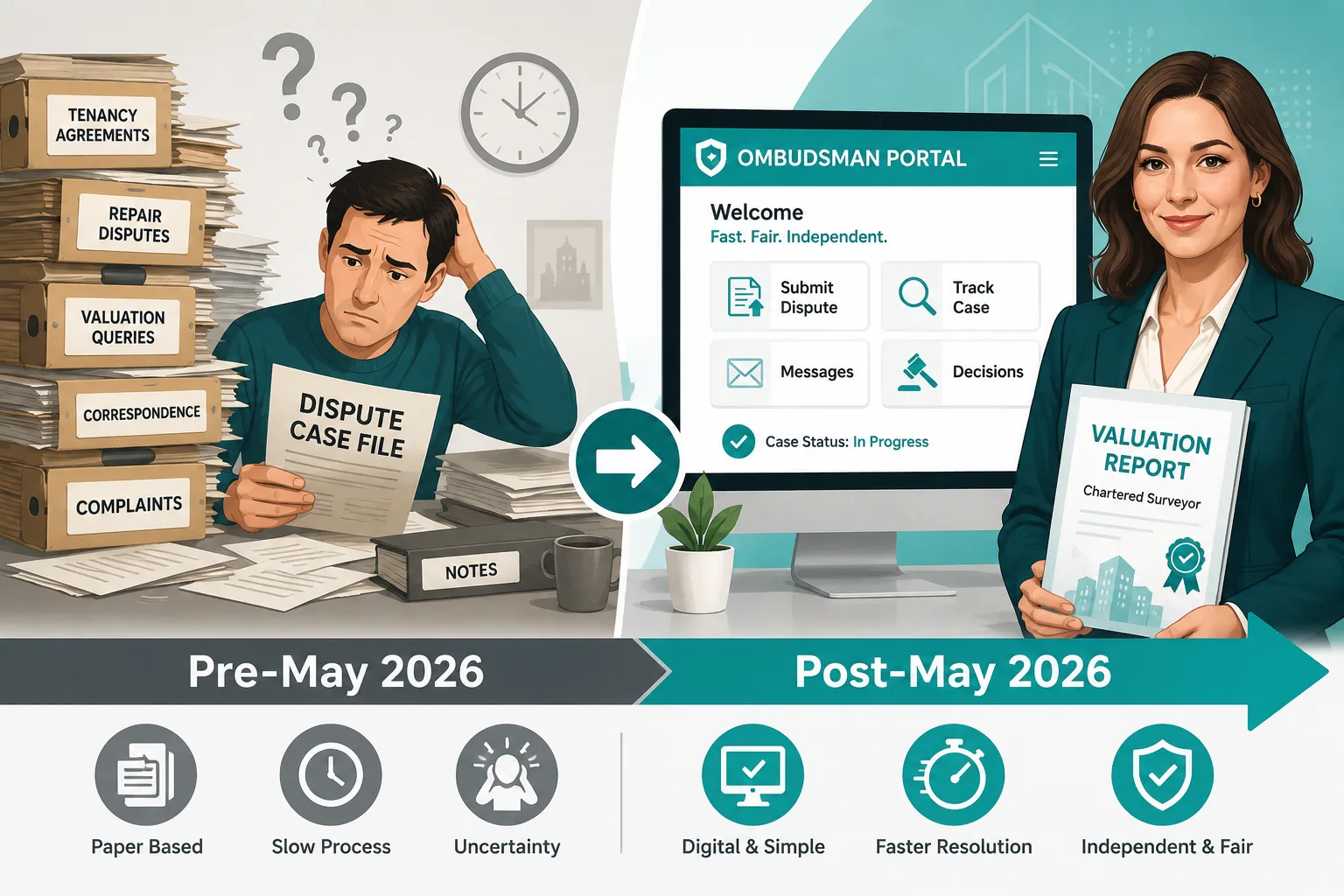
The practical shift: Before May 2026, many landlord-tenant valuation disputes were handled informally or through deposit protection schemes with limited evidentiary standards. The new ombudsman framework raises the bar. Expert witnesses must now produce reports that would withstand scrutiny in a formal adjudication, even if the ombudsman process is designed to be accessible and less adversarial than court.
What Qualifications Do You Need to Be an Expert Witness for Renters' Rights?
A credible expert witness for renters' rights ombudsman disputes should hold RICS (Royal Institution of Chartered Surveyors) membership at AssocRICS, MRICS, or FRICS level, with a specialism in residential valuation or building surveying.
Recommended qualifications and credentials:
| Credential | Why It Matters |
|---|---|
| MRICS or FRICS | Recognised professional standard for UK property experts |
| RICS Valuation (Red Book) compliance | Ensures valuations meet international standards |
| Expert Witness accreditation (e.g., Expert Witness Institute) | Demonstrates CPR Part 35 training |
| PI insurance | Required for formal expert witness appointments |
| Relevant local market experience | Ombudsman adjudicators expect knowledge of comparable properties |
Edge case: A surveyor with strong credentials but no CPR training may produce a technically sound valuation that is procedurally rejected because the report format does not comply with Part 35. Format matters as much as content.
For professionally accredited expert witness reports, see Prince Surveyors' expert witness report service.
Can You Challenge a Valuation in Ombudsman Disputes with Expert Testimony?
Yes. Expert testimony is one of the most effective tools for challenging a disputed valuation in ombudsman proceedings. Whether the dispute concerns the market rent used in a Section 13 notice, a landlord's assessment of damage beyond fair wear and tear, or a service charge calculation, an independent RICS valuation report can directly counter the opposing party's figures.
Steps to mount a valuation challenge:
- Obtain the original valuation or rent assessment you wish to challenge.
- Instruct a RICS-qualified expert witness to produce a CPR-compliant report addressing the specific valuation question.
- Submit the report to the ombudsman or tribunal within the required timeframe.
- Ensure the expert is available to answer supplementary questions if the adjudicator requests clarification.
Decision rule: Choose expert testimony if the disputed amount exceeds the cost of the report (typically £500-£2,500 for a standard residential case), or if the outcome sets a precedent for ongoing rent levels. For disputes under £300 with no recurring implications, the cost-benefit calculation often favours self-representation.
For context on what an independent valuation involves, see this guide on getting an independent property valuation.
What Types of Valuations Need Expert Witnesses in Renters' Disputes?
Not every valuation question requires a formal expert witness, but several categories of dispute consistently benefit from one.
Valuations most likely to require expert evidence:
- Market rent assessments: When a landlord issues a Section 13 rent increase notice and the tenant disputes whether the proposed rent reflects open market value.
- Damage and dilapidations: When a landlord claims deposit deductions for damage and the tenant disputes the cost or cause. A surveyor's schedule of condition and repair costs is often decisive.
- Service charge disputes: In blocks of flats, where the reasonableness of charges is contested. See our overview of service charge management and ground rent collection.
- Reinstatement cost disputes: Where insurance claims or landlord repair obligations are in question.
- Rent-in-advance or deposit valuation: Where the financial position of the property is central to the dispute.
Valuations less likely to require expert evidence:
- Administrative complaints (failure to respond, communication issues).
- Disputes about tenancy agreement terms that do not involve a financial valuation.
- Minor repair disputes where the cost is not contested.
What Is the Difference Between CPR and Other Expert Witness Standards?
CPR Part 35 is the primary framework governing expert evidence in civil courts in England and Wales. Other standards, such as those used by deposit protection schemes (TDS, DPS, mydeposits) or informal mediation services, apply lower evidentiary thresholds.
Key differences:
- CPR Part 35: Requires a formal declaration of independence, a structured report format, and the expert's primary duty to the court or tribunal. Used in First-tier Tribunal (Property Chamber) cases and expected to apply to the PRS Ombudsman for technical disputes.
- Deposit scheme adjudication standards: Less formal. Adjudicators review written submissions and photographic evidence. A full CPR-compliant report is not required, though a professional valuation still carries more weight.
- RICS Red Book: A valuation standard, not an expert witness standard. A Red Book valuation is methodologically rigorous but does not automatically satisfy CPR procedural requirements unless formatted accordingly.
Practical implication: A landlord who submits a Red Book valuation to the ombudsman without a CPR declaration may find the report given less weight than a properly formatted expert witness report from a surveyor with equivalent qualifications.
How Much Does an Expert Witness Cost for Ombudsman Disputes?
Expert witness fees for residential ombudsman disputes in the UK typically range from approximately £500 to £2,500 for a written report, with additional fees for attendance at hearings (estimated at £150-£400 per hour). These are market estimates based on current RICS-qualified surveyor rates and will vary by region, property type, and case complexity.
Cost factors:
- Seniority of the surveyor (MRICS vs FRICS).
- Whether a physical inspection is required.
- Complexity of the valuation question (simple market rent vs. dilapidations schedule).
- Whether the expert is required to attend a hearing or respond to questions in writing.
- London and South East rates are generally higher than regional rates.
Cost vs. benefit: For a rent dispute involving a £200 per month increase on a two-year tenancy, the financial exposure is £4,800. An expert witness report at £800-£1,200 is clearly justified. For a £150 deposit deduction, self-representation through the deposit scheme's own adjudication process is usually more proportionate.
For broader context on tenant-related fees and financial obligations, see this guide on tenant fees and rent.
When Should You Hire an Expert Witness vs. Handle It Yourself?
Hire an expert witness when the financial stakes are material, when the dispute turns on a technical valuation question, or when the opposing party has already submitted professional evidence. Handle it yourself when the dispute is straightforward, the amounts are small, and no specialist knowledge is required.
Hire an expert witness if:
- The disputed amount exceeds £1,000 or has ongoing financial implications.
- The dispute involves market rent, dilapidations, or service charges requiring professional assessment.
- The opposing party has instructed their own expert.
- The ombudsman or tribunal has specifically requested technical evidence.
Self-represent if:
- The dispute is about landlord conduct, communication, or administrative failure.
- The deposit deduction is minor and the evidence is photographic.
- You are using a deposit protection scheme's own adjudication service for a straightforward claim.
Common Mistakes Expert Witnesses Make in Renters' Rights Cases
The most damaging mistakes are procedural rather than technical. A surveyor who produces an accurate valuation but fails to follow CPR requirements risks having the report disregarded entirely.
Top mistakes to avoid:
- Advocacy tone: Writing as though the report supports one party rather than assisting the tribunal. This is the single most common reason reports are challenged.
- Missing CPR declaration: Omitting the Part 35 statement of truth and independence declaration.
- Exceeding expertise: Commenting on legal questions or matters outside the surveyor's professional competence.
- Insufficient comparable evidence: Failing to cite enough comparable transactions to support a market rent opinion.
- Outdated data: Using comparable sales or rental data that predates the relevant period by more than six months.
- Vague methodology: Not explaining how the valuation figure was reached, making it impossible for the adjudicator to assess its reliability.
What Happens If Expert Witness Testimony Is Rejected by the Ombudsman?
If the ombudsman or adjudicator rejects expert testimony, the party who submitted it loses the evidential support for their position on that specific point. The adjudicator may still consider other evidence, but a rejected report weakens the overall case significantly.
Possible outcomes after rejection:
- The adjudicator may invite the party to resubmit a compliant report within a set timeframe.
- The case may proceed on the remaining evidence, which could disadvantage the party whose report was rejected.
- In serious cases, a poorly prepared expert witness report may lead to an adverse costs finding if the ombudsman has costs jurisdiction.
Recovery steps: If a report is rejected on procedural grounds (rather than substantive disagreement), a revised report addressing the specific deficiencies can often be resubmitted. Instructing a surveyor with formal CPR training from the outset avoids this risk entirely.
How Do You Find a Qualified Expert Witness for Ombudsman Disputes?
The most reliable route is through the RICS Expert Witness Register or by instructing a chartered surveying firm that explicitly offers expert witness services for property disputes.
Checklist for selecting an expert witness:
- Confirm RICS membership at MRICS or FRICS level.
- Ask whether they have produced CPR Part 35 compliant reports before.
- Verify they hold professional indemnity insurance.
- Check they have experience with the specific type of valuation in dispute (residential market rent, dilapidations, service charges).
- Confirm they are familiar with the local property market relevant to the dispute.
- Ask for a sample report structure before instructing.
Prince Surveyors provides expert witness reports for property disputes across London and the South East, with RICS-qualified surveyors experienced in CPR-compliant valuation evidence. For residential market valuations underpinning dispute evidence, see the full chartered surveyor valuation services.
Are Expert Witnesses Required for All Renters' Rights Ombudsman Cases?
No. Expert witnesses are not required for all ombudsman cases. The PRS Landlord Ombudsman is designed to be accessible and proportionate, and many complaints will be resolved on documentary evidence, correspondence, and the parties' own submissions.
Expert witnesses become necessary when:
- A dispute turns on a technical question that requires professional expertise to answer.
- One party submits professional evidence and the other needs to respond in kind.
- The ombudsman specifically requests independent technical evidence to resolve a factual dispute.
For the majority of conduct-based complaints (failure to carry out repairs, poor communication, unlawful charges), no expert is needed. The ombudsman's own adjudicators are expected to have sufficient knowledge to assess standard complaints without external expert input.
How Long Does Expert Witness Testimony Take in Ombudsman Proceedings?
Producing a CPR-compliant expert witness report typically takes two to four weeks from instruction to delivery, depending on the complexity of the valuation and whether a physical inspection is required. Hearing attendance, if required, adds further time.
Typical timeline:
- Instruction and initial review of documents: 2-5 days.
- Property inspection (if required): 1 day, plus travel.
- Report drafting and peer review: 5-10 working days.
- Submission and any supplementary questions: 3-7 days.
- Total from instruction to submission: approximately 3-4 weeks.
For urgent cases, some surveyors offer expedited services at a premium. Always confirm the ombudsman's submission deadline before instructing, and build in time for the expert to respond to any questions from the adjudicator.
FAQ: Expert Witness Roles in Renters' Rights Ombudsman Disputes
Q: Does the PRS Landlord Ombudsman require expert witnesses to follow CPR Part 35?
A: The ombudsman is not a court, but its decisions are legally binding and it is expected to adopt CPR-aligned standards for technical evidence. Submitting a CPR Part 35 compliant report is best practice and reduces the risk of evidence being challenged or disregarded.
Q: Can a landlord instruct their own surveyor as an expert witness?
A: A landlord's regular surveyor can act as an expert witness, but only if they can genuinely act with independence and sign the CPR declaration confirming their duty is to the tribunal, not the landlord. If there is any conflict of interest, a separate independent expert should be instructed.
Q: What is the difference between a valuation report and an expert witness report?
A: A valuation report (such as a RICS Red Book valuation) establishes the value of a property using a recognised methodology. An expert witness report addresses specific questions posed in a dispute, includes a CPR declaration of independence, and is formatted for adjudication. A valuation can form the core of an expert witness report, but the two are not the same document.
Q: When will the PRS Landlord Ombudsman be fully operational?
A: Phase 1 of the Renters' Rights Act began on 1 May 2026. The PRS Landlord Ombudsman is expected in Phase 2, from late 2026, with full mandatory landlord membership anticipated around 2028. The scheme will be selected and scaled at least 12-18 months before full implementation.
Q: Can tenants instruct their own expert witness, or is it only for landlords?
A: Either party can instruct an expert witness. Tenants challenging a rent increase or disputing a deposit deduction have the same right to submit independent expert evidence as landlords. In some cases, both parties instruct separate experts, and the ombudsman must weigh the competing reports.
Q: What happens if both parties submit conflicting expert valuations?
A: The ombudsman adjudicator will assess both reports on their methodology, comparable evidence, and compliance with CPR standards. The report that better explains its reasoning and cites stronger comparable evidence will generally carry more weight. In some cases, the adjudicator may request a joint statement from both experts identifying areas of agreement and disagreement.
Conclusion
The Renters' Rights Act 2025 has fundamentally changed the landscape for landlords and tenants in the private rented sector. With Phase 1 already in force from May 2026 and the PRS Landlord Ombudsman taking shape in Phase 2, the role of expert witnesses in valuation disputes has never been more consequential. Ombudsman decisions will be legally binding, and the quality of technical evidence submitted will directly determine outcomes.
Actionable next steps for landlords and property professionals:
- Review any pending rent increase notices or deposit disputes to assess whether independent valuation evidence is needed.
- If a dispute is heading toward the ombudsman or First-tier Tribunal, instruct a RICS-qualified surveyor with demonstrable CPR Part 35 experience before the submission deadline.
- Ensure any expert witness report you commission includes a signed independence declaration and addresses the specific questions in dispute, not just a general valuation.
- Register with the PRS database when it launches and keep records of all property condition assessments, as these will form part of any future expert evidence trail.
- For ongoing valuation needs across residential or commercial properties, engage a chartered surveyor early to build a defensible evidence base.
For expert witness reports and independent property valuations that meet CPR standards, contact Prince Chartered Surveyors to discuss your specific dispute requirements.
.ew-tool{font-family:Arial,sans-serif;max-width:540px;margin:2rem auto;background:#f8f9fc;border:1px solid #d0d7e3;border-radius:8px;padding:1.5rem}
.ew-tool h3{margin:0 0 1rem;font-size:1.1rem;color:#1a2a4a}
.ew-tool label{display:block;margin:.5rem 0 .2rem;font-size:.9rem;color:#333;font-weight:600}
.ew-tool select,.ew-tool input[type=range]{width:100%;margin-bottom:.8rem;padding:.4rem;border:1px solid #b0bac8;border-radius:4px;font-size:.9rem}
.ew-tool .ew-btn{background:#1a2a4a;color:#fff;border:none;padding:.6rem 1.4rem;border-radius:4px;cursor:pointer;font-size:.95rem;width:100%;margin-top:.4rem}
.ew-tool .ew-btn:hover{background:#2d4270}
.ew-result{margin-top:1rem;padding:.9rem;border-radius:6px;font-size:.92rem;display:none}
.ew-yes{background:#e6f4ea;border:1px solid #7bc47f;color:#1e5c2a}
.ew-no{background:#fff3e0;border:1px solid #f0a040;color:#7a4000}
.ew-range-val{font-size:.85rem;color:#555;margin-bottom:.5rem}
Do You Need an Expert Witness for Your Ombudsman Dispute?
document.getElementById(‘ew-amount’).addEventListener(‘input’,function(){
document.getElementById(‘ew-amtlabel’).textContent=’£’+parseInt(this.value).toLocaleString();
});
function ewCalc(){
var t=document.getElementById(‘ew-type’).value;
var a=parseInt(document.getElementById(‘ew-amount’).value);
var o=document.getElementById(‘ew-opp’).value;
var r=document.getElementById(‘ew-result’);
if(!t||!o){r.style.display=’block’;r.className=’ew-result ew-no’;r.textContent=’Please answer all questions to get a recommendation.’;return;}
var needEW=false;
var msg=”;
if(t===’conduct’||t===’repair’){msg=’An expert witness is unlikely to be necessary for this type of dispute. The ombudsman can assess conduct and minor repair complaints from documentary evidence and correspondence alone.’;}
else if(a>=1000||o===’yes’){needEW=true;msg=’An expert witness is recommended. The disputed amount and/or the opposing party’s professional evidence means a CPR-compliant valuation report from a RICS-qualified surveyor will significantly strengthen your case.’;}
else{msg=’An expert witness may not be cost-effective at this dispute value. Consider whether the ombudsman’s own adjudication process, supported by your own documentation, is sufficient before incurring report fees.’;}
r.style.display=’block’;
r.className=’ew-result ‘+(needEW?’ew-yes’:’ew-no’);
r.textContent=msg;
}
Tags: expert witness property disputes, renters rights act 2026, CPR Part 35 valuation, PRS landlord ombudsman, RICS expert witness, ombudsman valuation challenge, renters rights ombudsman, chartered surveyor expert witness, property valuation disputes, CPR standards surveyor, private rented sector disputes, ombudsman evidence standards