

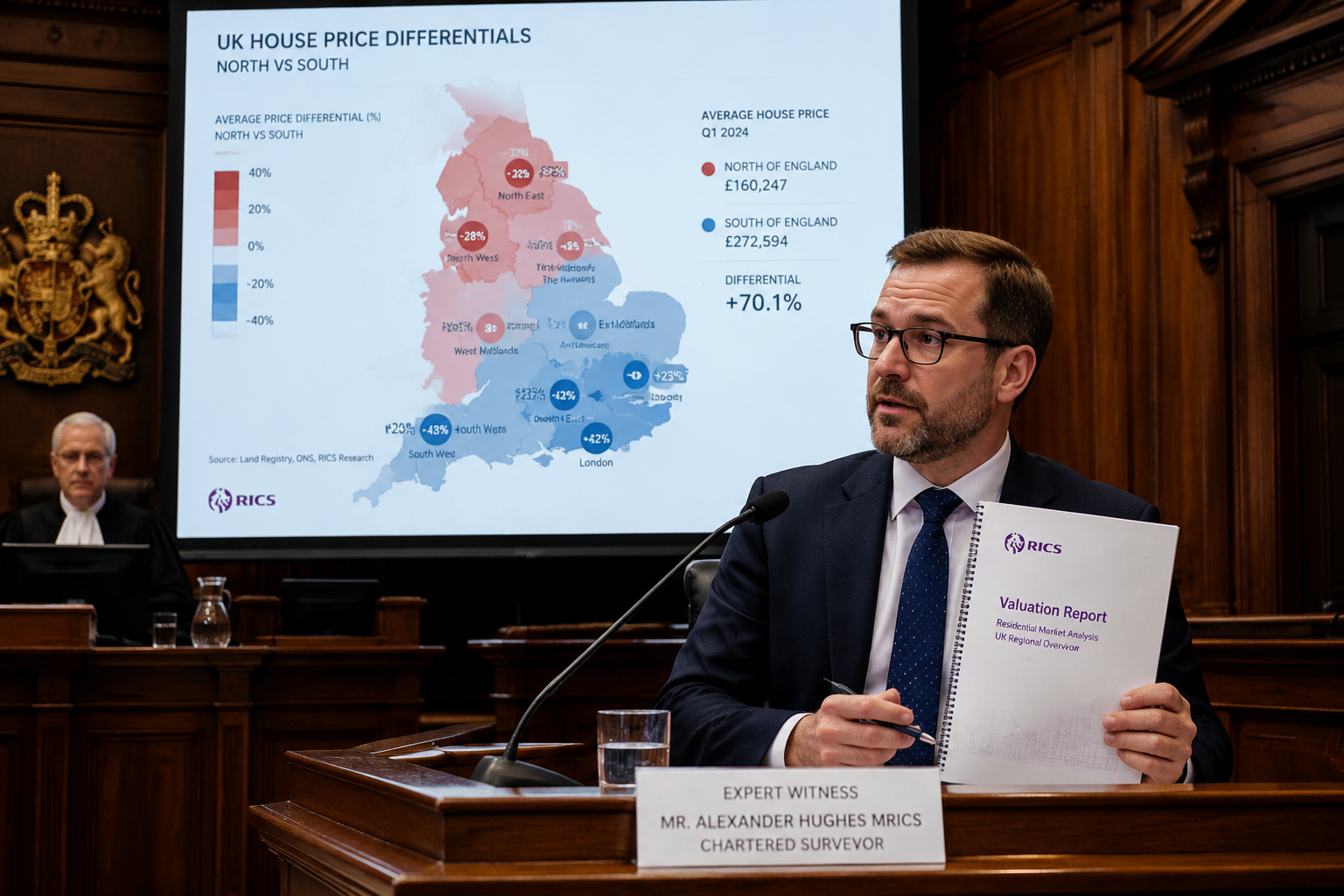
A residential property in Manchester can be worth less than a quarter of a comparable home in Central London — and in 2026, that gap is wider than at any point in the past two decades. When that disparity sits at the heart of a legal dispute, the difference between a well-prepared expert witness and an underprepared one can determine the outcome of a case entirely.
Expert Witness Roles in Regional Valuation Disputes: Leveraging RICS 2026 Survey Data for North-South Divides has become one of the most technically demanding areas of property law practice. Courts, tribunals, and arbitration panels now routinely encounter conflicting valuations that stem not from professional incompetence but from genuine, data-supported regional divergence. The RICS 2026 Residential Market Survey confirms that the price-per-square-foot differential between London and the North of England has reached a record spread, creating fertile ground for valuation disagreements that require expert testimony to resolve.
This article examines how expert witnesses can use RICS 2026 survey data effectively, what structures make reports court-admissible, and how regional market knowledge translates into credible, persuasive testimony.
Key Takeaways
- The North-South property price divide in the UK has reached its widest recorded margin in 2026, directly increasing the frequency of regional valuation disputes.
- Expert witnesses in valuation cases must comply with RICS Red Book Global Standards and Civil Procedure Rules Part 35 to maintain credibility before courts and tribunals.
- RICS 2026 survey data provides a defensible, independently verified evidence base for reconciling conflicting comparable evidence across regions.
- Structuring expert reports with clear methodology, transparent assumptions, and region-specific comparable selection is essential for persuasive testimony.
- Instructing a RICS-registered valuer with demonstrable local market knowledge is a critical strategic decision for any party entering a regional valuation dispute.
Why Regional Valuation Disputes Are Increasing in 2026
The widening gap between property markets in different parts of the UK is not a new story, but the pace of divergence has accelerated sharply. According to RICS 2026 survey data, average residential values in Prime Central London now exceed those in parts of the North West by a factor of eight or more when measured on a per-square-foot basis. For commercial property, the disparity in yield compression between London and Northern cities such as Leeds, Sheffield, and Manchester has created a similarly contested landscape.
Several factors are driving the increase in formal disputes:
- Matrimonial proceedings involving properties in different regions, where each party commissions a valuation reflecting local market bias
- Probate and inheritance tax assessments where HMRC challenges valuations submitted for Northern estates
- Lease renewal and rent review disputes in commercial property, where landlords and tenants cite incompatible regional datasets
- Compulsory purchase order (CPO) challenges where public bodies and landowners disagree on market value in regeneration zones
- Lending disputes following mortgage shortfalls, particularly in post-industrial Northern towns where values have stagnated
Each of these scenarios places an expert witness at the centre of a fact-finding process. Their role is not to advocate for a client's position but to assist the court with independent, evidence-based analysis. Understanding that distinction is foundational to effective expert witness practice.
For parties involved in property boundary or ownership disagreements, reviewing the guide to boundary dispute and party wall surveyors in London provides useful context on how surveyors engage in formal dispute processes.
Understanding Expert Witness Roles in Regional Valuation Disputes: Leveraging RICS 2026 Survey Data for North-South Divides

The Legal Framework Governing Expert Witnesses
In England and Wales, expert witnesses in property valuation disputes operate under Civil Procedure Rules (CPR) Part 35 and the accompanying Practice Direction. The overriding duty of an expert is to the court, not to the instructing party. This principle is non-negotiable and is reinforced by RICS Guidance Note GN 2/2014 on Surveyors Acting as Expert Witnesses, which was updated to align with current practice in 2026.
Key obligations under CPR Part 35 include:
| Obligation | Practical Requirement |
|---|---|
| Independence | Opinions must not be influenced by the instructing party's preferred outcome |
| Completeness | All material facts must be disclosed, including those unfavourable to the instructing party |
| Qualification | The expert must demonstrate relevant expertise in the specific market under review |
| Clarity | Reports must be comprehensible to a non-specialist judge or arbitrator |
| Updatability | Experts must be prepared to revise opinions in light of new evidence |
A valuer instructed as an expert witness in a North-South dispute must be able to demonstrate not just general RICS registration but specific competence in the regional market at issue. A London-based RICS registered valuer may be highly credible when addressing Central London values but may face challenge if opining on comparable evidence from Sunderland or Burnley without documented regional experience.
How RICS 2026 Survey Data Strengthens Expert Testimony
The RICS Residential Market Survey is published monthly and provides sentiment data from chartered surveyors across all UK regions. The RICS 2026 annual summary presents a particularly compelling picture of regional divergence, with the following headline findings relevant to dispute work:
- Price balance indicators show a sustained positive reading in London and the South East, contrasting with flat or negative readings across much of the North East and parts of Yorkshire
- New instructions and sales volumes in Northern markets remain constrained by affordability pressures despite relatively lower absolute prices
- Rental market data shows sharply divergent yield profiles, with Northern yields averaging 6.5-8% against London yields of 3-4.5% in comparable residential stock
For an expert witness, citing RICS 2026 survey data serves three critical functions. First, it anchors the opinion to an independently produced, professionally recognised source. Second, it contextualises the comparable evidence selected, explaining why certain transactions are or are not representative of the market at the relevant valuation date. Third, it provides the tribunal with a framework for understanding regional market dynamics without requiring detailed prior knowledge.
"The strength of an expert valuation report lies not in the conclusion it reaches but in the transparency of the reasoning used to reach it."
This principle applies with particular force in North-South disputes, where the same property type can produce radically different values depending on location, and where a court unfamiliar with regional markets needs clear signposting through the evidence.
For those seeking to understand the cost implications of commissioning a formal valuation, the RICS valuation cost guide provides a useful reference point.
Structuring RICS-Compliant Expert Reports for Regional Disputes
Core Components of a Court-Admissible Valuation Report
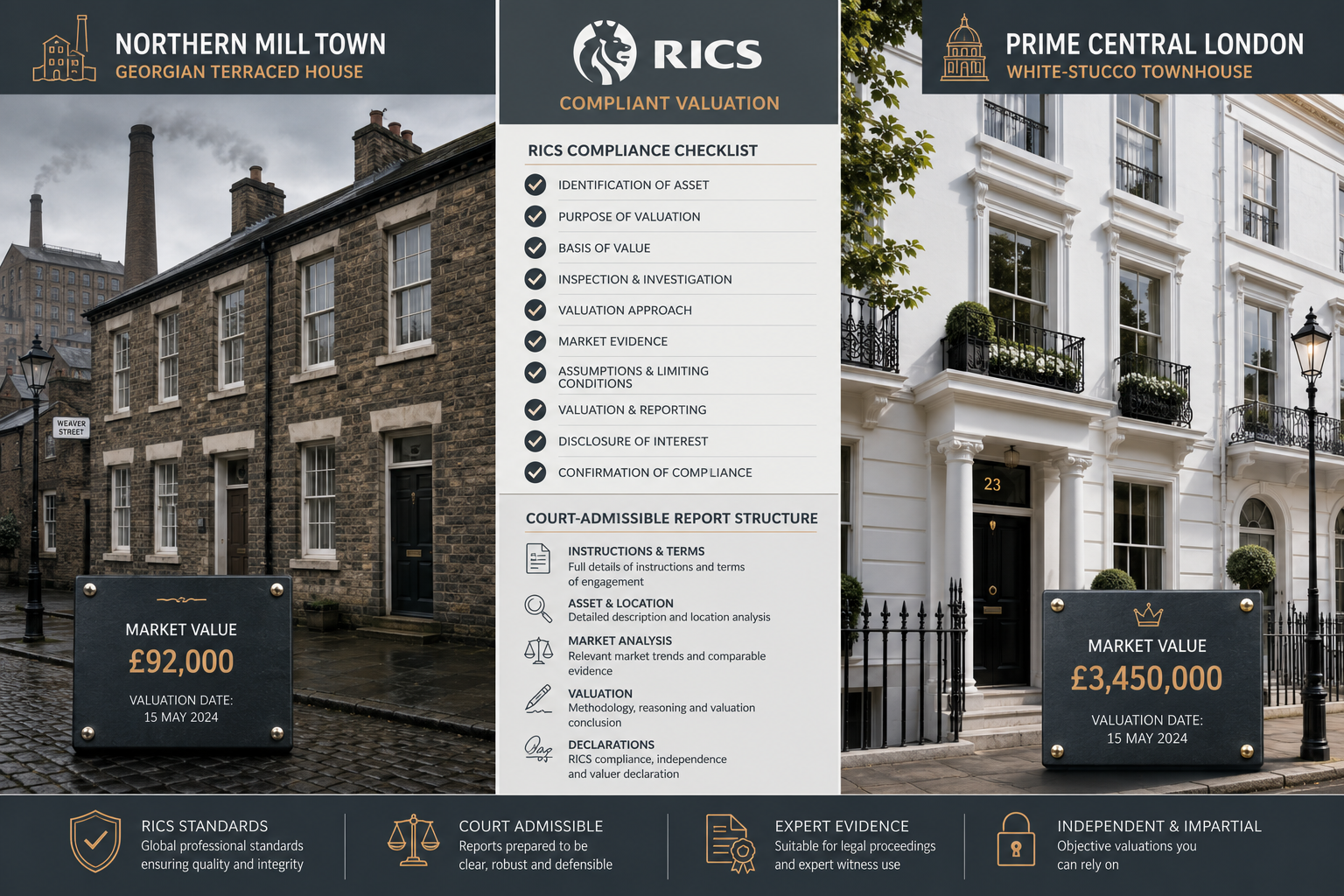
A valuation report prepared for litigation or arbitration differs materially from a standard Red Book valuation. While both must comply with RICS Valuation — Global Standards (the Red Book), the litigation report carries additional requirements driven by CPR Part 35.
The recommended structure for a court-admissible expert valuation report in a regional dispute includes:
1. Expert's Declaration
A signed statement confirming the expert's understanding of their duty to the court, their independence, and the limits of their expertise. This section should explicitly reference any geographic limitations on the expert's competence.
2. Instructions and Scope
A clear summary of what the expert was asked to do, by whom, and on what basis. Any joint instructions or single joint expert (SJE) appointment should be noted here.
3. Property Description and Inspection Record
Detailed notes on the physical inspection, including date, access conditions, and any limitations. For Northern properties being assessed by a London-based expert (or vice versa), this section should demonstrate genuine local market engagement.
4. Market Overview Using RICS 2026 Data
A region-specific market commentary drawing on RICS 2026 survey data, Land Registry price paid data, and any locally published market reports. This section must address the North-South divide directly if it is relevant to the dispute.
5. Comparable Evidence Analysis
A table of comparable transactions with full addresses, sale dates, prices, and adjustments. Adjustments for location, condition, size, and tenure must be explicitly stated and justified. This is typically the most contested section in regional valuation disputes.
6. Valuation Methodology
A clear statement of the valuation method used (comparison, income capitalisation, residual, etc.) and why it is appropriate for the subject property and market.
7. Opinion of Value
The final figure, expressed as a single value or a range with justification. Where a range is given, the expert should indicate where within that range the most probable value lies.
8. Statement of Truth
As required by CPR Part 35.
For complex commercial property matters, working with commercial property surveyors in London who have experience in tribunal work can provide a useful benchmark for report quality.
Selecting and Defending Comparable Evidence Across Regions
The comparable evidence section is where most regional valuation disputes are won or lost. The fundamental challenge is that there are no truly comparable transactions between a property in Hartlepool and one in Hammersmith. The expert's task is to identify the best available comparables within the relevant local market and apply transparent adjustments.
Common pitfalls in regional comparable selection include:
- Cherry-picking: Selecting only transactions that support a predetermined conclusion
- Temporal mismatch: Using comparables from a different market cycle without adjustment
- Geographic overreach: Treating a comparable from a different sub-market as directly applicable
- Condition assumptions: Failing to adjust for physical differences between the comparable and the subject property
RICS 2026 survey data is particularly valuable in this context because it provides a contemporaneous market sentiment benchmark against which individual transactions can be tested. If a comparable sale appears to be an outlier relative to RICS survey data for that region, the expert must address this discrepancy explicitly.
Case Studies: North-South Valuation Disputes in Practice
Case Study 1: Matrimonial Dispute — London Flat vs. Northern Portfolio
In a 2025 matrimonial case heard in the Family Division, the matrimonial assets included a leasehold flat in West London and a portfolio of three buy-to-let terraced houses in a Northern city. The husband's expert valued the portfolio at a combined figure 22% higher than the wife's expert, based on differing assumptions about rental yield and market sentiment.
The court appointed a single joint expert who used RICS 2025 regional survey data to establish that the Northern market had experienced a modest correction in the preceding 12 months. The SJE's report reconciled the two positions by demonstrating that the husband's expert had used pre-correction comparables without adjustment, while the wife's expert had applied an overly pessimistic yield assumption unsupported by local letting agent evidence.
The outcome turned on the quality of the SJE's methodology, not on which party had instructed the more expensive valuer. For those navigating similar proceedings, the matrimonial valuation service provides a structured approach to this type of instruction.
Case Study 2: Probate Dispute — HMRC Challenge to Northern Estate Valuation
A 2024 probate dispute involved HMRC challenging a valuation submitted for a mixed residential and commercial estate in a post-industrial Northern town. The original valuation had applied a comparison method using transactions from a neighbouring, more prosperous town, resulting in an inflated figure that reduced the inheritance tax liability.
The expert witness instructed by HMRC demonstrated, using RICS regional data and Land Registry price paid records, that the subject town constituted a distinct sub-market with materially lower values. The tribunal accepted the HMRC expert's analysis, resulting in a significantly higher tax assessment.
This case illustrates the importance of sub-market granularity. Regional data at the city or county level is often insufficient — the expert must be able to drill down to postcode or neighbourhood level to defend or challenge a valuation credibly.
Case Study 3: Commercial Rent Review — Leeds vs. London Yield Assumptions
A commercial rent review dispute for a retail unit in Leeds centred on whether the landlord's expert had correctly applied a London-derived yield model to a Northern city centre location. The tenant's expert argued that the yield compression observable in Central London over the preceding three years had not been replicated in the Leeds retail market, citing RICS 2026 commercial survey data showing flat or widening yields in Northern retail.
The arbitrator found in favour of the tenant, noting that the landlord's expert had failed to adequately distinguish between national trends and local market conditions. The decision reinforced the principle that regional specificity is not optional in expert valuation work — it is a fundamental requirement of credible testimony.
For rent review matters in London and the South East, the rent review service provides a relevant point of reference for understanding how these disputes are typically structured.
Practical Guidance for Instructing Parties and Legal Teams
Selecting the Right Expert for a Regional Dispute
The selection of an expert witness is a strategic decision with significant consequences. Legal teams should consider the following criteria when instructing a valuation expert for a North-South dispute:
- Demonstrable local market knowledge: The expert should be able to evidence recent instructions in the relevant region, not merely RICS registration
- Litigation experience: Prior experience of giving oral evidence, preparing joint statements, and engaging in without-prejudice discussions with opposing experts is highly valuable
- Report quality: Request a sample redacted report to assess clarity, structure, and evidential rigour before instructing
- Availability: Expert witness work is time-intensive; confirm the expert can meet tribunal deadlines before appointment
- Independence: Avoid experts with a commercial relationship with the instructing party that could be challenged under CPR Part 35
The Role of Joint Statements and Without-Prejudice Meetings
In most property valuation disputes, the court will direct opposing experts to meet without their clients and produce a joint statement identifying areas of agreement and disagreement. This process, known as a "without-prejudice experts' meeting," is often where disputes are effectively resolved.
A well-prepared expert enters this meeting with a clear understanding of:
- The precise points of difference between the two reports
- The evidential basis for their own position on each point
- The areas where concession is appropriate without undermining the overall opinion
- The RICS 2026 data points that support or qualify their comparable selection
For expert surveyors seeking to develop their practice in this area, the resources available under expert surveyor advice provide a useful foundation for understanding best practice in dispute-related instructions.
When to Commission a Valuation Report for Dispute Purposes
Not every valuation disagreement requires formal expert witness testimony. Many disputes are resolved through negotiation once both parties have commissioned independent Red Book valuations. The decision to escalate to formal expert witness proceedings should be based on:
- The quantum of the dispute relative to the cost of expert evidence
- The complexity of the valuation issues, particularly where regional market knowledge is contested
- The likelihood of the matter proceeding to a hearing
- Whether a single joint expert appointment would be more cost-effective than party-appointed experts
For a comprehensive overview of the valuation process and what different types of reports involve, the London property valuation guide and the RICS registered valuers in London page provide accessible starting points.
Conclusion
The widening North-South property divide documented in RICS 2026 survey data is not merely a macroeconomic observation — it is a live challenge for every expert witness, legal practitioner, and instructing party involved in regional valuation disputes. Expert Witness Roles in Regional Valuation Disputes: Leveraging RICS 2026 Survey Data for North-South Divides demands a combination of technical rigour, regional market depth, and procedural discipline that not every valuer is equipped to provide.
The case studies examined here demonstrate a consistent pattern: disputes are resolved in favour of the expert who has engaged most thoroughly with local market evidence, applied RICS data transparently, and structured their report to withstand cross-examination. The expert who imports assumptions from a different regional market without adjustment, or who fails to acknowledge the limitations of their geographic expertise, will face serious challenge before any competent tribunal.
Actionable next steps for parties facing a regional valuation dispute in 2026:
- Instruct a RICS-registered valuer with documented experience in the specific regional market at issue — not merely a national firm with a regional office
- Request that the expert's report explicitly references RICS 2026 survey data as a market context benchmark
- Ensure the comparable evidence section includes a written justification for each comparable selected and each adjustment applied
- Consider whether a single joint expert appointment would reduce costs and accelerate resolution
- Engage legal counsel experienced in CPR Part 35 to review the expert's report before service
- Use the without-prejudice experts' meeting constructively — well-prepared experts narrow issues efficiently and reduce hearing time
Regional valuation disputes will continue to increase in frequency as the UK's property market remains structurally divided. The expert witnesses who thrive in this environment will be those who treat RICS 2026 data not as a background reference but as a central pillar of their evidential architecture.
References
- Royal Institution of Chartered Surveyors. (2024). RICS Valuation — Global Standards (Red Book). RICS.
- Royal Institution of Chartered Surveyors. (2014). Surveyors Acting as Expert Witnesses (GN 2/2014, 4th ed.). RICS.
- Civil Procedure Rules Part 35 and Practice Direction 35. (2023). Ministry of Justice, England and Wales.
- Royal Institution of Chartered Surveyors. (2025). RICS Residential Market Survey: Annual Summary 2025. RICS.
- HM Land Registry. (2025). UK House Price Index: Regional Breakdown Q4 2025. HM Land Registry.
- Crosby, N., & Murdoch, S. (2021). Property Valuation: The Five Methods (3rd ed.). Wiley-Blackwell.
- Peel, M., & Wilkinson, S. (2019). Expert Evidence in Property Disputes. Estates Gazette.
How Prince Surveyors can help: explore our expert witness surveyors or learn about our RICS valuations.