

Last updated: July 24, 2026
Quick Answer: Expert witnesses in geopolitical valuation disputes provide independent, court-compliant property opinions that help tribunals and judges resolve contested values where market volatility has produced conflicting evidence. In 2026, RICS-accredited surveyors are expected to anchor their testimony to verified comparable data, demonstrate methodological transparency, and comply with the updated RICS Professional Statement on Expert Witnesses. Getting this right from the start of instruction, not just before trial, is what separates defensible reports from those that collapse under cross-examination.
Key Takeaways
- A 26% decline in buyer enquiries in early 2026 has driven a significant rise in contested property valuations reaching Lands Tribunal hearings and court proceedings.
- Expert witnesses in valuation disputes owe their primary duty to the court, not to the instructing party, this is non-negotiable under RICS standards.
- RICS updated its Expert Witness Professional Statement consultation in October 2025, addressing conditional fees, AI tools, and methodological transparency.
- Geopolitical uncertainty, including trade disruptions, sanctions, and currency volatility, now features as a material factor in many UK commercial and residential valuation disputes.
- RICS Expert Witness Accreditation (EWAS) is increasingly expected by courts and tribunals as a baseline credibility marker.
- The difference between an expert witness and an appraiser is legal, not just technical: only the expert witness owes a duty to the court.
- Automated Valuation Models (AVMs) can support expert testimony but cannot replace a qualified surveyor's independent opinion in contested proceedings.
- Common failures in expert witness testimony include advocacy bias, inadequate comparable evidence, and poor documentation of methodology.
- Fees for geopolitical valuation expert witnesses in the UK typically range from several thousand to tens of thousands of pounds depending on case complexity and hearing duration.
- Preparation must begin at instruction stage, leaving document assembly until the eve of trial is one of the most avoidable mistakes in this field.

What Does an Expert Witness Do in Property Valuation Disputes
An expert witness in a property valuation dispute provides an independent, evidence-based opinion on the value of a property at a specific date, for the benefit of a court, tribunal, or arbitration panel. Unlike a standard valuation report prepared for a client, expert witness evidence is governed by a duty to the court that overrides any obligation to the instructing solicitor or party.
In practice, this means the expert witness must:
- Assess and apply relevant comparable evidence objectively
- Disclose limitations in the data or methodology used
- Produce a written report that meets court-prescribed standards (CPR Part 35 in England and Wales)
- Attend hearings and withstand cross-examination on their conclusions
- Participate in expert meetings ("hot tubbing" or sequential questioning) where directed by the tribunal
The expert witness role is distinct from acting as an advocate. Any surveyor who allows their report to drift toward supporting their client's position rather than assisting the court risks having their evidence excluded or heavily discounted. For a detailed overview of how expert witness reports are structured and commissioned, see expert witness reports from Prince Chartered Surveyors.
How Geopolitical Risk Affects Real Estate Valuations
Geopolitical risk affects property values by creating uncertainty in investor sentiment, altering financing conditions, and disrupting the supply chains that underpin development costs. In a court setting, this matters because the date of valuation may fall within a period of acute market volatility, and both parties may cite the same market data to reach very different conclusions.
Key geopolitical factors that have influenced UK property valuations in 2026 include:
- Trade tariff changes affecting construction material costs and commercial lease yields
- Currency fluctuations impacting overseas investor demand, particularly in prime London markets
- Sanctions regimes creating uncertainty around beneficial ownership and transaction volumes
- Energy price volatility altering the relative attractiveness of different commercial asset classes
For expert witnesses, the challenge is not simply acknowledging these factors but demonstrating precisely how they affected value at the valuation date. A surveyor who says "the market was uncertain" without quantifying the impact on comparable yields or transaction volumes will struggle under cross-examination. Region-specific evidence is essential: geopolitical shocks do not affect a Hounslow industrial estate and a Chelsea residential flat in the same way. For context on how professional valuations account for market conditions, see Prince Chartered Surveyors' commercial valuations service.
"The expert witness who can show precisely how a geopolitical event moved the yield curve on comparable assets, with dated evidence, will always outperform one who relies on general market commentary."
What Are RICS Standards for Expert Witnesses in 2026
RICS sets the professional framework for surveyors acting as expert witnesses through its Expert Witness Professional Statement, which was subject to a public consultation update in October 2025. The revised statement addresses several areas that had become contested in practice, including the use of conditional fees, the role of AI-assisted analysis, and the standard of methodological transparency required in reports.
Under current RICS standards, surveyors acting as expert witnesses must:
- Accept instructions only where they have genuine subject matter expertise
- Declare and manage any conflicts of interest before accepting appointment
- Maintain independence from the instructing party throughout the engagement
- Structure written reports clearly, with a statement of truth and a declaration of duty to the court
- Engage constructively in expert meetings and narrow issues where possible
The RICS Expert Witness Accreditation Service (EWAS) provides a formal quality mark for surveyors who have demonstrated appropriate experience, training, and commitment to continuing professional development in this role. Courts and tribunals are increasingly treating EWAS accreditation as a baseline expectation rather than an optional credential. RICS also offers a 12-week online Expert Witness Certificate programme covering report preparation, tribunal duties, and evidence presentation for surveyors seeking to formalise their competence.
Who Needs Expert Witnesses for Geopolitical Valuation Disputes
Expert witnesses in geopolitical valuation disputes are needed by a specific set of parties facing contested property values where market instability is a central issue. This is not a service for routine valuation disagreements, it applies where the stakes are high enough to justify formal proceedings.
Typical clients include:
- Property owners and investors disputing compulsory purchase compensation where the valuation date falls in a volatile period
- Commercial landlords and tenants in rent review arbitrations where geopolitical factors have moved yields
- Solicitors and barristers instructing surveyors to support litigation in the Lands Chamber or Upper Tribunal
- Pension fund trustees where a disputed SIPP or pension property valuation has regulatory consequences (see SIPP pension valuations)
- Executors and beneficiaries where an inheritance tax valuation is challenged by HMRC (see inheritance tax valuations)
- Matrimonial proceedings where a disputed property value affects the financial settlement (see matrimonial valuations)
The common thread is a formal dispute process, whether court, tribunal, or arbitration, where an independent professional opinion carries legal weight.
What Qualifications Do You Need to Be an Expert Witness for Valuations
To act as an expert witness in a UK property valuation dispute, a surveyor must be a qualified RICS member (MRICS or FRICS) with demonstrable expertise in the relevant property type and market. Membership alone is not sufficient, the surveyor must be able to show genuine, current experience in valuing comparable assets.
Recommended qualifications and credentials include:
- MRICS or FRICS designation with a valuation specialism
- RICS Registered Valuer status (mandatory for Red Book valuations)
- RICS Expert Witness Accreditation Service (EWAS) certification
- Completion of the RICS Expert Witness Certificate (12-week programme)
- Relevant CPD in the specific asset class and geographic market
Courts have excluded expert evidence where the witness lacked direct experience in the relevant market. A residential surveyor offering expert opinion on a specialist industrial asset, or vice versa, is unlikely to survive a challenge to their credentials. Choosing the right expert at instruction stage, rather than substituting one later, avoids costly procedural delays.
How to Prepare Expert Witness Testimony for Court
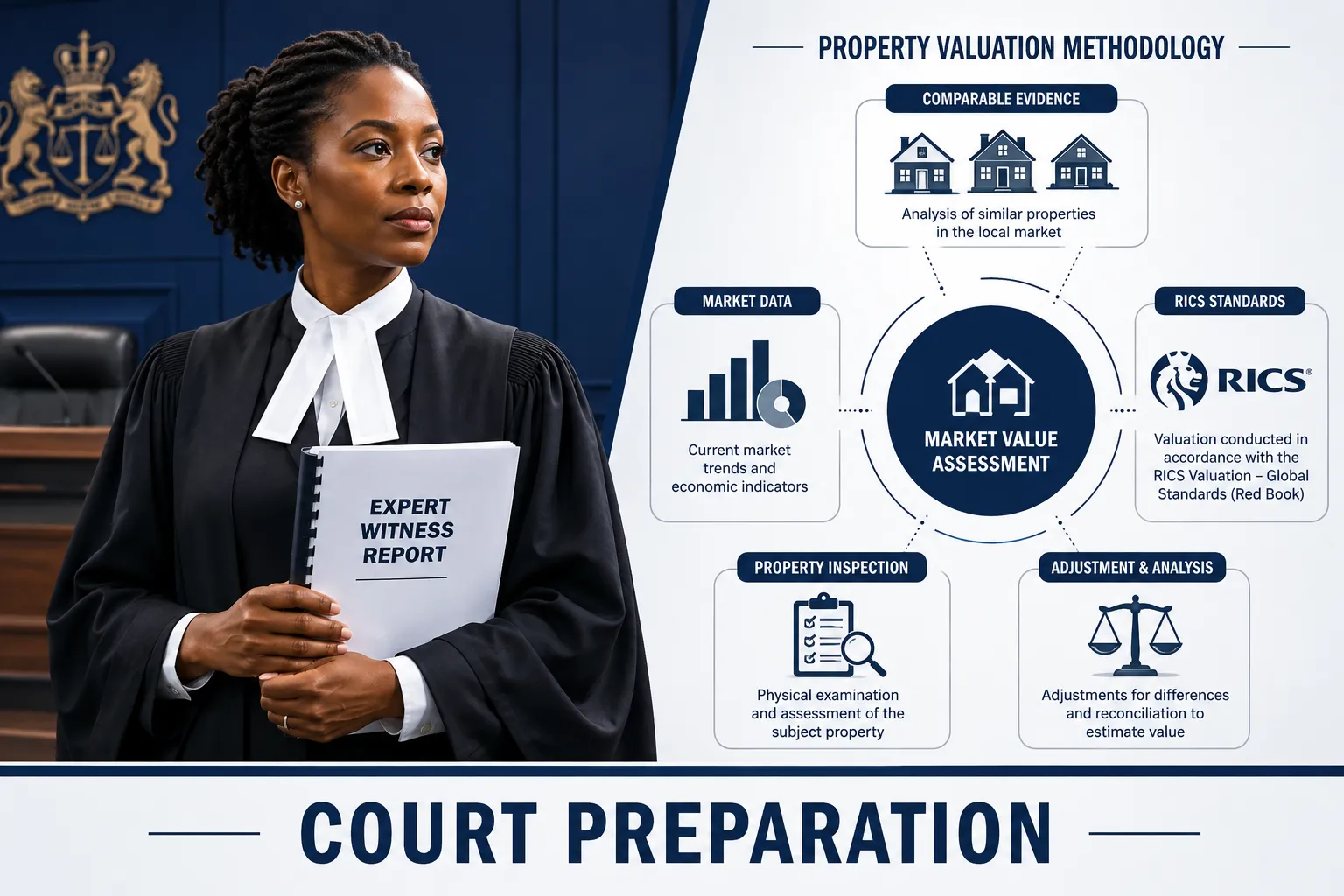
Effective court preparation for expert witness roles in geopolitical valuation disputes begins at the point of instruction, not in the weeks before trial. The RICS February 2026 insights for court preparation emphasise that methodological decisions made early in the process determine whether the final report can withstand scrutiny.
Step-by-step preparation checklist:
- Confirm instructions in writing, scope, valuation date, property type, and the specific question the court needs answered
- Conduct a conflict of interest check before accepting the appointment
- Inspect the property and document conditions contemporaneously
- Assemble comparable evidence, prioritise arm's-length transactions close to the valuation date; document why each comparable was included or excluded
- Address geopolitical market context, identify which specific factors affected the market at the valuation date and quantify their impact where possible
- Prepare the written report in compliance with CPR Part 35 and the RICS Professional Statement format
- Review and sign the statement of truth, this carries personal professional and legal consequences
- Attend the expert meeting (if directed) and produce a joint statement of agreed and disputed issues
- Prepare for cross-examination, anticipate challenges to methodology, comparable selection, and geopolitical adjustments
Documents to prepare before trial include: the full comparable evidence file, market data sources with dates, correspondence log, inspection notes, and any earlier drafts that may be disclosable.
What Is the Difference Between an Expert Witness and an Appraiser in Valuation Cases
The difference is primarily legal rather than technical. An appraiser (or valuer) produces a report for a client's commercial purposes, a mortgage, a sale, a tax return. An expert witness produces evidence for a court or tribunal, with a primary duty to that tribunal rather than to the instructing party.
| Feature | Appraiser / Valuer | Expert Witness |
|---|---|---|
| Primary duty | To the client | To the court / tribunal |
| Report format | RICS Red Book / client brief | CPR Part 35 compliant |
| Advocacy role | Permitted | Prohibited |
| Cross-examination | Rare | Standard |
| EWAS accreditation | Not required | Strongly recommended |
In practice, the same RICS-registered surveyor may act in both capacities at different points, but never simultaneously on the same matter. A surveyor who prepared the original valuation for a client should generally not then act as that client's expert witness, as independence may be compromised. For background on what a standard independent property valuation involves, see getting an independent property valuation.
Common Mistakes Expert Witnesses Make in Valuation Testimony
The most damaging mistakes in expert witness valuation testimony are those that signal advocacy bias or methodological weakness. Courts are experienced at identifying both.
Most common errors:
- Cherry-picking comparables that support the instructing party's position while ignoring contrary evidence
- Failing to address geopolitical market conditions at the valuation date, leaving the methodology looking context-free
- Overstating certainty, presenting a point estimate without acknowledging the range of defensible values
- Inadequate documentation of how and why adjustments were made to comparable evidence
- Changing opinions between the report and expert meeting without a clear, documented reason
- Using AVMs or automated data without qualification, presenting computer-generated output as if it were independent professional judgment
- Accepting instructions outside genuine expertise, a valuer experienced in residential property should not accept instructions on specialist commercial assets without disclosing the limitation
The single most avoidable mistake is writing a report that reads like a client's submission rather than an independent analysis. Courts notice this immediately, and it undermines the credibility of every opinion in the document.
Can You Use AI or Automated Valuation Models as Expert Witness Evidence
AI and Automated Valuation Models (AVMs) can be used to support expert witness evidence, but they cannot substitute for a qualified surveyor's independent professional judgment. The RICS October 2025 consultation update specifically addressed the role of technological tools in expert witness work, confirming that the expert witness remains personally responsible for every opinion expressed in their report, regardless of the tools used to generate supporting data.
AVMs are useful for:
- Identifying a broad range of comparable transactions quickly
- Cross-checking a manual comparable analysis for outliers
- Demonstrating market trend context to a tribunal
AVMs are not acceptable as:
- A standalone basis for a valuation opinion in contested proceedings
- A substitute for physical inspection and professional judgment
- Evidence of value where the AVM's methodology cannot be fully explained and defended
Any expert witness who presents AVM output without explaining the model's assumptions, data sources, and limitations risks having that element of their evidence excluded. The expert must be able to explain every number in their report, if they cannot, it should not be there.
How Do You Handle Conflicting Valuations from Multiple Expert Witnesses
Conflicting expert valuations are common in geopolitical valuation disputes, precisely because volatile market conditions produce a wider range of defensible outcomes. Courts and tribunals have established procedures for managing this.
Standard approaches:
- Expert meetings (without prejudice): Both experts meet to identify agreed facts, narrow disputed issues, and produce a joint statement. This is mandatory in most Lands Tribunal proceedings.
- Hot tubbing: Experts give evidence simultaneously, with the judge directing questions to both. This format exposes inconsistencies in methodology more effectively than sequential cross-examination.
- Single Joint Expert (SJE): Where the court directs, one expert is appointed to serve both parties. This is more common in lower-value disputes or where the valuation methodology is relatively straightforward.
When valuations diverge significantly, the tribunal will scrutinise the comparable evidence each expert relied upon, the adjustments made, and whether geopolitical factors were treated consistently. The expert who can demonstrate a transparent, reproducible methodology, rather than simply asserting a conclusion, is more likely to be preferred.
How Much Do Expert Witnesses Charge for Geopolitical Valuation Cases
Expert witness fees in geopolitical valuation disputes vary considerably depending on the complexity of the case, the seniority of the surveyor, and the duration of proceedings. There is no fixed RICS scale for expert witness fees in 2026.
Typical fee ranges (estimates based on market practice):
- Initial report preparation: £3,000 to £15,000 for a standard residential or commercial case
- Complex geopolitical or high-value commercial disputes: £15,000 to £50,000 or more
- Attendance at tribunal or court (per day): £1,500 to £5,000 depending on seniority
- Expert meetings and joint statement preparation: typically charged at hourly rates
Fees should be agreed in writing at instruction stage, with a clear scope of work. The RICS updated Professional Statement addressed conditional fee arrangements, confirming that expert witnesses must not accept fees contingent on the outcome of proceedings, this would compromise the independence that makes their evidence admissible.
What Happens If Your Expert Witness Valuation Gets Challenged in Court
A challenged expert witness valuation does not automatically mean the case is lost, but it does require the expert to defend their methodology under cross-examination. The strength of the original documentation determines how well that defence holds.
Possible outcomes when a valuation is challenged:
- The court prefers one expert's evidence over another's and explains why in the judgment
- The court adopts a figure between the two expert opinions
- The court directs a further expert meeting to narrow the gap
- In rare cases, the court appoints its own assessor or directs a fresh valuation
If an expert witness's report is found to have been prepared without genuine independence, or if the expert is shown to have withheld material contrary evidence, professional consequences can follow, including referral to RICS for a conduct investigation. This is why the duty to the court is not a formality but a genuine professional obligation.
For context on how valuation disputes arise in the first place, see what to do if your home valuation is less than an offer and understanding the top factors in a property valuation.
Applying RICS February 2026 Insights for Court Preparation in Practice
The RICS February 2026 survey data and the broader Expert Witness Roles in Geopolitical Valuation Disputes: RICS February 2026 Insights for Court Preparation framework give surveyors a structured basis for defending opinions in a volatile market. The key practical applications are:
- Anchor opinions to RICS survey data, cite the specific RICS market indicators that support the market conditions described at the valuation date
- Build region-specific comparable evidence, national trends are insufficient; the comparable pool must reflect the specific sub-market
- Document methodology at every stage, from comparable selection through to final adjustments, every decision should be recorded and defensible
- Obtain EWAS accreditation before accepting instructions in formal proceedings
- Consider whether a Single Joint Expert appointment would serve the proceedings more efficiently in lower-value disputes
The surveyors most effective in this environment are those who treat court preparation as a continuous process throughout the instruction, not a last-minute exercise. For capital gains tax valuation disputes, a common context for contested expert evidence, see capital gains valuations.
.ew-checker{font-family:Arial,sans-serif;max-width:560px;margin:24px auto;border:2px solid #1a3a5c;border-radius:8px;overflow:hidden}
.ew-checker h3{background:#1a3a5c;color:#fff;margin:0;padding:14px 18px;font-size:1rem}
.ew-checker .ew-body{padding:16px 18px}
.ew-checker label{display:flex;align-items:flex-start;gap:10px;margin-bottom:10px;font-size:0.9rem;cursor:pointer;line-height:1.4}
.ew-checker input[type=checkbox]{margin-top:2px;accent-color:#1a3a5c;width:16px;height:16px;flex-shrink:0}
.ew-checker .ew-score{margin-top:14px;padding:12px;background:#f0f4f8;border-radius:6px;font-size:0.9rem;text-align:center}
.ew-checker .ew-score strong{color:#1a3a5c;font-size:1.1rem}
.ew-checker button{display:block;width:100%;padding:10px;background:#c8a84b;color:#1a3a5c;border:none;border-radius:4px;font-weight:bold;font-size:0.95rem;cursor:pointer;margin-top:12px}
.ew-checker button:hover{background:#b8963a}
Expert Witness Court Readiness Checklist
function calcScore(){
var items=document.querySelectorAll(‘.ew-item’);
var checked=0;
items.forEach(function(i){if(i.checked)checked++;});
var total=items.length;
var pct=Math.round((checked/total)*100);
var msg=pct===100?’Court-ready. All key steps completed.’:pct>=70?’Nearly ready. Address remaining steps before filing.’:’Further preparation needed before accepting instructions.’;
var el=document.getElementById(‘ew-result’);
el.style.display=’block’;
el.innerHTML=’‘+checked+’ / ‘+total+’ complete (‘+pct+’%)
‘+msg;
}
Frequently Asked Questions
What is the primary duty of an expert witness in a UK property valuation dispute?
The primary duty is to the court or tribunal, not to the instructing party. This means the expert must provide an honest, independent opinion even if it does not support the client's position. This duty is set out in CPR Part 35 and reinforced by the RICS Expert Witness Professional Statement.
Do I need RICS accreditation to act as an expert witness in 2026?
RICS membership (MRICS or FRICS) and Registered Valuer status are the baseline requirements. RICS Expert Witness Accreditation Service (EWAS) certification is not legally mandatory but is increasingly expected by courts and tribunals as a credibility marker, and RICS recommends it for anyone regularly accepting expert witness instructions.
How does geopolitical uncertainty affect a court's assessment of a valuation dispute?
Courts recognise that geopolitical events can widen the range of defensible values at a given date. An expert who can demonstrate precisely how specific geopolitical factors affected comparable yields, transaction volumes, or investor sentiment at the valuation date will carry more weight than one who makes general references to market uncertainty.
Can the same surveyor who prepared the original valuation act as expert witness for the same client?
Generally, no. A surveyor who prepared the original valuation for a client may have their independence questioned if they then act as that client's expert witness. The RICS Professional Statement requires expert witnesses to be genuinely independent, and prior involvement in the transaction is a recognised conflict risk.
What happens at an expert meeting in a valuation dispute?
Expert meetings are without-prejudice discussions between the opposing experts, usually directed by the court or tribunal. The purpose is to identify agreed facts, narrow the issues in dispute, and produce a joint statement. They are not negotiations, the experts must not allow the instructing parties' lawyers to dictate the content of the joint statement.
Are Automated Valuation Models (AVMs) acceptable as expert evidence in court?
AVMs can be used as supporting tools but cannot replace a qualified surveyor's independent opinion. The expert must be able to explain the AVM's methodology, data sources, and limitations. Presenting AVM output without qualification is a recognised weakness that opposing counsel will exploit under cross-examination.
How long does it typically take to prepare an expert witness report for a geopolitical valuation dispute?
For a standard case, allow four to eight weeks from instruction to a finalised report. Complex geopolitical disputes involving multiple asset classes, contested comparable evidence, or international ownership structures may require significantly longer. Starting preparation at instruction stage, not weeks before trial, is essential.
Conclusion
Expert Witness Roles in Geopolitical Valuation Disputes: RICS February 2026 Insights for Court Preparation represent a demanding but well-defined professional discipline. The surveyors who perform best in this environment share three characteristics: they maintain genuine independence throughout the instruction, they document every methodological decision from the first site visit onwards, and they treat the court's need for clarity as their primary obligation.
Actionable next steps for property professionals and legal teams in 2026:
- If instructing an expert witness, verify RICS membership, Registered Valuer status, and EWAS accreditation before appointment
- Begin document assembly at instruction stage, do not leave comparable evidence gathering until after proceedings are issued
- Address geopolitical market conditions explicitly in the report, with dated, source-referenced evidence rather than general commentary
- Consider whether a Single Joint Expert appointment would reduce costs and procedural complexity in lower-value disputes
- Ensure fee arrangements are agreed in writing and do not include any element contingent on the outcome
For professional expert witness reports prepared by RICS-accredited chartered surveyors, or for independent property valuations across residential, commercial, and specialist asset classes, Prince Chartered Surveyors' expert witness and valuation services provide the depth of expertise that contested proceedings demand.
Tags: expert witness valuation, RICS expert witness, geopolitical property valuation, property valuation disputes, RICS 2026 standards, court preparation surveyor, valuation expert testimony, Lands Tribunal valuation, EWAS accreditation, chartered surveyor expert witness, property valuation court, contested property valuation