

Boundary disputes now account for a growing share of property litigation in England and Wales, with solicitors reporting a marked rise in instructions tied directly to the surge in conveyancing activity that has defined the housing market since late 2025. As lending volumes climb and more titles change hands, ambiguous boundary lines that sat dormant for decades are suddenly flashpoints between neighbours, lenders, and developers. Understanding expert witness roles in boundary disputes amid 2026's increased transaction volumes is no longer a niche concern for specialist solicitors — it is a practical necessity for any surveyor, property owner, or legal professional navigating today's recovering market.

Key Takeaways
- Expert witness surveyors must follow strict RICS standards when preparing reports for court, mediation, or arbitration in boundary disputes.
- Drone survey technology is now a standard tool for producing defensible aerial evidence in contested boundary cases.
- Initial expert witness reports in 2026 typically cost between £2,500 and £6,000, with additional fees for court appearances and supplementary drone surveys.
- Early intervention through mediation significantly reduces total dispute costs and timescales compared to full litigation.
- Rising transaction volumes mean more dormant boundary ambiguities are being triggered, placing greater demand on qualified surveyors with litigation experience.
Why Boundary Disputes Are Surging in 2026
The connection between transaction volume and dispute frequency is well established. When properties sit with the same owner for years, boundary ambiguities rarely surface. The moment a sale, remortgage, or development application arrives, title plans are scrutinised, and discrepancies become visible.
In 2026, several converging factors have amplified this effect:
- Post-pandemic development catch-up: Delayed planning applications approved in 2024 and 2025 are now moving to construction phase, triggering boundary questions at the edges of sites.
- Increased remortgaging activity: Lenders are requiring more precise valuations and title confirmations, which surfaces boundary issues that conveyancers must resolve before completion.
- Heightened litigation awareness: Property owners are better informed about their legal rights than at any previous point, and are more willing to challenge boundary delineations they consider inaccurate [2].
For surveyors, this environment creates both opportunity and pressure. The demand for expert witness services has risen sharply, but so has scrutiny of the quality and impartiality of expert reports [1].
Understanding the average cost of a boundary dispute is an important first step for any property owner considering whether to pursue or defend a claim — costs escalate rapidly once litigation begins.
The Expert Witness Role: Duties, Standards, and Court Processes
Overriding Duty to the Court
The foundational principle governing every expert witness in England and Wales is that their primary duty runs to the court, not to the instructing party. This is codified in Civil Procedure Rule 35 and reinforced by the RICS Expert Witness Practice Statement. A surveyor who loses sight of this principle — by shading evidence to favour the client — risks having their report excluded and faces potential disciplinary action from their professional body.
In practice, this means:
- Reports must present all material facts, including those that are unfavourable to the instructing party.
- Opinions must be genuinely held and clearly distinguished from factual findings.
- The expert must acknowledge the limits of their expertise and not stray into areas outside their competence.
RICS Standards and the 2026 Context
Expert witness roles in boundary disputes amid 2026's increased transaction volumes are shaped directly by the RICS Expert Witness Practice Statement (5th edition) and the RICS Boundaries: Guidance for Surveyors guidance note. These documents set out how a surveyor should:
- Examine and interpret title deeds, Land Registry filed plans, and historical conveyancing documents.
- Conduct physical site inspections and record findings systematically.
- Prepare a structured report that separates factual evidence from expert opinion.
- Comply with the single joint expert (SJE) framework where the court appoints one expert rather than each party instructing their own [1].
Adherence to these standards is not optional. Courts have become increasingly willing to disallow the costs of expert witnesses whose reports do not meet the required standard, and in some cases have referred surveyors to RICS for disciplinary review.
Surveyors working across London and the South East should also be familiar with UK boundary wall rules and the Party Wall Act 1996, as boundary disputes frequently overlap with party wall matters.
Structuring the Expert Witness Report
A well-structured report typically follows this sequence:
| Section | Content |
|---|---|
| Instructions and scope | Who instructed the expert and on what basis |
| Documents examined | Title deeds, OS maps, historical photographs, planning records |
| Site inspection findings | Physical features, measurements, encroachments |
| Expert opinion | Interpretation of the boundary line based on evidence |
| Summary and declaration | Confirmation of duty to the court |
Reports that omit the declaration of truth, fail to identify the documents relied upon, or conflate factual observation with opinion are among the most common reasons expert evidence is challenged or excluded.
Drone Surveys and Technology in 2026 Boundary Cases
How Drone Technology Is Changing Evidence Standards
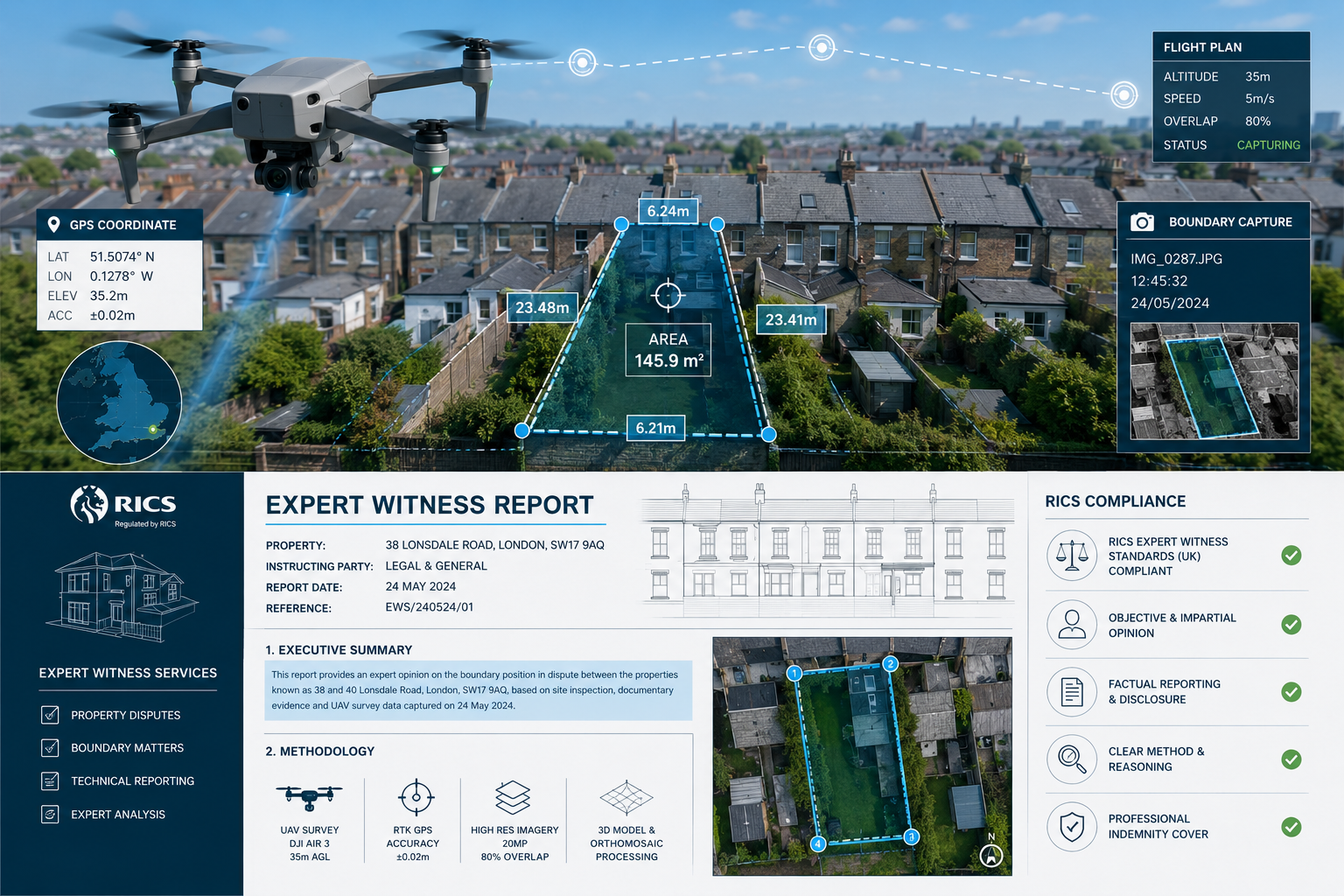
One of the most significant developments shaping expert witness roles in boundary disputes amid 2026's increased transaction volumes is the widespread adoption of drone survey technology. Where a surveyor once relied solely on ground-level measurements and Ordnance Survey data, drone-mounted LiDAR and high-resolution cameras now produce sub-centimetre accurate aerial imagery that can be presented directly to a court or mediator [1].
The practical advantages are considerable:
- Precision: Drone surveys can capture boundary features — walls, fences, hedges, drainage channels — with accuracy that ground surveys sometimes miss due to access restrictions.
- Contemporaneous evidence: A time-stamped aerial record of the property at the point of dispute is difficult to challenge and provides a clear baseline for comparison with historical data.
- Visual clarity for non-specialists: Judges and mediators who are not surveyors find aerial imagery far easier to interpret than abstract plan references.
The cost of integrating drone surveys into an expert witness instruction adds to the overall fee, but courts have generally accepted this as a reasonable and proportionate expense in contested boundary cases [1].
Combining Traditional and Digital Methods
Responsible expert witnesses do not rely on drone imagery alone. The strongest reports triangulate multiple data sources:
- Original conveyance plans (often pre-decimal, requiring careful scale conversion)
- Land Registry title plans (which are indicative only and not definitive as to boundary position)
- Ordnance Survey historical map overlays
- Drone and ground-level photographic evidence
- Witness evidence from long-standing neighbours or previous owners
Surveyors with expertise in land surveying techniques and topographic mapping are best placed to synthesise these sources into a coherent and defensible expert opinion.
Cost Implications and Common Pitfalls in Recovering Markets
What Expert Witness Services Cost in 2026
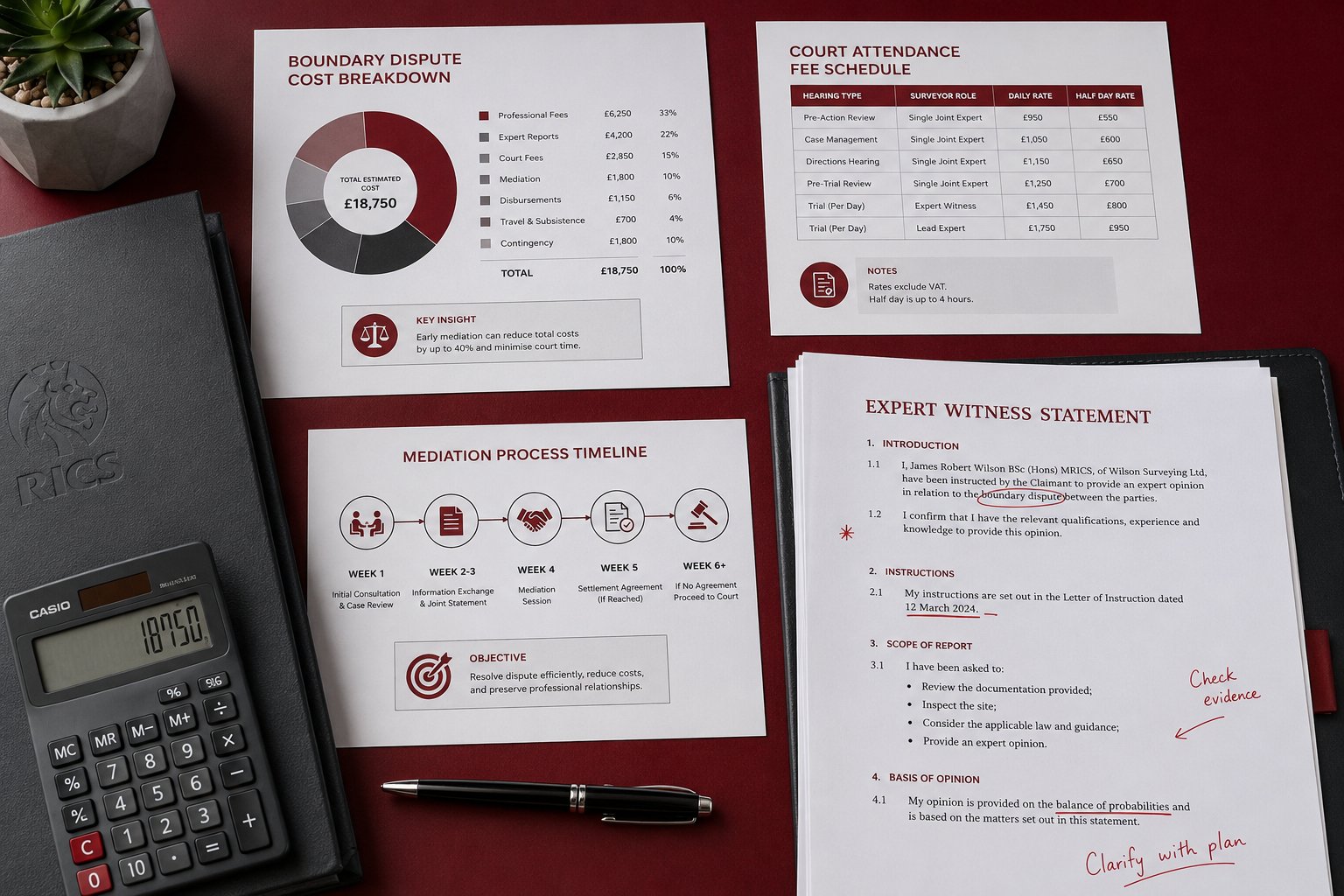
The financial stakes in boundary disputes have risen alongside transaction volumes. Expert witness fees in 2026 follow a broadly tiered structure:
| Service | Typical Cost Range |
|---|---|
| Initial expert report | £2,500 to £6,000 |
| Drone survey supplement | £800 to £2,500 |
| Court attendance (per day) | £1,500 to £3,500 |
| Joint statement preparation | £500 to £1,500 |
| Supplementary report | £750 to £2,000 |
These figures reflect the complexity of the instruction and the seniority of the expert. Cases involving commercial or development land typically attract fees at the upper end of these ranges [1].
Key point: Total litigation costs in a contested boundary dispute — including solicitors, barristers, court fees, and expert witnesses — can exceed £50,000 per side. Early resolution through mediation or a joint expert instruction typically costs a fraction of this.
Common Pitfalls Surveyors Must Avoid
The increased workload generated by 2026's transaction volumes has created conditions where errors are more likely. The most frequently observed pitfalls include:
1. Accepting instructions where impartiality is compromised
A surveyor who has previously acted as a party's general surveyor, or who has a financial interest in the outcome, should decline expert witness instructions. Courts scrutinise the independence of experts closely.
2. Overstating certainty in opinions
Boundary evidence is often genuinely ambiguous. An expert who presents an opinion as definitive when the evidence supports only a probable conclusion will be exposed under cross-examination. Qualified language — "on the balance of probabilities" — is both professionally honest and legally appropriate.
3. Failing to update reports when new evidence emerges
In recovering markets where transactions move quickly, new documents sometimes surface after an initial report has been filed. The expert has a duty to notify the court and update their opinion if material new evidence changes their view.
4. Poor time management under increased demand
Expert witnesses are facing real pressure to manage litigation commitments alongside conventional survey work [2]. Accepting more instructions than can be handled to the required standard is a reputational and professional risk. Sustainable practice development — including clear diary management and support staff — is essential [2].
5. Inadequate site inspection records
Contemporaneous notes, photographs with timestamps, and measurement records taken at inspection are the foundation of a defensible report. Surveyors who rely on memory or reconstruct notes after the fact are vulnerable to challenge.
Surveyors who regularly handle surveyor responsibilities across complex urban environments will recognise that these pitfalls are amplified when caseloads are high and timescales are compressed.
The Role of Early Intervention
There is a strong and growing consensus that early intervention produces better outcomes for all parties [1]. Mediation, expert determination, and the use of a single joint expert appointed by agreement (rather than by court order) all offer faster and cheaper routes to resolution than contested litigation.
For property owners, the practical message is clear: engaging a qualified surveyor early — before positions become entrenched — dramatically reduces the risk of a dispute escalating to trial. For surveyors, offering pre-litigation boundary assessments as a distinct service line is both commercially sensible and professionally valuable.
Those dealing with property line restrictions or seeking guidance on UK property boundaries will find that early professional input often resolves apparent conflicts before they reach a solicitor's desk.
Building a Sustainable Expert Witness Practice in 2026
The sustained rise in transaction volumes means that demand for qualified expert witnesses is unlikely to diminish in the near term. Surveyors who wish to develop or expand an expert witness practice should consider the following:
- Formal training: RICS and the Academy of Experts both offer structured programmes in expert witness procedure. Completing these before accepting court instructions is strongly advisable.
- Professional indemnity cover: Expert witness work requires specific PI cover. Standard surveying PI policies may not extend to litigation support services without an endorsement.
- Specialist software: Case management tools, report templates aligned to CPR Part 35, and drone data processing software all improve efficiency and output quality.
- Peer review: Having reports reviewed by a colleague before submission catches errors and strengthens the analysis.
- Regulatory awareness: Increased regulatory scrutiny means that expert witnesses must stay current with both RICS guidance updates and changes to Civil Procedure Rules [2].
Surveyors based in London and the surrounding area can find local surveying expertise to support boundary and expert witness instructions across a wide range of property types and dispute contexts.
Conclusion
Expert witness roles in boundary disputes amid 2026's increased transaction volumes demand a higher standard of preparation, impartiality, and technical capability than at any previous point. The combination of rising caseloads, drone-enabled evidence standards, strict RICS compliance requirements, and heightened court scrutiny means that only surveyors who approach this work with rigour and discipline will produce reports that withstand challenge.
Actionable next steps for surveyors:
- Review your current PI cover to confirm it extends to expert witness and litigation support work.
- Complete formal expert witness training through RICS or the Academy of Experts if you have not already done so.
- Invest in drone survey capability or establish a reliable referral relationship with a licensed drone operator.
- Build a pre-litigation boundary assessment service to capture early-stage instructions before disputes escalate.
- Implement a peer review process for all expert reports before submission.
Actionable next steps for property owners:
- Commission a professional boundary survey at the earliest sign of a dispute — before legal positions harden.
- Request that your solicitor consider a single joint expert appointment to reduce costs.
- Explore mediation as a first step rather than a last resort.
The surveyors and legal professionals who treat expert witness work as a distinct discipline — with its own standards, tools, and ethical obligations — will be best positioned to serve clients and courts effectively throughout 2026 and beyond.
References
[1] Expert Witness Valuations In Neighbour Boundary Disputes Rics Standards And Drone Survey Integration For 2026 Cases – wimbledonsurveyors.com
[2] Expert Witness Roles In 2026 Lender Valuation Disputes Evidence Standards Amid Rising Transactions – wimbledonsurveyors.com
How Prince Surveyors can help: explore our expert witness surveyors or learn about our RICS valuations.