

Last updated: July 24, 2026
Quick Answer: Expert witness reports in party wall damage claims are formal, court-admissible documents prepared by a chartered surveyor that quantify the actual loss suffered by a neighbouring property owner as a result of party wall works. They address three core valuation questions: what the genuine repair cost is, whether betterment applies (where new materials improve on what was there before), and what constitutes reasonable reinstatement. Getting these three elements right determines whether a claim succeeds or fails.
Key Takeaways
- An expert witness report must be impartial, evidence-based, and comply with Civil Procedure Rules Part 35 if it is to be used in court proceedings.
- Actual loss is calculated as the cost to return the property to its pre-works condition, not to upgrade it.
- Betterment deductions apply when repairs would leave the claimant in a materially better position than before the damage occurred.
- Reasonable reinstatement means the most cost-effective method that restores the property to its former condition, not necessarily the most expensive option.
- A schedule of condition prepared before works begin is the single most powerful document in any party wall damage claim.
- Expert witness fees for party wall damage reports typically range from £800 to £3,500 depending on the complexity of the claim.
- The building owner (the party carrying out works) is liable for damage caused under Section 7(2) of the Party Wall etc. Act 1996.
- Courts and party wall surveyors apply a "like-for-like" standard, adjusted for age and condition, when assessing reinstatement costs.
What Is an Expert Witness Report for Party Wall Damage Claims?
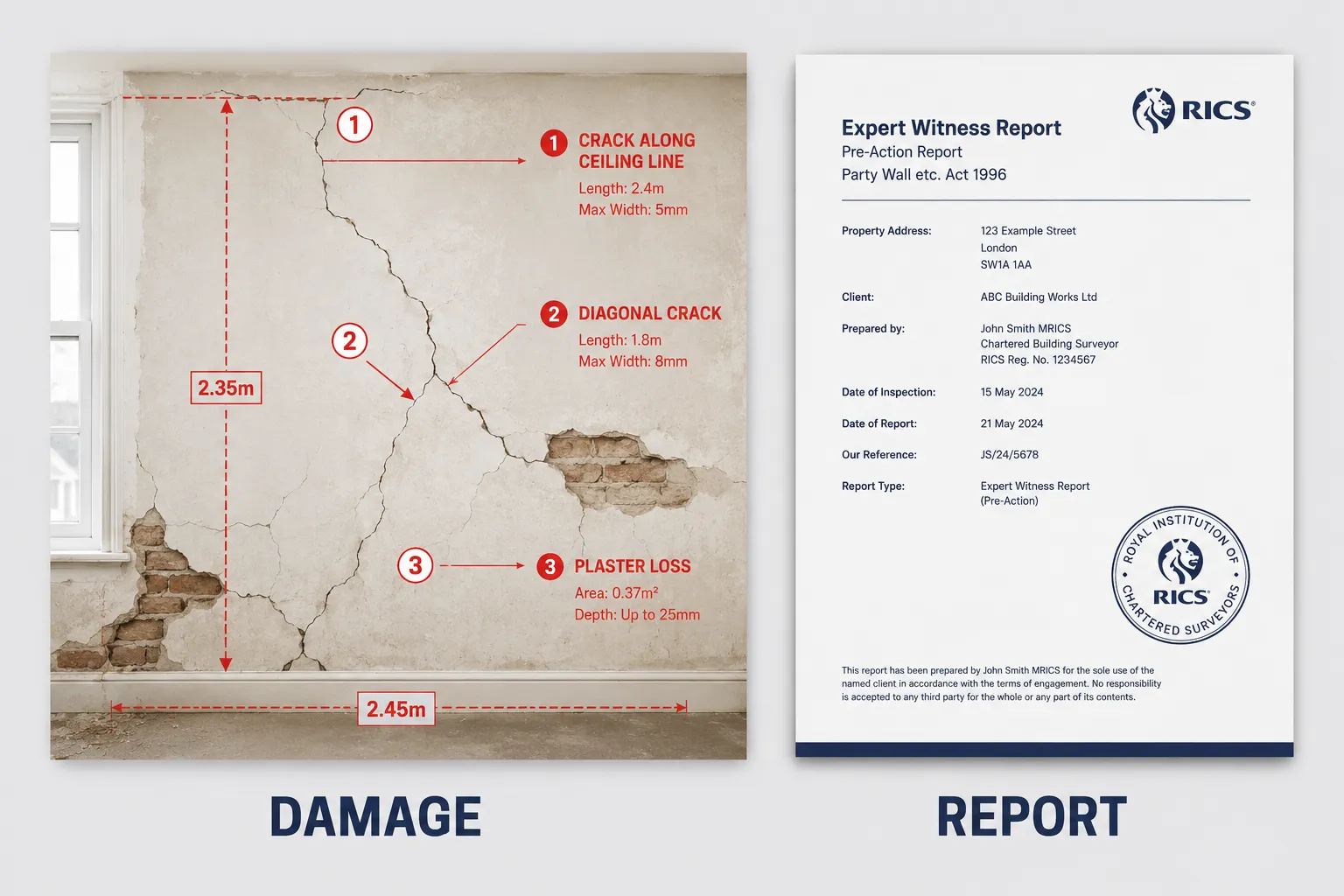
An expert witness report for party wall damage claims is a formal, written opinion prepared by a suitably qualified chartered surveyor that identifies, describes, and financially quantifies damage caused to a neighbouring property by party wall works. It is distinct from a standard survey report because the author owes a primary duty to the court or the party wall tribunal, not to the client who commissioned it.
Under Civil Procedure Rules Part 35 (CPR 35), an expert witness must be independent. The report must state the expert's qualifications, the facts relied upon, the methodology used, and must include a declaration that the expert understands their overriding duty to the court. In party wall disputes that do not reach litigation, the same standards of impartiality are expected by the appointed surveyors and are considered best practice by the Royal Institution of Chartered Surveyors (RICS).
Key contents of a compliant expert witness report:
- Description of the property and its pre-works condition (cross-referenced to a party wall schedule of condition)
- Photographic and written evidence of damage
- Causation analysis linking the damage to the notified works
- Quantification of loss, including labour and materials
- Betterment assessment and any deductions applied
- Statement of reasonable reinstatement methodology
- CPR 35 declaration of independence
What Makes a Party Wall Damage Claim Valid vs Invalid?
A valid claim requires three things: evidence that damage exists, a credible causal link to the party wall works, and a pre-works baseline to compare against. Without all three, a claim is likely to fail or be significantly reduced.
A claim is generally valid when:
- The damage was not present before works commenced (confirmed by a schedule of condition)
- The type of damage is consistent with the works carried out (for example, cracking consistent with vibration from excavation)
- The damage is documented with dated photographs and professional assessment
- The building owner was served a valid party wall notice under the Party Wall etc. Act 1996
A claim is generally invalid or weakened when:
- No schedule of condition was prepared before works began, making causation difficult to prove
- The damage pre-existed the works and is documented in earlier surveys
- The claimed damage is not consistent with the type of works carried out
- The claimant has delayed reporting damage, allowing other causes to become plausible
Understanding your rights under the Party Wall Act is essential before pursuing any damage claim. If a building owner failed to serve proper notice, the consequences of ignoring the Party Wall Act can significantly strengthen a neighbour's claim.
How Do You Calculate Actual Loss in Party Wall Damage Cases?
Actual loss is the cost of returning the damaged property to the condition it was in immediately before the works began, no better and no worse. This is assessed at current market rates for labour and materials, but adjusted to reflect the age and condition of the element being repaired.
The standard calculation process:
- Identify each damaged element (e.g., cracked plasterwork, disturbed floor tiles, damaged brickwork)
- Obtain contractor quotes or use published pricing guides (such as BCIS or Spon's)
- Apply an age and condition adjustment to reflect the pre-existing state of each element
- Deduct betterment where applicable (see below)
- Confirm the methodology is consistent with "reasonable reinstatement"
A common mistake is submitting a single contractor quote without any independent verification. Courts and party wall surveyors expect the expert to cross-check quotes against recognised pricing databases and to confirm the scope of works is no greater than what is strictly necessary to remedy the damage.
What Is the Difference Between Betterment and Repair Costs in Party Wall Claims?
Betterment arises when the repair work would leave the claimant in a materially better position than they were in before the damage occurred. In those cases, the building owner is only liable for the proportion of the cost that restores the property to its former condition, not for the improvement element.
A practical example: If a 30-year-old timber floor was damaged during excavation works and the only practical remedy is to replace it entirely with new timber, the claimant cannot recover the full cost of a brand-new floor. The expert witness would apply a betterment deduction, typically calculated as a percentage reflecting the remaining useful life of the original floor versus its expected total lifespan.
How betterment deductions are calculated:
| Element | Original Age | Expected Lifespan | Remaining Life | Betterment Deduction |
|---|---|---|---|---|
| Timber floor | 30 years | 50 years | 20 years | ~40% |
| Plasterwork | 15 years | 40 years | 25 years | ~38% |
| Roof tiles | 20 years | 60 years | 40 years | ~33% |
Note: These figures are illustrative. Actual deductions depend on condition, material type, and expert assessment.
Betterment is one of the most contested areas in party wall damage claims. Claimants often argue that like-for-like replacement is impossible (for example, matching original Victorian tiles), which can reduce or eliminate the deduction. The expert witness must address this argument directly and with evidence.
What Is Reasonable Reinstatement in Party Wall Damage Disputes?
Reasonable reinstatement means restoring the damaged property to its pre-works condition using the most appropriate and cost-effective method available. It does not mean the most expensive repair, nor does it mean the cheapest possible patch.
The test is objective: what would a reasonable property owner in the same circumstances accept as adequate reinstatement? Courts have consistently held that claimants are not entitled to insist on a particular contractor or method if a cheaper, equally effective alternative exists.
Factors that influence what is "reasonable":
- Whether the property is listed or in a conservation area (where like-for-like materials may be legally required)
- The age and character of the building
- Whether partial repair is visually or structurally adequate
- The availability of matching materials
For properties with unusual or heritage materials, the reasonable reinstatement standard may justify a higher cost. An expert witness report must explain and justify any departure from the cheapest available option.
How Do Surveyors Quantify Loss in Party Wall Claims?
Chartered surveyors quantify loss by combining physical inspection, documentary evidence, and professional cost assessment. The process is methodical and must be defensible under cross-examination.
The quantification methodology in practice:
- Site inspection: The surveyor inspects and records all damage, noting location, extent, and character (e.g., crack width, pattern, depth)
- Schedule of condition review: Damage is compared against the pre-works baseline
- Causation analysis: The surveyor assesses whether each item of damage is consistent with the type and timing of the works
- Cost assessment: Repair costs are calculated using contractor quotes, BCIS data, or Spon's Architects' and Builders' Price Book, adjusted for location and specification
- Betterment assessment: Age-and-condition adjustments are applied to each element
- Report drafting: All findings are set out in a structured, evidence-based report
For complex claims involving structural damage or subsidence, the expert may need to commission specialist structural engineering input. The expert witness reports service provided by chartered surveyors typically covers all of these stages.
What Documentation Do You Need for a Party Wall Damage Expert Report?
The strength of an expert witness report depends directly on the quality of the documentation available. The more contemporaneous and detailed the evidence, the stronger the claim.
Essential documents:
- Schedule of condition prepared before works began (the most important document)
- Dated photographs showing the property before and after works
- Copy of the party wall notice and any party wall award
- Contractor quotes for the proposed repairs
- Any correspondence between the parties about the damage
- Building owner's method statement or structural engineer's report (if available)
Helpful additional documents:
- Previous survey reports showing the pre-existing condition
- Insurance assessments
- Receipts for any emergency or temporary repairs already carried out
If no schedule of condition exists, the expert must work from other available evidence, which significantly weakens the claim. This is why a party wall schedule of condition is strongly recommended before any notifiable works begin.
Who Needs an Expert Witness for Party Wall Damage?
Any property owner who has suffered damage as a result of a neighbour's party wall works and cannot resolve the matter by agreement needs an expert witness report. This applies to homeowners, landlords, and commercial property owners alike.
An expert witness report is specifically needed when:
- The building owner disputes that the damage was caused by their works
- The parties cannot agree on the cost or scope of repairs
- The matter is heading toward court or formal arbitration
- An insurance claim requires independent professional evidence of causation and quantum
For disputes that remain within the party wall surveyor framework, the appointed surveyors may resolve the matter without formal expert witness involvement. However, if the dispute escalates to the County Court or the Technology and Construction Court, CPR 35-compliant expert evidence becomes essential.
If a neighbour refuses to engage with the party wall process altogether, understanding what happens when a neighbour refuses party wall works is an important first step.
How Much Does a Party Wall Expert Witness Report Cost?
Expert witness reports for party wall damage claims typically cost between £800 and £3,500 in 2026, depending on the complexity of the damage, the number of items claimed, and whether the report needs to be CPR 35 compliant for court use.
Indicative cost ranges:
- Simple claim (minor cracking, single room): £800 to £1,200
- Moderate claim (multiple rooms, structural elements): £1,500 to £2,500
- Complex claim (structural damage, heritage property, litigation): £2,500 to £3,500+
These figures are estimates based on typical market rates for RICS-regulated chartered surveyors in London and the South East. Costs outside these areas may be lower. For broader context on surveying fees, the cost of a party wall surveyor guide provides useful benchmarks.
The building owner is generally liable for the reasonable costs of the adjoining owner's surveyor under the Party Wall etc. Act 1996, but expert witness fees for litigation are treated separately and may be subject to court cost orders.
How Long Does It Take to Get an Expert Witness Report for Party Wall Damage?
Most expert witness reports for party wall damage claims are completed within two to six weeks of instruction, depending on the complexity of the case and the availability of documentation.
Typical timeline:
- Week 1: Initial instruction, document review, site inspection booked
- Week 2: Site inspection carried out, damage recorded
- Weeks 3-4: Cost assessment, betterment analysis, report drafting
- Weeks 5-6: Final report issued (or sooner for straightforward cases)
If the matter is urgent (for example, because court directions require expert evidence by a specific date), many chartered surveyors can prioritise the instruction, though this may attract an additional fee.
What If the Property Owner Won't Pay for Party Wall Damage Repairs?
If the building owner refuses to pay for damage caused by their party wall works, the adjoining owner has several options. The Party Wall etc. Act 1996 does not itself provide an enforcement mechanism, so the adjoining owner must pursue the matter through the civil courts or through the party wall award process.
Available routes:
- Party wall award: If surveyors are appointed, they can make an award that includes a requirement to make good damage. Awards are legally binding and can be enforced in the County Court.
- County Court claim: A small claims or fast-track claim can be issued for the quantified loss, supported by the expert witness report.
- Insurance: If the building owner has valid public liability or building insurance, a claim may be made directly against their insurer.
The expert witness report is the key piece of evidence in all of these routes. Without it, quantifying the loss to the satisfaction of a court or insurer is extremely difficult. For a broader overview of how party wall disputes are resolved, see the party wall disputes guide.
How Do Courts Decide Between Repair vs Replacement in Party Wall Cases?
Courts apply a "reasonable reinstatement" test, weighing the cost of repair against the cost of replacement and asking which approach genuinely restores the claimant to their pre-damage position. Replacement is only justified when repair is not technically feasible or would cost more than replacement.
The repair vs replacement decision framework:
- Repair is preferred when it can restore the element to its former condition at a lower cost than replacement
- Replacement is justified when the damaged element cannot be adequately repaired (for example, a cracked structural beam), when matching materials for repair are unavailable, or when the cost difference is marginal
- Betterment applies to replacement but not to repair (since repair by definition does not improve on the original)
Courts have also held that where a claimant unreasonably insists on replacement when repair would suffice, the damages award may be limited to the repair cost. The expert witness must address this issue directly in the report and provide a clear recommendation with supporting reasoning.

Common Mistakes People Make When Filing Party Wall Damage Claims
The most common and costly mistake is failing to commission a schedule of condition before works begin. Without this baseline, proving that damage was caused by the works rather than pre-existing becomes very difficult.
Other frequent mistakes:
- Delaying the claim: Reporting damage weeks or months after works finish allows the building owner to argue alternative causes
- Obtaining only one contractor quote: A single quote without independent verification is easy to challenge
- Overclaiming: Including pre-existing damage or improvements in the claim damages credibility and can result in the entire claim being discounted
- Using a non-independent expert: An expert who is seen as an advocate for the claimant rather than an impartial professional will carry less weight with surveyors and courts
- Ignoring betterment: Failing to address betterment in the report invites the opposing party to raise it at the worst possible moment
For homeowners unfamiliar with the party wall process, reviewing common misconceptions about party wall agreements can help avoid procedural errors that undermine a legitimate claim.
Interactive Tool: Party Wall Damage Claim Checklist
.cg-pw{font-family:Arial,sans-serif;max-width:560px;margin:0 auto;background:#f7f9fc;border:1px solid #d0d7e2;border-radius:8px;padding:20px}
.cg-pw h3{margin:0 0 4px;font-size:1.05rem;color:#1a2e4a}
.cg-pw p.cg-sub{margin:0 0 14px;font-size:.82rem;color:#5a6a7e}
.cg-pw label{display:flex;align-items:flex-start;gap:10px;margin-bottom:9px;font-size:.88rem;color:#2c3e50;cursor:pointer;line-height:1.4}
.cg-pw input[type=checkbox]{margin-top:2px;accent-color:#1a5276;width:16px;height:16px;flex-shrink:0}
.cg-pw button{margin-top:12px;background:#1a5276;color:#fff;border:none;border-radius:5px;padding:9px 20px;font-size:.9rem;cursor:pointer;width:100%}
.cg-pw button:hover{background:#154360}
.cg-pw .cg-result{margin-top:12px;padding:10px 14px;border-radius:5px;font-size:.88rem;display:none}
.cg-pw .cg-ok{background:#eafaf1;border:1px solid #a9dfbf;color:#1e8449}
.cg-pw .cg-warn{background:#fef9e7;border:1px solid #f9e79f;color:#7d6608}
.cg-pw .cg-risk{background:#fdedec;border:1px solid #f5b7b1;color:#922b21}
Party Wall Damage Claim Readiness Checker
Tick every item you have in place before pursuing a claim.
function cgCheck(){
var items=document.querySelectorAll(‘.cg-item’),n=0;
items.forEach(function(i){if(i.checked)n++;});
document.getElementById(‘cg-ok’).style.display=’none’;
document.getElementById(‘cg-warn’).style.display=’none’;
document.getElementById(‘cg-risk’).style.display=’none’;
var id=n>=5?’cg-ok’:n>=3?’cg-warn’:’cg-risk’;
document.getElementById(id).style.display=’block’;
}
Frequently Asked Questions
Can I claim for party wall damage without a schedule of condition?
Yes, but the claim is significantly harder to prove. Without a pre-works baseline, you must rely on other evidence (previous survey reports, photographs, or witness statements) to establish that the damage did not pre-exist the works. A chartered surveyor can advise on the strength of your evidence.
Does betterment always apply to party wall damage claims?
No. Betterment only applies where the repair or replacement would leave the claimant materially better off than before the damage. Simple like-for-like repairs to elements in good condition typically carry no betterment deduction.
Who pays for the expert witness report?
In most cases, the building owner (the party who carried out the works) is liable for reasonable costs under Section 7(2) of the Party Wall etc. Act 1996. However, if the claim is disputed and goes to court, cost recovery depends on the outcome of the proceedings.
Can I use the same surveyor as my neighbour for an expert witness report?
No. An expert witness must be independent. If an agreed surveyor was appointed under the Party Wall Act, they act for both parties in that role. For an expert witness report in contested litigation, each party should instruct their own independent expert.
What is the difference between a party wall surveyor and an expert witness?
A party wall surveyor acts under the statutory framework of the Party Wall etc. Act 1996 and owes duties to both parties. An expert witness is instructed by one party (or the court) and owes their primary duty to the court. The same individual can fulfil both roles at different stages of a dispute, but not simultaneously in the same matter.
How do I find a qualified expert witness for a party wall damage claim?
Look for a chartered surveyor who is a member of the Royal Institution of Chartered Surveyors (RICS) and has specific experience in party wall matters and expert witness work. The RICS Expert Witness Register and the Pyramus and Thisbe Club are useful starting points.
What happens if the two expert witnesses disagree on the quantum of loss?
In litigation, the court may direct a "without prejudice" meeting between experts to narrow the issues. Where disagreement persists, the judge will weigh the evidence and reasoning of each expert and determine the appropriate award. Clear, well-evidenced methodology generally carries more weight than bare assertions.
Conclusion
Expert witness reports in party wall damage claims are not a formality. They are the mechanism by which genuine loss is separated from speculation, betterment is fairly apportioned, and reasonable reinstatement is defined with enough precision to withstand challenge. Getting the process right from the outset, starting with a schedule of condition before works begin, is far less costly than trying to reconstruct a case after the fact.
Actionable next steps for property owners in 2026:
- Before any notifiable works begin next door, commission a party wall schedule of condition to create an undisputed baseline.
- If damage occurs, document it immediately with dated photographs and written notes, and notify the building owner in writing without delay.
- Instruct a RICS-regulated chartered surveyor with party wall and expert witness experience to assess causation and quantify loss.
- Ensure the report addresses betterment and reasonable reinstatement explicitly, as these are the two areas most likely to be contested.
- If the matter cannot be resolved by agreement, seek advice on whether to pursue resolution through the party wall award process or through the courts.
For professional guidance on expert witness reports and party wall matters, the party wall services offered by Prince Chartered Surveyors cover the full range of statutory and expert witness work.
References
- Party Wall etc. Act 1996, UK Parliament
- Civil Procedure Rules Part 35 (Expert Evidence), Ministry of Justice
- RICS Guidance Note: Surveyors Acting as Expert Witnesses, 4th Edition, RICS, 2014
- Spon's Architects' and Builders' Price Book, AECOM, annual publication
- BCIS (Building Cost Information Service), RICS