

Last updated: July 24, 2026
Quick Answer: Expert witness reports for defective works claims are formal, court-compliant documents prepared by qualified building surveyors to provide independent technical opinion on alleged construction defects in legal proceedings. RICS (Royal Institution of Chartered Surveyors) sets the professional standards governing how these reports must be prepared, structured, and presented. A surveyor acting as an expert witness owes their primary duty to the court, not to the instructing party, and failure to meet RICS standards can result in a report being rejected or the surveyor facing disciplinary action.
Key Takeaways
- Expert witness reports for defective works claims must comply with the Civil Procedure Rules (CPR Part 35) and RICS professional guidance.
- The surveyor's overriding duty is to the court or tribunal, not to the client who instructs them.
- RICS publishes specific guidance on expert witness practice, currently in its 4th edition, with a 5th edition consultation ongoing as of mid-2026.
- An expert witness report is fundamentally different from a standard defects report: it carries legal weight and must meet strict procedural requirements.
- RICS-qualified (MRICS or FRICS) surveyors are the recognised standard for building defect expert evidence in UK courts.
- Costs for a RICS expert witness report typically range from £2,000 to £10,000+, depending on complexity and whether court attendance is required.
- Common mistakes include lack of impartiality, failure to state the basis of opinion, and omitting a declaration of truth.
- Both parties in litigation can instruct their own experts, or the court may direct a single joint expert (SJE).

What Is a RICS Expert Witness Report for Defective Works Claims
A RICS expert witness report for defective works claims is a formal written document in which a chartered building surveyor provides independent technical opinion on whether construction or repair works were defective, what caused the defects, and what remediation is required. It is prepared specifically for use in litigation, arbitration, adjudication, or other formal dispute resolution proceedings.
Unlike a standard building defects survey, an expert witness report carries a legal status. The surveyor is not acting as an advocate for their client. Instead, they are providing objective, evidence-based opinion to assist the court or tribunal in reaching a decision.
Key characteristics of a compliant RICS expert witness report:
- Written in the first person, clearly identifying the expert's qualifications and experience
- Includes a signed declaration that the expert understands their duty to the court
- States clearly what facts have been assumed and what has been independently verified
- Distinguishes between fact, inference, and opinion
- Complies with CPR Part 35 (for English and Welsh courts) or equivalent rules in Scotland and Northern Ireland
What Is the Difference Between a Defects Report and an Expert Witness Report
A standard defects report and an expert witness report serve very different purposes, even when they cover the same building problems.
A defects report (sometimes called a building pathology report) is a professional opinion document prepared for a client's own information. It describes defects, suggests causes, and recommends remediation. It has no formal procedural status.
An expert witness report, by contrast, is prepared for a legal forum. It must:
| Feature | Defects Report | Expert Witness Report |
|---|---|---|
| Primary audience | Client | Court or tribunal |
| Duty of care | To client | To the court |
| Procedural rules | None | CPR Part 35 / RICS guidance |
| Declaration of truth | Not required | Mandatory |
| Cross-examination | Not applicable | Surveyor may be called |
| Impartiality test | Advisory | Strictly enforced |
The practical implication: a defects report cannot simply be repackaged as expert evidence. A surveyor must prepare a fresh, compliant document if the matter proceeds to litigation.
What Are the RICS Standards and Guidelines for Expert Witness Testimony
RICS standards for expert witness reports for defective works claims in litigation are set out in the RICS Professional Practice Standard "Surveyors Acting as Expert Witnesses," currently in its 4th edition. A 5th edition is under global consultation as of mid-2026, with updates expected to reflect changes in digital evidence, remote hearings, and international arbitration practice.
The standard applies to all RICS members acting as expert witnesses, regardless of the forum (court, arbitration, adjudication, or mediation). Key requirements include:
- Independence: The expert must not be an advocate. Opinion must be based on evidence, not on what the instructing party wants to hear.
- Competence: The surveyor must only accept instructions within their area of expertise. A general building surveyor should not opine on specialist structural engineering matters without appropriate qualifications.
- Transparency: All material facts and assumptions must be disclosed. If the expert changes their opinion, they must notify all parties promptly.
- Compliance with procedural rules: In England and Wales, CPR Part 35 and the associated Practice Direction govern the form and content of expert reports.
- Single Joint Expert (SJE) obligations: Where the court directs a single joint expert, that surveyor must serve all parties equally and answer questions from both sides.
RICS members who breach these standards face disciplinary proceedings, and reports that do not comply may be struck out by the court.
Can a Building Surveyor Be an Expert Witness in Court
Yes. A building surveyor with appropriate qualifications and relevant experience can act as an expert witness in court proceedings concerning construction defects, workmanship failures, and property condition disputes. RICS membership (MRICS or FRICS) is the recognised professional benchmark in UK courts for building surveying expertise.
The court does not require a specific "expert witness" qualification, but the surveyor must demonstrate:
- Relevant technical expertise in the subject matter of the dispute
- Familiarity with the procedural obligations under CPR Part 35
- The ability to remain impartial under cross-examination
Many experienced building surveyors also complete specialist training through bodies such as the Expert Witness Institute or the Academy of Experts, which strengthens their credibility in court.
Choose a RICS-qualified surveyor if: the dispute involves residential or commercial building defects, workmanship claims, or property condition at a specific date. Consider a structural engineer as a co-expert if the defects involve load-bearing elements or foundation failures.
Do You Need a RICS-Qualified Surveyor, or Can Any Surveyor Write an Expert Report
For building defect claims in UK courts and tribunals, a RICS-qualified surveyor (MRICS or FRICS) is strongly preferred and, in many cases, effectively required. Courts assess the weight of expert evidence partly on the expert's professional standing.
An unqualified or non-RICS surveyor can technically submit a report, but opposing counsel will challenge their credibility, and the court may give the evidence little weight. For expert witness reports in defective works claims, RICS membership provides:
- A recognised code of professional conduct
- Mandatory professional indemnity insurance
- A disciplinary framework that gives courts confidence in the expert's accountability
- Access to up-to-date RICS guidance on expert witness practice
For insurance claims (rather than court proceedings), the threshold may be lower, but a RICS-qualified surveyor still carries significantly more authority with loss adjusters and insurers.
What Should Be Included in an Expert Witness Report for Building Defects
A compliant expert witness report for building defects must contain specific sections to satisfy both RICS standards and CPR Part 35 requirements.
Required sections:
- Title and instructions, who instructed the expert and the specific questions they were asked to address
- Expert's qualifications, relevant experience and professional membership
- Summary of facts, what the expert inspected, when, and under what conditions
- Methodology, how the inspection was conducted, what tests were carried out, what documents were reviewed
- Findings, a clear description of the defects identified, supported by photographs and measurements
- Opinion, the expert's technical opinion on causation, liability (where instructed), and remediation
- Basis of opinion, the standards, codes, and technical references relied upon (e.g., relevant British Standards, NHBC guidance, building regulations)
- Statement of truth, a signed declaration that the expert has complied with their duty to the court
- Appendices, photographs, test results, relevant correspondence, and any documents relied upon
A level 3 building survey often forms the factual foundation for an expert witness report, but the expert report goes further by addressing causation and professional standards of workmanship.
How Do Building Surveyors Prepare Expert Witness Reports for Litigation
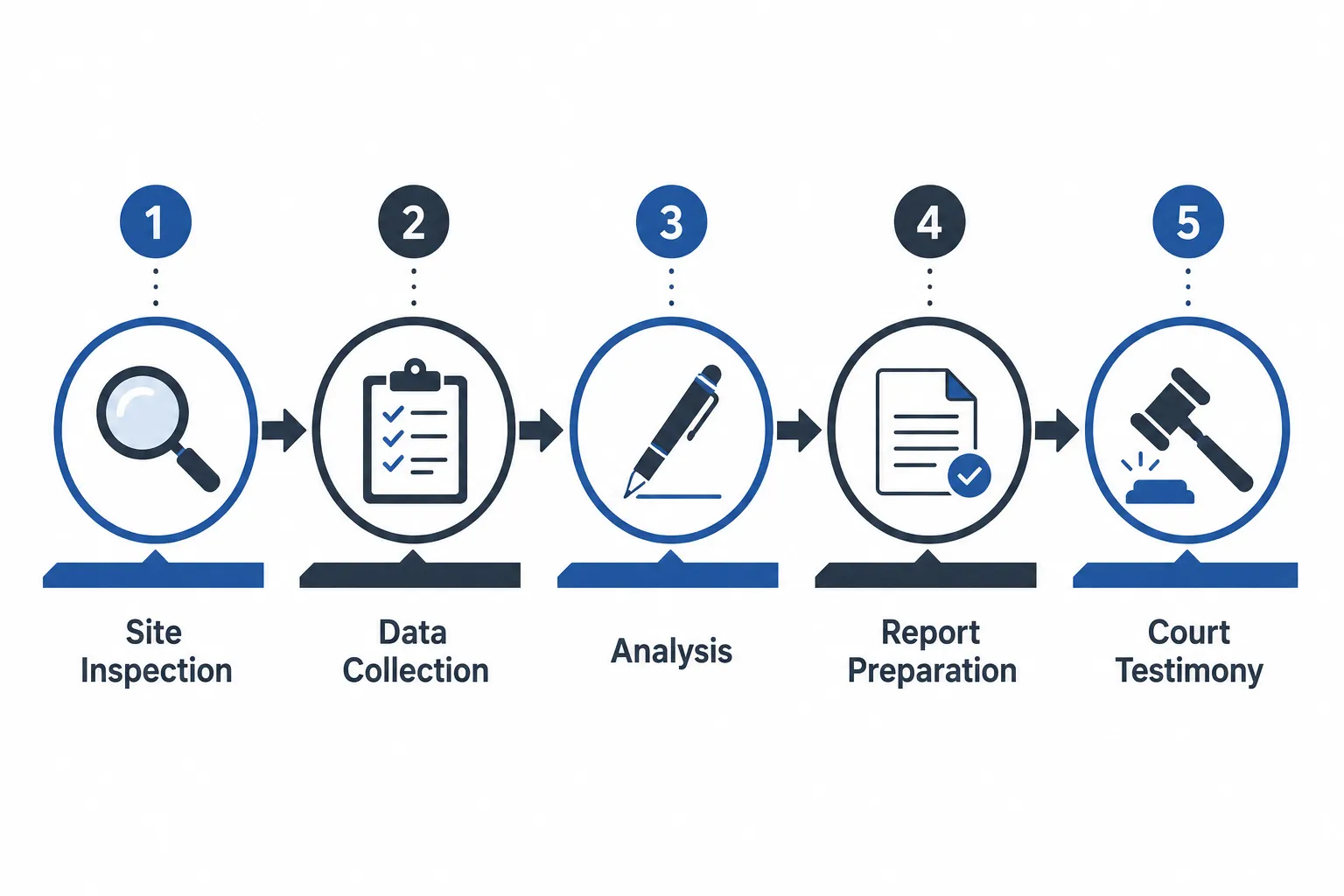
Preparing expert witness reports for defective works claims in litigation follows a structured process. Cutting corners at any stage weakens the report's credibility and exposes the expert to challenge.
Step-by-step process:
- Accept instructions carefully, confirm the matter falls within the surveyor's expertise and that no conflict of interest exists
- Review all available documents, contracts, specifications, planning permissions, previous survey reports, photographs, and correspondence
- Conduct a thorough site inspection, document all defects with photographs, measurements, and condition notes; consider specialist testing where relevant (e.g., moisture readings, building materials assessments)
- Research applicable standards, identify the relevant British Standards, building regulations, and NHBC or warranty requirements in force at the time the works were carried out
- Draft the report, structure it to answer the specific questions posed in the instructions
- Review for compliance, check the report against CPR Part 35 and RICS guidance before finalising
- Sign the declaration of truth, this is a legal requirement and cannot be omitted
- Respond to Part 35 questions, opposing parties may submit written questions; the expert must answer them within the required timeframe
How Long Does It Take to Prepare an Expert Witness Report
The timeframe for preparing an expert witness report for defective works claims depends on the complexity of the case, the extent of the defects, and the availability of site access.
As a general guide:
- Simple residential defect claim (e.g., a single contractor dispute over damp or roofing): 2 to 4 weeks from instruction to final report
- Complex multi-defect residential claim (e.g., post-renovation dispute with multiple trades): 4 to 8 weeks
- Commercial or large-scale construction dispute: 8 to 16 weeks or longer, particularly where joint statements with other experts are required
Delays commonly arise from restricted site access, the need for specialist testing, or late disclosure of documents. Solicitors should instruct the expert as early as possible to avoid court deadline pressure.
How Much Does a RICS Expert Witness Report Cost
RICS expert witness reports for defective works claims are not a fixed-price service. Costs vary significantly based on the scope of work, the expert's seniority, and whether court attendance is required.
Indicative cost ranges (as of 2026, based on typical UK market rates):
- Initial report (residential, straightforward): £2,000 to £4,500
- Complex residential or mixed-use dispute: £4,500 to £8,000
- Commercial construction dispute: £8,000 to £20,000+
- Court attendance (per day): £1,500 to £3,500 depending on the expert's seniority
- Joint statement preparation: £500 to £2,000 additional
These are estimates based on typical market rates. Actual fees should be confirmed in writing before instruction. Most RICS experts charge on an hourly basis rather than a fixed fee, so the final cost depends on the time required.
Note: in many disputes, the losing party may be ordered to pay the winning party's expert witness costs, so the investment can be recoverable.
What Happens If an Expert Witness Report Does Not Follow RICS Standards
Non-compliance with RICS standards and CPR Part 35 in an expert witness report can have serious consequences for both the report and the surveyor.
For the report:
- The court may give the evidence little or no weight
- The judge may strike out the report entirely, leaving the instructing party without technical evidence
- In severe cases, the court may order the party to pay wasted costs
For the surveyor:
- RICS can investigate and sanction members who breach professional standards
- The expert may face claims of professional negligence if their non-compliant report causes the client to lose a case they would otherwise have won
- Reputational damage within the legal community can effectively end an expert witness practice
Common non-compliance issues include:
- Failing to include the mandatory CPR Part 35 declaration
- Expressing opinions outside the expert's area of competence
- Appearing to act as an advocate rather than an independent expert
- Omitting the basis for opinions (e.g., not citing the relevant British Standard or building regulation)
Who Can Challenge a RICS Expert Witness Report in Litigation
Any party to the litigation can challenge an expert witness report. The main routes are:
- Written questions under CPR Part 35.6, the opposing party can submit written questions to the expert, which must be answered within 28 days
- Commissioning a counter-expert, the opposing party instructs their own RICS expert to produce a competing report
- Joint statement process, where both parties have experts, the court typically directs them to meet and produce a joint statement identifying areas of agreement and disagreement
- Cross-examination at trial, the expert can be questioned in court by opposing counsel
A well-prepared expert who has followed RICS standards and CPR Part 35 will be far better positioned to withstand challenge. Experts who have strayed into advocacy or made assumptions without evidential support are most vulnerable.
How Is an Expert Witness Report Different for Insurance Claims vs Court Cases
The purpose and format of an expert witness report differs depending on whether it is prepared for an insurance claim or formal court proceedings.
For court cases: The report must strictly comply with CPR Part 35, include a declaration of truth, and address the specific legal questions posed. The expert may be cross-examined.
For insurance claims: The report is typically less formal. It may be structured as a technical assessment or building condition report rather than a CPR-compliant expert report. However, if the insurance dispute escalates to litigation or arbitration, the report will need to be upgraded to meet court standards.
Key practical differences:
- Insurance reports focus on causation and quantum (repair costs); court reports also address liability and professional standards
- Insurance reports are usually disclosed only to the insurer; court reports are disclosed to all parties
- The expert's duty in an insurance context is primarily to the instructing party; in court, it shifts to the tribunal
If there is any prospect of a dispute escalating to court, it is worth instructing a surveyor to prepare the report to court standards from the outset. Retro-fitting compliance is time-consuming and costly.
What Are Common Mistakes in Expert Witness Reports for Construction Claims
Even experienced surveyors make avoidable errors that undermine the value of their expert witness reports for defective works claims.
Most common mistakes:
- Advocacy creep, writing to support the client's position rather than giving balanced opinion
- Missing the declaration, omitting or incorrectly wording the CPR Part 35 statement of truth
- Scope creep, opining on matters outside the expert's competence (e.g., a building surveyor commenting on structural calculations without engineering qualifications)
- Insufficient photographic evidence, failing to document defects thoroughly at the time of inspection
- No reference to applicable standards, stating that work was defective without citing the standard it failed to meet
- Failure to consider alternative explanations, a robust report addresses and dismisses alternative causes, not just the one that supports the instructing party
- Late instructions, accepting instructions too close to court deadlines, leaving insufficient time for a thorough inspection and report
Frequently Asked Questions
What qualifications does a building surveyor need to act as an expert witness?
A RICS-qualified surveyor (MRICS or FRICS) with relevant experience in the type of defects in dispute is the recognised standard for UK courts. Additional training through the Expert Witness Institute or Academy of Experts is beneficial but not mandatory.
Can the same surveyor who carried out the original building survey act as expert witness?
Generally, no. A surveyor who previously advised the client may be seen as lacking the independence required of an expert witness. A fresh, independent expert should be instructed for litigation.
What is a single joint expert (SJE) in a building defects case?
An SJE is a single expert appointed by agreement of both parties (or directed by the court) to provide independent opinion. The SJE serves all parties equally and cannot be instructed by one side alone. This is common in lower-value disputes to control costs.
How does the court treat conflicting expert reports?
Where two experts disagree, the court will assess the quality of each expert's reasoning, their adherence to professional standards, and their performance under cross-examination. The judge is not bound to prefer either expert and may accept parts of both reports.
Is an expert witness report confidential?
Once disclosed in litigation, an expert witness report is not confidential between the parties. It forms part of the court record. Draft reports prepared before disclosure may retain some privilege, but this is a complex legal area and solicitors should advise on it.
Can a RICS expert witness report be used in adjudication as well as court?
Yes. RICS expert witness guidance applies across courts, arbitration, and adjudication. The procedural rules differ slightly between forums, but the core obligations of independence, competence, and transparency remain the same.
What is a joint statement of experts?
A joint statement (sometimes called a Scott Schedule in construction disputes) is a document produced after the two opposing experts have met to identify areas of agreement and disagreement. It helps the court focus on the genuine points of dispute and often reduces trial time significantly.
Conclusion
Expert witness reports for defective works claims sit at the intersection of building surveying expertise and legal procedure. Getting them right requires more than technical knowledge of construction defects: it demands strict compliance with RICS professional standards, CPR Part 35, and an unwavering commitment to independence.
For property owners, landlords, and developers facing a construction dispute, the quality of the expert evidence often determines the outcome. A poorly prepared report can be struck out, leaving a party without the technical support their case depends on.
Actionable next steps:
- Instruct a RICS-qualified building surveyor (MRICS or FRICS) with demonstrable experience in expert witness work, not just general surveying.
- Engage the expert as early as possible, before proceedings are issued if possible, so there is time for a thorough inspection and report.
- Ensure the brief to the expert is specific: set out the exact questions you need answered, not a general request to "comment on the defects."
- Ask the expert to confirm they have no conflict of interest and carry adequate professional indemnity insurance.
- If the dispute may settle before trial, consider whether a jointly instructed expert could save costs while still producing authoritative evidence.
For professional guidance on expert witness reports for building defects or to discuss a specific defective works claim, speak with a RICS-qualified chartered surveyor experienced in litigation support.
.ew-wrap{font-family:Arial,sans-serif;max-width:560px;margin:24px auto;border:2px solid #1a3a5c;border-radius:8px;overflow:hidden}
.ew-head{background:#1a3a5c;color:#fff;padding:14px 18px;font-size:1.05rem;font-weight:700}
.ew-body{padding:16px 18px;background:#f7f9fc}
.ew-item{display:flex;align-items:flex-start;margin-bottom:10px;font-size:.92rem;color:#222}
.ew-item input{margin:3px 10px 0 0;accent-color:#1a3a5c;width:16px;height:16px;flex-shrink:0}
.ew-btn{display:block;width:100%;padding:10px;background:#1a3a5c;color:#fff;border:none;border-radius:5px;font-size:1rem;cursor:pointer;margin-top:8px}
.ew-btn:hover{background:#2a5a8c}
.ew-result{margin-top:12px;padding:10px 14px;border-radius:5px;font-size:.93rem;display:none}
.ew-pass{background:#e6f4ea;border:1px solid #34a853;color:#1a6630}
.ew-warn{background:#fff8e1;border:1px solid #f9a825;color:#7a5c00}
.ew-fail{background:#fce8e6;border:1px solid #ea4335;color:#8b1a1a}
Tick each item your report currently includes:
function ewCheck(){
var boxes=document.querySelectorAll(‘.ew-chk’),checked=0;
boxes.forEach(function(b){if(b.checked)checked++;});
document.getElementById(‘ew-pass’).style.display=’none’;
document.getElementById(‘ew-warn’).style.display=’none’;
document.getElementById(‘ew-fail’).style.display=’none’;
if(checked>=6){document.getElementById(‘ew-pass’).style.display=’block’;}
else if(checked>=3){document.getElementById(‘ew-warn’).style.display=’block’;}
else{document.getElementById(‘ew-fail’).style.display=’block’;}
}
Tags: expert witness reports, defective works claims, RICS standards, building surveyor litigation, CPR Part 35, construction defects, chartered surveyor expert witness, building defects survey, RICS expert witness, property litigation, building pathology, defective works