

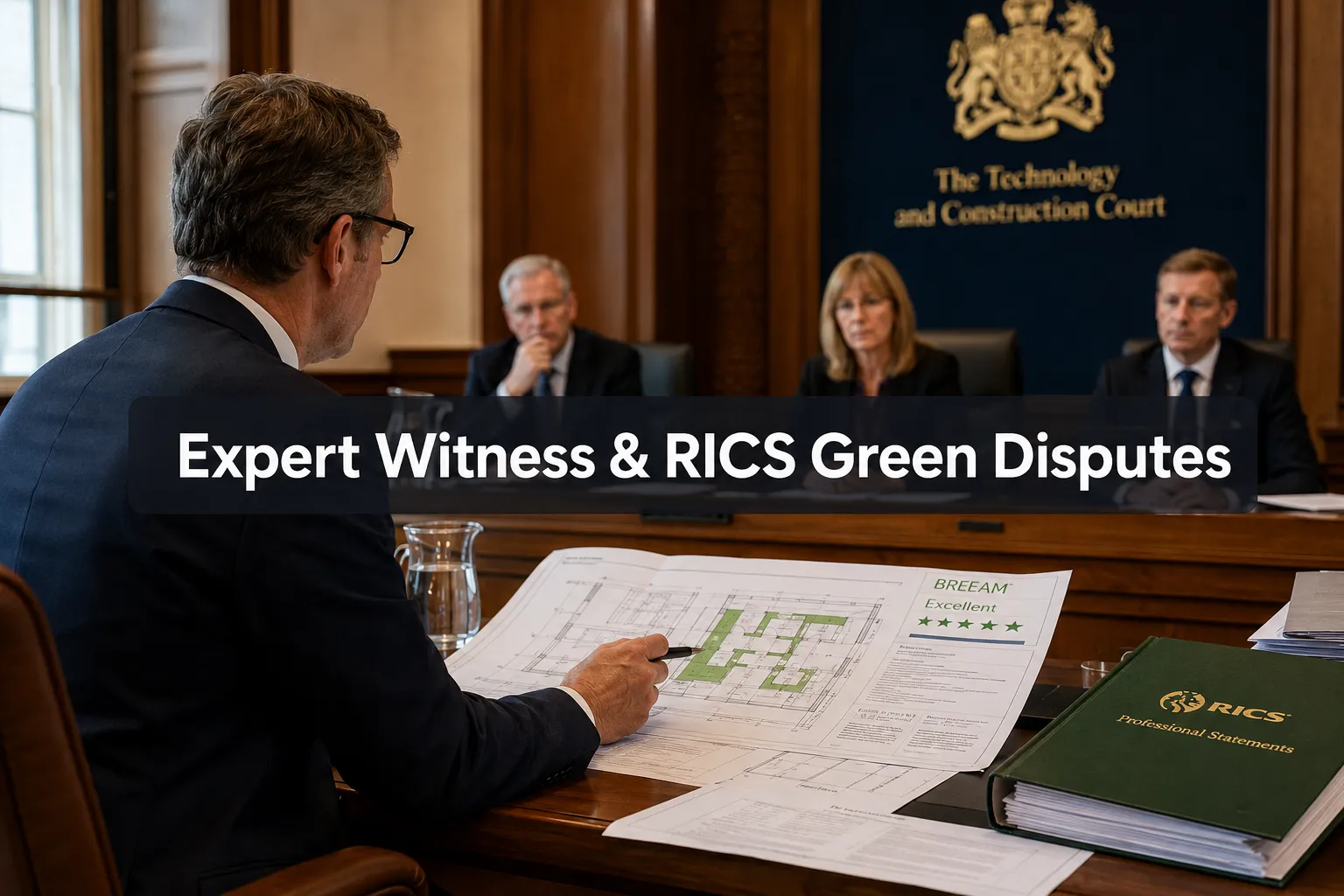
Last updated: July 24, 2026
Quick Answer: Expert witness preparation for RICS Sustainability Report 2025 disputes requires a thorough understanding of the updated ESG valuation standards that became mandatory for commercial property from April 30, 2026. Expert witnesses must meet strict evidence standards, document sustainability data meticulously, and demonstrate that their methodology aligns with the fourth edition of the RICS global professional standard on ESG and sustainability. Failing to meet these benchmarks can undermine credibility and expose clients to significant financial risk.
Key Takeaways
- RICS mandated systematic ESG integration in all commercial property valuations from April 30, 2026, making sustainability evidence central to any valuation dispute.
- The RICS Sustainability Report 2025 recorded a drop in the Sustainable Building Index from +41 to +30, signalling market caution that expert witnesses must account for.
- 46% of construction professionals do not track carbon emissions across projects, creating a significant evidence gap that frequently triggers disputes.
- Expert witnesses must produce self-contained, verifiable reports that cite specific data sources, measurement methodologies, and any uncertainty discounts applied.
- Courts assess expert credibility on independence, methodology transparency, and whether the witness's approach aligns with current RICS professional standards.
- Blanket ESG assessments are no longer acceptable under the 2026 mandatory standard; each factor must be individually substantiated with market evidence.
- Whole-life carbon data, EPC ratings, and ESG performance benchmarks are the three most commonly disputed categories in green valuation cases.
- Property owners, lenders, and developers all have standing to commission expert witness reports in RICS sustainability disputes.
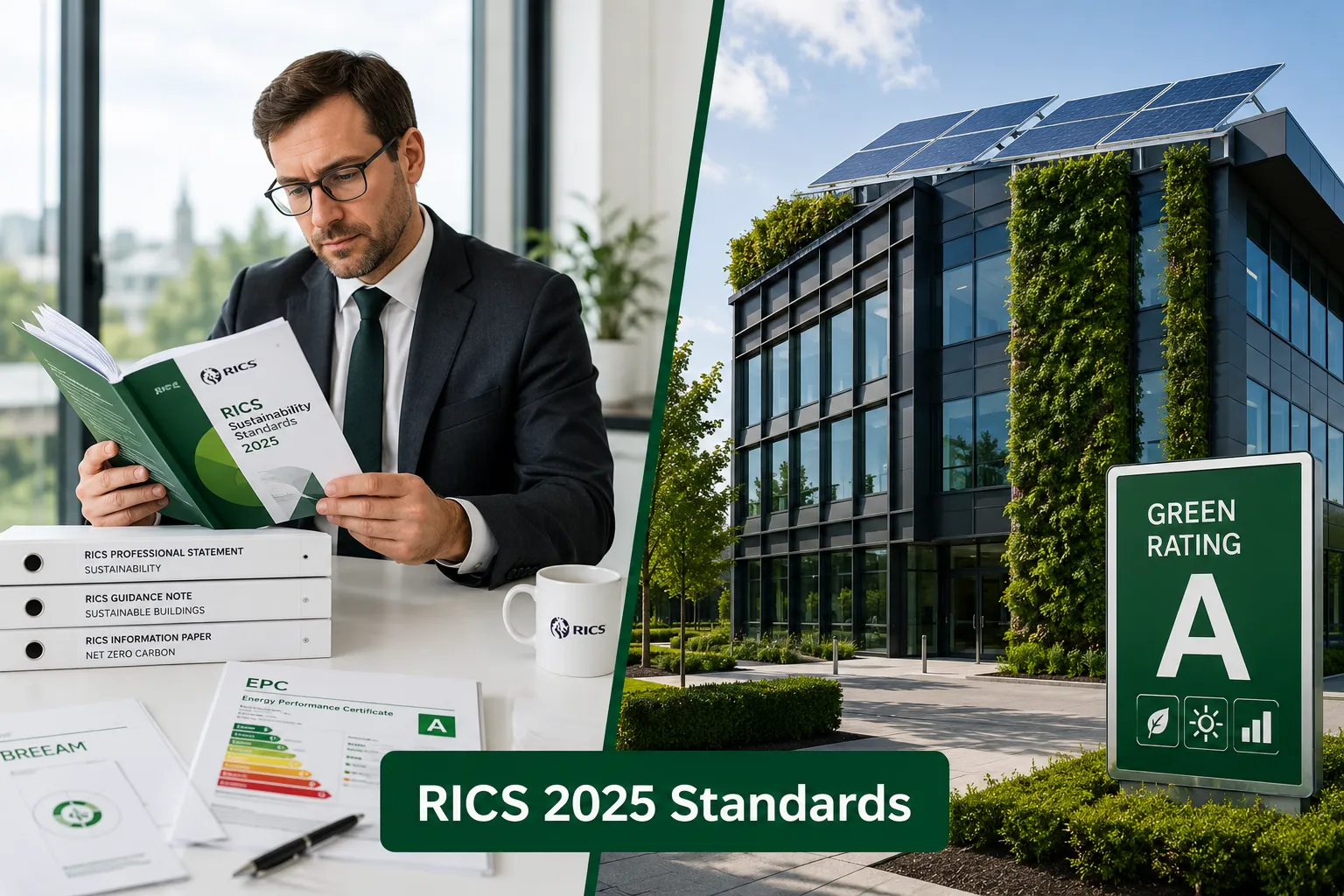
What Is the RICS Sustainability Report 2025 and How Does It Affect Property Valuations
The RICS Sustainability Report 2025 is an annual global survey that tracks demand, professional practice, and data quality across the sustainable built environment sector. Its findings directly shape how RICS-accredited valuers are expected to treat sustainability factors in their assessments.
Two findings from the 2025 report are particularly significant for valuation disputes. First, the Sustainable Building Index fell from +41 in 2024 to +30 in 2025, reflecting slower demand growth globally and a sharper decline in the Americas (where the index dropped to +11). Second, 46% of construction professionals reported not tracking carbon emissions across projects, up from 34% the year before. Both findings feed directly into the "valuation deadlock" problem: valuers struggle to reflect sustainability factors accurately when market evidence and carbon data are thin.
For UK property professionals, the practical effect is that any valuation produced from April 30, 2026 onwards must systematically incorporate ESG factors in line with the fourth edition of the RICS global professional standard. Valuations that ignore or inadequately address sustainability features are now non-compliant by default, which is precisely the ground on which most disputes arise.
For context on what a compliant property valuation looks like in practice, see the chartered surveyors valuation services overview.
What Evidence Standards Do Expert Witnesses Need to Meet in Green Valuation Disputes
Expert witnesses in green valuation disputes must satisfy two overlapping frameworks: the Civil Procedure Rules (CPR) Part 35 duty to the court, and the RICS professional standards that govern the underlying valuation methodology.
Under CPR Part 35, an expert's overriding duty is to the court, not to the instructing party. This means the expert must present evidence that is:
- Objective and impartial, conclusions must follow the evidence, not the client's preferred outcome.
- Methodology-transparent, every step in the valuation process must be documented and reproducible.
- Scope-limited, the expert should only opine on matters within their demonstrable expertise.
Under the RICS 2026 mandatory standard, the additional requirements for green valuation evidence include:
- Individual substantiation of each ESG factor affecting value (blanket assessments are explicitly insufficient).
- Disclosure of data quality limitations, including measurement-uncertainty discounts where carbon or energy data is incomplete.
- Reference to comparable market transactions that demonstrate how sustainability features have been priced.
- Consideration of whole-life carbon data covering embodied, operational, and end-of-life carbon where that data exists.
Common mistake: Expert witnesses sometimes cite ESG credentials (BREEAM ratings, EPC bands) without connecting them to actual market value evidence. A BREEAM "Excellent" rating does not automatically translate to a premium unless comparable sales data supports that premium in the specific sub-market.
How to Prepare Expert Witness Testimony for RICS Sustainability Challenges
Effective expert witness preparation for RICS Sustainability Report 2025 disputes follows a structured process that begins well before any hearing date.
Step 1: Establish the scope of instruction clearly. The expert must confirm whether they are instructed as a single joint expert or as a party-appointed expert, as this affects the degree of advocacy permissible.
Step 2: Audit the available sustainability data. Gather all EPC certificates, BREEAM or NABERS assessments, energy bills, carbon tracking records, and any whole-life carbon assessments. Flag gaps immediately, because data absences are often the core of the dispute.
Step 3: Identify comparable market evidence. Source transactional data for properties with similar sustainability profiles in the same or comparable markets. The RICS Sustainability Report 2025 notes that market evidence remains thin in many sectors, so the expert must be explicit about the weight given to each comparable.
Step 4: Apply and document the valuation methodology. Whether using the investment method, the comparison method, or a discounted cash flow approach, every adjustment for sustainability features must be individually justified with reference to market data or published benchmarks.
Step 5: Prepare a compliant expert report. The report must include a statement of truth, a declaration of independence, a clear summary of instructions, the methodology used, the evidence relied upon, and the expert's conclusions. Any areas of uncertainty must be explicitly flagged.
Step 6: Prepare for cross-examination. The most effective preparation involves a mock cross-examination focused on the weakest links in the evidence chain, particularly any comparables that are not directly equivalent or any carbon data that relies on estimates rather than measured figures.
For expert witness report services from RICS-accredited chartered surveyors, see the expert witness reports service page.
What Are Common Mistakes Expert Witnesses Make in Green Valuation Cases
The most damaging mistakes in green valuation expert witness work share a common thread: they undermine the appearance of independence or expose methodological weaknesses under cross-examination.
- Over-reliance on certification labels. Treating a green certification as a proxy for market value without supporting transactional evidence.
- Ignoring data quality limitations. Failing to apply or disclose measurement-uncertainty discounts when carbon data is estimated rather than metered.
- Inconsistent comparable selection. Cherry-picking comparables that support the client's position rather than applying a consistent selection methodology.
- Scope creep. Opining on planning, legal, or structural matters outside the expert's valuation expertise.
- Outdated standards references. Citing the 2024 RICS guidance rather than the 2026 mandatory standard, which can be used to challenge the report's currency.
- Vague sustainability adjustments. Making a percentage adjustment to value for "green features" without itemising which features, what evidence supports each adjustment, and how each was quantified.
How Is ESG Performance Valued Differently Under RICS 2025 Guidelines
Under the RICS 2026 mandatory standard (informed by the 2025 report), ESG performance is no longer treated as a qualitative add-on to a valuation. Each ESG dimension, environmental, social, and governance, must be assessed separately and connected to measurable value effects where market evidence allows.
Environmental factors include energy performance, carbon emissions, flood risk, and biodiversity net gain. The updated standard explicitly references the EU taxonomy, the Energy Performance of Buildings Directive (EPBD), and national climate targets as relevant frameworks for UK and European properties.
Social factors include occupant wellbeing, accessibility, and proximity to public transport or community infrastructure. These are harder to quantify but must still be addressed where they are material to value.
Governance factors include the quality of building management, compliance with sustainability reporting obligations, and transparency of ESG data.
The key shift from earlier practice is that valuers must now substantiate and document each ESG-related value effect individually. A property with strong environmental credentials but weak governance (for example, poor carbon data management) cannot simply receive a composite "green premium." Each component is assessed on its own merits.
For properties with community or sustainability-focused uses, the community housing projects and sustainability services page provides relevant context.
What Documentation Do You Need to Support Green Building Valuation Claims
The documentation required to support a green building valuation claim in a dispute context is more extensive than for a standard valuation. The following checklist covers the core requirements:
| Document Category | Specific Items Required |
|---|---|
| Energy Performance | EPC certificate (current), BREEAM/NABERS/LEED assessment report |
| Carbon Data | Whole-life carbon assessment, metered energy consumption records |
| Market Evidence | Comparable transaction records with sustainability attributes noted |
| Building Systems | M&E specifications, renewable energy installation certificates |
| Compliance Records | Planning conditions relating to sustainability, building regulations sign-off |
| Valuation Methodology | Written methodology statement, adjustment justifications |
Edge case: Where carbon data is absent (as is the case for 46% of projects per the RICS 2025 report), the expert must explicitly state the assumptions used to estimate carbon performance and apply a measurement-uncertainty discount to the value conclusion. Failing to do so is one of the most frequently criticised omissions in green valuation disputes.
For guidance on what a compliant survey report looks like, the condition survey report guide provides useful background.
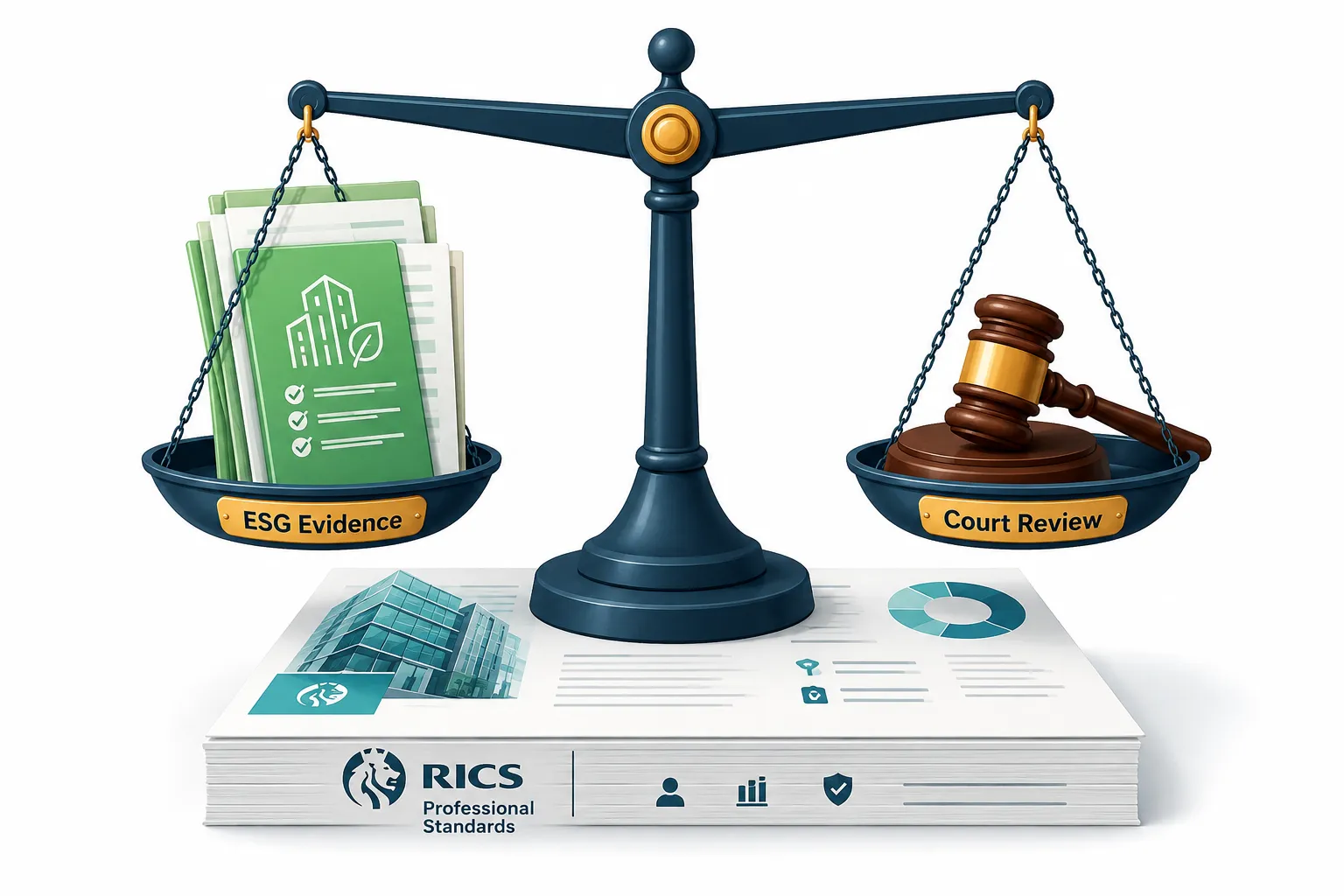
How Do Courts Evaluate Expert Witness Credibility in Sustainability Disputes
Courts assess expert witness credibility in sustainability disputes using the same criteria applied in any expert evidence case, but with additional scrutiny on whether the expert has kept pace with rapidly evolving RICS standards.
The key credibility factors are:
- Qualifications and current practice. The expert must demonstrate active, current experience in sustainability valuation, not just general valuation expertise.
- Independence. Any prior relationship with the instructing party or a commercial interest in the outcome must be disclosed.
- Methodology consistency. Courts look for experts who apply the same methodology regardless of which party they are instructed by.
- Responsiveness to counter-evidence. An expert who refuses to acknowledge legitimate weaknesses in their evidence loses credibility quickly. Acknowledging uncertainty, where it genuinely exists, actually strengthens an expert's standing.
- Alignment with current standards. Referencing the 2026 mandatory RICS standard and the RICS Sustainability Report 2025 findings demonstrates that the expert's approach is current and professionally grounded.
Decision rule: If an expert's report was prepared before April 30, 2026 but is being used in a 2026 dispute, it should be reviewed and updated to confirm alignment with the mandatory ESG standard. Courts have discretion to discount reports that pre-date material changes in professional standards.
What Is the Difference Between RICS 2024 and 2025 Sustainability Standards for Valuers
The shift from the 2024 to the 2025/2026 RICS sustainability framework represents a move from guidance to mandatory obligation.
Under the pre-2026 framework, incorporating ESG factors was encouraged but not required. Valuers could note sustainability features without quantifying their value impact, and data gaps were treated as an acceptable limitation rather than a compliance issue.
Under the 2026 mandatory standard:
- ESG integration is compulsory for all commercial property valuations by RICS-accredited valuers globally.
- Each ESG factor must be individually assessed and documented.
- Whole-life carbon data must be included where available, with explicit uncertainty discounts where it is not.
- Jurisdiction-specific sections (including UK, EU, and Australia) provide local regulatory context that must be reflected in the valuation.
For expert witnesses, this distinction is critical. A report prepared under 2024 guidance that omits individual ESG substantiation may have been acceptable then but is non-compliant now. In a 2026 dispute, the opposing expert will almost certainly highlight this gap.
Can Expert Witnesses Challenge RICS Sustainability Report Findings in Court
Yes, expert witnesses can challenge RICS Sustainability Report findings in court, but the bar for doing so credibly is high. The RICS Sustainability Report 2025 is a survey-based document reflecting professional sentiment and market trends, not a prescriptive standard. It informs practice but does not itself set mandatory requirements.
An expert witness can legitimately argue that:
- The local market evidence in the subject property's sub-market diverges from the national or global trends reported by RICS.
- The specific sustainability features of the subject property are not adequately captured by the broad index metrics used in the RICS report.
- The data quality limitations acknowledged in the RICS report (such as the 46% carbon tracking gap) apply to the comparables used by the opposing expert, undermining their value conclusions.
What an expert cannot credibly do is dismiss the RICS mandatory standard itself. The fourth edition professional standard is not a survey; it is a binding professional obligation for RICS-accredited valuers. Challenging its application requires demonstrating that the specific circumstances of the case fall outside its scope, not that the standard is wrong.
What Training Do Expert Witnesses Need for RICS Green Valuation Disputes
Expert witnesses in RICS green valuation disputes need a combination of formal valuation qualifications, sustainability-specific training, and litigation support experience.
Minimum qualifications:
- MRICS or FRICS status with an active practising certificate.
- Demonstrable experience in commercial or residential property valuation involving sustainability features.
Recommended additional training:
- RICS-accredited CPD on ESG integration in valuations, updated to reflect the 2026 mandatory standard.
- Familiarity with whole-life carbon assessment methodology (e.g., RICS Whole Life Carbon Assessment professional statement).
- Understanding of EPC methodology, BREEAM assessment criteria, and relevant EU taxonomy classifications.
- Expert witness training covering CPR Part 35 obligations, report writing standards, and cross-examination preparation.
The RICS Sustainability Report 2025 explicitly identifies professional skills development as a priority need across the built environment sector. For expert witnesses, this is not aspirational, it is a credibility requirement.
How Do You Calculate the Financial Impact of Sustainability Features on Property Value
Calculating the financial impact of sustainability features on property value requires a structured approach that connects physical attributes to market evidence.
The three main methods used in expert witness reports:
-
Comparable sales analysis, Identify transactions involving properties with and without the sustainability feature in question, control for other variables, and derive an implied premium or discount. This is the most defensible method but requires sufficient comparable data.
-
Income capitalisation adjustment, For investment properties, model the impact of sustainability features on rent, void rates, and exit yield. Green-certified buildings in many UK markets command rent premiums and lower yields, but these must be evidenced from actual lease transactions.
-
Cost-to-remedy approach, Where a sustainability deficiency (such as a poor EPC rating) would require capital expenditure to remedy, the cost of that expenditure can be used as a proxy for the value impact. This method is most useful where market evidence is thin.
Important constraint: The RICS 2026 mandatory standard requires that measurement-uncertainty discounts be applied where data quality is questionable. If the carbon or energy data underpinning the calculation is estimated rather than metered, the expert must reduce the confidence interval of the value conclusion accordingly and state this explicitly in the report.
For guidance on how property valuations are approached more broadly, the independent property valuation guide provides useful context.
What Are the Most Disputed Aspects of RICS 2025 Sustainability Valuations
The most frequently contested areas in green valuation disputes cluster around three themes: data availability, methodology choice, and the size of sustainability adjustments.
Data availability disputes arise because 46% of construction professionals do not track carbon emissions, leaving expert witnesses on both sides working with incomplete information. The dispute then becomes about whose assumptions are more defensible.
Methodology disputes arise when one expert uses comparable sales analysis and another uses a cost-to-remedy approach, producing materially different value conclusions from the same property. Courts expect experts to justify their methodology choice, not simply assert it.
Adjustment size disputes are the most common. A green premium of 5% versus 15% for the same EPC rating can represent hundreds of thousands of pounds on a commercial property. Without granular comparable evidence, both figures can appear plausible, which is why the RICS standard now requires individual substantiation rather than composite adjustments.
For context on how disputes in related property matters are handled, the party wall disputes guide illustrates the general framework for evidence-based property disagreements.
Who Needs Expert Witnesses for RICS Sustainability Disputes
Expert witnesses in RICS sustainability disputes are needed by a broader range of parties than many property professionals realise.
- Property owners and landlords disputing a downward valuation that they believe undervalues sustainability improvements they have made.
- Lenders and mortgagees challenging a valuation that they believe overstates a green premium, particularly where the loan-to-value ratio is sensitive to the sustainability adjustment.
- Developers in planning or development viability disputes where sustainability obligations affect the residual land value calculation.
- Tenants in rent review or lease renewal proceedings where the energy performance of the building is a material factor in the market rent assessment.
- Insurers in reinstatement cost disputes where green building specifications affect rebuild costs.
For developers specifically, the property development valuation services page covers how sustainability factors are addressed in development appraisals.
What Happens If Expert Witness Testimony Contradicts RICS Sustainability Standards
If an expert witness's testimony contradicts the RICS 2026 mandatory standard, the consequences are serious and potentially career-limiting.
In court, the opposing party will use the contradiction to challenge the expert's credibility and the reliability of their methodology. Judges and arbitrators are increasingly familiar with RICS standards and will scrutinise departures from them carefully.
With RICS, a member who produces a valuation report that is non-compliant with a mandatory standard may face a regulatory complaint. The RICS Regulatory Board has the power to impose sanctions including fines, suspension, and removal of RICS membership.
For the client, a report that contradicts mandatory standards may be inadmissible or given minimal weight, potentially undermining an otherwise strong case.
The only defensible basis for departing from RICS standards in an expert witness report is to explain clearly why the standard does not apply to the specific circumstances, for example, if the property in question falls outside the scope of the commercial valuation standard. That explanation must be explicit, reasoned, and documented in the report itself.
.cg-checker{font-family:Arial,sans-serif;max-width:560px;margin:2em auto;border:2px solid #1a5c3a;border-radius:8px;padding:1.2em;background:#f9fdf9}
.cg-checker h3{margin:0 0 .8em;color:#1a5c3a;font-size:1.05em}
.cg-checker label{display:flex;align-items:center;gap:.6em;padding:.35em 0;font-size:.93em;cursor:pointer;border-bottom:1px solid #dde}
.cg-checker label:last-of-type{border-bottom:none}
.cg-checker input[type=checkbox]{width:16px;height:16px;accent-color:#1a5c3a;flex-shrink:0}
.cg-checker .cg-progress{margin-top:.9em;background:#dde;border-radius:4px;height:10px;overflow:hidden}
.cg-checker .cg-bar{height:10px;background:#1a5c3a;width:0%;transition:width .3s}
.cg-checker .cg-score{margin-top:.5em;font-size:.88em;color:#444;text-align:right}
RICS Green Valuation Evidence Checklist
var items=document.querySelectorAll(‘.cg-item’);
function update(){var c=0;items.forEach(function(i){if(i.checked)c++;});document.getElementById(‘cgBar’).style.width=(c/items.length*100)+’%’;document.getElementById(‘cgScore’).textContent=c+’ of ‘+items.length+’ items complete’;}
items.forEach(function(i){i.addEventListener(‘change’,update);});
Frequently Asked Questions
What is the RICS Sustainability Report 2025 in simple terms?
It is an annual global survey published by RICS that measures demand for sustainable buildings, professional practice standards, and data quality across the construction and property sectors. Its findings inform how RICS-accredited valuers are expected to treat sustainability in their assessments.
When did RICS make ESG integration in valuations mandatory?
RICS made ESG integration mandatory for all commercial property valuations by RICS-accredited valuers from April 30, 2026, through the fourth edition of its global professional standard on ESG and sustainability.
Can a property owner commission their own expert witness report?
Yes. Property owners, landlords, lenders, developers, and tenants can all instruct an expert witness. If both parties instruct separate experts, the court may direct a joint statement identifying areas of agreement and disagreement before the hearing.
What is a measurement-uncertainty discount in a green valuation?
It is a reduction applied to a value conclusion to reflect the reduced reliability of a valuation when the underlying carbon or energy data is estimated rather than directly measured. The RICS 2026 standard requires this to be applied and documented explicitly.
How long does it take to prepare an expert witness report for a green valuation dispute?
Preparation time varies depending on data availability, but a thorough expert witness report for a sustainability valuation dispute typically takes four to eight weeks from instruction to final report, assuming all documentation is provided promptly.
What is the "valuation deadlock" in ESG property valuation?
The valuation deadlock refers to the situation where valuers cannot adequately reflect sustainability factors in property prices because market evidence is insufficient, yet market evidence cannot develop until valuations start reflecting those factors. It is a recognised challenge within the profession and is one reason disputes in this area are increasing.
Does the RICS sustainability standard apply to residential properties?
The April 2026 mandatory standard applies specifically to commercial property valuations. However, RICS guidance on sustainability increasingly influences residential valuation practice, and EPC ratings are already a material factor in residential mortgage valuations under UK lender requirements.
What happens if an expert witness report pre-dates the 2026 mandatory standard?
A report prepared before April 30, 2026 should be reviewed and updated before use in a current dispute to confirm alignment with the mandatory standard. Courts may discount reports that do not reflect the current professional requirements.
Conclusion
Expert witness preparation for RICS Sustainability Report 2025 disputes requires a level of technical precision and procedural discipline that goes well beyond standard valuation practice. The shift to mandatory ESG integration from April 2026, combined with the data quality challenges highlighted in the RICS Sustainability Report 2025, has created fertile ground for disputes, and raised the bar for what courts and tribunals expect from expert evidence.
Actionable next steps for property professionals and owners:
- Audit your sustainability documentation now. Gaps in carbon tracking or EPC records are the most common trigger for disputes and the hardest to remedy retrospectively.
- Instruct a qualified, RICS-accredited expert witness early. The sooner an expert reviews the evidence, the more time there is to address weaknesses before a hearing.
- Ensure any valuation report references the 2026 mandatory standard. Reports citing only pre-2026 guidance are vulnerable to credibility challenges.
- Request individual ESG substantiation. Do not accept a valuation that applies a composite "green adjustment" without itemised justification for each sustainability factor.
- Prepare for cross-examination on data quality. If your carbon or energy data is estimated rather than metered, ensure your expert has applied and documented appropriate uncertainty discounts.
For specialist chartered surveyor support with green valuation disputes and expert witness reports, the expert witness reports service and commercial valuations service provide the professional expertise required to meet these demanding evidence standards.
Tags: expert witness preparation, RICS sustainability report 2025, green valuation disputes, ESG property valuation, RICS 2026 standards, expert witness evidence, sustainable building valuation, green building disputes, chartered surveyor expert witness, ESG valuation challenges, property dispute evidence, RICS ESG mandatory standard