

Last updated: July 24, 2026
Quick Answer: Expert witness preparation for RAAC and cladding remediation disputes in 2026 building surveys requires a chartered surveyor or structural engineer with demonstrable specialist knowledge, a thorough site investigation, and a report that strictly complies with Civil Procedure Rules (CPR) Part 35. The expert's primary duty is to the court, not to the instructing party, and any opinion must be grounded in verified physical evidence and current regulatory standards.
Key Takeaways
- RAAC (Reinforced Autoclaved Aerated Concrete) is a high-risk legacy material found in buildings from the 1950s to late 1980s; visual inspection alone cannot confirm its presence or condition.
- Expert witnesses in building disputes must comply with CPR Part 35 and RICS Practice Statements on expert witness duties.
- Qualifications matter: MRICS or FRICS status, combined with specialist experience in building pathology or structural defects, is the standard expected by courts.
- Cladding remediation disputes frequently involve multiple parties including freeholders, leaseholders, developers, and insurers, making independent expert opinion essential.
- Evidence collection must include site visits, material sampling, photographic records, and documentary review of original build specifications.
- Expert witness fees for RAAC and cladding cases typically range from several thousand to tens of thousands of pounds depending on complexity and hearing time required.
- A poorly prepared expert witness report is one of the most common reasons building defect cases are lost or settled below value.
- New regulatory guidance published in 2025 and applied through 2026 has raised the documentation bar for cladding assessments across England and Scotland.
What Is RAAC and Why Does It Matter for Building Surveys
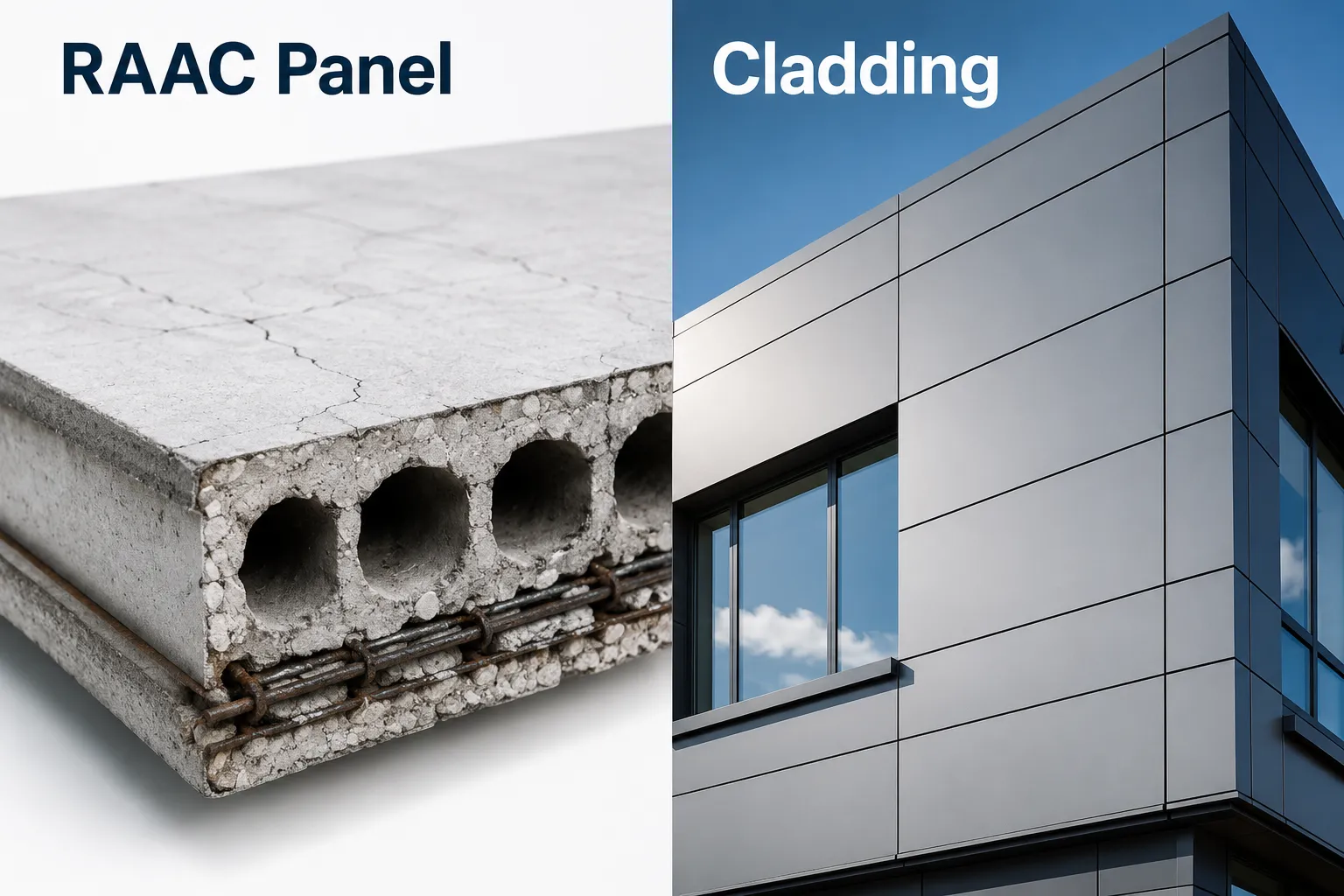
RAAC is a lightweight precast concrete material used extensively in UK public and residential buildings between the 1950s and the late 1980s. It matters for building surveys because its structural lifespan is significantly shorter than conventional reinforced concrete, and deterioration can be rapid once moisture ingress begins.
Unlike standard concrete, RAAC panels have a porous, aerated structure that makes them vulnerable to carbonation and corrosion of the embedded steel reinforcement. The Institution of Structural Engineers has confirmed that RAAC panels can fail suddenly without visible warning signs, which is why professional surveys are essential and visual inspections alone are insufficient to assess risk.
For property professionals and homebuyers, the key facts are:
- RAAC is most commonly found in flat roofs, floors, and wall panels of schools, hospitals, and residential blocks built between approximately 1955 and 1990.
- A building constructed during this period does not automatically contain RAAC, but the possibility must be investigated before any purchase, sale, or remediation decision.
- Confirmation requires physical investigation, often including material sampling and laboratory analysis, not just a desktop review.
For a detailed assessment of construction materials and their condition, a building materials assessment carried out by a chartered surveyor is the appropriate starting point.
What Is the Difference Between RAAC and Other Defective Materials in Buildings
RAAC is distinct from other notifiable building defects because its failure mode is structural and can be sudden, whereas materials like ACM cladding primarily create fire safety risks. Both categories are serious, but they require different expert disciplines and different remediation strategies.
| Material | Primary Risk | Typical Era | Failure Mode |
|---|---|---|---|
| RAAC | Structural collapse | 1955-1990 | Sudden, without visible warning |
| ACM Cladding | Fire spread | 1980s-2010s | Rapid fire propagation |
| High-pressure laminate (HPL) | Fire spread (lower risk) | 1990s-2010s | Slower than ACM |
| Asbestos | Health/respiratory | Pre-2000 | Long-term exposure |
The distinction matters for expert witness preparation because a structural engineer may be the appropriate expert for RAAC cases, while a fire safety engineer or facade specialist may be better suited for cladding disputes. In complex cases, joint expert teams are common.
For broader context on building defects and their solutions, the building problems and solutions resource covers the full range of defect types relevant to UK property.
Who Needs an Expert Witness for RAAC and Cladding Disputes
Any party in litigation or formal dispute resolution involving RAAC or cladding defects will likely need an independent expert witness. This includes leaseholders pursuing freeholders for remediation costs, freeholders defending claims, developers facing negligence actions, and local authorities managing public buildings.
Specifically, an expert witness is needed when:
- A dispute has reached tribunal, court, or formal arbitration stage.
- An insurer requires independent technical evidence before settling a claim.
- A party needs to challenge or respond to an opposing expert's report.
- A building owner needs to establish the scope and cost of remediation before pursuing recovery from a contractor or developer.
Expert witness preparation for RAAC and cladding remediation disputes in 2026 building surveys is not limited to courtroom testimony. Written reports are often the primary mechanism through which technical evidence is presented, and many cases settle once a credible expert report is served on the opposing party.
What Qualifications Do You Need to Be an Expert Witness in Building Disputes
An expert witness in building disputes should hold MRICS or FRICS status and have direct, demonstrable experience in the specific defect type at issue. Membership of the Royal Institution of Chartered Surveyors alone is not sufficient; courts expect specialism.
The core qualifications and attributes courts look for include:
- RICS membership (MRICS or FRICS) as a baseline professional credential.
- Relevant specialism: building pathology, structural engineering, or fire safety engineering depending on the defect type.
- Practical site experience with the specific material or defect, not just theoretical knowledge.
- Familiarity with CPR Part 35, which governs expert witness duties in English civil courts.
- No conflict of interest: the expert must be genuinely independent of all parties.
Compliance with RICS Practice Statements on expert witness duties is also expected. These statements require the expert to confirm in their report that they understand their overriding duty is to the court, not to the party paying their fee.
The expert witness reports service at Prince Chartered Surveyors provides reports prepared to these standards for building defect disputes.
Can You Be an Expert Witness If You Work for a Building Contractor
No. A person who is employed by or has a financial relationship with a party to the dispute cannot act as an independent expert witness. Courts and tribunals require genuine independence, and any connection to a contractor, developer, or insurer involved in the case will disqualify the witness or severely undermine their credibility.
This is a common mistake in building defect cases. Parties sometimes instruct a surveyor who has previously worked on the building or who has a commercial relationship with the defendant. Even if the individual is technically competent, their evidence is likely to be challenged and may be excluded.
Edge case: A surveyor who carried out the original building survey before the dispute arose may be called as a factual witness (to give evidence about what they observed), but they cannot simultaneously act as the independent expert witness providing opinion evidence.
How Do Expert Witnesses Prepare for Cladding Remediation Cases
Effective expert witness preparation for RAAC and cladding remediation disputes in 2026 building surveys follows a structured process that begins well before any report is written. The preparation phase is where cases are won or lost.
Step-by-step preparation process:
- Initial instructions review: Confirm the scope of the expert's remit, the legal questions to be answered, and any court deadlines.
- Document review: Examine original building specifications, planning permissions, fire risk assessments, previous survey reports, and any remediation records.
- Site investigation: Conduct a thorough physical inspection, including areas not accessible during routine surveys. Drone surveys can be valuable for high-rise facades.
- Material sampling and testing: Where RAAC or specific cladding types are suspected, arrange laboratory analysis to confirm material identity and condition.
- Photographic and video evidence: Systematic documentation of all defects observed, with location references tied to building plans.
- Regulatory review: Confirm which standards applied at the time of construction and which apply to remediation in 2026.
- Draft report: Prepare a report that addresses the specific questions posed, states the expert's opinion clearly, and acknowledges any areas of uncertainty.
- Peer review: Have the draft reviewed by a colleague before service to identify gaps or unsupported assertions.
For high-rise or complex facades, drone survey services provide photographic evidence of areas that cannot be safely accessed on foot.

What Evidence Do You Need to Prove RAAC or Cladding Defects
Strong evidence in RAAC and cladding cases combines physical investigation findings, documentary records, and expert analysis. Courts expect more than opinion; they expect opinion grounded in verifiable facts.
The essential evidence categories are:
- Physical inspection records: Dated site visit notes, photographs, and measurements.
- Material identification: Laboratory test results confirming the presence of RAAC or specific cladding materials (ACM, HPL, etc.).
- Original build documentation: Specifications, architect drawings, and materials schedules from the original construction.
- Maintenance and inspection history: Records showing when defects first appeared and how they were managed.
- Remediation cost evidence: Contractor quotes or schedules of works to quantify the financial loss.
- Regulatory compliance records: Evidence of whether the building met the standards applicable at the time of construction and whether it meets current standards.
Under Scottish Government Single Building Assessment standards published in January 2025, commissioning parties are required to retain assessment and remediation documentation for at least two years after completion. This documentation can be compelled as evidence in dispute proceedings.
A Level 3 Full Building Survey provides the most comprehensive baseline evidence for properties where defects are suspected.
Common Mistakes Expert Witnesses Make in Building Defect Testimony
The most damaging mistakes in expert witness work are not technical errors but procedural and presentational failures. A technically sound opinion can be destroyed in cross-examination if the report does not comply with CPR Part 35 requirements.
Common mistakes to avoid:
- Advocacy: Writing a report that argues the instructing party's case rather than giving an independent opinion. Courts treat this as a fundamental breach of duty.
- Failing to acknowledge uncertainty: Overstating confidence in conclusions where the evidence is genuinely ambiguous.
- Inadequate site access: Forming opinions about defects without physically inspecting the relevant areas.
- Ignoring the opposing expert's report: Failing to engage with and address the points made by the other side's expert.
- Missing the legal question: Answering a technical question rather than the specific legal question the court needs addressed.
- Outdated regulatory references: Citing superseded standards rather than those applicable at the time of construction or remediation.
"The expert's duty to the court overrides any obligation to the person from whom the expert has received instructions or by whom the expert is paid.", CPR Part 35.3
How Long Does Expert Witness Preparation Take for Building Surveys
For a straightforward single-property dispute, expert witness preparation typically takes four to eight weeks from initial instruction to a finalised report. Complex multi-party cases involving large residential blocks can take six months or longer.
The main time variables are:
- Access to the building: Coordinating site visits with multiple parties or gaining access to occupied buildings takes time.
- Laboratory testing: Material analysis can take two to four weeks depending on the testing required.
- Document disclosure: Waiting for the opposing party to disclose relevant documents before the report can be finalised.
- Court timetable: Courts set exchange dates for expert reports, and preparation must be planned backwards from those deadlines.
Early instruction of an expert witness is strongly recommended. Instructing an expert at the last minute is one of the most avoidable causes of inadequate preparation.
How Much Does an Expert Witness Cost for RAAC and Cladding Cases
Expert witness fees for RAAC and cladding disputes vary considerably based on the expert's seniority, the complexity of the case, and the time required. As a general guide, a written expert report for a moderate-complexity case typically costs between £3,000 and £10,000. Cases requiring attendance at a hearing, joint expert meetings, or multiple site visits will cost more.
The main cost components are:
- Initial review and instructions: Two to five hours of professional time.
- Site investigation: One to three days depending on building size and access.
- Report preparation: Five to fifteen hours for a standard report.
- Court attendance: Charged at a daily rate, often £1,500 to £3,500 per day for a senior chartered surveyor.
Costs are recoverable from the losing party in most civil proceedings, but only if the court considers them reasonable and proportionate. Instructing an overqualified expert for a low-value dispute can result in costs being disallowed.
Are There New Regulations for RAAC Expert Witnesses in 2026
Yes. The regulatory landscape for both RAAC and cladding has continued to evolve through 2025 and into 2026, raising the bar for expert evidence in building disputes.
Key regulatory developments affecting expert witness preparation in 2026:
- Building Safety Act 2022 implementation: The full implementation of the Building Safety Act has clarified the legal responsibilities of building owners and developers for higher-risk buildings, creating new grounds for claims and new standards against which expert evidence is measured.
- Scottish SBA standards (2025): The Scottish Government's Single Building Assessment standards set out detailed requirements for cladding assessments, including mandatory documentation retention, which directly affects what evidence experts can access and rely upon.
- Updated RICS guidance: RICS has continued to update its practice notes on building surveys and expert witness duties, and experts are expected to work to the current versions.
- Fire Safety (England) Regulations: Ongoing updates to fire safety requirements for multi-occupancy buildings affect the standards against which cladding installations are assessed.
For properties where statutory compliance is in question, the statutory considerations and building regulation compliance testing services provide the regulatory context needed to support expert evidence.
How Do You Challenge an Expert Witness Report on Building Defects
Challenging an opposing expert's report requires instructing your own independent expert and identifying specific weaknesses in the methodology, evidence base, or conclusions. A general attack on credibility is rarely effective; courts respond better to targeted, evidence-based challenges.
Effective challenge strategies include:
- Joint expert meetings: Courts frequently order opposing experts to meet and produce a joint statement identifying areas of agreement and disagreement. This process often narrows the issues significantly.
- Questions under CPR Part 35.6: Either party can put written questions to the opposing expert, who must answer them. This is a useful tool for exposing gaps in the evidence.
- Challenging the methodology: If the opposing expert did not carry out a physical inspection, did not obtain material samples, or relied on outdated standards, these are legitimate grounds for challenge.
- Identifying conflicts of interest: Any undisclosed connection between the expert and a party to the dispute should be raised with the court.
The building defects survey service provides the independent technical foundation needed to support or challenge expert evidence in building disputes.
Frequently Asked Questions
What is the difference between an expert witness and a factual witness in a building dispute?
A factual witness gives evidence about what they personally observed or did. An expert witness gives opinion evidence, drawing on their specialist knowledge to interpret facts and answer technical questions the court cannot resolve without expert help.
Does an expert witness have to be a chartered surveyor?
Not necessarily. The expert must have the specific knowledge relevant to the dispute. For structural RAAC issues, a structural engineer may be more appropriate. For fire safety cladding cases, a fire safety engineer may be required. Chartered surveyor status is common but not mandatory.
Can the same expert witness act for both parties?
No. An expert witness is instructed by one party, but their duty is to the court. A single joint expert (SJE) can be appointed by agreement of both parties, which is common in lower-value disputes, but this is a different arrangement from acting for both parties simultaneously.
What happens if the two experts disagree?
The court hears both expert opinions and decides which to prefer, or takes a view somewhere between the two. This is why the quality of the report and the expert's performance under cross-examination matters so much.
How do I find a qualified expert witness for a RAAC or cladding case?
Look for RICS-registered surveyors or structural engineers with specific experience in the defect type at issue. The RICS Expert Witness Register and specialist surveying firms with dedicated expert witness services are the most reliable starting points.
Can an expert witness report be used in mediation as well as court?
Yes. Expert witness reports are frequently used in mediation, arbitration, and other forms of alternative dispute resolution. A well-prepared report often encourages early settlement by clearly establishing the technical merits of a case.
Conclusion
Expert witness preparation for RAAC and cladding remediation disputes in 2026 building surveys is a specialist discipline that demands both technical depth and procedural rigour. The stakes are high: inadequate preparation can result in a technically sound case being lost on evidential grounds, while a well-prepared expert report often resolves disputes before they reach a hearing.
Actionable next steps for property professionals and owners:
- Instruct a specialist expert witness early, before court deadlines create time pressure.
- Ensure the expert has direct, verifiable experience with the specific defect type, not just general surveying credentials.
- Commission a thorough Level 3 Full Building Survey as the evidential foundation for any dispute involving building defects.
- Preserve all documentation relating to the building's construction, maintenance, and any previous surveys or remediation works.
- Engage a surveyor familiar with the current regulatory framework, including 2025-2026 updates to Building Safety Act implementation and cladding assessment standards.
For properties with suspected RAAC or unresolved cladding concerns, early professional assessment through a building pathology review is the most cost-effective way to understand the risk before any dispute arises.
.cg-checker{font-family:Arial,sans-serif;max-width:560px;margin:24px auto;border:2px solid #1a3a5c;border-radius:8px;padding:20px;background:#f7f9fc}
.cg-checker h3{color:#1a3a5c;margin:0 0 14px;font-size:1.05rem}
.cg-checker label{display:flex;align-items:flex-start;gap:10px;margin-bottom:10px;font-size:.92rem;color:#333;cursor:pointer}
.cg-checker input[type=checkbox]{width:18px;height:18px;flex-shrink:0;margin-top:2px;accent-color:#1a3a5c}
.cg-btn{background:#1a3a5c;color:#fff;border:none;padding:10px 22px;border-radius:5px;cursor:pointer;font-size:.95rem;margin-top:10px}
.cg-btn:hover{background:#2a5298}
.cg-result{margin-top:14px;padding:10px 14px;border-radius:5px;font-size:.93rem;display:none}
.cg-ok{background:#e6f4ea;color:#1e6b3a;border:1px solid #a8d5b5}
.cg-warn{background:#fff8e1;color:#7a5c00;border:1px solid #f0d080}
.cg-poor{background:#fdecea;color:#8b1a1a;border:1px solid #f5a8a8}
Expert Witness Readiness Checker
Tick each item your expert witness report currently satisfies.
function cgCheck(){
var items=document.querySelectorAll(‘.cg-item’);
var checked=Array.from(items).filter(function(i){return i.checked}).length;
var r=document.getElementById(‘cg-result’);
r.style.display=’block’;
r.className=’cg-result’;
if(checked===7){r.classList.add(‘cg-ok’);r.textContent=’Strong readiness: Your expert witness preparation covers all key criteria.’;}
else if(checked>=4){r.classList.add(‘cg-warn’);r.textContent=’Partial readiness: ‘+(7-checked)+’ area(s) need attention before the report is served.’;}
else{r.classList.add(‘cg-poor’);r.textContent=’Significant gaps: ‘+(7-checked)+’ critical items are missing. Consider early re-instruction.’;}
}
Tags: expert witness building disputes, RAAC remediation, cladding remediation, building survey 2026, chartered surveyor expert witness, CPR Part 35, building defects, RAAC concrete, cladding assessment, building pathology, fire safety cladding, building safety act