

Last updated: July 24, 2026
Quick Answer: Local authority search delays in 2026 are directly contributing to a rise in property valuation disputes, as gaps between the search date and the valuation date create uncertainty about planning status, contamination risk, and infrastructure liabilities. Expert witnesses instructed in these cases must demonstrate a clear, documented methodology that accounts for the temporal gap, applies verified market adjustments, and withstands rigorous cross-examination. Chartered surveyors preparing expert witness reports need to treat search delay evidence as a core component of their valuation narrative, not a footnote.
Key Takeaways
- Local authority search delays in 2026 can run from several weeks to over three months in some council areas, creating a material gap between the information relied upon and the valuation date.
- Valuation disputes arising from search delays typically centre on whether a property's assessed value properly reflected planning constraints, road schemes, or environmental designations that a timely search would have revealed.
- Expert witnesses must anchor their reports to a precise valuation date and document every assumption affected by incomplete or delayed search information.
- Courts are applying greater scrutiny to expert methodology in 2026, particularly around the selection of comparable transactions and the treatment of market conditions over time.
- A delayed search is legally distinct from a missing or defective search result; each carries different implications for how an expert frames their evidence.
- Comprehensive documentation of all comparables considered, including those rejected, is essential for credibility under cross-examination.
- Automated Valuation Models (AVMs) are insufficient as a primary basis for expert evidence in search delay cases because they cannot account for the specific information gaps created by a delayed search.
- Proactive engagement with the instructing solicitor about what the search did and did not cover at the relevant date is a prerequisite for a sound expert witness report.
What Is a Local Authority Search Delay and How Does It Affect Property Valuations
A local authority search delay occurs when the turnaround time for a CON29 or LLC1 search result from a council exceeds the timeframe reasonably expected in a conveyancing transaction. In 2026, turnaround times vary considerably between local authorities, with some urban councils returning results within five to ten working days while others, particularly those managing high transaction volumes or staffing shortfalls, can take eight to twelve weeks or longer.
The effect on property valuations is direct. A valuation report is anchored to a specific date, and the information available at that date shapes the surveyor's conclusions. When a search result is outstanding or only partially returned at the valuation date, the valuer is working without confirmed knowledge of:
- Planning permissions or refusals affecting the subject property or its immediate surroundings
- Road adoption status and any proposed highway schemes
- Contaminated land designations under Part IIA of the Environmental Protection Act 1990
- Tree Preservation Orders or conservation area constraints
- Compulsory purchase or development plan allocations
Each of these factors can materially affect market value. A property with an unresolved planning constraint, for example, may be worth significantly less than a comparable property with a clean search result. When the search is delayed, the valuer must either qualify their opinion or make explicit assumptions, both of which can become the subject of a dispute.
For a broader understanding of what drives a property valuation, the top factors considered during a property valuation provide useful context on how search information feeds into the overall assessment.
How Do Search Delays Impact 2026 Property Valuation Disputes
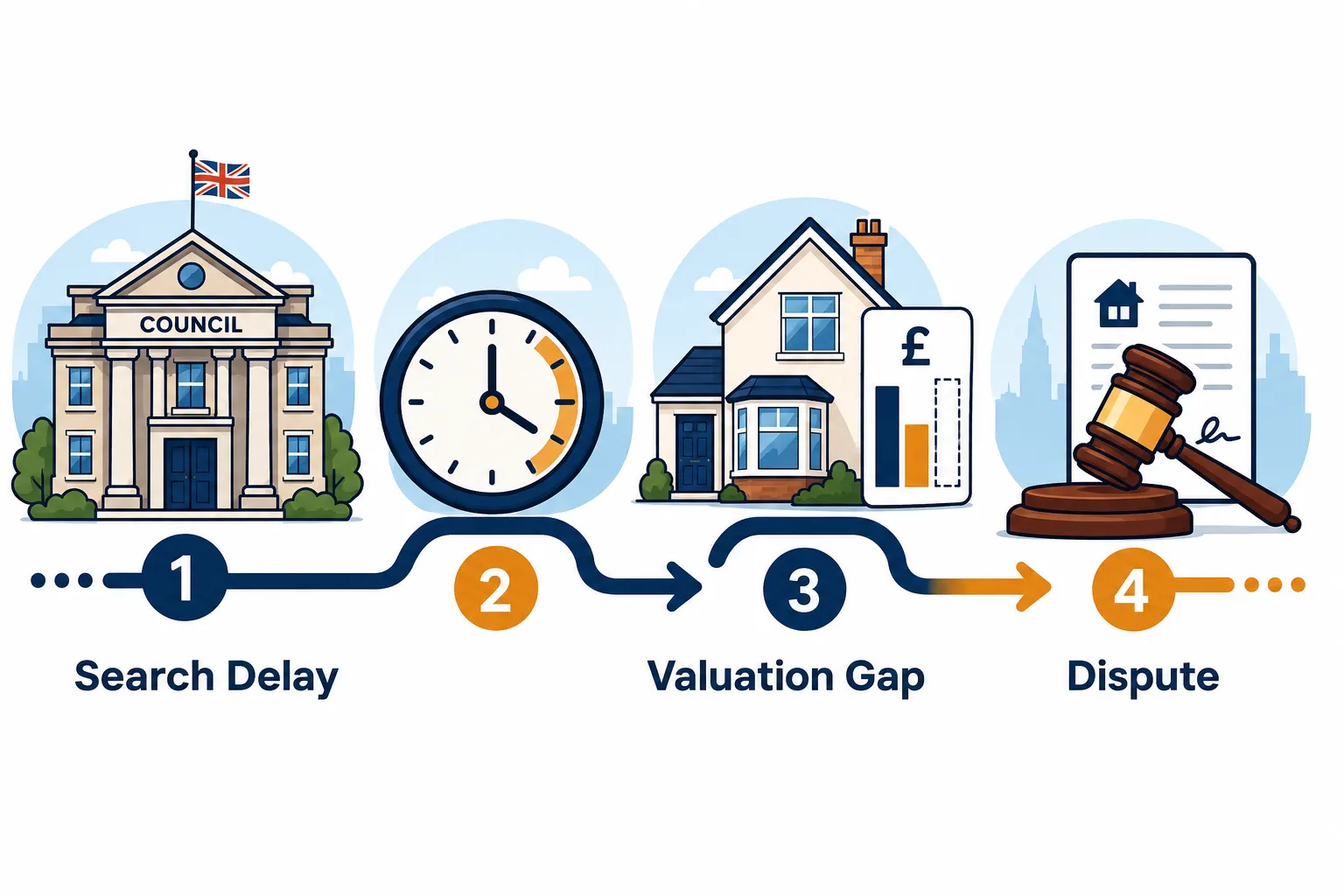
Search delays are fuelling a measurable increase in valuation disputes in 2026, particularly in cases where a transaction has stalled, a mortgage offer has lapsed, or a deal has collapsed entirely. The dispute typically arises when one party argues that the valuation was either too high or too low because the expert relied on incomplete search information.
Three dispute patterns are most common in 2026:
- Mortgage valuation challenges: A lender's valuation was completed before the search returned, and the borrower later discovers a planning constraint that reduces the property's value below the loan amount.
- Sale and purchase disputes: A buyer claims the agreed price was based on a valuation that did not account for information a timely search would have revealed, such as a proposed road widening scheme.
- Matrimonial and inheritance valuation disputes: Where a property is being valued for division or probate purposes, a delayed search can create disagreement about what the market value was at the relevant date. Matrimonial valuations and inheritance tax valuations are particularly sensitive to this issue because the valuation date is fixed by law.
Regional disparities also matter. Property values and the reliability of local authority data vary considerably across England and Wales in 2026, meaning an expert witness must demonstrate familiarity with the specific council's search performance and any known backlogs at the relevant date.
How Long Do Local Authority Searches Typically Take in 2026
In 2026, the national average for a personal local authority search is broadly five to fifteen working days, but official searches from some councils can take considerably longer. There is no statutory maximum turnaround time for local authority searches in England and Wales, which means delays are a recurring feature of the conveyancing process rather than an exceptional event.
Key variables affecting search timescales include:
- Council resourcing: Authorities with reduced planning and land charges staff see the longest delays.
- Transaction volume: Periods of high market activity, such as following stamp duty threshold changes, create backlogs.
- Digitisation status: Councils that have not fully digitised their land charges registers tend to process searches more slowly.
- Search type: Personal searches carried out by specialist search companies are often faster than official searches but may carry different liability implications.
For expert witnesses, the practical implication is that the specific turnaround time at the relevant council on the relevant date must be established as a fact, not assumed. Contemporaneous evidence such as council-published turnaround statistics, Law Society guidance, or correspondence from the conveyancer is the appropriate source for this.
What Should an Expert Witness Know About Local Authority Search Timelines
An expert witness instructed in a search delay case needs to understand not just the general context of search delays, but the specific operational position of the relevant local authority at the date of the transaction in dispute. This is a factual matter that underpins the expert's opinion.
Core knowledge requirements include:
- The distinction between official and personal searches, and the different liability frameworks that apply to each
- The council's published turnaround times at the relevant date, obtainable from archived council communications or industry tracking data
- Whether any known backlogs or exceptional circumstances applied at the time
- The specific entries that would have appeared on a returned search, and how each would have affected the valuation
- RICS guidance on how to treat incomplete information in a valuation report
Courts in 2026 are scrutinising expert methodology more closely than in previous years, with particular focus on whether the expert's selection of comparable transactions and treatment of market conditions is grounded in accepted appraisal principles. An expert who cannot explain precisely what the search would have revealed, and how that information would have changed the valuation, will struggle under cross-examination.
What Evidence Do You Need for an Expert Witness Report on Search Delays
A credible expert witness report on search delays must be built on verifiable, contemporaneous evidence rather than assumption. The report needs to demonstrate what information was available at the valuation date, what was missing because of the delay, and how the missing information would have affected the valuation opinion.
Essential evidence to gather:
- Copy of the search application and any correspondence showing the date of request and date of return
- Council-published turnaround statistics for the relevant period
- The actual search result, once returned, showing all entries
- Planning portal records for the subject property and surrounding area at the relevant date
- Comparable transaction evidence with clear dates, adjusted for time using a verified regional house price index
- Any lender or conveyancer correspondence referencing the search delay
- The original valuation report and any assumptions or qualifications stated within it
A critical point for expert witnesses: Document every comparable considered, not just those ultimately relied upon, and record the reasons for exclusion. This transparency is the single most effective protection against credibility challenges in cross-examination.
Relying on Automated Valuation Models as primary evidence is inadvisable. AVMs cannot account for the specific information gaps created by a delayed search, and they lack the transparency required for expert witness evidence in court proceedings.
For cases involving independent property valuations, the same evidential discipline applies: the report must be capable of standing alone as a complete and self-contained document.
Can Search Delays Be Used as a Defence in Valuation Disputes
Yes, a search delay can form part of a defence in a valuation dispute, but only where it can be shown that the delay materially affected the information available to the valuer at the relevant date, and that a competent valuer in those circumstances would reasonably have qualified their opinion or declined to provide an unconditional figure.
The defence argument typically runs as follows: the valuer could not have known about a particular planning constraint or designation because the search had not been returned at the valuation date, and the valuation was therefore prepared on a stated assumption that the search would return clear. If the search subsequently revealed a material entry, the argument is that the valuer's opinion was reasonable given the information available, and that any loss flows from the delay itself rather than from a negligent valuation.
This defence is stronger where:
- The valuation report explicitly states the assumption about the search
- The delay was demonstrably outside the valuer's control
- The valuer took reasonable steps to flag the outstanding search to the instructing party
- The information revealed by the search, once returned, was genuinely material to value
The defence is weaker where:
- The valuer proceeded without any qualification or caveat
- Industry practice at the time required the valuer to await the search result
- The missing information related to a matter the valuer should have identified through physical inspection
What Is the Difference Between a Delayed Search and a Missing Search Result
A delayed search is one that has been applied for but not yet returned at the relevant date. A missing search result is one that was never applied for, was lost in the process, or was returned but not disclosed to the relevant party. The distinction matters significantly in expert witness work.
| Scenario | Key Characteristic | Typical Legal Issue |
|---|---|---|
| Delayed search | Applied for; not yet returned | Timing and reliance on assumptions |
| Missing search | Never applied for or lost | Conveyancing negligence or non-disclosure |
| Defective search | Returned but incomplete or incorrect | Liability of search provider or council |
| Stale search | Returned but out of date by transaction date | Whether reliance was reasonable |
In valuation disputes, a delayed search typically raises questions about the reasonableness of the valuer's assumptions. A missing search raises questions about conveyancing negligence that may involve different expert disciplines entirely. An expert witness instructed in a search delay case should be clear in their report about which category applies, because conflating the two undermines the credibility of the evidence.
How to Prepare an Expert Witness Statement About Delayed Searches
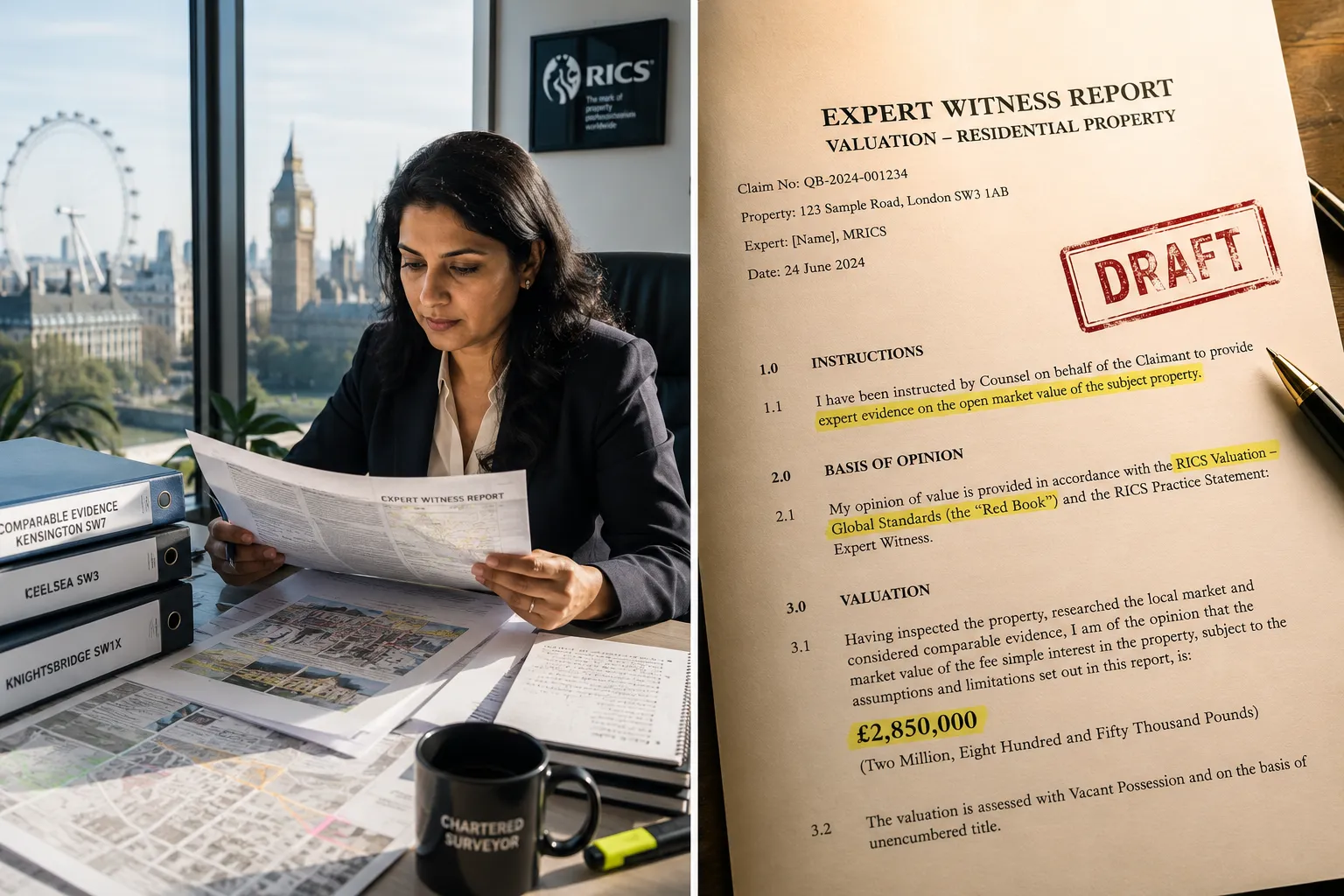
Preparing an expert witness statement for a search delay case follows the standard framework required by CPR Part 35 and the associated Practice Direction, but with specific adaptations for the search delay context. The statement must be addressed to the court, not to the instructing party, and must contain a declaration of the expert's overriding duty to the court.
Step-by-step preparation process:
- Establish the precise valuation date and confirm what search information was and was not available at that date.
- Obtain and review all contemporaneous documents, including the search application, any interim correspondence, and the eventual search result.
- Identify every entry on the returned search and assess its potential impact on market value at the valuation date.
- Select comparable transactions from the relevant market period, applying explicit time adjustments supported by a named regional house price index. Appraisers routinely underutilise time adjustments, which leads to valuations that lag actual market conditions, this is a known credibility risk in 2026.
- Draft the valuation opinion with and without the information that the delayed search would have provided, to demonstrate the materiality of the delay.
- Document all comparables considered, including those rejected, with reasons.
- Prepare a clear methodology section explaining how the search delay affected the information base and how the expert has addressed that gap.
- Review the draft against CPR Part 35 requirements before finalising.
The expert witness reports service provided by chartered surveyors covers this full preparation process for property-related disputes.
Common Mistakes When Preparing Expert Witness Testimony on Search Delays
Several recurring errors weaken expert witness evidence in search delay cases. Awareness of these mistakes is as important as knowing what to include.
Most common errors:
- Failing to establish the exact search status at the valuation date. An expert who cannot confirm precisely when the search was applied for, and what had been returned by the valuation date, has a fundamental gap in their evidence.
- Over-reliance on AVMs. Automated models cannot account for the specific information gaps created by a delayed search and lack the transparency courts require.
- Treating the search delay as background rather than as a material fact. The delay must be addressed head-on in the methodology section, not mentioned in passing.
- Selecting only favourable comparables. Courts expect experts to document all comparables considered, not just those that support the conclusion.
- Failing to apply time adjustments. In a market where conditions have shifted between the comparable date and the valuation date, unexplained time adjustments are a significant credibility risk.
- Conflating the expert's role with the advocate's role. The expert's duty is to the court. A report that reads as an advocacy document rather than an independent assessment will be challenged effectively.
- Ignoring regional market conditions. Property values and search performance vary materially by area. An expert who applies national benchmarks without adjustment to local conditions will face challenge.
Who Needs an Expert Witness for Local Authority Search Delay Cases
Expert witnesses for search delay valuation disputes are instructed across a range of scenarios. The common thread is that a party needs an independent, qualified opinion on what a property was worth at a specific date, and how a search delay affected that opinion.
Typical instructing parties include:
- Homebuyers and sellers where a transaction has collapsed or resulted in a loss attributable to delayed search information
- Mortgage lenders seeking to establish whether a valuation was negligent given the search position at the relevant date
- Landlords and property investors in disputes about the value of commercial or residential investment property where search delays affected due diligence
- Solicitors and conveyancers defending or pursuing professional negligence claims where search management is in issue
- Parties to matrimonial proceedings where the value of the family home is disputed and a search delay is a complicating factor
For landlords and property investors, understanding the full scope of chartered surveyor valuation services is a useful starting point when considering whether expert evidence is needed.
How to Challenge a Valuation Based on Search Delay Issues
Challenging a valuation on search delay grounds requires a structured approach that targets the specific information gap and its effect on the valuation opinion.
Effective challenge strategies:
- Obtain the original valuation report and identify any assumptions or qualifications relating to the search position.
- Commission an independent valuation that explicitly addresses what the value would have been had the search been returned on time and revealed the relevant entries.
- Gather evidence of the search delay, including application dates, correspondence, and council turnaround statistics for the relevant period.
- Instruct a chartered surveyor as expert witness to prepare a report that compares the original valuation with what a competent valuer would have produced with complete search information.
- Consider whether the delay constitutes a breach by the conveyancer, the search provider, or the local authority, as this affects who the claim is directed against.
If a valuation has come in lower than expected in a related context, the guidance on what to do if your home valuation is less than an offer provides useful background on the options available before escalating to a formal dispute.
How Much Does Expert Witness Preparation Cost for Search Delay Cases
Expert witness preparation costs for search delay valuation disputes vary depending on the complexity of the case, the value of the property in dispute, and the amount of documentation that needs to be reviewed. There is no fixed fee schedule, and costs should be discussed with the instructing solicitor at the outset.
Factors that affect cost:
- Property type and value: Commercial property disputes typically involve more complex valuation methodology than residential cases.
- Volume of documentation: Cases with extensive conveyancing files, multiple search results, or a long transaction history require more preparation time.
- Whether court attendance is required: A written report alone costs less than a report plus attendance at a hearing or tribunal.
- Expert's experience and RICS accreditation: Fees reflect the expert's qualifications and track record in similar cases.
As a general guide, expert witness reports for residential property disputes in 2026 typically start from a few hundred pounds for straightforward cases and can run to several thousand pounds for complex commercial or high-value residential matters. Always obtain a written fee estimate before instructing.
Are There Specific Regulations About Acceptable Search Delay Times
There is no statutory maximum turnaround time for local authority searches in England and Wales as of 2026. The Land Charges Act 1972 and the Local Land Charges Act 1975 govern the register itself, but neither sets a mandatory response deadline for search applications.
However, several frameworks create practical expectations:
- The Law Society's Conveyancing Protocol sets out best practice for managing searches within a transaction, and failure to follow it can be relevant in professional negligence claims.
- The Search Code, administered by the Council of Property Search Organisations (CoPSO), sets standards for personal search companies, including requirements around accuracy and timeliness.
- RICS guidance on valuation in the context of incomplete information is relevant to how a valuer should respond when a search is outstanding.
- Local authority performance data, published by some councils and tracked by industry bodies, provides a benchmark for what was reasonable at a given time.
For cases involving statutory considerations in a building survey context, the statutory considerations guidance provides additional background on how regulatory frameworks interact with property assessments.
FAQ
What is the difference between a CON29 and an LLC1 search?
The LLC1 (Local Land Charges Register search) reveals financial charges and restrictions registered against a property, such as planning conditions and listed building designations. The CON29 (Enquiries of Local Authority) covers a broader range of planning and highways information. Both are typically ordered together, and a delay to either can affect the completeness of the information available at the valuation date.
Can a valuation be challenged if the search was delayed but eventually returned clean?
Yes, but the challenge is harder to sustain. If the search returned with no material entries, the argument that the delay caused a loss in value is difficult to establish. The challenge is more viable where the delay caused the transaction to collapse, resulting in costs or a lost opportunity, rather than where the eventual search result was clear.
Does an expert witness need to be RICS-accredited to give evidence in a search delay case?
RICS accreditation is not a legal requirement for expert witnesses, but it is strongly expected in property valuation disputes. Courts and tribunals give greater weight to evidence from RICS-qualified surveyors because their methodology is governed by professional standards, including the RICS Red Book for valuations.
How far back can a search delay dispute go?
Limitation periods under the Limitation Act 1980 generally allow six years from the date the cause of action arose for contract claims, and three years from the date of knowledge for personal injury or latent damage claims. In property disputes, the clock typically starts from the date of the transaction or the date the loss was discovered. Always take legal advice on limitation at the outset.
What if the local authority made an error on the search rather than just delaying it?
A search that contains an error, such as a failure to register a planning condition, is a defective search rather than a delayed one. The liability framework is different: the local authority may be liable under the Local Land Charges Act 1975 for losses caused by an official search error. Expert evidence is still relevant to quantify the loss, but the legal basis for the claim differs from a pure delay case.
Can search delays affect commercial property valuations as well as residential?
Yes, and often more significantly. Commercial property valuations are sensitive to planning use class, environmental designations, and infrastructure constraints, all of which appear on local authority searches. A delayed search in a commercial transaction can affect not just the capital value but also the rental value and the suitability of the property for its intended use.
What happens if a search delay causes a property deal to fall through entirely?
Where a transaction collapses because a search was not returned in time for exchange of contracts, the losses can include abortive legal fees, survey costs, and in some cases the difference between the agreed price and the price at which the property is subsequently sold. Quantifying these losses for litigation purposes is a task for an expert witness with valuation and property expertise.
Conclusion
Expert witness preparation for local authority search delays requires a disciplined, evidence-led approach that goes well beyond standard valuation methodology. In 2026, with courts applying greater scrutiny to expert evidence and valuation disputes on the rise, the quality of preparation is the single biggest determinant of whether an expert's opinion will be accepted.
Actionable next steps for those involved in or anticipating a search delay dispute:
- Establish the facts first. Confirm the exact search status at the valuation date before forming any opinion on value.
- Instruct a RICS-qualified expert witness with specific experience in search-related valuation disputes, not just general valuation work.
- Preserve all contemporaneous documentation, including search applications, correspondence, and council turnaround data for the relevant period.
- Ensure the expert's report addresses the search delay directly in the methodology section, with explicit assumptions and their effect on value.
- Seek legal advice early on limitation periods and the correct defendant, particularly where the delay involves a local authority, a personal search company, or a conveyancer.
- Do not rely on AVMs as primary evidence. Use verified comparable transaction data with explicit time adjustments.
For professional expert witness reports prepared by RICS-qualified chartered surveyors, or for an independent property valuation that can withstand scrutiny in a dispute context, engaging a specialist early in the process is always the most cost-effective approach.
Meta title: Expert Witness & Search Delays: 2026 Valuation Disputes
Meta description: Learn how local authority search delays affect 2026 property valuation disputes and how to prepare credible expert witness reports. Guidance for UK homeowners and property professionals.
Tags: expert witness preparation, local authority search delays, property valuation disputes, 2026 valuation disputes, chartered surveyor expert witness, search delay property law, RICS expert witness, conveyancing delays, property dispute evidence, valuation methodology, UK property law, search result delays