

Last updated: July 24, 2026
Quick Answer: Expert witness preparation for interest rate cut valuation disputes requires RICS-qualified surveyors to apply the RICS Professional Standard for Expert Witnesses alongside Red Book Global Standards, clearly separating historical market evidence from forward-looking rate forecasts. Post-2026, with the Bank of England having signalled a sustained easing cycle, expert witnesses must demonstrate how anticipated rate reductions were already priced into comparable evidence at the relevant valuation date, and do so in a way courts and tribunals will accept.
Key Takeaways
- An expert witness in property valuation disputes must be RICS-qualified, independent, and bound by the RICS Professional Standard for Expert Witnesses (currently under active revision as of mid-2026).
- Interest rate cuts affect property valuations primarily through capitalisation rates, yield compression, and buyer affordability, all of which must be evidenced, not assumed.
- The RICS Red Book (Valuation, Global Standards) governs how valuations are conducted; separate RICS expert witness guidance governs how those valuations are presented in legal proceedings.
- Post-2026 rate forecasts can be referenced in expert testimony, but courts require that any forward-looking assumptions be clearly labelled, sourced, and distinguished from established fact.
- Common mistakes include conflating advocacy with independence, failing to disclose methodology, and over-relying on macro forecasts without local market evidence.
- Expert witness fees for property valuation disputes in the UK typically range from £2,000 to £15,000 or more, depending on complexity and hearing length.
- You should instruct an expert witness as early as possible, ideally before formal proceedings begin, to allow adequate report preparation time.
- RICS strategies for post-2026 disputes differ meaningfully from pre-2026 approaches because the rate environment has shifted from tightening to easing, changing which comparable evidence is most relevant.
What Is an Expert Witness in Real Estate Valuation Disputes?
An expert witness in real estate valuation disputes is a qualified professional, almost always a RICS-chartered surveyor or valuer, appointed to provide independent, impartial opinion evidence to a court, tribunal, or arbitration panel. Their duty is to the court, not to the party instructing them.
In practice, this means the expert witness must:
- Hold relevant RICS qualifications (typically MRICS or FRICS with a valuation specialism)
- Comply with the RICS Professional Standard for Expert Witnesses
- Produce a written report that clearly states the basis of opinion, methodology, and any limitations
- Be willing to be cross-examined on their conclusions
Expert witnesses differ from advocates. A solicitor argues a client's case; an expert witness provides honest professional opinion even if it is unhelpful to the instructing party. Courts take this duty seriously, and an expert who appears to be an advocate risks having their evidence dismissed entirely.
For property valuation disputes specifically, whether arising from matrimonial proceedings, capital gains tax assessments, or commercial lease renewals, the expert witness will typically produce a formal valuation report and, where required, a separate expert report for court use.
How Do Interest Rate Cuts Affect Property Valuations?
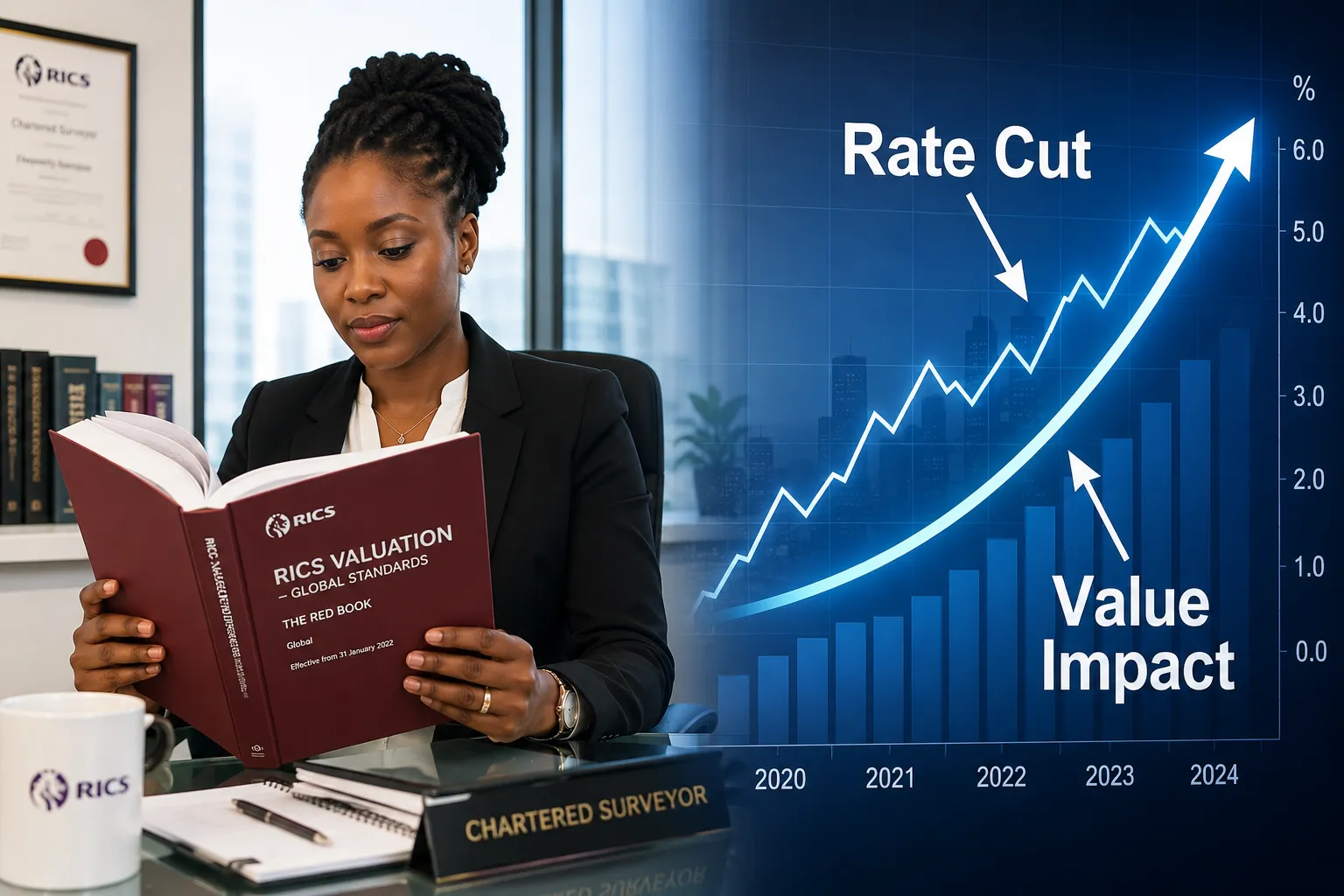
Interest rate cuts affect property valuations through several interconnected mechanisms: lower borrowing costs increase buyer purchasing power, compress investment yields, and tend to push capital values upward, all else being equal.
Here is how each mechanism works in practice:
Residential property: When the Bank of England cuts its base rate, mortgage rates typically follow. Lower monthly repayments allow buyers to borrow more for the same income, which increases demand and tends to support or lift prices. The effect is not instantaneous and varies by property type, location, and wider economic sentiment.
Commercial and investment property: Valuers use a capitalisation rate (or initial yield) to convert rental income into a capital value. When interest rates fall, investors accept lower yields because the risk-free rate of return has also fallen. A lower yield applied to the same income produces a higher capital value.
Timing matters enormously in disputes. A valuation dispute often centres on what the market was doing at a specific historical date. If rate cuts were anticipated but not yet implemented at the valuation date, the expert witness must address whether, and to what extent, those expectations were already reflected in market transactions.
For a broader understanding of what drives property values, see the top factors considered during a property valuation.
What Are RICS Standards for Expert Witness Testimony?
RICS sets out specific requirements for expert witnesses through its Professional Standard titled "RICS Professional Standard: Surveyors Acting as Expert Witnesses." As of mid-2026, this standard is under active revision, with updated guidance expected to address the increased complexity of valuation disputes in a post-rate-cycle environment.
The core requirements under current RICS guidance include:
- Independence: The expert must not have a financial or personal interest in the outcome.
- Duty to the court: The expert's overriding duty is to assist the tribunal, not to advance the client's case.
- Basis of opinion: The report must state clearly whether the valuation is on a Market Value, Fair Value, or other RICS-defined basis.
- Methodology disclosure: The expert must explain how comparables were selected, adjusted, and weighted.
- Limitations: Any material uncertainty, including uncertainty arising from interest rate volatility, must be disclosed.
- Single joint expert provisions: In some proceedings (particularly lower-value disputes), courts may direct parties to use a single jointly instructed expert rather than opposing experts.
Failure to comply with these standards does not just weaken the evidence, it can result in the expert being removed from the case or costs sanctions being imposed.
What Is the Difference Between the RICS Red Book and Expert Witness Guidelines?
The RICS Red Book (formally, "RICS Valuation, Global Standards") governs how a valuation is carried out. The RICS Expert Witness Professional Standard governs how that valuation is presented and defended in legal proceedings. They serve different purposes and both apply in a dispute context.
| Aspect | RICS Red Book | Expert Witness Standard |
|---|---|---|
| Primary purpose | Valuation methodology | Court/tribunal presentation |
| Applies when | Conducting any formal valuation | Acting in legal proceedings |
| Key output | Valuation report | Expert report / witness statement |
| Duty owed to | Client (and market integrity) | Court (overriding duty) |
| Covers rate assumptions | Yes (basis of value, market conditions) | Yes (transparency of assumptions) |
A common mistake is producing a Red Book-compliant valuation report and submitting it directly as expert evidence without adapting it to meet the separate requirements of the Expert Witness Standard. Courts expect expert reports to include a statement of truth, a declaration of independence, and explicit acknowledgment of the expert's duty to the court, none of which are required in a standard Red Book report.
For context on what a professional property valuation involves, see Prince Chartered Surveyors' valuation services.
How Do Post-2026 Interest Rate Forecasts Impact Current Property Valuations?
Post-2026 interest rate forecasts are relevant to current valuations when the valuation date falls in a period of active rate expectation, meaning the market was already pricing in future cuts at the time of the transaction or assessment.
Expert witnesses handling disputes in 2026 face a specific challenge: the Bank of England's easing cycle, which began in 2024 and has continued into 2026, means that many historical transactions used as comparables were completed under different rate expectations than those prevailing today. This creates a "moving baseline" problem.
Practical implications for expert witness preparation:
- Comparables from 2023-2024 (a high-rate environment) may require upward adjustment when applied to a 2025-2026 valuation date.
- Conversely, if the dispute concerns a valuation date in late 2023, the expert must be careful not to import 2026 rate expectations retrospectively.
- Forward guidance from the Bank of England and published forecasts from bodies such as the Office for Budget Responsibility can be cited as evidence of market expectations at a given date, but must be clearly labelled as forward-looking opinion, not established fact.
"The valuation date is sacrosanct. An expert witness who imports post-valuation-date rate movements into a historical assessment is not conducting a valuation, they are conducting a revision."
This principle is central to Expert Witness Preparation for Interest Rate Cut Valuation Disputes: RICS Strategies Post-2026 Forecasts and is one of the most frequently challenged areas in cross-examination.
How to Prepare an Expert Witness Report for Valuation Disputes
Preparing a compliant, persuasive expert witness report for a valuation dispute is a structured process. Cutting corners at any stage creates vulnerabilities under cross-examination.
Step-by-step preparation process:
- Accept instructions carefully. Confirm the valuation date, the basis of value required, and the legal proceedings in question. Decline if there is any conflict of interest.
- Inspect the property. A desk-based review is rarely sufficient for contested valuations. Document the inspection thoroughly.
- Gather comparable evidence. Use Land Registry data, EPC registers, and professional databases. Select comparables that are genuinely comparable, similar type, location, condition, and tenure.
- Adjust for rate environment. Where comparables were transacted under materially different rate conditions, apply and explain any adjustments transparently.
- Draft the valuation section. Follow Red Book methodology. State the basis of value, the approach (sales comparison, income, or cost), and the conclusion.
- Draft the expert report wrapper. Add the statement of truth, independence declaration, and court duty acknowledgment required by the RICS Expert Witness Standard and CPR Part 35 (in England and Wales).
- Peer review. Have a colleague review the report for logical consistency and potential weaknesses before submission.
- Prepare for joint statement. If opposing experts are appointed, courts often direct a without-prejudice meeting to produce a joint statement of agreed and disagreed issues. Prepare for this systematically.
For disputes involving inheritance tax valuations or leasehold enfranchisement, the same framework applies but with additional statutory considerations layered on top.
What Evidence Do Courts Accept for Interest Rate Impact on Property Values?
Courts in England and Wales accept several categories of evidence when assessing the impact of interest rate changes on property values. The key is that evidence must be objective, verifiable, and directly linked to the valuation date.
Accepted evidence categories:
- Transactional comparables: Actual sales of comparable properties around the valuation date, sourced from Land Registry or professional databases.
- Published market commentary: RICS market surveys, Nationwide and Halifax house price indices, and Bank of England Monetary Policy Committee minutes published at or before the valuation date.
- Yield data: Published commercial property yield surveys (such as those from MSCI/IPD) demonstrating how yields moved in response to rate changes.
- Expert opinion on adjustment: The expert's reasoned opinion on how rate differences between comparable transactions and the subject property's valuation date should be quantified.
What courts are sceptical of:
- Unverified assertions that rate cuts "would have" increased value by a specific percentage without evidential support.
- Over-reliance on national indices when local market evidence tells a different story.
- Forecasts presented as if they were facts at the valuation date.
Common Mistakes Expert Witnesses Make in Interest Rate Valuation Cases
The most damaging mistakes in Expert Witness Preparation for Interest Rate Cut Valuation Disputes are those that undermine the expert's credibility rather than just their methodology.
The most frequent errors:
- Advocacy creep: Unconsciously shading conclusions toward the instructing party's preferred outcome. Courts notice this, and opposing counsel will exploit it.
- Retrospective rate adjustment without explanation: Adjusting comparables for rate differences without explaining the quantum or basis of the adjustment.
- Ignoring material uncertainty: Failing to acknowledge that rate forecasts carry inherent uncertainty, especially when the valuation date falls during a period of active monetary policy change.
- Weak comparable selection: Cherry-picking comparables that support the conclusion rather than selecting the most genuinely comparable evidence.
- Outdated qualifications: Presenting as an expert in a specialist area (commercial property, leasehold, development land) without current, demonstrable experience in that sector.
- Inadequate report structure: Submitting a valuation report that does not meet CPR Part 35 requirements, missing the statement of truth, independence declaration, or instructions summary.
If you are unsure whether a valuation dispute warrants expert witness involvement, an independent property valuation at an early stage can help clarify the gap between competing positions before formal proceedings begin.
How Much Does an Expert Witness Cost for Valuation Disputes?
Expert witness fees for UK property valuation disputes vary considerably based on the complexity of the case, the seniority of the expert, and the length of any hearing.
Typical fee ranges (2026 estimates):
- Report preparation only (no hearing): £2,000 to £6,000 for a straightforward residential dispute; £5,000 to £15,000 for complex commercial or multi-property cases.
- Report plus hearing attendance: Add £1,500 to £4,000 per day of hearing, depending on the expert's seniority and the tribunal type.
- Joint statement preparation: Usually charged at an hourly rate; allow 4 to 10 hours for a contested case.
- Travel and disbursements: Charged separately; factor in inspection costs, database subscriptions, and Land Registry searches.
Costs are often recoverable from the losing party in civil proceedings, but this is not guaranteed. In tribunal proceedings (such as First-tier Tribunal for leasehold disputes), cost orders are less common.
Choose an expert witness if: the valuation gap between parties is material (typically more than £10,000 in residential cases, or where the financial stakes justify the cost), or where the dispute involves a complex rate-adjustment argument that a non-specialist judge or tribunal panel cannot resolve without expert assistance.
What Qualifications Do You Need to Be an Expert Witness in Property Valuation?
There is no single statutory qualification for property valuation expert witnesses in England and Wales, but RICS membership is the de facto standard courts expect.
Minimum qualifications and requirements:
- MRICS or FRICS status, with a current practising certificate
- Demonstrable experience in the relevant property type and market
- Familiarity with CPR Part 35 (for civil court proceedings) or the relevant tribunal rules
- Completion of RICS-approved expert witness training (strongly recommended; required by some courts)
- Professional indemnity insurance covering expert witness work
Additional credentials that strengthen credibility:
- Registered Valuer status under the RICS Valuer Registration scheme
- Experience as a single joint expert in previous proceedings
- Published articles or CPD records demonstrating ongoing engagement with valuation methodology
RICS strategies for Expert Witness Preparation for Interest Rate Cut Valuation Disputes specifically recommend that experts instructed in rate-sensitive cases have current, active experience in the relevant market sector, not just historical credentials.
How Do RICS Strategies Differ for Pre-2026 vs Post-2026 Rate Forecasts?
Pre-2026 RICS guidance was developed primarily during a period of rising or stable interest rates. Post-2026 strategies must account for an easing cycle, which changes which comparables are most reliable and how yield adjustments should be framed.
Key strategic differences:
| Factor | Pre-2026 (Rising/Stable Rates) | Post-2026 (Easing Cycle) |
|---|---|---|
| Comparable selection | Recent sales in stable rate environment | Must adjust for rate differential between comp date and valuation date |
| Yield assumptions | Conservative; yields rising | Yield compression expected; requires evidenced justification |
| Market uncertainty disclosure | Standard language sufficient | Enhanced disclosure of rate forecast uncertainty required |
| Forward guidance use | Rarely material | Increasingly relevant; must be clearly labelled |
| Adjustment quantum | Modest adjustments typical | Larger adjustments may be warranted; require explicit methodology |
The practical implication is that expert witnesses in 2026 disputes need to be more explicit about their rate assumptions than their predecessors were. Courts are increasingly seeing cases where the entire valuation gap between parties is attributable to differing views on how rate cuts should be reflected in value, making methodology transparency non-negotiable.
When Should You Hire an Expert Witness for a Valuation Disagreement?
Instruct an expert witness as early as possible, ideally before formal proceedings are issued. Early instruction allows the expert to advise on the strength of the valuation case, potentially avoiding costly litigation.
Situations that warrant expert witness instruction:
- The gap between competing valuations is material and cannot be resolved by negotiation
- The dispute involves a complex rate-adjustment argument
- Proceedings have been issued or are imminent (court or tribunal)
- A tax authority (HMRC) has challenged a submitted valuation
- A lender's valuation is being disputed in a professional negligence claim
- Matrimonial or probate proceedings require an independent valuation opinion
Situations where a standard valuation may suffice:
- Early-stage negotiations where parties are close in their estimates
- Cases where the valuation date is recent and rate conditions are straightforward
- Low-value disputes where expert witness costs would exceed the amount in dispute
See Prince Chartered Surveyors' expert witness report services for a full overview of how expert reports are structured and what to expect from the instruction process.
Can an Expert Witness Testify About Predicted Interest Rate Cuts?
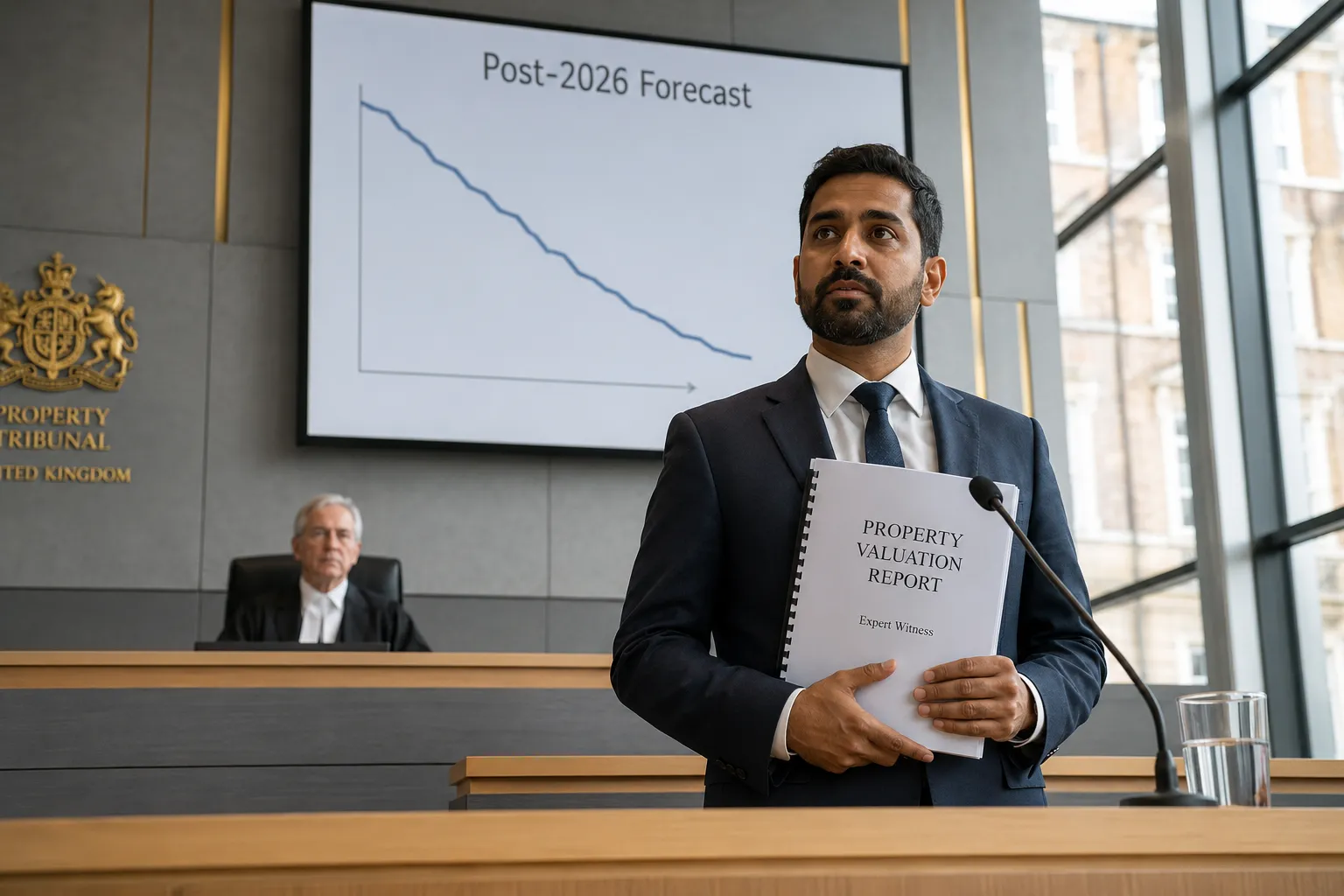
Yes, an expert witness can reference predicted interest rate cuts in testimony, but only within strict boundaries. The expert must clearly distinguish between what was known or reasonably foreseeable at the valuation date and what is known with hindsight.
Permissible: Citing published Bank of England forward guidance, market swap rates, or consensus forecasts that were publicly available at the valuation date as evidence of market expectations.
Not permissible: Asserting that a property would have been worth more because rates subsequently fell, without demonstrating that those future cuts were already priced into the market at the relevant date.
The distinction is subtle but legally significant. Courts have consistently held that valuations must reflect the market as it was, not as it turned out to be. An expert who conflates market expectations with market outcomes risks having their evidence challenged as speculative.
.ew-calc{font-family:Arial,sans-serif;max-width:480px;margin:2em auto;background:#f7f9fc;border:1px solid #d0d9e8;border-radius:8px;padding:1.5em}
.ew-calc h3{margin:0 0 1em;font-size:1.1em;color:#1a2e4a}
.ew-calc label{display:block;font-size:.85em;color:#444;margin:.8em 0 .2em}
.ew-calc select,.ew-calc input{width:100%;padding:.5em;border:1px solid #bcc8d8;border-radius:4px;font-size:.9em;box-sizing:border-box}
.ew-calc button{margin-top:1.2em;width:100%;padding:.7em;background:#1a2e4a;color:#fff;border:none;border-radius:4px;font-size:.95em;cursor:pointer}
.ew-calc button:hover{background:#2a4a7a}
.ew-result{margin-top:1em;padding:.9em;background:#e8f0fb;border-radius:4px;font-size:.9em;color:#1a2e4a;display:none}
.ew-result strong{display:block;font-size:1.05em;margin-bottom:.3em}
Expert Witness Cost Estimator (UK, 2026)
function ewCalc(){
var t=document.getElementById(‘ew-type’).value;
var h=document.getElementById(‘ew-hearing’).value;
var j=document.getElementById(‘ew-joint’).value;
var base={res:[2000,6000],com:[5000,15000],lease:[3000,9000],tax:[3500,10000]}[t];
var lo=base[0],hi=base[1];
if(h===’yes’){lo+=1500;hi+=4000;}
if(h===’yes2′){lo+=3000;hi+=8000;}
if(j===’yes’){lo+=600;hi+=1500;}
var r=document.getElementById(‘ew-result’);
r.style.display=’block’;
r.innerHTML=’Estimated range: £’+lo.toLocaleString()+’, £’+hi.toLocaleString()+’Figures are indicative for England & Wales (2026). Actual fees depend on expert seniority, report complexity, and disbursements. Always obtain a written fee estimate before instruction.’;
}
Frequently Asked Questions
What is the overriding duty of an expert witness in a UK property valuation dispute?
The expert witness's overriding duty is to the court or tribunal, not to the instructing party. This means the expert must provide honest, impartial opinion even if it is unhelpful to the party paying their fees. RICS and CPR Part 35 both make this explicit.
Can a RICS surveyor act as both valuer and expert witness in the same case?
A RICS surveyor can produce a Red Book valuation and then act as expert witness presenting that valuation in proceedings, provided they had no prior conflicting involvement with the property or parties. However, the report submitted to court must meet the separate requirements of the RICS Expert Witness Standard, not just Red Book standards.
How far back can interest rate evidence be used in a valuation dispute?
There is no fixed time limit, but the evidence must be relevant to the valuation date. Comparables and market data from periods with materially different rate conditions require explicit adjustment and explanation. Courts are generally sceptical of comparables more than 12 to 18 months from the valuation date unless the expert provides strong justification.
What happens if two expert witnesses reach different valuations?
Courts will typically direct the experts to produce a joint statement identifying areas of agreement and disagreement. The judge then evaluates the competing methodologies. A well-reasoned, transparent methodology generally carries more weight than a higher or lower figure alone.
Is an RICS expert witness report admissible in HMRC tax disputes?
Yes. HMRC accepts RICS-compliant expert valuation reports in disputes over inheritance tax, capital gains tax, and stamp duty land tax. The report must state the basis of value (usually Market Value as defined by RICS and HMRC), the valuation date, and the methodology used.
How long does it take to prepare an expert witness report for a valuation dispute?
A straightforward residential case typically requires four to eight weeks from instruction to report delivery, assuming prompt access to the property and comparable data. Complex commercial or multi-property cases can take three to six months. Instructing early is critical, courts rarely grant extensions because an expert was instructed late.
Conclusion
Expert Witness Preparation for Interest Rate Cut Valuation Disputes: RICS Strategies Post-2026 Forecasts is a field that demands both technical rigour and procedural precision. The shift to an easing rate environment since 2024 has introduced new complexity: comparables now span materially different rate regimes, yield assumptions require more explicit justification, and forward-looking rate forecasts must be handled with particular care to avoid the appearance of hindsight bias.
Actionable next steps for property owners, landlords, and professionals:
- If a valuation dispute is emerging, instruct a RICS-qualified expert witness early, before formal proceedings if possible.
- Ensure any expert you instruct holds current Registered Valuer status and has demonstrable experience in the relevant property sector.
- Ask your expert to confirm they are familiar with the current RICS Expert Witness Professional Standard and CPR Part 35.
- Request a clear written methodology statement explaining how rate environment differences between comparables and the valuation date will be handled.
- Use the cost estimator above to budget realistically before committing to proceedings.
For specialist support with expert witness reports or independent property valuations, Prince Chartered Surveyors provides RICS-qualified expertise across residential, commercial, and specialist valuation contexts throughout the UK.
Tags: expert witness property valuation, RICS expert witness, interest rate valuation disputes, Red Book standards, property valuation disputes UK, RICS chartered surveyor, post-2026 interest rate forecasts, valuation dispute evidence, CPR Part 35 property, expert witness report preparation, Bank of England rate cuts property, leasehold valuation disputes