

Between 2016 and 2026, London's property market grew by just 10% — while the national average climbed 41% [3]. That ten-percentage-point gap is not merely a headline statistic. It is the kind of divergence that ends up in tribunals, arbitration hearings, and civil litigation. When markets move at radically different speeds across regions, valuations become contested ground — and the expert witness who steps into that ground without rigorous preparation risks undermining both their credibility and their client's case.
Expert Witness Preparation for Cooling House Price Disputes: RICS Strategies in England's 2026 Regional Contrasts sits at the intersection of professional surveying standards, legal procedure, and rapidly shifting market data. This article equips RICS-accredited surveyors and legal teams with the evidence-building frameworks, methodological safeguards, and courtroom-ready documentation strategies needed to navigate valuation disputes in a market defined by stark geographic inequality.
Key Takeaways
- England's 2026 property market is deeply fragmented: the North East recorded 9.9% annual price growth while London fell 2.1%, creating fertile conditions for valuation disputes [1].
- RICS expert witnesses must anchor every opinion to the RICS Red Book (Valuation — Global Standards) and demonstrate methodology transparency to withstand cross-examination.
- Regional divergence demands location-specific comparable evidence; national averages are legally insufficient as the sole basis for a valuation opinion.
- Cooling market conditions — driven by mortgage rates averaging 5.68% and the highest housing supply since 2015 — shift the burden of proof in price-reduction disputes [2].
- Structured report preparation, clear separation of fact from opinion, and familiarity with Civil Procedure Rules Part 35 are non-negotiable for court-ready expert witnesses.

England's 2026 Market Landscape: Why Regional Contrasts Fuel Disputes
Understanding the litigation environment begins with understanding the data. As of April 2026, the average UK house price stood at £270,000 — a 3.8% annual increase [1]. England's average was slightly higher at £291,000, reflecting 3.9% annual growth [1]. On the surface, these figures suggest a stable, modestly growing market. Beneath the surface, the picture is far more turbulent.
The Regional Divide in Numbers
| Region | Annual Price Change (April 2026) | Average Price |
|---|---|---|
| North East | +9.9% | Below national avg |
| England (overall) | +3.9% | £291,000 |
| UK (overall) | +3.8% | £270,000 |
| London | -2.1% | £553,000 |
| South East | Monthly decline of 0.3% | Above national avg |
Source: UK House Price Index, April 2026 [1]
London's annual price decrease of 2.1% — combined with a 1.9% monthly increase in April 2026 — illustrates the volatility that makes expert valuation so contentious [1]. A property valued in January 2026 and disputed in June 2026 may reflect entirely different market conditions depending on the month of assessment.
Analysts have flagged potential house price declines of up to 5% nationally during 2026, driven by geopolitical instability, elevated borrowing costs, and weakened consumer confidence [2]. Average two-year fixed mortgage rates reached 5.68% by May 2026, compressing buyer affordability and suppressing demand in already-stretched markets [2]. Simultaneously, the number of homes listed for sale reached its highest level since 2015, adding further downward pressure [2].
What this means for disputes: When a buyer argues that a property was overvalued at the point of sale, or when a lender pursues a surveyor for a negligent valuation, the regional context is not background noise — it is central evidence. A valuation that was defensible in a rising North East market may be indefensible if applied using the same methodology to a contracting London market.
For surveyors advising on what to do if your home valuation is less than an offer, the regional dimension must always inform the advice given. A below-offer valuation in London in 2026 carries entirely different implications than the same scenario in Newcastle.
Expert Witness Preparation for Cooling House Price Disputes: RICS Strategies in England's 2026 Regional Contrasts — Building the Evidence Base

The foundation of any expert witness instruction is the quality of the evidence base. In cooling or divergent markets, weak evidence selection is the most common reason expert opinions fail under cross-examination.
Selecting Comparable Evidence in a Fragmented Market
RICS guidance requires that valuation opinions be grounded in market evidence. In a uniform, rising market, finding reliable comparables is relatively straightforward. In England's 2026 landscape — where North East prices rose nearly 10% while London fell — the selection of comparables requires explicit justification.
Core principles for comparable selection:
- Temporal proximity: Comparables should ideally fall within three to six months of the valuation date. In volatile markets, even a three-month-old comparable may require adjustment.
- Geographic precision: National or even regional averages are insufficient. Comparables must reflect the specific sub-market — postcode level where possible.
- Property type matching: A detached house comparable cannot be applied to a terraced property without documented adjustment methodology.
- Transaction type: Only arm's-length open market transactions should be used. Distressed sales, auction results, and related-party transactions require explicit flagging and adjustment.
Understanding the top three things looked at during a property valuation — location, condition, and comparable evidence — helps frame why each element must be documented with equal rigour in litigation contexts.
Documenting Market Conditions at the Valuation Date
One of the most powerful tools an expert witness can deploy is a contemporaneous market conditions statement. This is a structured narrative that captures the state of the local market at the specific date of the valuation in dispute.
A robust market conditions statement should include:
- Published HM Land Registry data for the relevant postcode district
- RICS Housing Market Survey data for the quarter
- Local estate agent activity reports (supply and demand indicators)
- Mortgage availability and prevailing rates at the valuation date
- Any material local factors (planning decisions, infrastructure changes, employer relocations)
"An expert witness who can demonstrate that they understood the market conditions at the precise moment of valuation — not just the general trend — commands significantly more authority in tribunal proceedings."
This is particularly important given that London recorded a 1.9% monthly price increase in April 2026 alone [1], meaning a valuation conducted in March versus May of the same year could legitimately differ by several percentage points without any negligence occurring.
Condition Evidence and Its Role in Valuation Disputes
Property condition is frequently a secondary battleground in valuation disputes. A surveyor who valued a property without adequately investigating structural defects may face claims that the valuation was inflated. Equally, a buyer who argues a property was overvalued must demonstrate that the condition issues were discoverable at the time of inspection.
Reviewing common defects in older homes provides a useful checklist for expert witnesses assessing whether a surveyor's original inspection was adequate. Defects such as subsidence, damp penetration, and roof deterioration are the most commonly cited in valuation negligence claims. Understanding what causes moisture in buildings is equally relevant when assessing whether a surveyor should have identified moisture-related devaluation factors.
For properties where the level of survey instructed is itself in dispute, the distinction between survey types is material. The difference between a Level 2 and Level 3 survey determines what a surveyor was contractually obliged to investigate — and therefore what they can be held liable for missing.
RICS Standards, Civil Procedure Rules, and Report Architecture
Expert witness work in property valuation disputes is governed by two parallel frameworks: RICS professional standards and the Civil Procedure Rules (CPR). Failure to comply with either can result in the expert's evidence being excluded or given reduced weight.
RICS Red Book Compliance
The RICS Valuation — Global Standards (commonly called the Red Book) sets out the mandatory bases of value, valuation approaches, and reporting requirements. For litigation purposes, the most relevant provisions concern:
- Basis of value: The expert must clearly state whether the opinion is based on Market Value, Market Rent, or another defined basis. Using the wrong basis — even inadvertently — can invalidate the entire opinion.
- Valuation date: The opinion must be tied to a specific date. In disputes about historical valuations, the expert is opining on what the market value was at a past date, not what it is today.
- Assumptions and special assumptions: Any departure from standard market conditions must be explicitly flagged as an assumption or special assumption. In cooling markets, assumptions about typical marketing periods deserve particular scrutiny.
Civil Procedure Rules Part 35
CPR Part 35 governs expert evidence in civil proceedings in England and Wales. Key obligations include:
- The expert's overriding duty is to the court, not to the instructing party.
- The report must contain a statement of truth and a declaration of compliance with CPR Part 35.
- The expert must clearly distinguish between facts, agreed facts, and opinions.
- Where there is a range of defensible opinions, the expert must acknowledge that range rather than presenting only the most favourable view.
Common CPR Part 35 failures in property disputes:
| Failure Type | Impact on Credibility |
|---|---|
| Advocacy masquerading as opinion | Report may be struck out |
| Failure to acknowledge contrary evidence | Severely undermines cross-examination |
| Undisclosed assumptions | Opens methodology to challenge |
| Inconsistent comparable selection | Suggests cherry-picking |
Structuring the Expert Witness Report
A court-ready expert witness report in a property valuation dispute should follow a clear architecture:
- Executive summary — key opinion and basis in plain language
- Instructions received — verbatim or summarised instruction from solicitors
- Documents reviewed — complete list of all materials considered
- Factual background — property description, transaction history, planning status
- Market conditions analysis — regional and local market data at valuation date
- Methodology — comparable selection, adjustments, and reasoning
- Valuation opinion — stated with confidence interval where appropriate
- Matters outside expertise — explicit acknowledgement of limitations
- Statement of truth and CPR declaration
For complex properties or those with significant defects, a Level 3 full building survey may form part of the evidence base, particularly where the original surveyor's scope of inspection is in dispute. Understanding building survey timeframes is also relevant when assessing whether an original surveyor had adequate time to conduct a thorough inspection.
Expert Witness Preparation for Cooling House Price Disputes: RICS Strategies in England's 2026 Regional Contrasts — Practical Preparation Techniques
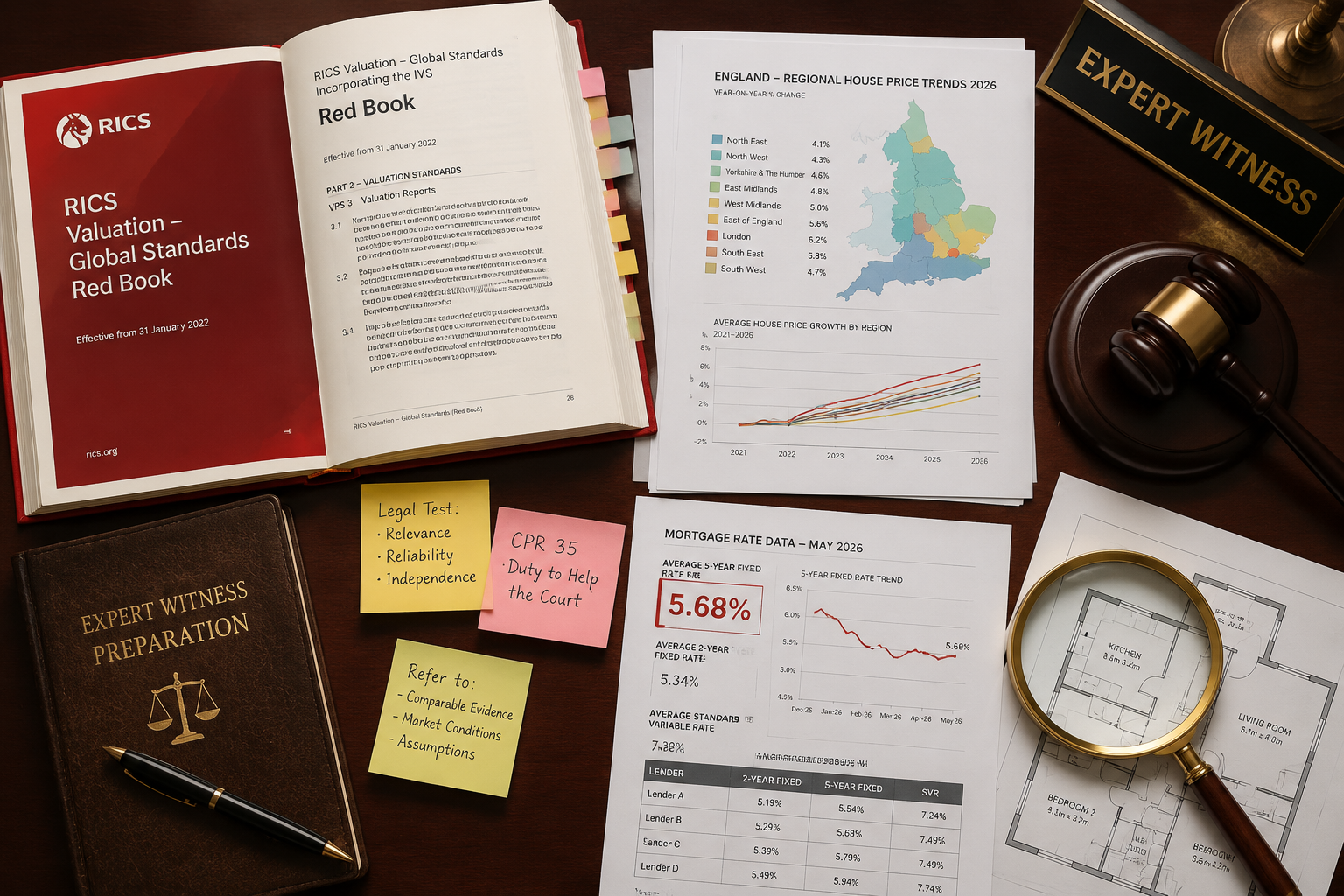
The gap between a technically competent valuation opinion and a persuasive expert witness performance often comes down to preparation discipline. The following techniques are drawn from established RICS guidance and litigation practice.
Pre-Instruction Due Diligence
Before accepting an expert witness instruction, a surveyor should conduct a conflict of interest check and assess whether the instruction falls within their genuine area of expertise. An expert who regularly values residential property in Surrey is not automatically qualified to opine on commercial property in Manchester — and a court will probe this.
Questions to ask before accepting instruction:
- Does the subject property fall within the geographic area of my regular practice?
- Do I have access to the comparable evidence needed to form an independent opinion?
- Is the valuation date within a period for which I have contemporaneous market knowledge?
- Have I previously acted for either party in any capacity?
Handling the Regional Divergence Challenge
England's 2026 regional contrasts present a specific preparation challenge: the expert must be able to explain why a valuation methodology appropriate in one region is inappropriate in another, in terms that a non-specialist judge or arbitrator can follow.
A useful technique is the market narrative bridge — a concise written explanation that connects raw data (regional price indices, transaction volumes, mortgage approval rates) to the specific property and valuation in dispute. This narrative should be written at a level accessible to a non-specialist reader, avoiding jargon without sacrificing precision.
For example, explaining that London's 2.1% annual price decline [1] reflects a structural affordability ceiling — rather than cyclical weakness — requires a different analytical frame than explaining the North East's 9.9% growth as catch-up from a historically undervalued base [5]. Both explanations require evidence; neither should be asserted without support.
Preparing for Cross-Examination
Cross-examination in property valuation disputes typically targets three areas:
- Comparable selection: Why were these comparables chosen and not others? The expert must be able to defend every inclusion and exclusion.
- Adjustments: How were adjustments for differences in size, condition, location, and time calculated? Undocumented adjustments are the most common point of attack.
- Market conditions: Did the expert adequately account for the state of the market at the valuation date? In a cooling market, failure to apply a downward time adjustment can be fatal to the opinion.
Preparation should include a mock cross-examination exercise with the instructing solicitor, working through the opposing expert's likely challenges. Where a joint statement of experts is required under CPR Part 35, the areas of agreement and disagreement must be clearly documented before the hearing.
The Role of Survey Quality in Establishing Negligence
In cases where the dispute centres on whether the original surveyor met the required standard of care, the expert witness must be able to articulate what a competent surveyor would have done differently. This requires familiarity with the RICS guidance in force at the time of the original instruction.
Understanding how to negotiate a house price down after a survey illustrates the practical downstream consequences of a survey that identifies material defects — and by extension, the harm caused when such defects are missed. Similarly, understanding what is covered in a RICS HomeBuyer Report is essential when the original instruction was for that specific product, as the scope of duty differs from a full building survey.
Conclusion
England's 2026 property market presents expert witnesses with both a challenge and an opportunity. The challenge is that regional divergence — from the North East's near-10% growth to London's 2.1% decline [1] — makes every valuation opinion inherently context-dependent and therefore contestable. The opportunity is that a well-prepared expert witness, armed with granular regional data, RICS-compliant methodology, and a court-ready report structure, can provide the kind of authoritative, transparent opinion that resolves disputes efficiently and withstands the most rigorous cross-examination.
Actionable next steps for surveyors and legal teams:
- Audit your comparable database to ensure it reflects 2026 sub-market conditions, not national averages.
- Review CPR Part 35 compliance requirements and update your standard report template accordingly.
- Build a contemporaneous market conditions library for your primary practice areas, updated quarterly.
- Conduct at least one mock cross-examination per instruction before any hearing or tribunal.
- Engage instructing solicitors early to clarify the valuation date, basis of value, and scope of the expert's opinion before drafting begins.
- Where condition evidence is central to the dispute, commission or review a full building survey to establish the property's state at the relevant date.
The courts expect RICS expert witnesses to be the most reliable source of property valuation opinion available. In a market as fractured as England's in 2026, meeting that expectation demands preparation that goes well beyond pulling a few comparables from the Land Registry database.
References
[1] UK House Price Index For April 2026 – gov.uk
[2] Could House Prices Fall – moneyweek.com
[3] London House Prices – moneyweek.com
[4] House Prices – moneyweek.com
[5] Regional UK House Price Trends 2026 – offerhound.co.uk