

Only 38% of UK construction projects completed in Q4 2025 finished on time and within budget, according to industry cost benchmarking data — a figure that helps explain why construction disputes continue to flood arbitration panels and Technology and Construction Court (TCC) dockets in 2026 [2]. For expert witnesses navigating this environment, the challenge is not simply knowing the facts. It is presenting those facts with the precision, impartiality, and methodological rigour that modern tribunals demand.
Expert Witness Preparation for Construction Monitor Insights: Dispute Strategies from Q4 2025 Recovery Data sits at the intersection of two converging forces: a construction sector experiencing a shallow, uneven technical recovery and a legal landscape that places ever-greater scrutiny on expert opinion evidence. Understanding how to bridge these two worlds is now a core professional competency for chartered surveyors, project monitors, and construction consultants who find themselves instructed as expert witnesses.

Key Takeaways
- The Q4 2025 construction recovery is technically positive but operationally fragile, making contemporaneous monitoring data the cornerstone of credible expert testimony.
- Forward indicators from RICS and other bodies signal only gradual improvement into 2026, which experts must reflect honestly in causation and quantum analyses rather than relying on optimistic project baselines.
- Courts and arbitral tribunals continue to reinforce that expert witnesses owe their primary duty to the tribunal, not the instructing party — a principle that shapes every stage of preparation.
- Procedural scrutiny of expert disclosure has intensified in 2025-26, raising the premium on consistent, well-documented opinions that can withstand cross-examination.
- Multidisciplinary expert teams anchored in rigorous cost and schedule analytics are now standard practice in high-value construction disputes.
The Q4 2025 Construction Landscape and What It Means for Disputes
A Technical Recovery with Structural Weaknesses
RICS data from late 2025 describes UK construction activity as "subdued," with forward indicators pointing to only a gradual recovery through 2026 [1]. The headline figures mask significant variation. Residential starts showed modest improvement, but infrastructure and commercial sectors remained under persistent margin pressure driven by elevated material costs, labour shortages, and financing constraints [2].
Gordian's Construction Cost Insights Report for Q4 2025 reinforces this picture, documenting continued cost escalation in key material categories and labour rates that outpaced project contingency allowances set at contract award [5]. For expert witnesses, this is not background noise. It is the evidentiary foundation on which causation arguments are built or dismantled.
Why this matters for dispute strategy:
- Contractors claiming delay damages must demonstrate that cost overruns were caused by specific events, not by the broader market conditions affecting all participants.
- Employers defending against extension of time claims need experts who can isolate project-specific failures from sector-wide pressures.
- Lenders and funders relying on construction monitoring reports require experts who can distinguish between recoverable programme slippage and systemic project failure.
The IMA Corporation's Q4 2025 construction market analysis notes a "technical recovery" in new starts but flags persistent subcontractor insolvency risk and supply chain fragility as ongoing dispute triggers [2]. Expert witnesses who fail to account for these macro conditions in their opinions risk having those opinions characterised as unrealistic or partisan.
For a broader understanding of how construction sector trends intersect with professional surveying practice, the complete 2025 review of building surveyor practice in London provides useful contextual grounding.
Core Principles of Expert Witness Preparation for Construction Monitor Insights
The Duty to the Tribunal Comes First
The Bond Solon Expert Witness Survey 2025 found that procedural compliance and impartiality remain the two most scrutinised aspects of expert evidence, with courts increasingly willing to exclude or discount opinions that appear to advocate for the instructing party rather than assist the tribunal [10]. This is not a new principle, but its enforcement has sharpened.
"The expert's overriding duty is to the court. That duty overrides any obligation to the person from whom the expert has received instructions or by whom the expert is paid." — CPR Part 35
For construction experts specifically, this means that monitoring data, progress valuations, and site inspection records must be presented as they are — not as the instructing party wishes they were. When Q4 2025 recovery data shows that delays were partly attributable to market-wide labour shortages rather than employer interference, a credible expert says so, even if it partially undermines the instructing party's case.
Anchoring Opinions in Construction Monitoring Data
Expert Witness Preparation for Construction Monitor Insights: Dispute Strategies from Q4 2025 Recovery Data requires a disciplined approach to evidence selection. Construction monitoring data — progress records, interim valuations, site diaries, photographic records, and contemporaneous correspondence — has moved from being background context to being primary evidence in 2025-26 dispute practice [8].
Key monitoring documents that experts must master:
| Document Type | Primary Use in Disputes | Common Pitfalls |
|---|---|---|
| Progress reports | Establishing actual vs planned programme | Gaps in reporting periods |
| Interim valuations | Quantifying work done and payment disputes | Inconsistent measurement bases |
| Site inspection records | Evidencing defects and causation | Lack of contemporaneous dating |
| Cost reports | Supporting or challenging quantum claims | Mixing actual and forecast costs |
| Weather and ground condition logs | Force majeure and delay analysis | Incomplete or retrospective records |
Experts who rely on reconstructed records rather than contemporaneous documentation face significant credibility challenges under cross-examination [6]. The preparation phase must therefore include a thorough audit of what monitoring data actually exists, what is missing, and how gaps will be addressed in the expert report.
For professionals involved in construction projects and sustainability, maintaining robust contemporaneous records is not just good project management — it is dispute prevention.
Dispute Strategies Informed by Q4 2025 Recovery Data
Framing Causation in a Recovery Market
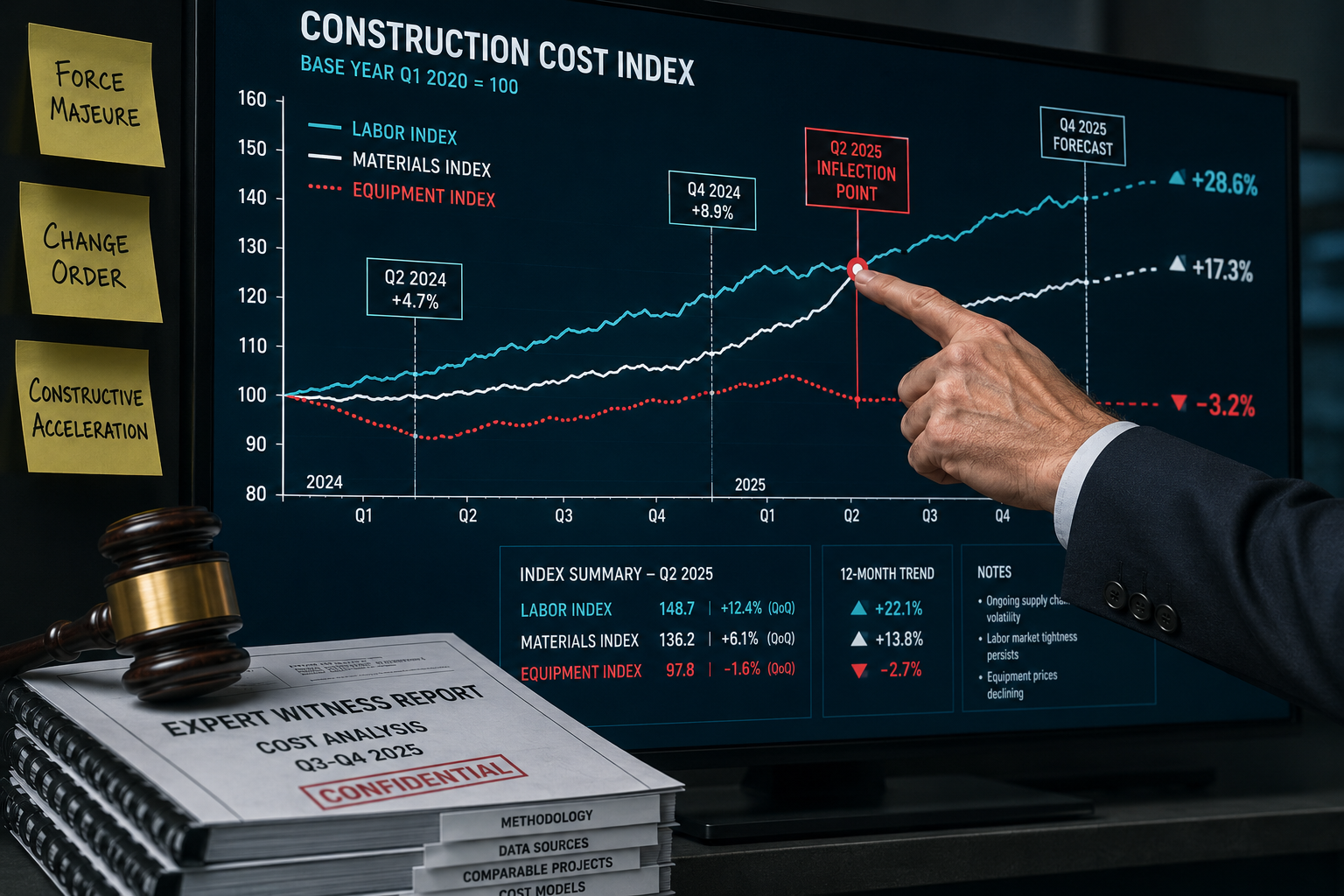
Expert Witness Preparation for Construction Monitor Insights: Dispute Strategies from Q4 2025 Recovery Data demands particular care in how causation is framed. In a genuine boom market, delay claims are relatively straightforward: the contractor was on site, resources were available, and something specific went wrong. In a fragile recovery market like Q4 2025, the causal picture is far more complex.
RICS forward indicators for 2026 show that tender price inflation, while moderating, remains above pre-2022 norms [1]. This means that project baselines set in 2023 or 2024 are likely to be materially different from actual out-turn costs, not because of any party's breach, but because of market movement. Experts must be equipped to:
- Distinguish concurrent delays — separating employer-caused, contractor-caused, and neutral delay events using recognised methodologies such as Time Impact Analysis or Windows Analysis.
- Apply appropriate cost indices — using published Q4 2025 cost data rather than contract-date indices when assessing prolongation costs [5].
- Address mitigation obligations — demonstrating whether the claiming party took reasonable steps to reduce delay and cost in the prevailing market conditions.
- Account for subcontractor insolvency — a significant Q4 2025 risk factor that affects both programme and cost claims [2].
Structuring the Expert Report for Maximum Credibility
Blake's guidance on making effective use of expert evidence emphasises that the structure and internal consistency of an expert report is as important as its substantive content [4]. A report that reaches the right conclusion through flawed methodology will be attacked at that methodological level, potentially invalidating the conclusion entirely.
Best practice report structure for construction disputes:
- Instructions and scope — clearly state what the expert was asked to do and what falls outside the report's scope.
- Documents reviewed — list every document considered, including monitoring reports, programmes, and cost data.
- Methodology — explain the analytical approach and why it was chosen over alternatives.
- Findings — present findings separately from opinions, making the logical chain transparent.
- Opinions — state opinions clearly, with confidence levels where appropriate.
- Areas of uncertainty — acknowledge limitations in the data or analysis honestly.
The HKIS CPD guidance on expert evidence reinforces that courts place significant weight on experts who acknowledge the boundaries of their knowledge rather than overreaching [7]. In the context of Q4 2025 recovery data, this means being explicit about the limitations of forward-looking market projections.
Understanding building defects surveys and building pathology is essential background for experts dealing with defect-related construction disputes, where the technical analysis must be as rigorous as the legal framing.
Cross-Examination Resilience: Preparation Strategies
SOCOTEC's expert witness testimony guidance identifies cross-examination resilience as the single most important differentiator between effective and ineffective expert witnesses [9]. In construction disputes informed by Q4 2025 recovery data, cross-examination will typically focus on three areas:
1. The reliability of the underlying data
Opposing counsel will probe whether monitoring records are complete, contemporaneous, and consistent. Experts should be prepared to explain any gaps and to demonstrate that their analysis is robust even where data is imperfect.
2. The appropriateness of the methodology
With multiple recognised delay analysis methodologies available, experts will be challenged on why they chose a particular approach. The answer must be grounded in the specific facts of the dispute, not simply professional preference.
3. The independence of the opinion
The Bond Solon 2025 survey found that 67% of expert witnesses reported being pressured by instructing parties to modify their opinions [10]. Experts must be able to demonstrate, through their working papers and communications, that their opinion was formed independently and has remained consistent throughout the proceedings.
Building a Multidisciplinary Expert Team
Why Single-Expert Approaches Are Increasingly Inadequate
The Expert Witness Insights platform documents a clear trend in 2025-26 toward multidisciplinary expert teams in complex construction disputes [3]. A high-value delay and disruption claim, for example, may require:
- A delay analyst to address programme and critical path issues
- A quantum expert to address prolongation costs and loss of productivity
- A technical expert (structural engineer, building surveyor, or specialist) to address defect causation
- A market expert to contextualise Q4 2025 cost and programme data within sector norms
Coordinating these experts requires a lead expert or legal team with the experience to ensure that opinions are consistent, that there is no inadvertent overlap or contradiction, and that the overall expert case supports a coherent legal theory [4].
For disputes involving party wall awards or basement construction in complex urban environments, the technical and legal dimensions are particularly intertwined, requiring expert witnesses who understand both the surveying and legal frameworks in depth. Similarly, professionals familiar with urgent or dangerous building issues bring critical technical insight to disputes where safety-critical defects are at the heart of the claim.
Data-Driven Preparation in 2026
The Expert Witness Insights platform and JD Supra's construction industry commentary both highlight a shift toward data-driven expert preparation, with analytics tools enabling more precise delay quantification and cost modelling than was possible even three years ago [3][8]. For Q4 2025 disputes specifically, this means:
- Using published cost indices (Gordian, BCIS, Aecom) to benchmark actual costs against market norms [5]
- Applying BIM data and digital site records where available to reconstruct programme events
- Leveraging drone survey data and photographic records to establish contemporaneous site conditions
- Cross-referencing RICS construction monitor data to contextualise project performance against sector benchmarks [1]

Professionals who understand building regulation compliance testing bring an additional layer of technical credibility when disputes involve alleged non-compliance as a contributing cause of delay or cost overrun.
Practical Preparation Checklist for Construction Expert Witnesses
Before accepting instructions in a construction dispute informed by Q4 2025 recovery data, expert witnesses should work through the following preparation framework:
Stage 1: Instructions and Conflict Check
- Confirm the scope of instructions in writing
- Conduct a thorough conflict of interest check
- Agree on access to all relevant monitoring documentation
Stage 2: Document Review
- Audit all construction monitoring reports for completeness
- Identify gaps in contemporaneous records and plan how to address them
- Review Q4 2025 market data relevant to the project type and location [2][5]
Stage 3: Methodology Selection
- Select delay analysis and quantum methodologies appropriate to the available data
- Document the rationale for methodology selection
- Consider whether a joint expert or single joint expert appointment is appropriate
Stage 4: Report Drafting
- Draft opinions before discussing with legal team to preserve independence
- Ensure all opinions are supported by specific documentary references
- Have the report reviewed by a peer with relevant expertise
Stage 5: Pre-Trial Preparation
- Prepare for joint expert meetings with a clear understanding of areas of agreement and disagreement
- Anticipate cross-examination lines and prepare clear, consistent answers
- Review the expert's own previous reports and evidence for consistency [10]
Conclusion
The intersection of a fragile Q4 2025 construction recovery and heightened procedural scrutiny of expert evidence creates both challenge and opportunity for expert witnesses in 2026. The challenge is clear: disputes are more complex, data requirements are more demanding, and tribunals are less tolerant of opinion evidence that lacks methodological rigour or appears partisan. The opportunity is equally clear: experts who invest in structured preparation, anchor their opinions in robust construction monitoring data, and maintain genuine independence will carry disproportionate weight in proceedings.
Actionable next steps for expert witnesses and instructing parties:
- Engage experts early — before the dispute crystallises, so that monitoring data is preserved and the expert can observe conditions contemporaneously.
- Audit your monitoring records now — gaps in progress reports, valuations, and site diaries will be exploited in cross-examination.
- Contextualise project data against Q4 2025 market benchmarks — using RICS, Gordian, and IMA data to demonstrate whether project performance was within or outside sector norms.
- Invest in cross-examination preparation — role-play sessions, mock cross-examinations, and consistency reviews are not optional extras in high-value disputes.
- Build multidisciplinary teams where the claim requires it — a single expert stretching beyond their core competence is a liability, not an asset.
Expert Witness Preparation for Construction Monitor Insights: Dispute Strategies from Q4 2025 Recovery Data is ultimately about credibility. In a market where the recovery is real but fragile, and where tribunals are sophisticated consumers of expert evidence, credibility is the expert's most valuable asset — and the one most worth protecting.
References
[1] UK Construction Activity Remains Subdued Forward Indicators Signal Gradual Recovery – rics.org
[2] Construction Markets In Focus Q4 2025 – imacorp.com
[3] Insights – expertwitnessinsights.com
[4] Making Effective Use Of Experts Expert Evidence – blakes.com
[5] Construction Cost Insights Report Q4 2025 – gordian.com
[6] Mastering Courtroom Best Practices Construction Expert Witnesses Abttc – linkedin.com
[7] CPD 2012126 – hkis.org.hk
[8] Construction Industry – jdsupra.com
[9] Expert Witness Testimony – socotec.us
[10] Expert Witness Survey 2025 – bondsolon.com