

Last updated: July 24, 2026
Quick Answer: The Courts and Tribunals Bill, introduced to Parliament in February 2026, fundamentally changes how valuation evidence is presented and assessed in UK tribunals. Expert witnesses in property disputes now face stricter admissibility thresholds, clearer duties of independence, and heightened scrutiny during cross-examination. Chartered surveyors and property professionals need to update their evidence preparation processes now to avoid having reports rejected or challenged on procedural grounds.
Key Takeaways
- The Courts and Tribunals Bill 2026 introduces statutory admissibility thresholds that valuation evidence must meet before a tribunal will accept it.
- Expert witnesses must demonstrate both technical reliability and clarity of reasoning, not just produce a figure.
- Post-budget disputes involving inheritance tax, capital gains, and leasehold valuations are among the highest-risk categories for non-compliant evidence.
- Cross-examination of valuation experts has been strengthened under the new framework, with judges given broader powers to probe methodology.
- Retraining is not mandatory, but continuing professional development aligned with the new standards is strongly advisable for all practising expert witnesses.
- Preparation timelines for compliant valuation evidence have increased: allow at least 8 to 12 weeks for complex cases.
- Experts whose reports fail to meet 2026 standards risk having their evidence excluded entirely, which can determine the outcome of a case.
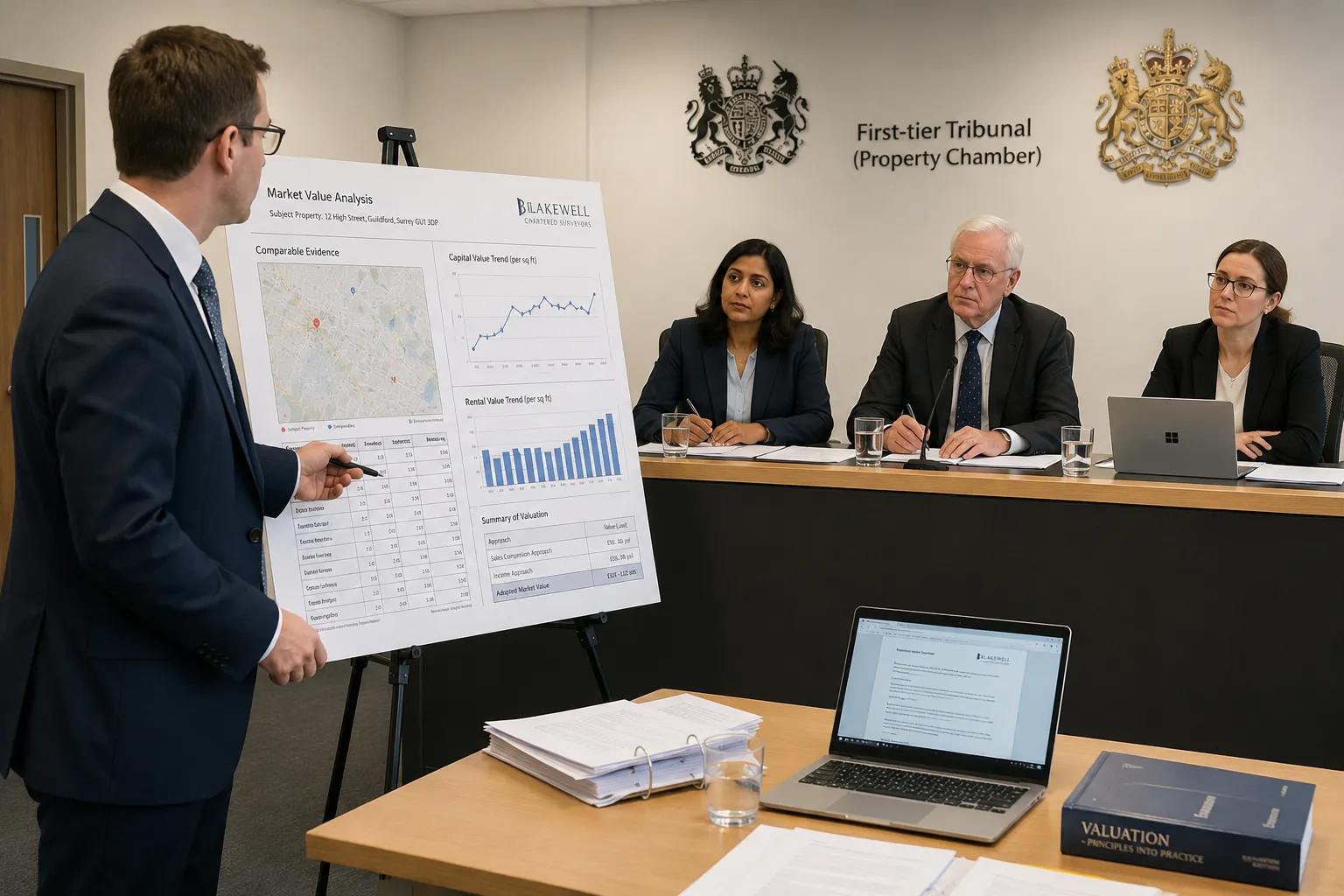
What Are the Main Changes to UK Tribunal Procedures in 2026?
The Courts and Tribunals Bill 2026 is the central legislative vehicle driving the most significant overhaul of tribunal procedure in over a decade. Introduced to Parliament on 25 February 2026, the Bill reshapes how evidence is admitted, how experts are scrutinised, and how complex financial and property cases are managed.
Key procedural changes include:
- Statutory admissibility thresholds: Tribunals can now apply clearer statutory tests to decide whether expert evidence, including property valuations, is sufficiently reliable to be admitted.
- Stronger judicial case management: Judges have expanded powers to direct how expert evidence is presented, including requiring single joint experts in lower-value disputes.
- New Bench Division for complex financial cases: A dedicated division handles cases involving complex fraud, financial instruments, and high-value property disputes, reducing delays.
- Special measures extended: Provisions protecting vulnerable witnesses have been broadened, with knock-on implications for how expert evidence is framed in cases involving personal circumstances.
- Judge-alone trials in complex fraud: For complex financial cases, trial by judge alone is now permitted in the Crown Court, which affects how valuation evidence is pitched, written clarity matters more when there is no jury to persuade.
For property professionals, the practical effect is that a valuation report that would have passed scrutiny in 2024 may now be challenged or excluded if it does not meet the new reliability and clarity standards.
How Will the 2026 Budget Reforms Affect Expert Witness Testimony Requirements?
The October 2024 Budget introduced changes to inheritance tax on agricultural and business property, adjusted capital gains tax rates, and altered stamp duty thresholds. These changes have generated a significant pipeline of tribunal disputes that are now being heard under the 2026 procedural framework.
Expert witness testimony requirements have shifted in three important ways as a result:
- Valuation date precision: Post-budget disputes often hinge on the exact date a valuation is assessed. Experts must now clearly state the valuation date, the basis of value, and why that date was chosen, courts will not infer this.
- Methodology transparency: The new admissibility thresholds require experts to explain not just what a property was worth, but how they arrived at that figure, which comparable transactions they used, and why they weighted evidence as they did.
- Independence declaration: Expert witnesses must include a strengthened declaration confirming their overriding duty to the tribunal, not to the instructing party. This was already required under CPR Part 35, but the 2026 reforms make non-compliance a ground for exclusion rather than merely a procedural irregularity.
For disputes involving inheritance tax valuations or capital gains assessments, these requirements are not optional extras, they are now threshold conditions.
What Valuation Methods Are Now Required for Post-Budget Disputes?
No single valuation method is mandated by the 2026 reforms, but the new admissibility standards effectively require experts to justify their chosen methodology against alternatives. A report that simply applies one method without acknowledging others is now vulnerable to challenge.
The most commonly accepted approaches in post-budget tribunal disputes are:
| Method | Best Used For | Key Requirement Under 2026 Rules |
|---|---|---|
| Comparable sales analysis | Residential property | Must cite at least 3 verified comparables with adjustments explained |
| Discounted cash flow | Investment and commercial property | Discount rate assumptions must be explicitly justified |
| Residual valuation | Development land | All cost assumptions must be sourced and dated |
| Profits method | Licensed premises, hotels | Revenue forecasts must be independently supportable |
| Depreciated replacement cost | Specialist properties | Depreciation methodology must be stated and reasoned |
For leasehold disputes, which have increased sharply following the Leasehold and Freehold Reform Act 2024, leasehold extension and enfranchisement valuations require particular care, as the deferment rate and relativity assumptions are frequently contested.
"A valuation figure without a clearly reasoned methodology is not expert evidence, it is an opinion. The 2026 reforms make that distinction legally consequential."
How Do I Prepare Valuation Evidence for UK Tribunals After 2026 Reforms?
Preparing compliant valuation evidence under the new framework requires a structured approach. The following steps reflect current best practice for expert witness preparation for 2026 UK tribunal reforms and valuation evidence in post-budget disputes.
Step 1: Confirm the instruction basis
Establish whether you are instructed as a single joint expert, a party-appointed expert, or an assessor. Your duties and report format differ in each case.
Step 2: Identify the correct basis of value
Under RICS Valuation, Global Standards (Red Book), the basis of value (market value, fair value, investment value) must match the legal question being asked. Post-budget disputes often require "open market value" as at a specific historical date.
Step 3: Document your comparable evidence
Gather a minimum of three to five comparable transactions. Record the source, date, property details, and any adjustments made. Unexplained adjustments are a primary target for cross-examination.
Step 4: Produce a compliant report structure
A compliant 2026 report should include:
- Instructions received and scope of instruction
- Basis of value and valuation date
- Description of the property inspected
- Market commentary relevant to the valuation date
- Methodology chosen and alternatives considered
- Comparable evidence with adjustments
- Conclusion and opinion of value
- Expert's declaration of independence
Step 5: Review against the new admissibility criteria
Before submitting, check the report against the statutory reliability criteria introduced by the Courts and Tribunals Bill. Ask: would a tribunal be able to understand and test this reasoning without additional explanation?
For independent property valuations in dispute contexts, engaging a RICS-regulated chartered surveyor with tribunal experience is the most reliable way to meet these standards.
What Is the Difference Between Old and New Expert Witness Standards in UK Tribunals?
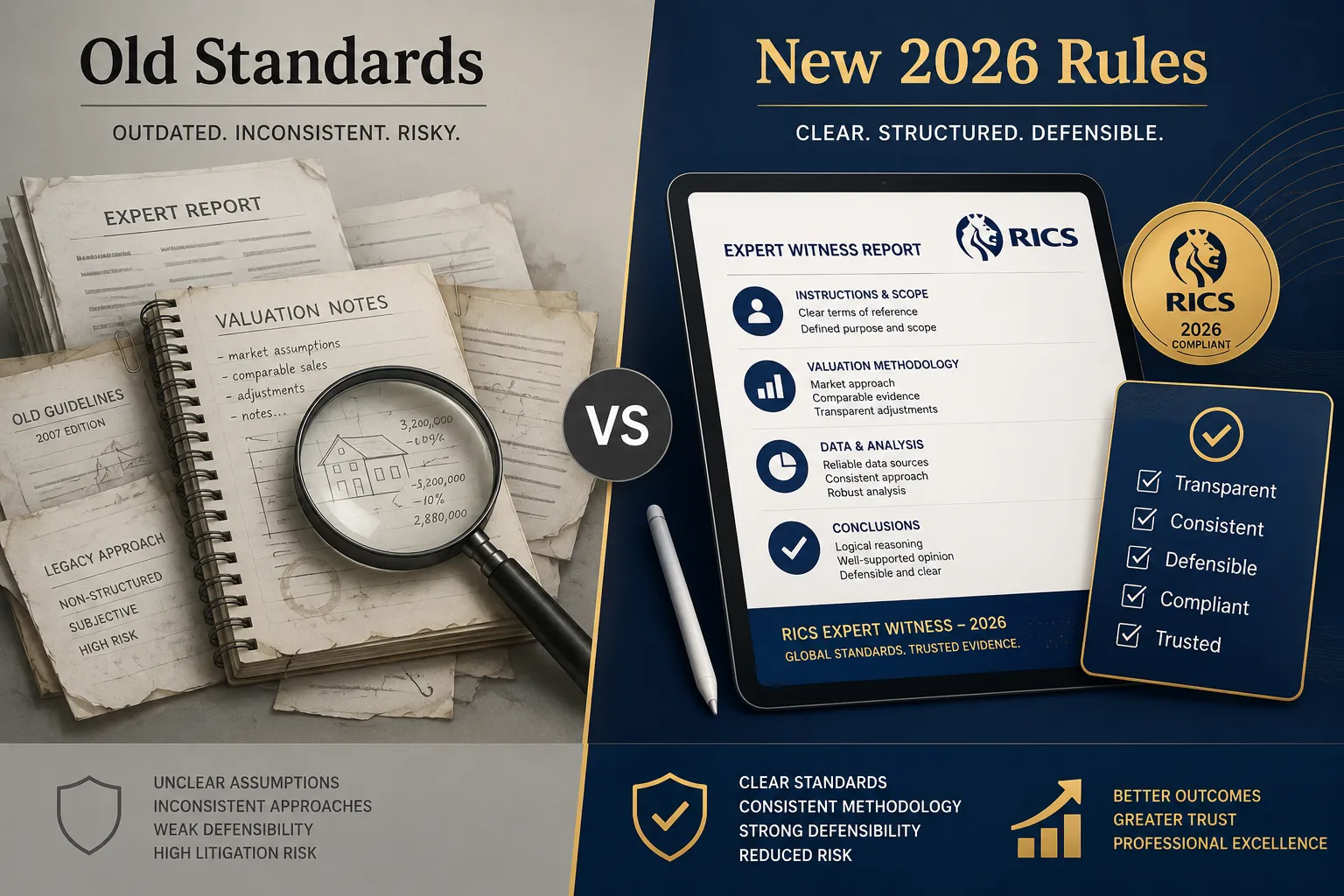
The shift from pre-2026 to post-2026 standards is less about what experts say and more about how they are required to say it. Under the old framework, procedural compliance was largely self-policed. Under the new framework, non-compliance has direct legal consequences.
Before 2026:
- Expert reports were expected to follow CPR Part 35 but enforcement was inconsistent.
- Admissibility challenges based on methodology were rare and usually unsuccessful.
- Cross-examination focused primarily on the valuation conclusion.
- Independence declarations were standard but rarely tested.
After 2026:
- Statutory admissibility thresholds give tribunals a clear legal basis to exclude reports that lack methodological transparency.
- Methodology is now a primary focus of both pre-hearing review and cross-examination.
- Judges in the new Bench Division are more likely to have financial and property expertise, meaning technical shortcuts are more likely to be identified.
- Independence declarations that are formulaic rather than substantive can be challenged.
For professionals who produce expert witness reports regularly, the practical advice is to treat every report as if it will face a rigorous admissibility challenge, even in lower-value cases.
Which Types of Disputes Need Updated Valuation Approaches Post-2026?
Several dispute categories have been directly affected by the combination of post-budget legislative changes and the 2026 tribunal reforms. Updated valuation approaches are most critical in:
- Inheritance tax disputes: The 2024 Budget's changes to agricultural property relief and business property relief have generated a significant number of HMRC challenges. Inheritance tax valuations must now include a more detailed market commentary section.
- Capital gains tax cases: Adjusted CGT rates have increased the financial stakes in disputed valuations. See guidance on capital gains valuations for current best practice.
- Leasehold disputes: Post-Leasehold Reform Act cases require updated deferment rate assumptions and relativity tables.
- Service charge disputes: Landlord and Tenant Act cases before the First-tier Tribunal (Property Chamber) now require clearer cost justification. Service charge accounting and budgeting is a related area where professional support is advisable.
- Matrimonial and partnership dissolution: Matrimonial valuations require independence declarations that are particularly robust given the adversarial nature of these proceedings.
- Commercial property disputes: Rent reviews, lease renewals, and compulsory purchase cases all require updated methodology documentation under the new standards.
How Much Does Expert Witness Preparation Cost for 2026 Tribunal Cases?
Costs vary considerably depending on case complexity, property type, and the extent of comparable research required. The following are reasonable estimates for 2026, based on typical market rates for RICS-regulated experts in England and Wales.
- Residential property (straightforward): £1,500 to £3,500 for a compliant expert witness report.
- Residential property (complex or high-value): £3,500 to £7,500, particularly where historical valuations or multiple comparables are required.
- Commercial property: £5,000 to £15,000 or more, depending on the valuation method and level of market analysis needed.
- Attendance at tribunal hearings: Typically charged at a day rate of £800 to £2,500 for chartered surveyors with tribunal experience.
- Joint expert appointments: Generally lower in total cost, as fees are shared between parties, but the expert must be agreed upon by both sides.
These are estimates based on publicly available fee guidance and market norms. Actual costs depend on the specific expert, location, and case requirements. Always obtain a written fee estimate before instructing an expert.
What Common Mistakes Do Experts Make With Valuation Evidence in Tribunals?
The most frequent reasons valuation evidence is challenged or excluded under the 2026 framework fall into a predictable set of errors.
Methodological gaps:
- Selecting comparables without explaining why they are relevant to the subject property.
- Failing to acknowledge and address the most significant comparable that goes against the conclusion.
- Using a valuation method appropriate for one property type on a different type without justification.
Report structure failures:
- Omitting or using a formulaic independence declaration.
- Mixing advocacy with expert opinion, the report should inform the tribunal, not argue a case.
- Failing to state the valuation date clearly and separately from the inspection date.
Process errors:
- Not inspecting the property personally (or not disclosing that a desktop valuation was used).
- Relying on out-of-date comparable data without acknowledging market movements since the comparables transacted.
- Failing to update the report when new evidence emerges before the hearing.
Common mistakes also arise when experts underestimate how much the property valuation process differs between a standard market appraisal and a tribunal-standard expert report.
Do I Need to Retrain as an Expert Witness for the 2026 Tribunal Changes?
Formal retraining is not a statutory requirement under the 2026 reforms. However, the new admissibility standards and strengthened cross-examination powers mean that experts who have not updated their practice since the Bill came into force are at material risk of having their evidence challenged.
The following CPD activities are strongly advisable:
- Attending RICS-accredited training on expert witness duties post-2026.
- Reviewing the updated Practice Direction supplementing CPR Part 35.
- Familiarising yourself with the Courts and Tribunals Bill's evidence provisions, particularly the statutory reliability criteria.
- Participating in mock cross-examination exercises, which several professional bodies now offer.
Experts who are new to tribunal work should consider formal mentoring from an experienced expert witness before accepting a sole appointment in a high-value case.
How Long Does It Take to Prepare Valuation Evidence Under New Tribunal Rules?
Under the 2026 framework, preparation timelines have increased for most case types. Allow the following as minimum planning horizons:
- Straightforward residential case: 4 to 6 weeks from instruction to completed report.
- Complex residential or leasehold case: 8 to 12 weeks, particularly where historical market data requires detailed research.
- Commercial or development land case: 10 to 16 weeks, and potentially longer if a single joint expert process is used and both parties must agree on the appointment.
These timelines assume prompt access to the property for inspection and timely provision of relevant documents by the instructing party. Delays in either will extend the preparation period.
What Happens If My Valuation Evidence Does Not Meet 2026 Tribunal Standards?
Failure to meet the new standards carries serious consequences. Under the statutory admissibility framework introduced by the Courts and Tribunals Bill, a tribunal can:
- Exclude the report entirely, leaving the instructing party without expert evidence.
- Admit the report but reduce its weight, effectively treating it as background information rather than expert opinion.
- Require the expert to produce a supplementary report addressing identified deficiencies, at additional cost and delay.
- Refer the matter to RICS if the expert's conduct falls below professional standards.
In cases where a report is excluded, the instructing party may face an adverse costs order. For disputes involving significant sums, such as inheritance tax challenges or commercial lease renewals, this can represent a substantial financial loss beyond the disputed amount itself.
How Do the 2026 Reforms Affect Cross-Examination of Valuation Experts?
Cross-examination has been significantly strengthened under the 2026 framework. Judges in the new Bench Division are expected to have greater financial and technical literacy, which means that methodological weaknesses that might previously have gone unchallenged are now more likely to be identified and probed.
Specific changes affecting cross-examination include:
- Pre-hearing methodology challenges: Opposing parties can now raise admissibility objections before the hearing, meaning experts may be required to defend their methodology in writing before they reach the witness stand.
- Judicial questioning: Judges have broader powers to question experts directly on their methodology, not just on their conclusions.
- Hot-tubbing: Concurrent expert evidence (where both experts give evidence simultaneously and respond to each other's positions) is more commonly ordered in complex valuation disputes, requiring experts to be prepared to engage in real-time technical debate.
Experts who prepare thoroughly, with a clear, documented methodology and a genuine understanding of the opposing expert's position, are considerably better placed in this environment.
Are There Disputes That Do Not Need Expert Valuation Evidence After 2026?
Not every tribunal dispute requires a formal expert witness report. The 2026 reforms have also introduced proportionality measures that affect when expert evidence is required.
Disputes that may not require expert valuation evidence include:
- Low-value service charge disputes where the tribunal can assess reasonableness from documentary evidence alone.
- Cases where both parties agree on the valuation and the dispute turns on a legal point rather than a factual one.
- Small claims-track property disputes where the tribunal directs that expert evidence is disproportionate to the amount at stake.
However, even in cases where a formal report is not required, a professional valuation opinion can strengthen a party's position significantly. For homeowners uncertain about whether their situation warrants professional input, reviewing what to do if your home valuation differs from an offer provides useful context on when professional valuations add most value.
Frequently Asked Questions
What is the Courts and Tribunals Bill 2026?
The Courts and Tribunals Bill is legislation introduced to Parliament on 25 February 2026 that reforms court and tribunal procedures in England and Wales. For property disputes, it introduces statutory admissibility thresholds for expert evidence and strengthens judicial powers to manage how valuation evidence is presented and tested.
Does the 2026 tribunal reform apply to the First-tier Tribunal (Property Chamber)?
Yes. The First-tier Tribunal (Property Chamber), which hears leasehold disputes, service charge cases, and rent review matters, is within the scope of the new framework. Valuation experts appearing before it must meet the updated standards.
Can a chartered surveyor who is not RICS-registered act as an expert witness?
Technically, there is no statutory requirement for an expert witness to hold RICS membership. However, in practice, tribunals and opposing parties will scrutinise the expert's qualifications closely. RICS membership and adherence to the Red Book are widely regarded as the benchmark for credibility in property valuation disputes.
What is a single joint expert and when is one required?
A single joint expert (SJE) is appointed by both parties jointly rather than by one side alone. Under the 2026 reforms, tribunals are more likely to direct the use of an SJE in lower-value or less complex disputes as a proportionality measure. The SJE's duty is to the tribunal, not to either party.
How do I find a qualified expert witness for a post-budget property dispute?
Look for a RICS-regulated chartered surveyor with specific experience in tribunal work and the relevant property type. Check that they hold professional indemnity insurance covering expert witness work and that they can demonstrate familiarity with the 2026 procedural changes. Prince Chartered Surveyors provides expert witness reports for a range of dispute types.
Can I use the same valuation report for both HMRC and tribunal purposes?
Not without modification. A valuation prepared for HMRC (for example, for an inheritance tax return) is not automatically compliant with tribunal expert witness requirements. It will typically need to be reformatted to include the independence declaration, methodology justification, and comparable evidence sections required under the 2026 framework.
Conclusion
Expert witness preparation for 2026 UK tribunal reforms and valuation evidence in post-budget disputes is no longer a procedural formality, it is a substantive legal requirement with direct consequences for case outcomes. The Courts and Tribunals Bill has raised the bar for admissibility, strengthened cross-examination, and created a more technically demanding environment for all valuation experts appearing before UK tribunals.
Actionable next steps for property professionals and dispute parties:
- Review any existing expert witness reports against the new admissibility criteria before submitting them to a tribunal.
- Instruct a RICS-regulated chartered surveyor with documented tribunal experience for any post-budget dispute involving property valuation.
- Allow adequate preparation time, at least 8 to 12 weeks for complex cases.
- Ensure the expert's independence declaration is substantive, not formulaic.
- For leasehold, inheritance tax, or capital gains disputes, seek a specialist who understands the specific valuation assumptions those case types require.
For professional valuation support that meets 2026 tribunal standards, Prince Chartered Surveyors offers a full range of chartered surveyor valuation services, including specialist reports for dispute resolution across residential, commercial, and leasehold property types.
.cg-checker{font-family:Arial,sans-serif;max-width:560px;margin:2rem auto;background:#f4f7fb;border:1px solid #c8d6e8;border-radius:8px;padding:1.5rem}
.cg-checker h3{margin:0 0 .75rem;font-size:1.1rem;color:#1a2e4a}
.cg-checker p{font-size:.9rem;color:#444;margin:0 0 1rem}
.cg-item{display:flex;align-items:flex-start;gap:.6rem;margin:.5rem 0}
.cg-item input{margin-top:3px;accent-color:#1a5fa8}
.cg-item label{font-size:.88rem;color:#333;cursor:pointer}
.cg-btn{display:block;width:100%;margin-top:1rem;padding:.65rem;background:#1a5fa8;color:#fff;border:none;border-radius:5px;font-size:.95rem;cursor:pointer}
.cg-btn:hover{background:#154d8a}
.cg-result{margin-top:1rem;padding:.75rem;border-radius:5px;font-size:.9rem;display:none}
.cg-pass{background:#e6f4ea;color:#1e6b35;border:1px solid #a8d5b0}
.cg-fail{background:#fff3e0;color:#7a4000;border:1px solid #f0c070}
2026 Tribunal Valuation Report Readiness Checker
Check whether your expert witness report meets the key 2026 UK tribunal standards before submission.
function cgCheck(){
var items=[“c1″,”c2″,”c3″,”c4″,”c5″,”c6”],pass=true;
items.forEach(function(id){if(!document.getElementById(id).checked)pass=false;});
document.getElementById(“cg-pass”).style.display=pass?”block”:”none”;
document.getElementById(“cg-fail”).style.display=pass?”none”:”block”;
}
Tags: expert witness preparation, UK tribunal reforms 2026, valuation evidence, post-budget property disputes, chartered surveyor, RICS expert witness, property tribunal, inheritance tax valuation, capital gains valuation, leasehold disputes, Courts and Tribunals Bill, property valuation methods