

Only 3% of office buildings in major cities structurally qualify for residential conversion — yet the pipeline of proposed non-residential conversion projects continues to grow [2]. That gap between ambition and feasibility is precisely where valuation disputes are born, and where the quality of expert witness preparation determines whether a defence holds or collapses under cross-examination.
Expert Witness Preparation for 2026 Office Repurposing Disputes: Valuation Defence in Non-Resi Conversions has become one of the most technically demanding areas of property litigation practice. Subdued occupier demand, rising vacancy rates in secondary office stock, and shifting planning policy have combined to generate a new wave of contested valuations — ones that require RICS-compliant evidence, methodological rigour, and the ability to communicate complex arguments clearly to tribunals and courts.
This article sets out the core standards, practical preparation steps, and strategic considerations that chartered surveyors and their legal teams must master heading into 2026.
Key Takeaways
- RICS Practice Statements PS1 and PS2 govern expert witness conduct and override any instruction from a retaining party — compliance is non-negotiable.
- Structural unsuitability, economic viability gaps, and zoning complexity are the three primary drivers of valuation disputes in office-to-non-residential conversions.
- Goldman Sachs research indicates office acquisition prices may need to fall nearly 50% before conversion projects become financially viable, a figure that directly shapes residual valuation arguments [3].
- Comparable evidence selection, methodology transparency, and cross-examination readiness are the pillars of a defensible valuation report.
- Expert witnesses must demonstrate independence at every stage; any perception of advocacy for the instructing party undermines credibility with the tribunal.
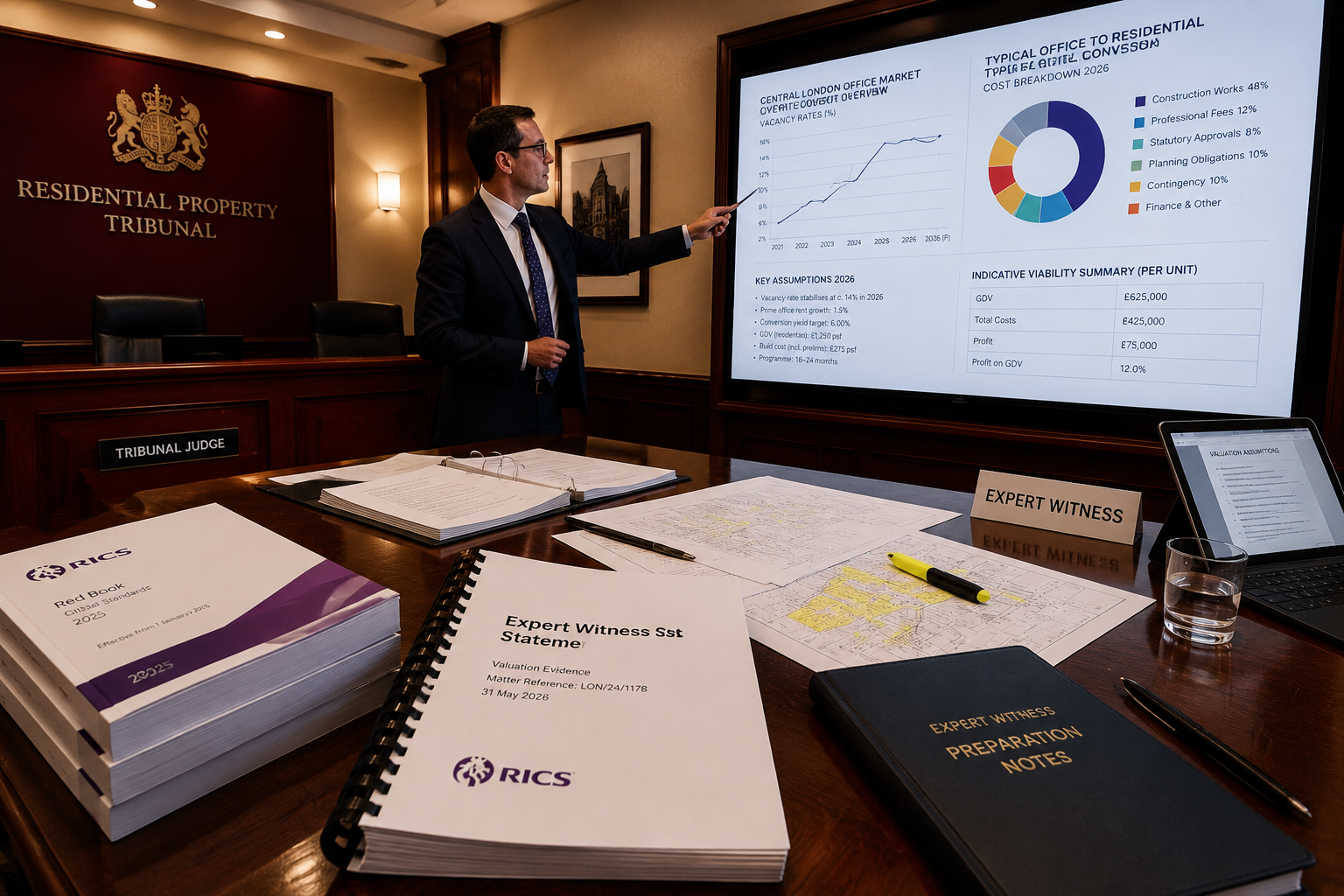
The 2026 Landscape: Why Office Repurposing Disputes Are Escalating
The commercial property market entered 2026 carrying significant structural imbalance. Remote and hybrid working patterns have permanently reduced occupier demand for large-format office floorplates, particularly in secondary locations outside core business districts. Vacancy rates in many regional office markets remain elevated, and landlords facing lease expiries are under pressure to reposition assets.
This pressure has accelerated proposals to convert underused office stock into mixed-use, residential, or other non-residential uses. However, the economics are frequently contested. Morgan Stanley has highlighted that converting underused office space faces numerous economic and logistical hurdles, including complex building and zoning regulations that vary significantly by jurisdiction [4]. When planning permissions are granted, refused, or conditioned in ways that affect value, disputes follow.
The disputes themselves take several forms:
- Compulsory purchase and compensation claims where the existing use value or conversion potential is disputed
- Lease renewal proceedings where the landlord argues for a higher rent based on alternative use potential
- Tax and rating appeals where the assessable value of a property undergoing or proposed for conversion is challenged
- Shareholder and partnership disputes where the value of a development asset is central to the disagreement [9]
In each scenario, the expert witness is asked to provide an independent, court-ready opinion on value. The quality of that opinion depends almost entirely on preparation.
For those seeking a broader understanding of how commercial assets are valued before disputes arise, the commercial valuations service offered by chartered surveyors provides a useful reference point for the methodologies typically applied.
RICS Evidence Standards: The Non-Negotiable Framework
PS1, PS2, and the Duty to the Tribunal
The RICS Practice Statement "Surveyors Acting as Expert Witnesses" (currently in its fourth edition) sets out binding obligations that every expert must understand before accepting an instruction in a non-residential conversion dispute. The two core practice statements are:
PS1 — Defines the expert's overriding duty to the tribunal or court. This duty takes precedence over any obligation to the instructing party. An expert who allows their opinion to be shaped by what the client wants to hear, rather than what the evidence supports, risks being disqualified and faces potential disciplinary action.
PS2 — Governs the form and content of the expert's report. It requires that the report be signed with a declaration confirming the expert's independence, that all material facts are disclosed, and that the basis of opinion is clearly stated.
"The expert's duty is to assist the court or tribunal, not to advocate for the party that instructed them. This principle is the foundation of all credible valuation defence work."
These obligations are not aspirational guidelines. They are enforceable professional standards, and tribunals are increasingly alert to reports that read as advocacy documents rather than independent analyses.
The RICS Red Book and Valuation Methodology
In most non-residential conversion disputes, the valuation itself must comply with the RICS Valuation — Global Standards (the Red Book). The relevant bases of value — Market Value, Market Rent, and in some cases Investment Value — must be applied correctly and the choice of basis must be justified in the report.
For office repurposing disputes specifically, the residual method of valuation is frequently employed. This method estimates the gross development value of the completed scheme, deducts all development costs and profit, and arrives at a residual land or building value. Each input in this calculation is a potential point of dispute, which is why the expert must document every assumption with supporting evidence.
Key methodological decisions that require explicit justification include:
| Valuation Input | Common Dispute Trigger |
|---|---|
| Gross Development Value | Comparable sales evidence for converted units |
| Construction and conversion costs | Contractor quotes vs. published cost data |
| Developer's profit margin | Market norm vs. project-specific risk |
| Finance costs | Rate assumptions and draw-down profile |
| Planning risk allowance | Probability of consent being granted or varied |
| Void and letting-up periods | Occupier demand evidence post-conversion |
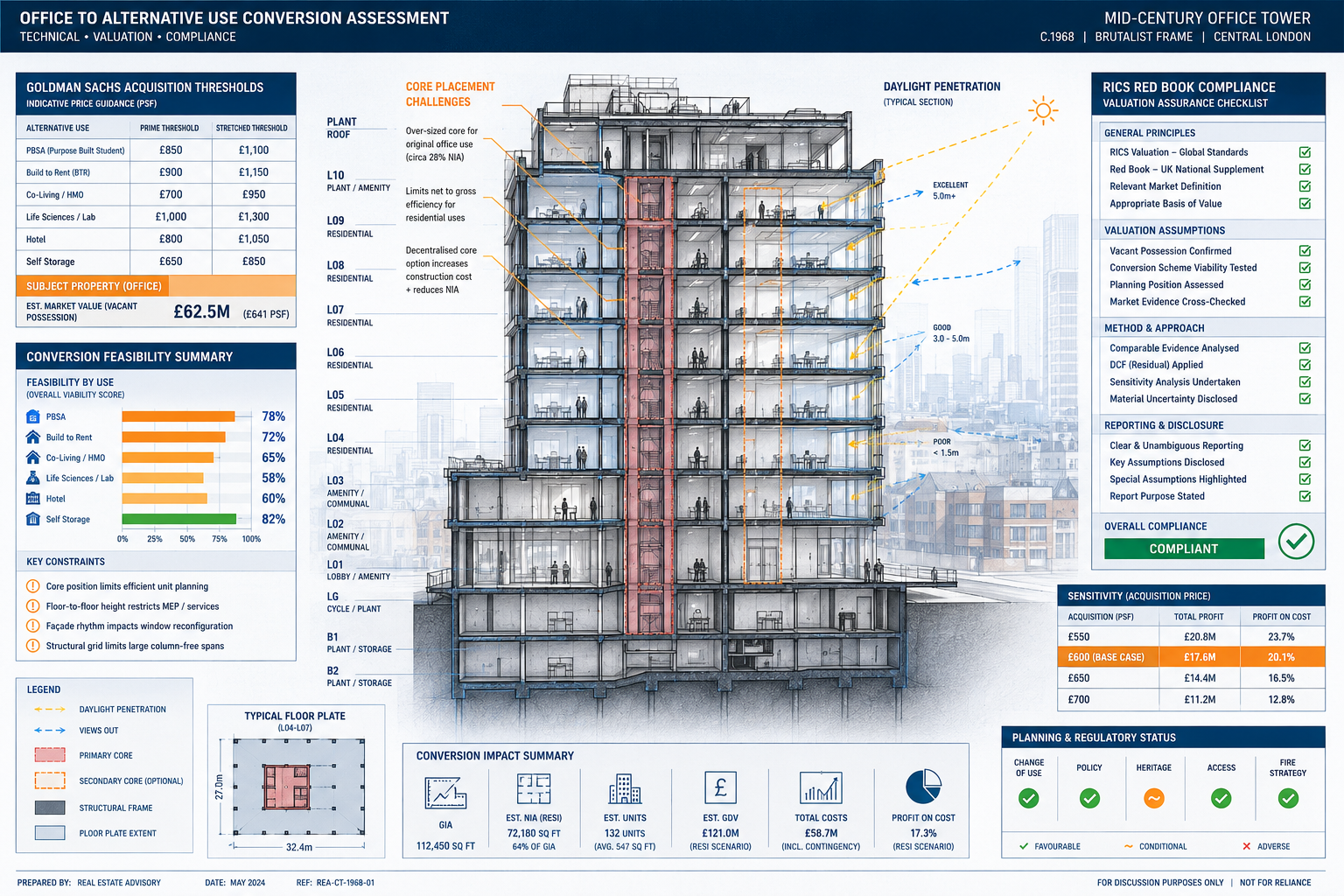
Structural and Economic Challenges That Shape Valuation Defence Arguments
Why Structural Suitability Matters to Valuation
A valuation defence in a non-residential conversion dispute cannot be prepared in isolation from the physical realities of the building. Vantage FDI research confirms that only approximately 3% of offices in major cities meet the structural criteria for conversion [2]. The factors that disqualify buildings include deep floor plates that prevent adequate natural light penetration, fixed core positions that make unit layout impractical, floor-to-ceiling heights that fall below habitable standards, and structural systems that cannot accommodate the required service runs.
When an opposing expert assumes a higher conversion value based on a scheme that the building cannot physically deliver, the defending expert must be prepared to challenge that assumption with building survey evidence. This is where collaboration between the valuation expert and a building surveyor becomes essential. A full building survey can identify structural constraints that directly affect the feasibility assumptions underpinning a valuation.
The Economic Viability Gap
Goldman Sachs analysis indicates that office acquisition prices would need to fall by nearly 50% for many conversion projects to achieve financial viability [3]. This figure is not universally applicable — it depends on location, asset quality, and the specific conversion use — but it illustrates the scale of the economic challenge that expert witnesses must engage with.
In practice, this means that a valuation defence strategy for a conversion dispute will often need to address:
- Whether the assumed acquisition price is consistent with market evidence
- Whether the projected development costs reflect current tender prices, which have risen significantly in recent years
- Whether the assumed end-values are achievable given subdued occupier and purchaser demand in the relevant market
Firms specialising in litigation support, including those that have expanded their dispute analysis practices specifically to address conversion-related claims, emphasise the importance of building a comparable evidence base that withstands forensic scrutiny [6].
Regulatory and Planning Complexity
Morgan Stanley's analysis of commercial-to-residential conversion barriers identifies zoning and regulatory complexity as a primary obstacle [4]. In the UK context, this translates to questions about permitted development rights, Article 4 directions that remove those rights, and the conditions attached to prior approval applications.
An expert witness preparing a valuation defence must understand the planning history of the subject property and the policy context in which any conversion consent was or would be granted. A valuation that ignores a restrictive condition — such as a requirement to provide affordable units or to retain ground-floor commercial use — will be vulnerable to challenge. Tax incentive programmes, such as those that offer long-term property tax benefits for qualifying conversions that include affordable units [5], can also affect value and must be factored into the analysis where applicable.
Practical Expert Witness Preparation for 2026 Office Repurposing Disputes: Valuation Defence in Non-Resi Conversions
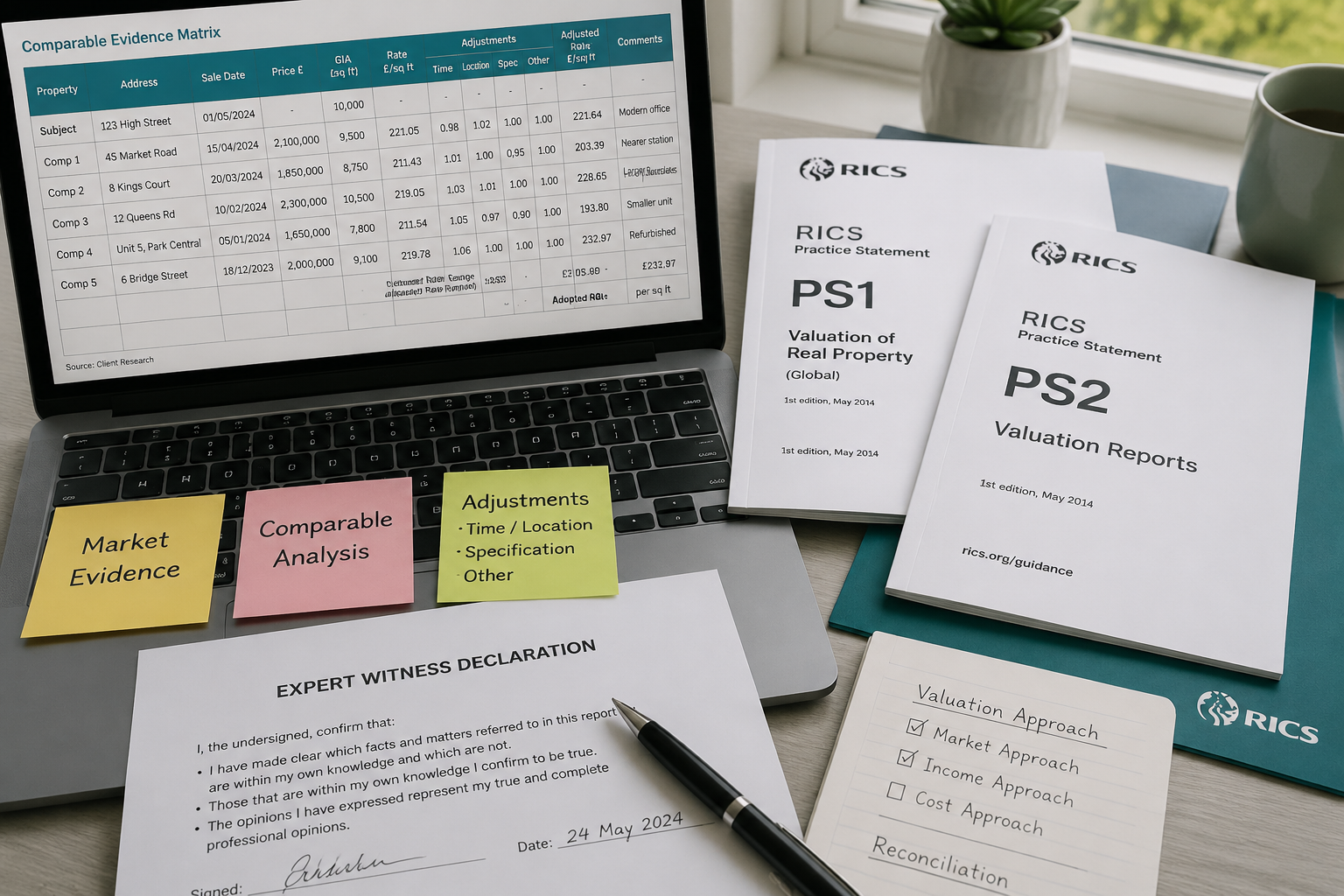
Building the Evidence File
The strength of a valuation defence rests on the quality and organisation of the evidence file assembled before the report is drafted. The following components are essential:
Comparable transaction evidence
- Sales and lettings of comparable converted properties within an appropriate search area and time frame
- Adjustments for differences in location, specification, size, and timing must be documented and justified
- Where comparable evidence is thin — as it often is in emerging conversion markets — the expert must explain why and demonstrate how the analysis has been adapted
Cost evidence
- Current construction cost data from recognised published sources (BCIS, Aecom, or equivalent)
- Where possible, contractor pricing obtained specifically for the subject scheme
- Evidence of any abnormal costs arising from the building's specific structural characteristics
Market commentary
- Research reports from recognised property market analysts addressing occupier demand trends in the relevant sector and location
- Evidence of void periods and incentive packages being offered in comparable schemes
Planning and legal documents
- The full planning history of the subject property
- Any pre-application advice received from the local planning authority
- Legal opinions on the scope of permitted development rights where relevant
Structuring the Expert Report
A well-structured expert report in a conversion dispute will typically follow this sequence:
- Instructions and scope — What the expert was asked to do and by whom
- Independence declaration — Signed confirmation of compliance with RICS PS1 and PS2
- Description of the subject property — Physical characteristics relevant to conversion feasibility
- Planning context — Relevant policy, consent history, and constraints
- Methodology — The valuation approach adopted and why
- Evidence — Comparables, cost data, and market commentary with full analysis
- Valuation — The expert's opinion with sensitivity analysis where appropriate
- Conclusions — A clear, unambiguous statement of the expert's opinion
Firms providing expert witness and litigation support services consistently stress the value of unbiased perspectives and clearly supportable conclusions [8]. Vague or qualified opinions that leave room for multiple interpretations are a liability in cross-examination.
Preparing for Cross-Examination
Cross-examination in a valuation dispute will typically probe three areas:
Methodology — Why did the expert choose the residual method rather than a direct comparison approach? Why were certain comparables included and others excluded? What assumptions underpin the developer's profit figure?
Independence — Has the expert acted for this client before? Does the expert have a financial interest in the outcome? Has the expert's opinion changed between the initial report and the final report, and if so, why?
Credibility of assumptions — Are the construction costs realistic given current market conditions? Is the assumed end-value supported by actual transactions or by aspirational asking prices?
Preparation for cross-examination requires the expert to review their own report as a hostile advocate would — identifying every assumption that could be challenged and ensuring that each one is supported by evidence cited in the report. Edge Realty Advisors and similar firms emphasise that clear, defensible insights are the foundation of effective expert testimony [7].
An independent property valuation obtained specifically for litigation purposes, as opposed to one prepared for transactional use, should be structured with these cross-examination pressures in mind from the outset. For reference on what independent valuations typically involve, see this guide on getting an independent property valuation.
The Role of Single Joint Experts and Without-Prejudice Meetings
In many tribunal and court proceedings, the parties will be directed to appoint a single joint expert, or existing experts will be required to meet without prejudice to narrow the issues in dispute. These meetings — sometimes called "hot tub" sessions — require the expert to be fully prepared to defend their methodology in a collegial but adversarial setting.
The output of these meetings is typically a joint statement identifying agreed facts, agreed methodology, and the specific points on which the experts remain in disagreement. A well-prepared expert will enter these meetings with a clear understanding of where their analysis is strongest and where it is most exposed.
For context on how disputes between property professionals are typically managed, the party wall disputes process offers a useful parallel in terms of the structured resolution mechanisms available.
Avoiding Common Preparation Failures
The most frequent failures in expert witness preparation for conversion disputes are not technical — they are procedural and presentational.
- Failing to disclose material facts that are adverse to the instructing party's case. Selective disclosure destroys credibility.
- Over-reliance on published cost guides without checking whether current tender conditions reflect those benchmarks. Construction costs have been volatile, and outdated data is easily exposed.
- Ignoring subdued demand evidence in favour of optimistic projections. Where occupier demand for converted space is weak, the valuation must reflect that reality.
- Confusing investment value with market value. An expert who values the property on the basis of what it is worth to a specific buyer, rather than what it would achieve in an open market transaction, is applying the wrong basis of value.
- Insufficient attention to the declaration of independence. The declaration is not a formality — it is a professional commitment that must be honoured throughout the instruction.
For those involved in more complex mixed-use or commercial schemes, understanding the full scope of chartered surveyor valuation services available can help ensure the right expertise is engaged from the outset.
The demand for expert witness services in this field has grown substantially. Major firms including Cushman & Wakefield have expanded their dispute analysis and litigation support practices specifically to address the volume of real estate valuation disputes arising from conversion activity [6]. Smaller specialist practices have similarly broadened their litigation support offerings [1].
Conclusion
Expert Witness Preparation for 2026 Office Repurposing Disputes: Valuation Defence in Non-Resi Conversions demands a combination of technical valuation skill, procedural discipline, and strategic awareness that goes well beyond the preparation of a standard valuation report.
The actionable steps for any expert or instructing party preparing for a conversion dispute in 2026 are clear:
- Engage a RICS-qualified expert early — before the dispute is formally issued, not after. Early preparation allows the evidence file to be built properly.
- Commission a structural assessment of the subject building to ensure that feasibility assumptions in the valuation are grounded in physical reality.
- Build a robust comparable evidence base — prioritising actual transactions over asking prices, and documenting every adjustment made.
- Stress-test the residual valuation using sensitivity analysis that reflects the range of realistic outcomes for each key input.
- Prepare the expert for cross-examination by conducting a mock examination focused on the weakest assumptions in the report.
- Ensure full compliance with RICS PS1 and PS2 from the first draft of the report to the final signed version.
The gap between a valuation that withstands tribunal scrutiny and one that does not is rarely a matter of the final number. It is almost always a matter of preparation.
References
[1] Litigation Support Expert Testimony – evcvaluation.com
[2] Office To Residential Conversion Reality – vantagefdi.com
[3] Goldman Sachs Office Residential Conversions Price Cut – fortune.com
[4] Commercial Residential Real Estate Conversion – morganstanley.com
[5] Office To Residential Conversion NYC Guide – sky-nyc.com
[6] Dispute Analysis Litigation Support – cushmanwakefield.com
[7] Edge Realty Advisors – edgerealtyadvisors.com
[8] Expert Witness And Litigation Support Services – schneidervc.com
[9] Real Estate Disputes – stout.com