

Last updated: July 24, 2026
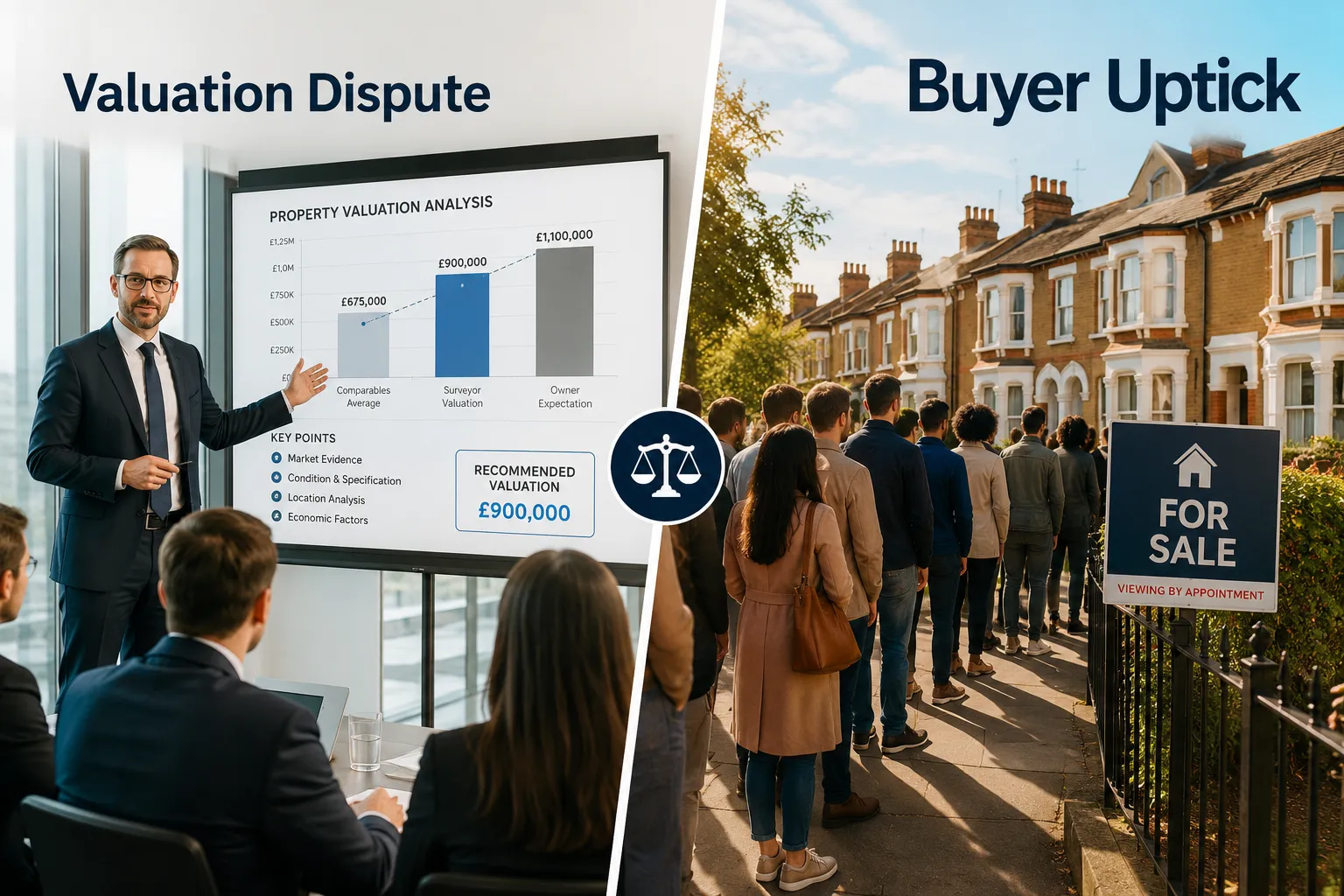
Quick Answer: As buyer enquiries rise across UK property markets in 2026, valuation disputes are becoming more common and more contested. Expert witness preparation for 2026 buyer enquiry upticks requires chartered surveyors to combine rigorous methodology, current market data, and tribunal-ready documentation to withstand cross-examination. Getting this preparation right from the outset is what separates a persuasive opinion from one that collapses under scrutiny.
Key Takeaways
- Valuation disputes are rising in 2026 as improving buyer demand creates wider gaps between asking prices, agreed prices, and surveyor-assessed values.
- An expert witness in property valuation must hold relevant RICS qualifications and owe their primary duty to the tribunal, not the instructing party.
- RICS launched a consultation on its fifth edition expert witness standard in April 2026, addressing AI use and reinforcing independence requirements.
- Thorough documentation, comparable evidence, market condition analysis, and a clear methodology statement, is the foundation of credible expert testimony.
- Cross-examination preparation is as important as the written report; experts must be able to defend every assumption under pressure.
- When two experts disagree, courts often order a joint statement to narrow the issues in dispute, which requires each expert to know their position precisely.
- Expert witness preparation for 2026 buyer enquiry upticks typically takes four to twelve weeks, depending on case complexity and instruction timing.
- Regional market variation in 2026 means a nationally averaged valuation argument will rarely survive scrutiny in a local dispute.
What Is an Expert Witness in Valuation Disputes?
An expert witness in a valuation dispute is an independent professional appointed to provide the court or tribunal with an evidence-based opinion on property value. Unlike a factual witness who reports what they observed, a valuation expert applies specialist knowledge to interpret market data and reach a defensible conclusion.
In UK property cases, this role is most commonly filled by a chartered surveyor holding RICS membership. The expert's duty runs to the tribunal first, not to the party who instructed them. This distinction is fundamental: an expert who argues their client's case rather than gives their honest professional opinion risks having their evidence disregarded entirely.
Common contexts where valuation expert witnesses appear:
- Leasehold extension and enfranchisement disputes before the First-tier Tribunal (Property Chamber)
- Matrimonial proceedings requiring an agreed or contested property value
- Inheritance tax and capital gains tax challenges with HMRC
- Boundary and party wall disputes with a valuation element
- Commercial lease rent reviews
- Mortgage shortfall and negligence claims against surveyors
For a detailed overview of what this service involves, see expert witness reports from Prince Chartered Surveyors.
What Qualifications Does an Expert Witness Need for Property Valuation Cases?
The minimum credible qualification for a property valuation expert witness in England and Wales is MRICS (Member of the Royal Institution of Chartered Surveyors), with FRICS (Fellow) carrying additional weight in high-value or complex disputes. Beyond the letters, tribunals look for demonstrable valuation experience in the specific property type and location at issue.
Key qualification and competency markers:
- Current RICS membership in good standing
- Specialist valuation experience relevant to the asset class (residential, commercial, leasehold, etc.)
- Familiarity with RICS Valuation, Professional Standards (the Red Book) and the RICS Expert Witness Practice Statement
- No undisclosed conflict of interest with any party
- Ability to produce a CPR Part 35-compliant report (Civil Procedure Rules) or equivalent tribunal-specific format
RICS launched a consultation on its fifth edition expert witness standard in April 2026. The updated guidance addresses the use of AI tools in preparing valuation opinions and reinforces that any AI-assisted analysis must be transparently disclosed and independently verified by the expert. Practitioners preparing for 2026 instructions should review this consultation carefully before accepting appointments.
How Do Market Conditions in 2026 Affect Expert Witness Valuation Opinions?
The 2026 property market creates specific challenges for valuation experts because improving buyer demand is not uniform, and the gap between seller expectations and surveyor-assessed values is widening in some regions. This directly feeds the volume of valuation disputes.
Key 2026 market conditions relevant to expert testimony:
- Price growth is slowing nationally. Revised forecasts suggest existing-home sale prices will rise approximately 1.2% through the end of 2026, well below earlier projections. This matters when a dispute turns on whether a valuation was reasonable at a specific date.
- Inventory is rising. Active listings increased year-on-year in mid-2026, giving buyers more options and reducing the urgency that inflated prices in prior years.
- Regional divergence is sharp. Markets in the Midwest and Northeast (US) and equivalent commuter-belt and regional city markets in the UK have seen price increases, while coastal and premium urban markets have softened. A nationally averaged comparable will not hold up in a local dispute.
- Mortgage rates remain elevated. Rates hovering in the mid-6% range (US benchmark) and equivalent UK rates have compressed buyer purchasing power, affecting the price a willing buyer would actually pay, a core concept in any open market valuation.
"An expert who relies on national averages when the dispute concerns a specific postcode is giving the tribunal a map of the wrong country."
For context on how property valuations are assessed in practice, the top three factors considered during a property valuation are a useful reference point.
What Documentation Does an Expert Witness Need for Valuation Disputes?
A credible expert witness file for a valuation dispute should be assembled before any report is drafted. Missing documentation discovered during cross-examination is one of the most damaging scenarios an expert can face.
Core documentation checklist:
- Inspection notes and photographs taken at the subject property
- Comparable transaction evidence (minimum three to five sales, ideally within six months and one mile)
- Market commentary from RICS, Land Registry, or recognised data providers relevant to the valuation date
- Planning history and any restrictions affecting value
- Lease terms (for leasehold properties) including ground rent, service charge, and unexpired term
- Correspondence with the instructing party (retained to demonstrate independence)
- A signed declaration of truth and confirmation of expert duty to the tribunal
The report itself must set out the methodology clearly enough that another qualified surveyor could follow the reasoning and either agree or identify specifically where they diverge. Vague reasoning is not a defence in cross-examination, it is an invitation to attack.
See also: what to do if your home valuation is less than an offer for context on how valuation gaps arise in practice.
What Is the Difference Between a Business Appraiser and an Expert Witness?
These two roles overlap but are not the same. A business appraiser or property valuer produces a valuation for transactional or advisory purposes. An expert witness produces a valuation opinion specifically for use in legal proceedings, under a duty to the tribunal, and subject to cross-examination.
| Feature | Valuation for Transaction | Expert Witness Valuation |
|---|---|---|
| Primary duty | Client | Tribunal |
| Format | Valuation report | CPR Part 35 / tribunal-compliant report |
| Cross-examination | No | Yes |
| Independence declaration | Not always required | Mandatory |
| Methodology disclosure | Summary level | Full, step-by-step |
A chartered surveyor can perform both roles, but they must not blur them. Producing a valuation for a client and then presenting it as independent expert evidence in that same client's dispute is a conflict that courts treat seriously.
How Should You Prepare a Valuation Expert for Cross-Examination?
Effective cross-examination preparation for a valuation expert focuses on stress-testing every assumption in the report before opposing counsel does it in the hearing room.
Step-by-step preparation process:
- Review the report as the opponent would. Identify every comparable used and ask whether a stronger counter-comparable exists.
- Test the methodology. If the expert used the investment method, can they defend the yield adopted? If the comparison method, why were those specific transactions chosen?
- Prepare for the "what if" questions. What if the market date was three months earlier? What if the lease term was five years shorter?
- Rehearse plain-language explanations. Judges and tribunal members are not always surveyors. The expert must explain yield, gross development value, or hope value in terms a non-specialist understands.
- Review any prior reports or published opinions. Opposing counsel will search for inconsistencies between this report and anything the expert has previously said in writing.
- Confirm the expert knows the CPR Part 35 duties by heart. Being asked to recite the expert's duty and hesitating is a poor start.
Common mistake: allowing the expert to become an advocate during preparation. The goal is not to win the argument in the prep session, it is to ensure the expert can give their honest opinion clearly and withstand challenge to it.
What Are Common Mistakes Expert Witnesses Make in Valuation Testimony?
Expert witness preparation for 2026 buyer enquiry upticks must account for the specific errors that cause valuation evidence to fail. These mistakes are consistent across cases and largely avoidable.
Most frequent errors:
- Selecting comparables that favour the instructing party rather than the most genuinely comparable transactions. Tribunals notice cherry-picking.
- Failing to address the valuation date precisely. A valuation opinion must reflect market conditions on a specific date, not conditions at the time of writing.
- Overstating certainty. Valuation is a professional opinion with a range. Claiming a figure is definitive rather than a point within a reasonable bracket invites credibility challenges.
- Ignoring the opposing expert's report. The joint statement process requires genuine engagement with the other side's reasoning, not a restatement of your own position.
- Using AI-generated analysis without verification. Given RICS's 2026 consultation on AI use, any AI-assisted comparable search or market commentary must be independently checked and disclosed.
- Conflating current market conditions with the valuation date. In a 2026 dispute about a 2023 transaction, the expert must value the property as at 2023, not apply 2026 market sentiment.
How Do You Challenge an Expert Witness Valuation Opinion in Court?
Challenging an opposing expert's valuation is done through the joint statement process, written questions under CPR Part 35, and cross-examination. The most effective challenges are methodological rather than personal.
Effective challenge strategies:
- Identify comparables the expert excluded that would support a different value, and ask why they were not used.
- Question the adjustments applied, if the expert adjusted a comparable downward by 5% for condition, what evidence supports that specific percentage?
- Examine the inspection notes. Did the expert actually inspect the property, or rely on desk-based research?
- In leasehold cases, challenge the relativity tables used, different recognised tables produce materially different results, and the choice is a legitimate area of dispute.
- Look for inconsistency with the expert's previous published opinions or prior tribunal appearances.
For boundary and access disputes with a valuation element, see the average cost of a boundary dispute for context on what is at stake financially.
What Happens If Two Expert Witnesses Disagree on Property Valuation?
Disagreement between experts is normal and expected. The tribunal's role is precisely to resolve such disagreements. What matters is how each expert handles the disagreement professionally.
When experts disagree, the court will typically order a without prejudice meeting followed by a joint statement setting out agreed points and the specific areas of remaining dispute. This process narrows the issues the tribunal must decide and is taken seriously, an expert who refuses to concede any point, even where the opposing argument is clearly stronger, damages their own credibility.
The tribunal will then weigh the competing opinions based on:
- The quality and relevance of the comparables used
- The transparency of the methodology
- The expert's demeanour and consistency under cross-examination
- Whether the expert engaged genuinely with the other side's reasoning in the joint statement
In practice, valuation gaps between experts of 10-15% are common in residential disputes. Gaps above 20% usually indicate a fundamental methodological difference that the joint statement process should identify clearly.
How Long Does Expert Witness Preparation Typically Take for a Valuation Case?
For most residential valuation disputes, expert witness preparation, from initial instruction to a tribunal-ready report, takes between four and twelve weeks. Complex commercial cases or those involving multiple properties can take longer.
Typical timeline breakdown:
- Weeks 1-2: Initial instruction, conflict check, site inspection, and data gathering
- Weeks 3-5: Comparable research, methodology selection, and draft report
- Weeks 6-8: Report review, CPR compliance check, and finalisation
- Weeks 9-12 (if required): Joint statement process with opposing expert
Instruction timing matters. Experts instructed close to a hearing date are working under pressure that can affect report quality. Solicitors and property professionals should aim to instruct a valuation expert as early as possible once a dispute is anticipated.
What Makes an Expert Witness Credible in a Buyer Dispute Scenario?
Credibility in a buyer dispute comes from three sources: qualifications, methodology, and conduct. All three must hold up simultaneously.
Credibility markers that tribunals respond to:
- Local market knowledge. An expert who can speak to specific streets, micro-markets, and recent transactions in the subject area carries more weight than one applying generic national data.
- Proportionate certainty. Acknowledging the inherent range in any valuation opinion, while defending why the chosen figure sits within that range, reads as honest rather than weak.
- Consistency. The expert's opinion in the report, in the joint statement, and in oral testimony must be coherent. Shifting positions without explanation destroys credibility.
- Independence. Any prior relationship with the instructing party must be disclosed. Undisclosed relationships, discovered by opposing counsel, are case-ending events.
- Current market awareness. In 2026, an expert who cannot speak to current buyer demand levels, inventory trends, and the impact of mortgage rates on purchaser behaviour will appear out of touch.
For an independent property valuation ahead of any potential dispute, Prince Chartered Surveyors' valuation services cover residential, commercial, leasehold, and specialist property types.
How Much Do Expert Witnesses Charge for Valuation Cases?
Expert witness fees for property valuation cases in the UK vary by case complexity, property type, and the seniority of the expert. There is no fixed scale, but the following ranges are broadly representative for 2026.
- Residential cases (First-tier Tribunal): Report fees typically range from £1,500 to £5,000 for a standard instruction. Attendance at a hearing adds a day rate, commonly £800 to £2,000 per day.
- High-value residential or commercial cases: Report fees of £5,000 to £15,000+ are common, with day rates of £1,500 to £3,500 for senior FRICS experts.
- Joint single expert appointments: Where both parties agree to instruct one expert, fees are shared and often lower than two separate instructions.
Costs can be recovered from the losing party in some tribunal proceedings, but this is not guaranteed. Parties should treat expert witness fees as a necessary investment in the quality of their evidence, not an area to economise on by instructing a less experienced valuer.
For related valuation services, leasehold extension and enfranchisement valuations and matrimonial valuations are among the most common expert witness contexts in residential property disputes.
.ew-checker { font-family: Arial, sans-serif; max-width: 560px; margin: 24px auto; background: #f7f9fc; border: 1px solid #d0d8e4; border-radius: 8px; padding: 20px; }
.ew-checker h3 { font-size: 1.1rem; color: #1a2e4a; margin: 0 0 4px; }
.ew-checker p { font-size: 0.85rem; color: #4a5568; margin: 0 0 14px; }
.ew-item { display: flex; align-items: flex-start; margin-bottom: 10px; }
.ew-item input[type=”checkbox”] { margin: 3px 10px 0 0; accent-color: #1a5276; width: 16px; height: 16px; flex-shrink: 0; }
.ew-item label { font-size: 0.88rem; color: #2d3748; cursor: pointer; }
.ew-progress { margin-top: 16px; background: #dce6f0; border-radius: 4px; height: 10px; overflow: hidden; }
.ew-bar { height: 10px; background: #1a5276; border-radius: 4px; width: 0%; transition: width 0.3s ease; }
.ew-status { font-size: 0.82rem; color: #1a5276; margin-top: 6px; font-weight: bold; }
.ew-reset { margin-top: 12px; background: #1a5276; color: #fff; border: none; border-radius: 4px; padding: 7px 16px; font-size: 0.82rem; cursor: pointer; }
Expert Witness Readiness Checker
Tick each item your valuation expert has completed before the hearing.
function ewUpdate() {
var total = 7, done = 0;
for (var i = 1; i <= total; i++) { if (document.getElementById('c' + i).checked) done++; }
var pct = Math.round((done / total) * 100);
document.getElementById('ewBar').style.width = pct + '%';
document.getElementById('ewStatus').textContent = done + ' of ' + total + ' complete (' + pct + '%)';
}
function ewReset() {
for (var i = 1; i <= 7; i++) { document.getElementById('c' + i).checked = false; }
ewUpdate();
}
Frequently Asked Questions
What is the primary duty of a valuation expert witness?
A valuation expert witness owes their primary duty to the tribunal or court, not to the party who instructed them. This means the expert must give their honest professional opinion even if it does not support the instructing party's position.
Can a chartered surveyor act as both a valuation adviser and an expert witness in the same case?
No. Acting as an adviser to a party and then presenting independent expert evidence in that same dispute is a conflict of interest. The two roles must be kept separate, and the expert must declare any prior advisory involvement.
What is a joint statement in a valuation dispute?
A joint statement is a document produced after the two opposing experts meet (without their clients present) to identify the points they agree on and the specific areas where their opinions differ. It narrows the issues the tribunal must decide and is a standard step in most contested valuation cases.
How does the 2026 RICS expert witness consultation affect current instructions?
RICS launched a consultation on its fifth edition expert witness standard in April 2026. While the final standard is not yet in force, experts accepting instructions now should be aware of the proposed changes, particularly around AI tool disclosure and global applicability, and apply the spirit of those requirements.
What happens if an expert witness changes their opinion during the case?
An expert may update their opinion if new evidence emerges or if the joint statement process reveals a flaw in their original reasoning. Any change must be documented promptly, disclosed to the tribunal, and explained clearly. Changing an opinion simply because the client is unhappy is not acceptable and will damage credibility.
How do rising buyer enquiries in 2026 create more valuation disputes?
When buyer demand increases, agreed sale prices can move ahead of surveyor-assessed values, creating gaps that trigger mortgage down-valuations, renegotiations, and ultimately formal disputes. The more active the market, the more frequently buyers, sellers, and lenders find themselves on different sides of a valuation argument.
Is an RICS Homebuyer Report the same as an expert witness report?
No. An RICS Homebuyer Report is a condition survey for a purchaser's own due diligence. An expert witness report is a formal legal document prepared under CPR Part 35 or equivalent tribunal rules, with a declaration of duty to the court. They serve entirely different purposes.
Conclusion
Expert witness preparation for 2026 buyer enquiry upticks is not a process that rewards last-minute effort. The combination of a recovering but uneven UK property market, updated RICS standards, and more sophisticated opposing experts means that valuation disputes in 2026 are better contested and harder to win on thin evidence.
Actionable next steps:
- Instruct early. Give your expert four to twelve weeks before any hearing date to build a properly documented opinion.
- Choose the right expert. Match RICS qualifications and local market experience to the specific property type and location in dispute.
- Audit the documentation. Before the report is finalised, check that comparables, methodology, and the CPR declaration are all in order.
- Prepare for cross-examination. Run a structured preparation session that stress-tests every assumption, not just the headline figure.
- Engage genuinely with the joint statement. Conceding defensible points early builds credibility on the points that matter most.
- Stay current on 2026 market data. Regional price trends, inventory levels, and mortgage rate movements are all legitimate grounds for challenging or defending a valuation opinion this year.
For professional expert witness valuation services, contact Prince Chartered Surveyors to discuss your specific dispute requirements.