

Fewer than 40% of higher-risk building valuation appeals heard before the First-tier Tribunal (Property Chamber) in recent years have succeeded where the expert witness report lacked structured post-remediation evidence — a sobering statistic that underlines just how much is at stake when preparing testimony under the Building Safety Act 2022. For chartered surveyors instructed in 2026, the landscape has shifted considerably. Mandatory digital documentation requirements, extended limitation periods of up to 30 years for historical fire safety defects, and updated RICS professional standards have collectively raised the bar for what constitutes defensible expert evidence [1][3].
This article sets out a comprehensive framework for Expert Witness Preparation for 2026 Building Safety Act Valuation Appeals: Post-Remediation Evidence, with a particular focus on higher-risk buildings (HRBs) under ongoing enforcement, RICS-standard testimony requirements, and the evidential chain needed to support robust valuation opinions in stabilizing markets.
Key Takeaways
- From April 1, 2026, all HRB expert witness reports must be digitally documented to comply with the Building Safety Act 2022 [1].
- Expert witnesses owe their primary duty to the tribunal, not the instructing party — independence is non-negotiable under RICS standards [2][4].
- Post-remediation valuations must be anchored to detailed physical inspection evidence, including photographs, floor plans, and cost-to-cure documentation [5][6].
- The Building Safety Act 2022 has extended limitation periods to 30 years for historical fire safety defect claims, significantly widening the scope of potential disputes [3].
- Compliance with CPR Part 35 is mandatory; failure to meet its requirements can result in reports being excluded from tribunal proceedings [5].
The Regulatory Framework Driving 2026 Valuation Disputes
Higher-Risk Buildings and the Building Safety Act 2022
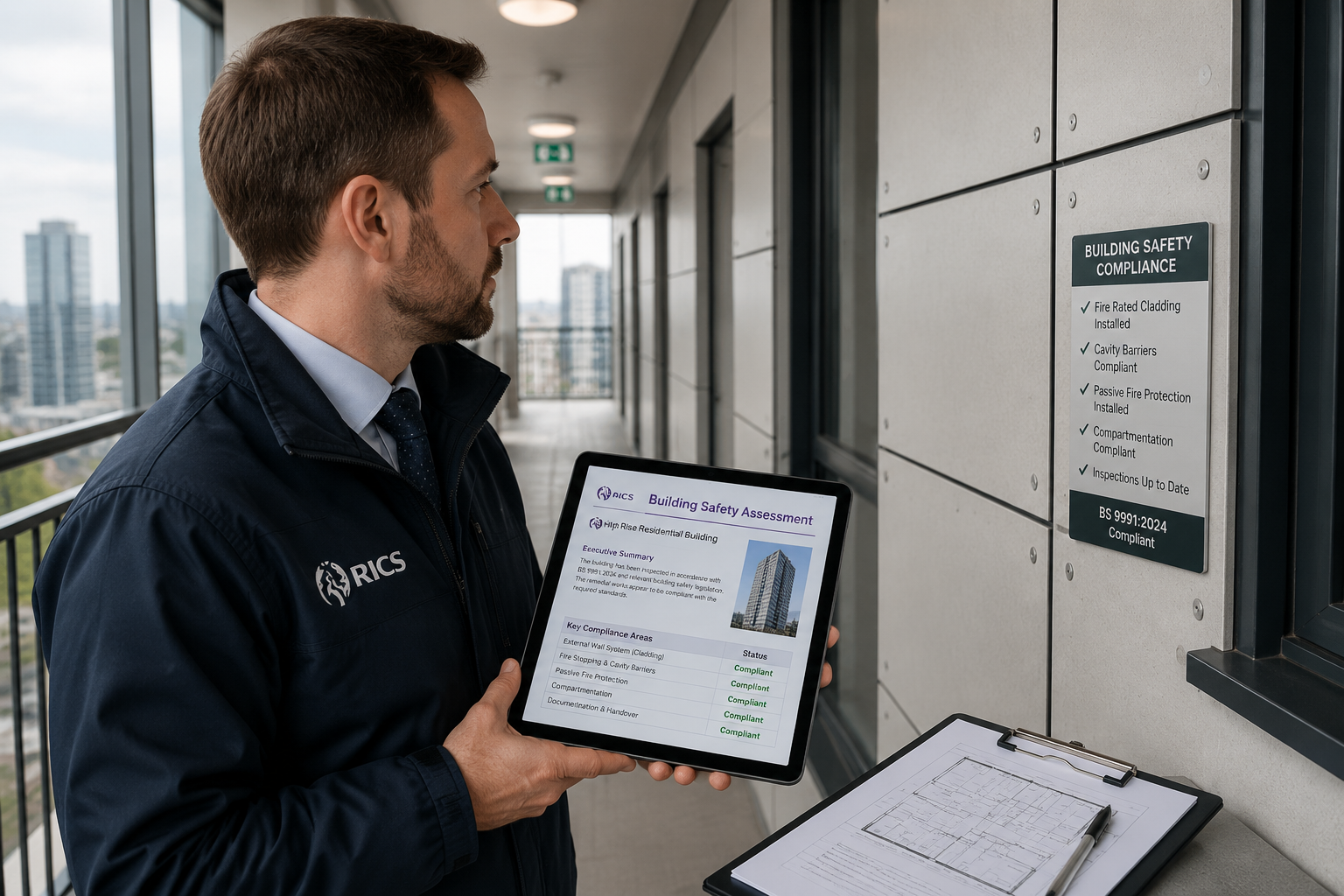
The Building Safety Act 2022 fundamentally restructured accountability for residential buildings over 18 metres or seven storeys in height. In 2026, the practical consequences of that legislation are now fully embedded in tribunal practice. Buildings classified as higher-risk are subject to mandatory registration with the Building Safety Regulator, ongoing safety case reporting, and stringent remediation obligations — all of which directly affect their market value and the evidence required to support any valuation appeal.
For expert witnesses, the critical shift is this: post-remediation evidence is no longer a supplementary consideration. It is the foundation upon which any credible valuation opinion must be built. Tribunals are increasingly scrutinizing reports that fail to document the precise scope, cost, and completion status of fire safety remediation works [1].
Key regulatory triggers for 2026 valuation appeals include:
- Completion of ACM (aluminium composite material) cladding replacement programmes
- Installation of fire suppression systems and compartmentation upgrades
- Building Safety Certificates issued under the new regime
- Leaseholder protection provisions under Schedule 8 of the Act
- Remediation contribution orders and building liability orders
Extended Limitation Periods and Their Valuation Impact
One of the most significant — and underappreciated — aspects of the Building Safety Act 2022 is the extension of limitation periods. Leaseholders can now pursue claims for historical fire safety defects for up to 30 years, compared with the standard six-year period under the Limitation Act 1980 [3]. This means that expert witnesses preparing valuation evidence in 2026 may need to address defects and remediation works stretching back to the mid-1990s.
The practical implication for valuation methodology is substantial. A comparable transaction from 2019 involving a building that has since undergone full remediation cannot be used without significant adjustment. The expert must document precisely what defects existed at the valuation date, what works have since been completed, and how the market has responded to those changes.
RICS Standards and CPR Part 35 Compliance in Post-Remediation Reports
The Overriding Duty to the Tribunal
RICS professional standards are unambiguous on one point: the expert witness's primary duty is owed to the tribunal, not to the party who instructed them [2][4]. This principle, reinforced by CPR Part 35 and the associated Practice Direction, has direct consequences for how post-remediation evidence is gathered, presented, and defended under cross-examination.
In practice, this means:
- Declarations of independence must appear prominently in the report body
- Methodology must be transparent — the expert cannot selectively present evidence that favours the instructing party
- Disagreements with opposing experts must be addressed honestly, with reasoned explanations rather than dismissals
- Competence declarations are mandatory, covering both valuation expertise and specific knowledge of fire safety remediation [4]
RICS has updated its standards to emphasize that expert witness reports must prioritize tribunal needs above all else [2]. For surveyors working on expert witness instructions, this is not merely a procedural formality — it is the ethical foundation of the entire engagement.
Mandatory Digital Documentation from April 2026
Effective April 1, 2026, all HRB expert witness reports must be digitally documented [1]. This requirement encompasses:
| Documentation Type | Required Format | Purpose |
|---|---|---|
| Inspection photographs | Geo-tagged, timestamped digital images | Evidence of physical condition |
| Floor plans | BIM-compatible or CAD-format drawings | Spatial context for defect mapping |
| Remediation completion certificates | PDF with digital signature | Proof of works completion |
| Comparable transaction data | Structured database format | Audit trail for valuation adjustments |
| Expert's methodology notes | Digitally signed working papers | Transparency and reproducibility |
This digital-first approach is designed to create an auditable evidence chain that tribunals can interrogate with precision. Reports that rely on handwritten notes, undated photographs, or unverified comparable data are increasingly vulnerable to challenge [1].
CPR Part 35 Requirements: A Practical Checklist
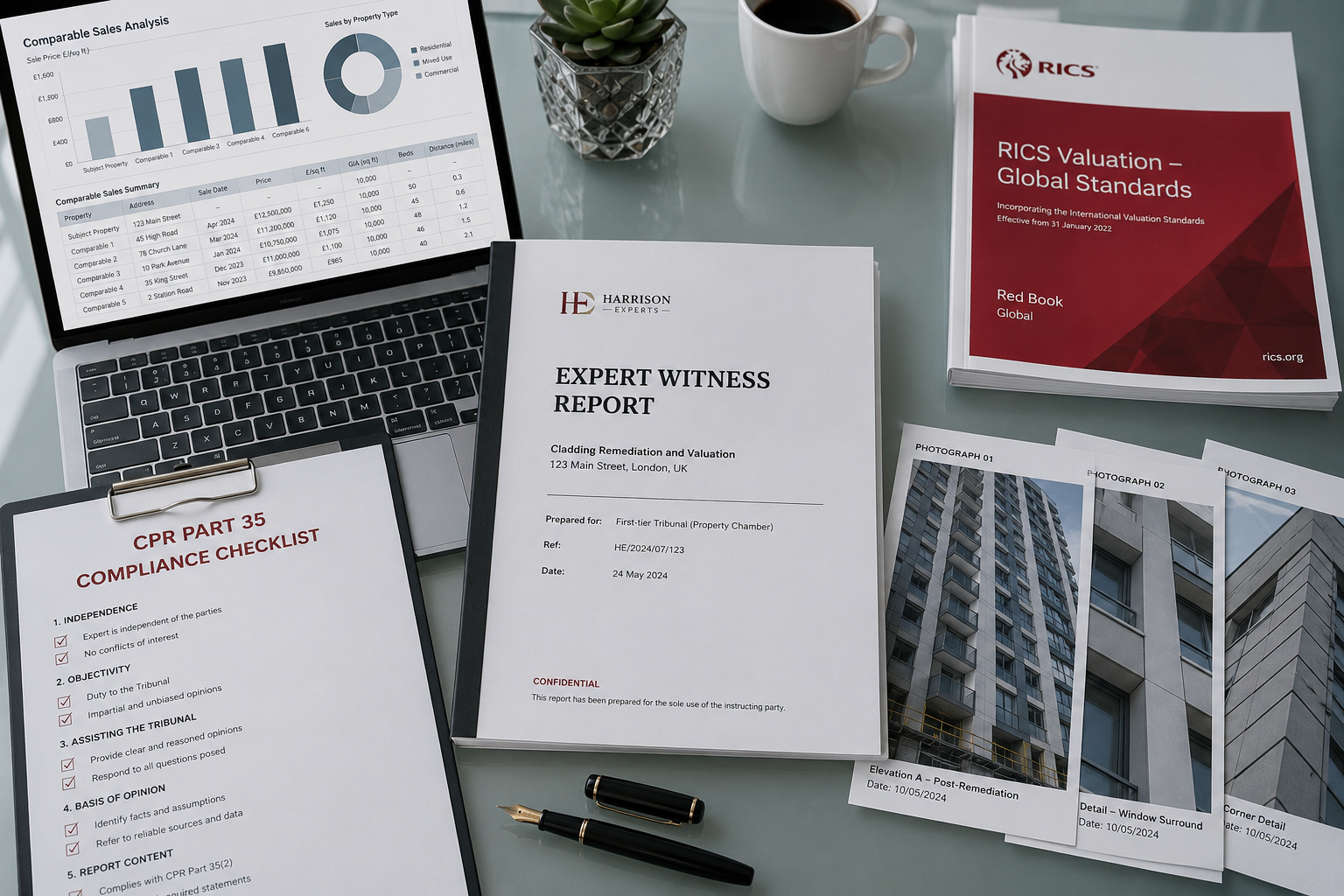
Every expert witness report submitted in 2026 Building Safety Act valuation appeals must comply with CPR Part 35. The core requirements are:
- A clear statement of the expert's qualifications and relevant experience
- A summary of the facts and instructions upon which the opinion is based
- A statement that the expert understands their duty to the court/tribunal
- A statement of truth signed by the expert personally
- Details of any literature or material relied upon
- A summary of the range of opinion on each issue, where opinion differs
- A summary of conclusions [5]
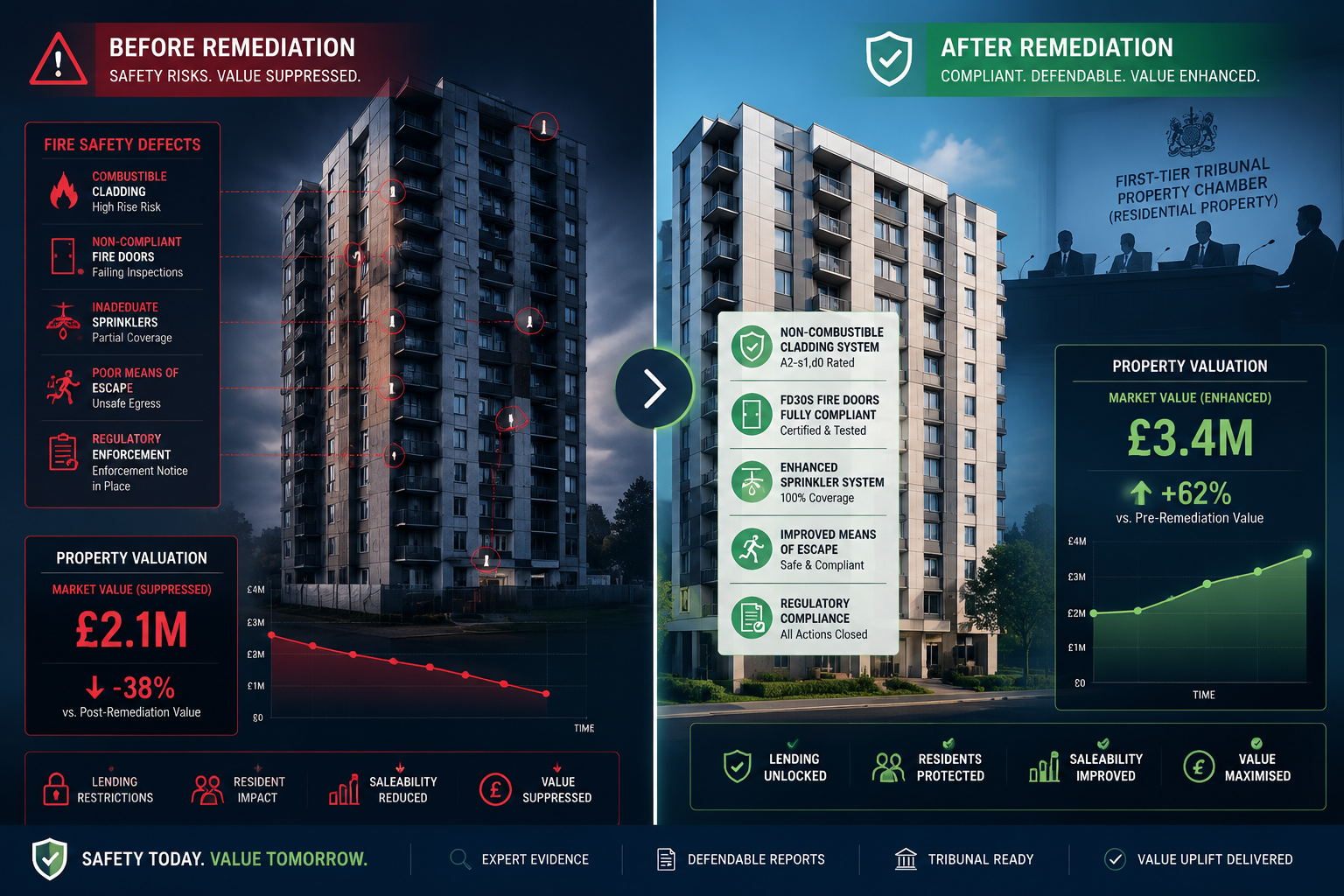
Failure to include any of these elements can result in the report being excluded or given reduced weight. For valuation disputes involving post-remediation evidence, the statement of facts is particularly important — it must clearly delineate the state of the building before, during, and after remediation works.
Building the Post-Remediation Evidence Base
Physical Inspection Standards for Higher-Risk Buildings
A thorough physical inspection is the cornerstone of defensible expert evidence in Building Safety Act valuation disputes [5][6]. For post-remediation HRBs, the inspection must go beyond a standard condition assessment. It should document:
- Completed remediation works — with reference to the original defect schedule and confirmation that all items have been addressed
- Residual defects — any issues not yet remediated, with cost-to-cure estimates
- Building Safety Certificate status — whether the building has received, applied for, or been refused certification
- Ongoing enforcement actions — any notices issued by the Building Safety Regulator that remain live at the valuation date
Surveyors conducting these inspections should be familiar with RICS specialist defect surveys and the specific technical requirements for fire safety assessments. The inspection report forms the evidential backbone of the valuation opinion — without it, any figure offered to the tribunal is unsupported assertion rather than expert evidence [6].
Valuation Methodology in Post-Remediation Markets
The choice of valuation methodology is itself a matter of expert judgment that must be explained and justified in the report. For post-remediation HRBs in 2026, the most commonly applied approaches are:
Comparable sales analysis — the preferred method where sufficient market evidence exists. However, comparables must be carefully adjusted to reflect:
- The remediation status of each comparable property
- The date of sale relative to the completion of remediation works
- Any residual stigma discount where market confidence has not fully recovered
- Leaseholder protection provisions that affect the net cost of ownership
Residual valuation — applicable where comparable evidence is thin, particularly for larger blocks or unusual building types. The expert must document all assumptions transparently, including development costs, finance rates, and profit margins.
Depreciated replacement cost — rarely used for residential leasehold valuations but may be relevant for specialist HRB components.
For a broader understanding of how different approaches are applied in practice, the methods of valuation framework provides useful context.
"Valuation opinions must be directly anchored to detailed building survey evidence, with clear documentation of structural defects and cost-to-cure estimates." [6]
Adjusting Comparables for Post-Remediation Status
One of the most technically demanding aspects of Expert Witness Preparation for 2026 Building Safety Act Valuation Appeals: Post-Remediation Evidence is the adjustment of comparable transactions. The market for higher-risk buildings has been highly distorted since the Grenfell Tower fire in 2017, and the recovery has been uneven across different building types, locations, and remediation completion stages [3].
Experts must avoid the common pitfall of using unadjusted comparables — a failure that tribunals have consistently criticized [2]. The adjustment process should:
- Identify the remediation status of each comparable at the date of sale
- Apply a quantified adjustment for any difference in remediation status relative to the subject property
- Document the market evidence supporting each adjustment (e.g., paired sales analysis, developer pricing data, lender valuation instructions)
- Address any residual stigma discount with reference to published market research
For leasehold properties, the interaction between post-remediation value and lease extension rights adds a further layer of complexity. Surveyors should be aware of how lease extension valuation principles apply in this context.
Common Pitfalls and How to Avoid Them
Errors That Undermine Credibility
Expert witness reports in Building Safety Act valuation appeals are subjected to rigorous scrutiny. The most frequently cited failures include [2][4]:
- Ignoring regulatory timelines — failing to note when remediation works were completed relative to the valuation date
- Failing to address leaseholder protections — Schedule 8 of the Building Safety Act 2022 limits what leaseholders can be charged for remediation; this affects both value and marketability
- Using unadjusted comparables — presenting sales evidence without adjustment for remediation status
- Overlooking building materials — not documenting the specific materials used in remediation (e.g., type of cladding system installed) which affects both safety compliance and market perception
- Inadequate independence declarations — particularly where the expert has previously advised the instructing party on related matters
Preparing for Cross-Examination
Cross-examination in tribunal proceedings tests not just the conclusions of the expert report but the entire evidential process that led to them. Experts should prepare by:
- Reviewing all source documents referenced in the report
- Being able to explain every adjustment made to comparable evidence
- Anticipating challenges to the physical inspection methodology
- Confirming that all digital documentation meets the April 2026 mandatory requirements [1]
A well-prepared expert will also have reviewed the opposing expert's report in advance and identified the key areas of disagreement for the joint statement process under CPR Part 35.
The Role of Structural and Specialist Surveys
In many Building Safety Act valuation appeals, the expert valuer will need to rely on specialist technical evidence produced by structural engineers or fire safety consultants. Understanding how to integrate this evidence into a valuation opinion — and how to present it clearly to a non-technical tribunal — is a critical skill.
Where structural issues remain unresolved, a structural survey or property certification report can provide the technical foundation for a defensible cost-to-cure estimate. Similarly, for buildings with ongoing damp or water ingress issues arising from remediation works, specialist damp surveys may be required to quantify residual defects.
For commercial properties affected by the Building Safety Act regime, commercial building surveys provide an additional layer of technical documentation that can strengthen the overall evidence base.
Conclusion
Expert Witness Preparation for 2026 Building Safety Act Valuation Appeals: Post-Remediation Evidence demands a level of technical rigour, procedural compliance, and evidential discipline that goes well beyond standard valuation practice. The combination of mandatory digital documentation, updated RICS standards, extended limitation periods, and heightened tribunal scrutiny has created a demanding environment in which only thoroughly prepared experts will carry weight.
Actionable next steps for surveyors and legal teams preparing for 2026 appeals:
- Audit your digital documentation systems now to ensure compliance with the April 2026 mandatory requirements for HRB expert reports [1].
- Review RICS updated standards on independence, competence declarations, and tribunal-first obligations before accepting any new instruction [2][4].
- Commission specialist surveys — structural, fire safety, and damp assessments — early in the process to build a complete evidential foundation [5][6].
- Stress-test your comparable evidence by applying a systematic adjustment framework that accounts for remediation status, leaseholder protections, and residual stigma.
- Engage with opposing experts early through the joint statement process to narrow areas of disagreement before the tribunal hearing.
The stakes in Building Safety Act valuation appeals are high — for leaseholders, freeholders, and the professionals who advise them. Thorough, independent, and rigorously documented expert evidence is not just good practice in 2026; it is the minimum standard the tribunal will expect.
References
[1] Building Safety Act 2022 Updates Expert Witness Protocols For Fire Safety And Retrofit Valuations In 2026 – Building safety act 2022 updates expert witness protocols for fire safety and retrofit valuations in 2026
[2] Higher Risk Building Valuations Post 2026 Reforms Expert Witness Preparation For Safety Compliance Disputes – Higher risk building valuations post 2026 reforms expert witness preparation for safety compliance disputes
[3] Expert Witness Preparation For Fire Safety Remediation Valuations Post Grenfell Rics Protocols In 2026 Cladding Disputes – wimbledonsurveyors.com
[4] Expert Witness Roles In 2026 Building Safety Act Disputes Evidence Standards For Mid Rise Residential Blocks – nottinghillsurveyors.com
[5] Expert Witness Preparation For 2026 Uk Valuation Disputes Rics Standards In A Recovering Market – canterburysurveyors.com
[6] Expert Witness Preparation For 2026 Homebuying Reform Disputes Valuation Impacts Of Upfront Survey Mandates – wimbledonsurveyors.com
How Prince Surveyors can help: explore our expert witness surveyors or learn about our RICS valuations.