

Last updated: July 24, 2026
Quick Answer: Expert witness pitfalls for building surveyors include bias toward the instructing party, template reports lacking genuine independent opinion, overstated qualifications, incomplete inspections, and exceeding the expert's remit. UK judges are increasingly willing to criticise, discount, or entirely reject expert evidence that fails to meet the standards set out in Civil Procedure Rules Part 35. Surveyors who understand these pitfalls before they enter the witness box protect both their professional reputation and their client's case.
Key Takeaways
- An expert witness's overriding duty is to the court, not to the party paying their fee, judges treat any departure from this as a serious credibility failure.
- Template or pre-populated reports that do not reflect genuine independent analysis are routinely identified and criticised by judges.
- Overstating qualifications or experience in a report can result in the evidence being struck out entirely.
- Conflicts of interest, including repeat instructions from the same claimant solicitor, must be declared upfront.
- Incomplete site inspections, missing photographs, and weak evidential records undermine even technically sound opinions.
- Changing an opinion mid-case without proper justification damages credibility; changing it with proper written reasons is acceptable and sometimes expected.
- Experts who stray beyond their area of expertise risk having their entire report disregarded.
- The cost of a building surveyor acting as expert witness typically ranges from £150 to £350 per hour, with total fees varying widely depending on case complexity.
- Training through RICS, the Academy of Experts, or the Expert Witness Institute is strongly recommended before accepting instructions.
What Makes an Expert Witness Report Inadmissible in UK Court
A building surveyor's expert report becomes inadmissible, or is given no weight, when it fails to comply with Civil Procedure Rules (CPR) Part 35 and the accompanying Practice Direction. The most direct route to inadmissibility is a report that does not contain the mandatory declaration confirming the expert understands their duty to the court.
Beyond the declaration, courts look for:
- A clear statement of the expert's qualifications and the scope of their instructions
- A summary of the facts relied upon, distinguishing them from opinion
- A statement of any range of opinion and reasons for the expert's preferred view
- Disclosure of any material facts that cut against the expert's conclusions
Reports that omit these elements, or that are clearly structured to advance one party's case rather than assist the court, are regularly criticised in UK judgments. In property and building disputes, judges have been particularly alert to reports that anchor conclusions to a client's desired outcome, a pattern sometimes called "hired gun" evidence.
For surveyors who also prepare detailed technical assessments, understanding the difference between a building defects survey and a court-ready expert report is essential: the former serves the client; the latter serves the court.
How Do Building Surveyors Lose Credibility in Court Testimony
Credibility collapses quickly in the witness box, and the damage is almost always self-inflicted. The most common ways building surveyors lose credibility during oral testimony are:
Advocacy instead of analysis. When a surveyor argues for their client's position rather than explaining their independent reasoning, experienced judges notice immediately. The tone shifts from measured to partisan, and the expert's usefulness to the court evaporates.
Inability to defend the methodology. If a surveyor cannot explain precisely how they reached a conclusion, which comparables they used, why they weighted certain defects more heavily, what guidance they applied, the opinion carries no evidential weight.
Inconsistency with the written report. Oral evidence that contradicts or significantly expands on the written report raises immediate questions about whether the report was genuinely the expert's own work.
Conceding too much or too little under cross-examination. Experts who refuse to acknowledge any legitimate point made by the opposing party appear dogmatic. Those who concede every challenge appear to have had no genuine opinion in the first place.
"The expert who says 'I agree with everything my learned friend puts to me' is as damaging to their client as the one who refuses to concede the obvious.", a sentiment reflected repeatedly in UK property dispute judgments.
What Are the Most Common Mistakes in Expert Witness Reports
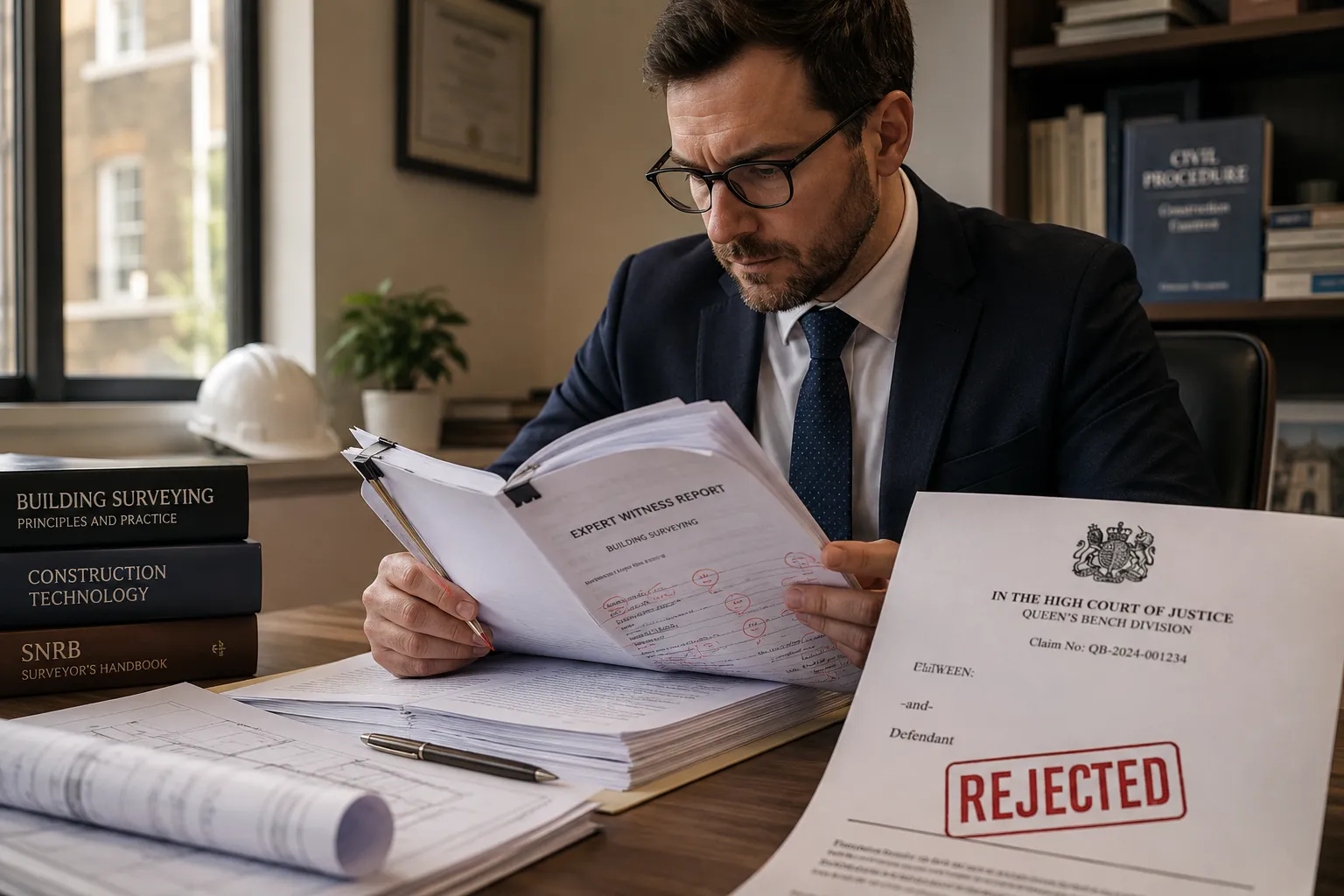
The expert witness pitfalls for building surveyors most frequently cited in UK court decisions fall into six categories:
| Error Category | What It Looks Like | Why It Matters |
|---|---|---|
| Template reports | Boilerplate text with client details inserted | Signals no genuine independent analysis |
| Overstated qualifications | Claiming expertise in areas outside core competence | Can result in report being struck out |
| Anchoring to client's figure | Conclusions that reverse-engineer a desired outcome | Destroys independence; judges identify it readily |
| Incomplete inspection | No photographs, no measurements, no lease review | Evidential foundation collapses under cross-examination |
| Conflicts of interest | Repeat instructions from same solicitor undisclosed | Raises questions about objectivity |
| Failure to disclose contrary evidence | Ignoring comparables that undermine the opinion | Breach of CPR Part 35 duty |
The use of template or pre-populated reports is a particular concern in 2026. Solicitors under cost pressure sometimes provide surveyors with a near-complete draft, expecting only minor amendments. Any surveyor who signs such a document without genuinely verifying every factual claim and independently reaching every conclusion is exposing themselves to serious professional and legal risk.
How Should a Building Surveyor Structure an Expert Report for Court
A well-structured expert report follows a clear, logical sequence that allows the judge, who may have no technical background, to follow the reasoning from facts to conclusion without assistance.
Recommended structure:
- Title page: expert's name, qualifications, date, case reference, instructing party
- Expert's declaration (CPR Part 35 compliant)
- Instructions received and scope of the report
- Summary of facts and documents reviewed
- Site inspection record: dates, access conditions, limitations
- Methodology: standards applied, comparable evidence used
- Analysis: reasoned application of methodology to facts
- Opinion: clear statement of conclusions, including any range of opinion
- Statement of truth
The inspection record deserves particular attention. Courts have criticised surveyor reports where the inspection was too brief, access was limited and not disclosed, or where no contemporaneous notes, photographs, or measurements were taken. Surveyors should treat the inspection as if every observation may need to be defended in the witness box months later.
For complex structural matters, linking the inspection findings to established building pathology principles strengthens the evidential foundation considerably.
What Is the Difference Between a Good and Bad Expert Witness
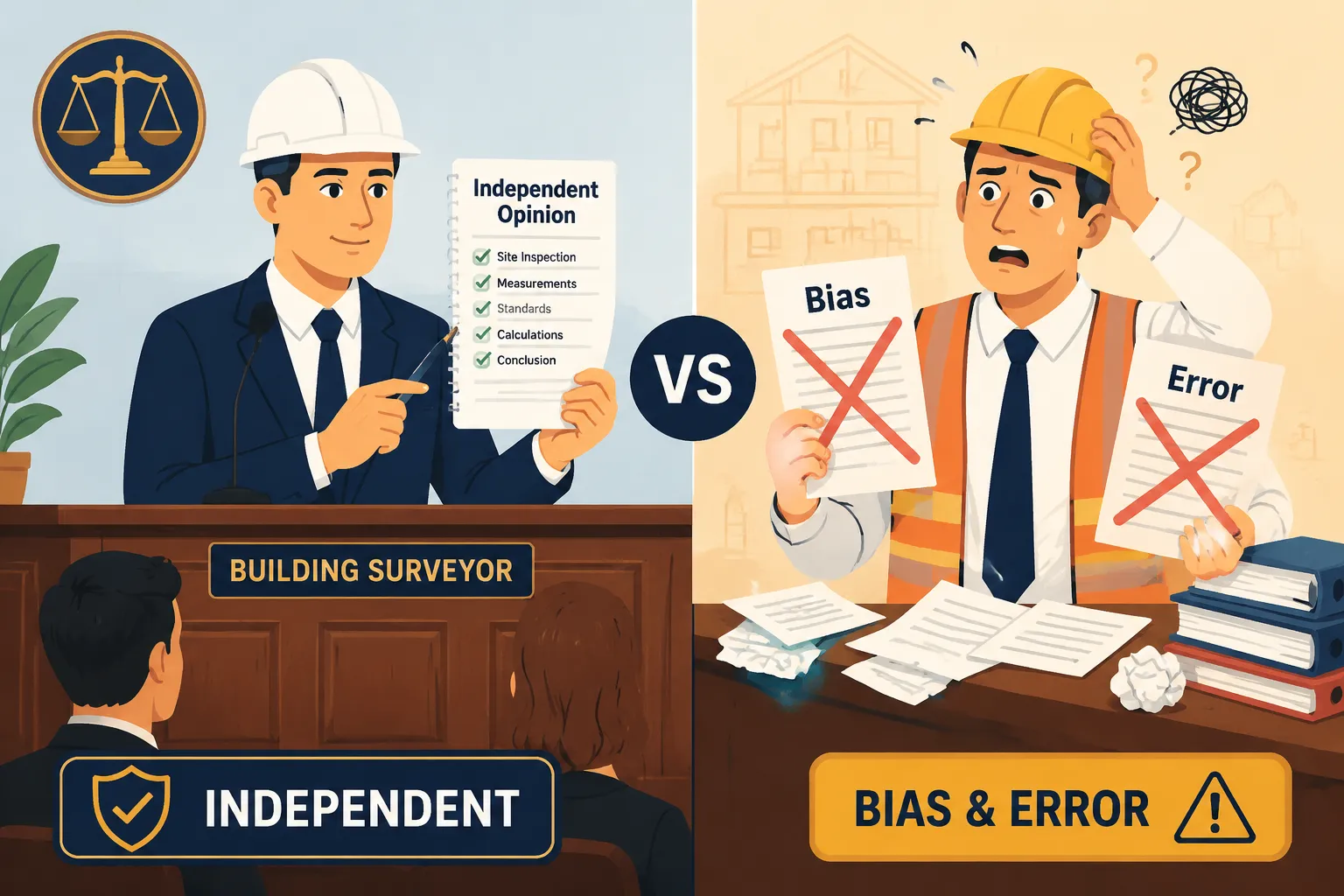
The difference between a credible and a discredited expert witness comes down to one word: independence. A good expert witness reaches their conclusions first and considers the client's position second. A bad expert witness does the reverse.
Good expert witness characteristics:
- Acknowledges the limits of their expertise and refers out where appropriate
- Discloses all conflicts of interest before accepting instructions
- Prepares a report that could withstand scrutiny even if instructed by the opposing party
- Engages constructively with the opposing expert's report in a without-prejudice discussion
- Updates their opinion in writing when new evidence changes the picture
Bad expert witness characteristics:
- Accepts instructions on matters outside their core competence
- Allows the instructing solicitor to draft or heavily edit the report
- Avoids mentioning evidence that undermines their conclusions
- Becomes defensive or evasive under cross-examination
- Treats the fee arrangement as a reason to support the client's position
Can an Expert Witness Be Sued for Negligence in Their Testimony
Until 2011, expert witnesses in England and Wales enjoyed immunity from civil suit for evidence given in court proceedings. The Supreme Court abolished that immunity in Jones v Kaney [2011] UKSC 13, meaning a building surveyor who gives negligent expert evidence can now be sued by the client who instructed them.
The practical implications are significant:
- Professional indemnity insurance must explicitly cover expert witness work, many standard surveyor policies do not.
- A surveyor who provides an opinion outside their competence, or who fails to inspect adequately, faces potential claims for wasted costs and damages.
- Surveyors should confirm their PI cover before accepting expert witness instructions.
Negligence in this context does not mean simply giving an opinion the court disagrees with. It means falling below the standard of a reasonably competent expert in the relevant field, for example, failing to inspect a property before opining on its condition, or applying an incorrect valuation methodology.
How Do Judges View Biased or Conflicted Expert Witnesses
UK judges are experienced at identifying bias, and their written judgments are often blunt about it. A surveyor who receives repeat instructions from the same claimant solicitor, or who operates on a conditional fee basis linked to the outcome, will face searching questions about independence.
Conflicts of interest that must be declared include:
- Any financial interest in the outcome of the proceedings
- A prior professional relationship with any party
- Repeat instructions from the same firm or individual that could create dependency
- Any personal or commercial relationship with the instructing solicitor
The consequences of undisclosed conflicts range from judicial criticism in the judgment, which becomes public, to referral to the RICS for disciplinary action. In serious cases, the court may order the conflicted expert to pay wasted costs personally.
Outcome-linked remuneration (where the expert's fee depends on the result) is expressly prohibited under CPR Part 35. Any such arrangement renders the expert's evidence inadmissible and exposes both the expert and the instructing solicitor to sanctions.
What Does the UK Civil Procedure Rules Say About Expert Evidence
CPR Part 35 is the primary framework governing expert evidence in civil proceedings in England and Wales. Its core provisions are:
- Duty to the court: The expert's overriding duty is to help the court on matters within their expertise, not to advance the case of the party instructing them.
- Single joint experts: Courts may direct that a single joint expert be appointed where the parties cannot agree, reducing costs and the risk of competing partisan reports.
- Written questions: Any party may put written questions to the opposing expert within 28 days of the report being served.
- Experts' discussions: The court may direct experts to meet and produce a joint statement identifying areas of agreement and disagreement.
- Permission required: Expert evidence may only be adduced with the court's permission; courts are increasingly reluctant to allow multiple experts in the same discipline.
Practice Direction 35 supplements these rules with detailed requirements on report content, including the mandatory declaration and the requirement to state the substance of all instructions received.
For surveyors providing expert witness reports in property disputes, familiarity with CPR Part 35 is not optional, it is the minimum standard of competence.
How Much Does an Expert Witness Cost in a Building Dispute Case
Building surveyor expert witness fees in the UK typically range from £150 to £350 per hour for report preparation and attendance at court, though specialist or highly experienced surveyors may charge more. Total costs vary considerably depending on case complexity.
Typical cost breakdown:
- Initial review of documents and site inspection: 4-12 hours
- Report preparation: 6-20 hours
- Attendance at experts' meeting: 2-4 hours
- Court attendance (half-day to full day): 4-8 hours
For a moderately complex residential dispute, total expert fees might fall between £3,000 and £12,000. Complex commercial or high-value residential cases can exceed this significantly.
The court controls the recoverability of expert costs. Where a party has incurred disproportionate expert fees, the costs judge may disallow a portion even if that party wins. This is a practical reason to instruct an expert who works efficiently and produces a focused, well-structured report rather than an exhaustive document covering every conceivable point.
What Training Do Building Surveyors Need to Become Expert Witnesses
There is no single mandatory qualification for expert witnesses in England and Wales, but several recognised training routes exist and courts increasingly expect surveyors to have completed formal preparation.
Recognised training routes:
- RICS Expert Witness Training: Covers CPR Part 35, report writing, and cross-examination technique. Widely recognised by courts and solicitors.
- Academy of Experts: Offers accreditation and training programmes ranging from introductory to advanced levels.
- Expert Witness Institute: Provides CPD-accredited training and a register of accredited experts.
Beyond formal training, surveyors should have:
- Substantial practical experience in the relevant area (residential defects, commercial valuation, party wall matters, etc.)
- Familiarity with the specific type of dispute they are being asked to address
- Experience of preparing formal reports under time and evidential pressure
Surveyors who accept instructions in areas where their experience is thin, for example, opining on specialist structural engineering matters when their background is residential valuation, risk both their credibility and a negligence claim.
How Do You Avoid Being Struck Off as an Expert Witness
Being "struck off" as an expert witness means the court formally removes an expert from a case, typically with adverse cost consequences and a public record in the judgment. It is rare but career-damaging.
Steps to avoid it:
- Comply fully with CPR Part 35 in every report.
- Declare all conflicts of interest before accepting instructions.
- Never allow the instructing solicitor to alter your substantive opinions.
- Maintain a complete and contemporaneous inspection record.
- Engage constructively and honestly in experts' discussions.
- Correct errors promptly and in writing when they come to light.
- Stay within the scope of your genuine expertise.
The RICS also has its own disciplinary framework. A surveyor found to have given dishonest or reckless expert evidence faces referral to the RICS Regulatory Board, which can result in suspension or removal of chartered status, a consequence far more serious than losing a single case.
What Happens If an Expert Witness Changes Their Opinion Mid-Case
An expert witness may legitimately change their opinion during proceedings, in fact, the CPR framework actively encourages experts to narrow their differences through discussion. The key is how the change is handled.
Acceptable: The expert receives new evidence (a further inspection report, additional comparables, updated test results) and updates their written opinion with a clear explanation of what changed and why.
Unacceptable: The expert changes their opinion under pressure from the instructing solicitor, or shifts position during cross-examination without any new factual basis, or produces a revised report that contradicts the original without explanation.
Judges treat unexplained opinion changes as evidence of either incompetence or partiality. Where an expert's written report and oral evidence are materially inconsistent, the court will typically prefer neither, and may comment adversely in the judgment.
If new evidence genuinely changes the picture, the correct procedure is to notify the instructing solicitor promptly, prepare a supplementary report, and serve it on all parties as soon as possible. Transparency is always the safer path.
What Questions Should You Prepare for When Giving Expert Testimony
Cross-examination of a building surveyor expert witness typically covers four areas: qualifications, methodology, independence, and the specific conclusions in the report.
Common lines of cross-examination:
- "How many times have you been instructed by this firm in the last three years?"
- "Did you inspect the property personally, and for how long?"
- "What comparables did you consider and reject, and why?"
- "Have you ever reached a conclusion that was unfavourable to the party instructing you?"
- "Is this report entirely your own work, or did you receive a draft from the solicitors?"
- "What is the basis for the methodology you applied?"
- "Are you aware of [contrary evidence]? Why does it not affect your conclusion?"
Preparation should include a thorough re-read of the report, a review of the opposing expert's report, and a careful look at any documents disclosed since the report was prepared. Surveyors who have completed formal expert witness training will have practised these scenarios and are significantly better equipped to handle them without becoming defensive or inconsistent.
Frequently Asked Questions
What is the single most common reason UK judges reject building surveyor expert evidence?
Lack of genuine independence. Reports that appear designed to support the instructing party's position rather than assist the court are the most frequently criticised category of expert evidence in UK property disputes.
Does a building surveyor need RICS membership to act as an expert witness?
RICS membership is not a legal requirement, but it is a strong indicator of competence and is expected in most property-related disputes. Courts and solicitors routinely ask for evidence of professional membership and relevant experience.
Can a surveyor act as both advocate and expert witness in the same case?
No. The roles are incompatible. An expert witness owes a duty to the court; an advocate owes a duty to the client. Attempting to combine them destroys the credibility of both functions.
What should a surveyor do if they discover an error in their report after it has been served?
Notify the instructing solicitor immediately, prepare a written correction or supplementary report, and ensure it is served on all parties. Attempting to conceal an error is far more damaging than disclosing it promptly.
Is conditional fee work (no win, no fee) permitted for expert witnesses?
No. CPR Part 35 expressly prohibits any fee arrangement that is contingent on the outcome of the proceedings. Such an arrangement renders the expert's evidence inadmissible.
How long does an expert witness report typically take to prepare for a building dispute?
For a straightforward residential defects dispute, allow 10-20 hours including inspection, research, and drafting. Complex cases involving multiple defects, disputed comparables, or substantial documentation may require significantly more time.
Conclusion
The expert witness pitfalls for building surveyors documented in UK court judgments share a common thread: they all stem from losing sight of the expert's primary duty to the court. Whether the failure is a template report, an undisclosed conflict, an incomplete inspection, or a partisan opinion anchored to the client's desired figure, the result is the same, discredited evidence and a damaged professional reputation.
Actionable next steps for building surveyors:
- Complete formal expert witness training through RICS, the Academy of Experts, or the Expert Witness Institute before accepting instructions.
- Review your professional indemnity policy to confirm it covers expert witness work.
- Establish a personal checklist based on CPR Part 35 requirements and apply it to every report.
- Maintain a detailed, contemporaneous inspection record for every case.
- Declare all potential conflicts of interest before accepting instructions, not after.
- Treat every report as if it will be read by a sceptical judge, because it will.
For property owners and professionals who need a surveyor with the technical depth and independence to withstand court scrutiny, understanding these standards helps in selecting the right expert. Reviewing what a thorough Level 3 building survey covers, and how construction law advice intersects with expert evidence, provides a useful starting point for any property dispute.
.ew-checker{font-family:Arial,sans-serif;max-width:560px;margin:2em auto;border:2px solid #1a3a5c;border-radius:8px;overflow:hidden}
.ew-checker__header{background:#1a3a5c;color:#fff;padding:14px 18px;font-size:1.05em;font-weight:700}
.ew-checker__sub{font-size:.82em;font-weight:400;margin-top:3px;opacity:.85}
.ew-checker__body{padding:14px 18px;background:#f7f9fc}
.ew-checker__item{display:flex;align-items:flex-start;gap:10px;padding:7px 0;border-bottom:1px solid #dce4ef}
.ew-checker__item:last-child{border-bottom:none}
.ew-checker__item input[type=checkbox]{margin-top:3px;width:17px;height:17px;accent-color:#1a3a5c;flex-shrink:0;cursor:pointer}
.ew-checker__item label{font-size:.9em;color:#222;cursor:pointer;line-height:1.4}
.ew-checker__progress{margin-top:12px;background:#dce4ef;border-radius:4px;height:10px;overflow:hidden}
.ew-checker__bar{height:10px;background:#1a3a5c;width:0%;transition:width .3s ease;border-radius:4px}
.ew-checker__score{text-align:right;font-size:.82em;color:#1a3a5c;margin-top:5px;font-weight:700}
function ewUpdate(){var t=document.querySelectorAll(‘#ewList input[type=checkbox]’),c=0;t.forEach(function(i){if(i.checked)c++;});var p=Math.round(c/t.length*100);document.getElementById(‘ewBar’).style.width=p+’%’;document.getElementById(‘ewScore’).textContent=c+’ of ‘+t.length+’ complete’;}
Tags: expert witness, building surveyor, expert witness report, CPR Part 35, UK court, building disputes, RICS, expert testimony, property litigation, surveyor credibility, civil procedure rules, expert witness training