

Rental growth across the UK slowed to just 1.9% in March 2026 — yet the average London rent still stands at £2,339 per month, a staggering 69% above the national average of £1,321 [4]. That gap between national moderation and local extremity is precisely the kind of contested terrain that lands landlords, tenants, and managing agents in formal dispute proceedings. When those disputes reach a tribunal or court, the quality of expert witness testimony on lettings valuation can be the single most decisive factor in the outcome.
This article examines the role of the Expert Witness in 2026 Lettings Valuation Disputes: RICS Guidance Amid Tenant Demand Growth, covering the protocols that govern expert testimony, how shifting rental market conditions shape the evidence base, and what practitioners must do to produce robust, court-ready valuations.
Key Takeaways
- RICS released the 5th edition of its expert witness guidance in 2025, reinforcing that the primary duty of any expert witness is to the tribunal, not the instructing client [1].
- Tenant demand fell 14% year-on-year by March 2026, while rental supply rose 11%, creating a more balanced but still contested market [3].
- Despite supply growth, rental stock remains 25% below pre-pandemic levels, sustaining upward pressure that expert witnesses must account for in their evidence [4].
- RICS distinguishes clearly between expert witnesses, single joint experts, and independent experts — each role carries distinct obligations and limitations [2].
- Expert testimony must be grounded in verifiable comparable evidence, with regional variations and supply constraints explicitly addressed to withstand cross-examination.

The 2026 Rental Market Landscape: What Expert Witnesses Must Understand
Before any expert witness can produce credible lettings valuation evidence, they must have a precise command of current market conditions. In 2026, the UK rental market is in a state of measured transition — not collapse, not boom, but a careful rebalancing that creates genuine scope for valuation disagreement.
Supply, Demand, and the Data Expert Witnesses Rely On
By March 2026, tenant demand had dropped 14% year-on-year, reaching its lowest point in six years. Zoopla attributes this to a combination of reduced net migration and a rise in first-time buyer activity as mortgage affordability improved [3]. Simultaneously, the number of homes available to rent increased by 11% compared to the prior year [3].
On the surface, these figures suggest a softening market. However, the picture is more complex when examined regionally. Rental stock across the UK remains approximately 25% below pre-pandemic levels [4], meaning that even with improved supply, competition for well-located, well-maintained properties persists. Around 25% of rental properties were already under offer in early 2026, with two-bedroom homes proving especially competitive due to their balance of space and affordability [5].
Key market metrics for 2026 expert witness reference:
| Metric | Figure | Source |
|---|---|---|
| Average UK rent (June 2026) | £1,321/month | Zoopla [4] |
| Average London rent (June 2026) | £2,339/month | Zoopla [4] |
| London premium above national average | 69% | Zoopla [4] |
| Year-on-year rental growth (March 2026) | 1.9% | Zoopla [3] |
| Rental growth stabilisation (June 2026) | 2.1% | Zoopla [4] |
| Supply vs. pre-pandemic levels | -25% | Zoopla [4] |
| Tenant demand change (year-on-year) | -14% | Zoopla [3] |
For an expert witness, these figures are not background reading — they are the evidential scaffolding upon which a lettings valuation argument is constructed. An opinion unsupported by current, verifiable market data will struggle under cross-examination.
"An expert witness who cannot explain the regional supply-demand dynamic in their subject market is not providing expert opinion — they are providing assertion."
Understanding these conditions is equally important for RICS property valuations generally, since the same comparable evidence standards apply whether the context is dispute resolution or transactional advice.
RICS Guidance Governing Expert Witness in 2026 Lettings Valuation Disputes
The framework that governs expert witness conduct in lettings valuation disputes is not discretionary. It is codified, updated, and enforceable through professional disciplinary channels.
The 5th Edition: What Changed and Why It Matters
In 2025, RICS published the 5th edition of "Surveyors acting as Expert Witnesses." The central principle reinforced throughout this edition is unambiguous: the expert witness's primary duty is to the tribunal, not to the client who instructed them [1]. This is not a new concept, but the 5th edition tightens the language and strengthens the compliance expectations around it.
Key obligations under the updated guidance include:
- Providing an opinion that is genuinely independent, even when instructed by one party
- Declaring any conflict of interest before accepting an instruction
- Ensuring that all factual assertions within the report are verifiable and sourced
- Distinguishing clearly between fact, inference, and opinion within the written evidence
- Complying with the relevant court or tribunal's procedural rules on expert evidence
Failure to meet these standards does not merely weaken a case — it can result in the evidence being excluded entirely, or in professional sanctions against the surveyor.
Expert Witness, Single Joint Expert, Independent Expert: Critical Distinctions
RICS draws a clear line between three distinct roles, and conflating them is a common source of procedural error [2]:
Expert Witness — Appointed by one party to provide impartial opinion evidence to a court or tribunal. Despite being instructed by one side, the duty of impartiality to the tribunal is paramount.
Single Joint Expert (SJE) — Jointly appointed by both parties, often at the direction of the court. The SJE's report is shared by both sides and is intended to reduce adversarial expert conflict.
Independent Expert — Acts as a decision-maker rather than an adviser. In lettings disputes, an independent expert may be appointed by agreement to determine a rent review figure, with their decision binding on both parties.
Understanding which role applies to a given instruction is essential before any valuation work begins. The procedural and ethical obligations differ materially between these three categories.
For practitioners handling legal disputes involving property, this distinction also affects how reports are structured, how comparable evidence is presented, and what level of advocacy (if any) is permissible in the written opinion.

Protocols for Expert Testimony on Rental Valuations with Constrained Supply
The specific challenge of the Expert Witness in 2026 Lettings Valuation Disputes: RICS Guidance Amid Tenant Demand Growth context is this: how does an expert produce a defensible lettings valuation when the market is simultaneously showing demand softening and structural supply constraints? The answer lies in methodology, comparables selection, and transparent reasoning.
Building the Comparable Evidence Base
A lettings valuation for dispute purposes is only as strong as its comparable evidence. The following protocol reflects current best practice under RICS standards:
Step 1: Define the subject property accurately
Specify property type, size, condition, location, and any features that affect lettability. This forms the basis for selecting appropriate comparables.
Step 2: Source contemporaneous rental evidence
Comparables should reflect the rental market at the relevant valuation date, not current asking rents. In a dispute about a tenancy that commenced in late 2025, for example, the expert must use evidence from that period, not June 2026 figures.
Step 3: Apply adjustments transparently
Where comparables are not identical to the subject property, adjustments must be made and explained. Adjustments for size, condition, floor level, parking, and garden access are all legitimate — but each must be reasoned and quantified.
Step 4: Address supply constraints explicitly
Given that rental stock remains 25% below pre-pandemic levels [4], an expert witness must address how this structural shortage affects the open market rent. Ignoring it leaves the opinion vulnerable to challenge.
Step 5: Reference authoritative market data
Published data from sources such as Zoopla's rental market reports, ONS private rental statistics, and Valuation Office Agency (VOA) data all provide the kind of authoritative market context that tribunals expect.
Handling Regional Variation in Expert Reports
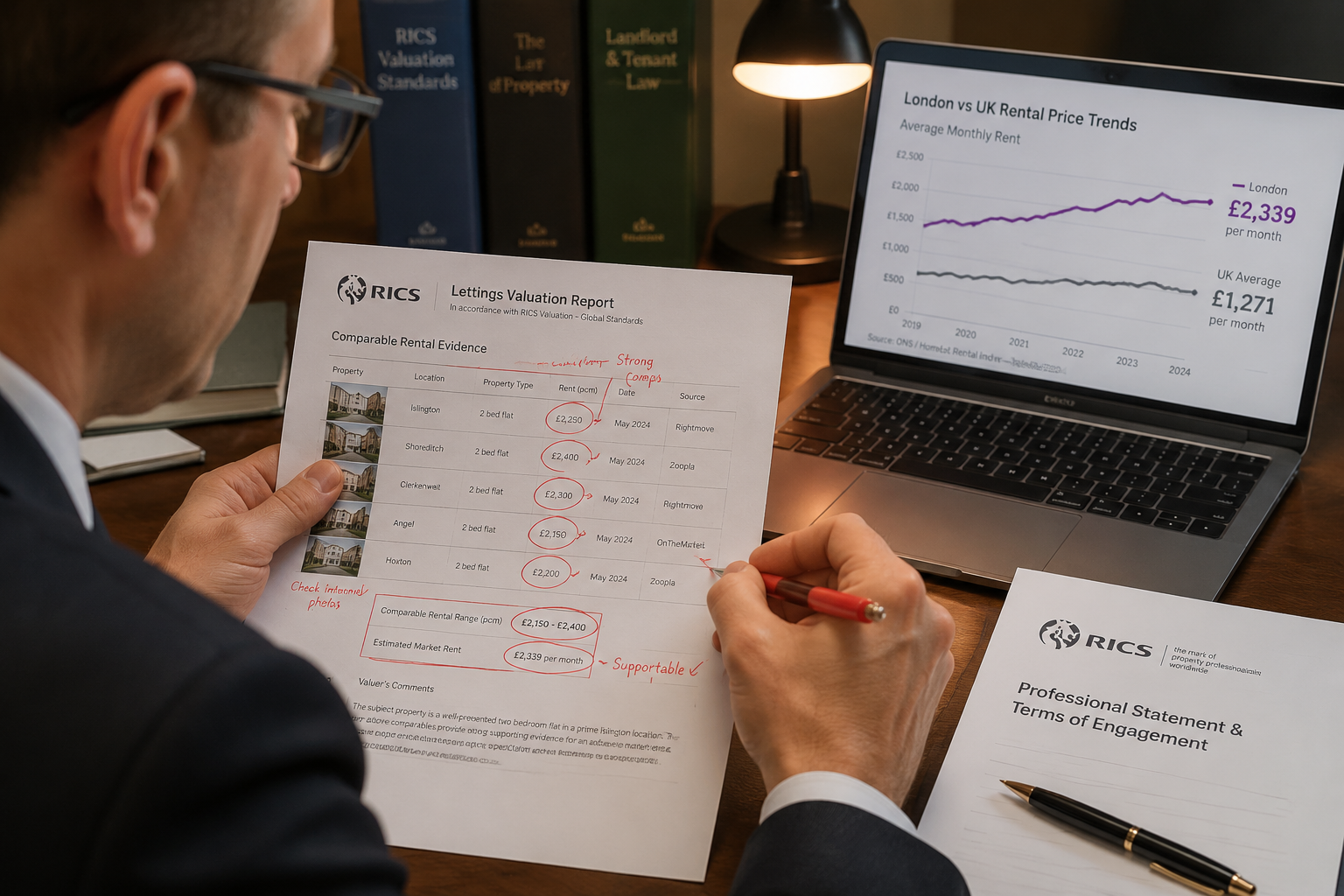
London's rental market operates on fundamentally different dynamics from the national average. At £2,339 per month, London rents are 69% above the UK average [4]. An expert witness instructed on a Central London lettings dispute cannot rely on national averages without explicitly explaining why local conditions diverge.
Regional granularity is not optional — it is a requirement of a credible expert opinion. This applies whether the dispute involves a property in Knightsbridge, Islington, Battersea, or outer London boroughs such as Bromley. Each sub-market has its own supply-demand characteristics, and the expert's report must reflect that specificity.
Common Methodological Errors That Undermine Expert Testimony
Even experienced surveyors can fall into errors that weaken their expert evidence. The most frequent include:
- Using asking rents rather than achieved rents — Asking rents reflect aspirations; achieved rents reflect the market. Tribunals expect the latter.
- Failing to date-adjust comparables — A comparable from 18 months prior in a market that has moved 5% requires adjustment. Failing to apply one suggests methodological carelessness.
- Over-reliance on a single comparable — A robust opinion is supported by multiple comparables. A single data point is not a market.
- Advocacy disguised as opinion — Expert witnesses must avoid language that reads as partisan. Phrases like "it is abundantly clear" or "the opposing valuation is untenable" cross the line from expert opinion into advocacy.
- Ignoring contradictory evidence — An expert who cherry-picks only the comparables that support their client's position will be exposed in cross-examination. A credible report addresses contradictory evidence and explains why it has been given less weight.
For a broader understanding of how professional property assessments are structured, reviewing guidance on expert building evaluation provides useful context on the standards of evidence expected across different surveying disciplines.
Practical Considerations for Instructing Parties and Legal Teams
Understanding the role of the Expert Witness in 2026 Lettings Valuation Disputes: RICS Guidance Amid Tenant Demand Growth is not only relevant to surveyors — it is essential knowledge for solicitors, barristers, and property managers who instruct them.
Selecting the Right Expert
Not every RICS-qualified surveyor is equipped to act as an expert witness in lettings valuation disputes. The instructing party should confirm:
- The surveyor holds current RICS membership in good standing
- They have demonstrable experience in the specific lettings sub-market relevant to the dispute
- They are familiar with the procedural rules of the relevant tribunal or court
- They have experience producing reports that comply with CPR Part 35 (for court proceedings) or equivalent tribunal rules
- They can clearly articulate the distinction between their role as expert witness and any prior advisory relationship with the client
Firms offering RICS-compliant expert witness services, such as HRE Group, provide independent property valuations specifically structured for dispute and litigation contexts, adhering to the latest RICS professional standards [6].
Managing the Expert's Independence
One of the most common practical errors made by instructing solicitors is attempting to direct the expert's conclusions. This is not only ethically problematic — it is tactically counterproductive. An expert whose independence is compromised will be identified as such in cross-examination, and the credibility damage extends to the entire case.
The correct approach is to:
- Provide the expert with all relevant factual information about the property and tenancy
- Identify the specific questions the expert is being asked to address
- Allow the expert to reach their own conclusions based on the evidence
- Review the draft report only for factual errors, not to seek changes to the opinion
The Role of Without-Prejudice Expert Discussions
In many dispute proceedings, the tribunal or court will direct experts from each side to meet and produce a joint statement identifying areas of agreement and disagreement. These without-prejudice discussions are a significant procedural step. Experts should approach them prepared to genuinely engage with the opposing opinion — not to defend their original report at all costs.
Areas of agreement should be recorded clearly, as they narrow the issues the tribunal must determine. Where disagreement persists, the joint statement should articulate the precise reason for the divergence — whether it is a difference in the comparables selected, the adjustments applied, or the interpretation of market conditions.
For those navigating legal liabilities for tenants or landlord obligations within dispute proceedings, understanding how expert evidence is tested at this stage can significantly affect litigation strategy.
When a Red Book Valuation Is Required
In some lettings disputes — particularly those involving lease renewals, rent reviews under commercial leases, or disputes with a financial threshold that requires formal RICS compliance — a Red Book valuation may be required rather than a standard expert report. The RICS Valuation — Global Standards (the "Red Book") impose additional requirements around independence, reporting format, and the basis of value used. Expert witnesses should be clear about whether their instruction requires Red Book compliance and structure their report accordingly.
Conclusion
The role of expert witness in lettings valuation disputes has never demanded more precision than it does in 2026. A rental market defined by slowing growth, regional price extremes, structural supply constraints, and shifting tenant behaviour provides fertile ground for valuation disagreement — and for the disputes that follow.
RICS guidance is unequivocal: the expert's duty is to the tribunal, and every element of the report must reflect that obligation [1]. The 5th edition of the expert witness professional standard raises the bar on impartiality, sourcing, and transparency. Meeting that bar requires not just technical valuation competence, but a thorough command of current market data, regional dynamics, and procedural rules.
Actionable next steps for practitioners and instructing parties in 2026:
- Confirm that any expert witness instruction explicitly references the RICS 5th edition professional standard and the relevant court or tribunal procedural rules.
- Ensure the expert's comparable evidence is drawn from achieved rents, properly dated, and adjusted with transparent reasoning.
- Address the structural supply shortfall of 25% below pre-pandemic levels directly in any lettings valuation opinion — omitting it is a methodological gap that opposing counsel will exploit.
- Distinguish clearly at the outset whether the instruction requires an expert witness, a single joint expert, or an independent expert, as each carries different obligations.
- Where London or high-value sub-markets are involved, use sub-market specific data rather than national averages, and explain the premium explicitly.
For professional guidance on RICS property valuations or to discuss an expert witness instruction, consulting a qualified RICS surveyor with dispute resolution experience is the most effective first step.
References
[1] Consultationhome – consultations.rics.org
[2] Expert Witnesses Single Joint Experts And Independent Experts – rics.org
[3] Competition For Rented Homes Falls To Lowest Level In Six Years More Homes – zoopla.co.uk
[4] Rental Market Report – zoopla.co.uk
[5] Uk Rental Market Demand 2026 Space Affordability – benhams.com
[6] Expert Witness Property Valuations – hre.group
How Prince Surveyors can help: explore our expert witness surveyors or learn about our RICS valuations.