

Last updated: July 24, 2026
Quick Answer: Certain building defects, structural movement, damp penetration, roof failure, and hazardous materials, appear so consistently across UK property surveys that they qualify as evergreen red flags. These issues directly reduce valuations, stall transactions, and contribute to market instability. Keeping RICS survey checklists current, and ensuring surveyors identify these problems reliably, is one of the most practical tools available for protecting buyers, sellers, and the broader housing market.
Key Takeaways
- Structural movement, rising damp, roof defects, subsidence, and hazardous materials are the red flags that never disappear from building surveys regardless of property age or market conditions.
- RICS uses a three-tier Condition Rating system (CR1 green, CR2 amber, CR3 red) to flag defect severity, but checklist content must evolve to reflect modern risks such as energy performance failures and climate-related drainage issues.
- Hidden defects can reduce a property's agreed sale price by 5-25% depending on severity, according to surveyor industry estimates.
- Outdated survey checklists create blind spots that cost buyers money and erode market confidence, particularly for first-time buyers.
- Regional variation matters: properties in flood-prone areas, mining regions, and coastal zones carry distinct red flags that a generic national checklist may underweight.
- A Level 3 Full Building Survey provides the most comprehensive defect coverage and is strongly recommended for older, extended, or non-standard construction properties.
- Surveyors who miss major defects can face professional negligence claims, making thorough, updated checklists a protection for practitioners as much as for clients.
What Are the Red Flags in Building Surveys That Never Go Away?
Some defects recur so reliably across UK property surveys that experienced surveyors treat them as near-certainties on older stock. These evergreen red flags in building surveys represent the foundation of any RICS checklist and remain relevant regardless of market conditions or property type.
The most persistent red flags include:
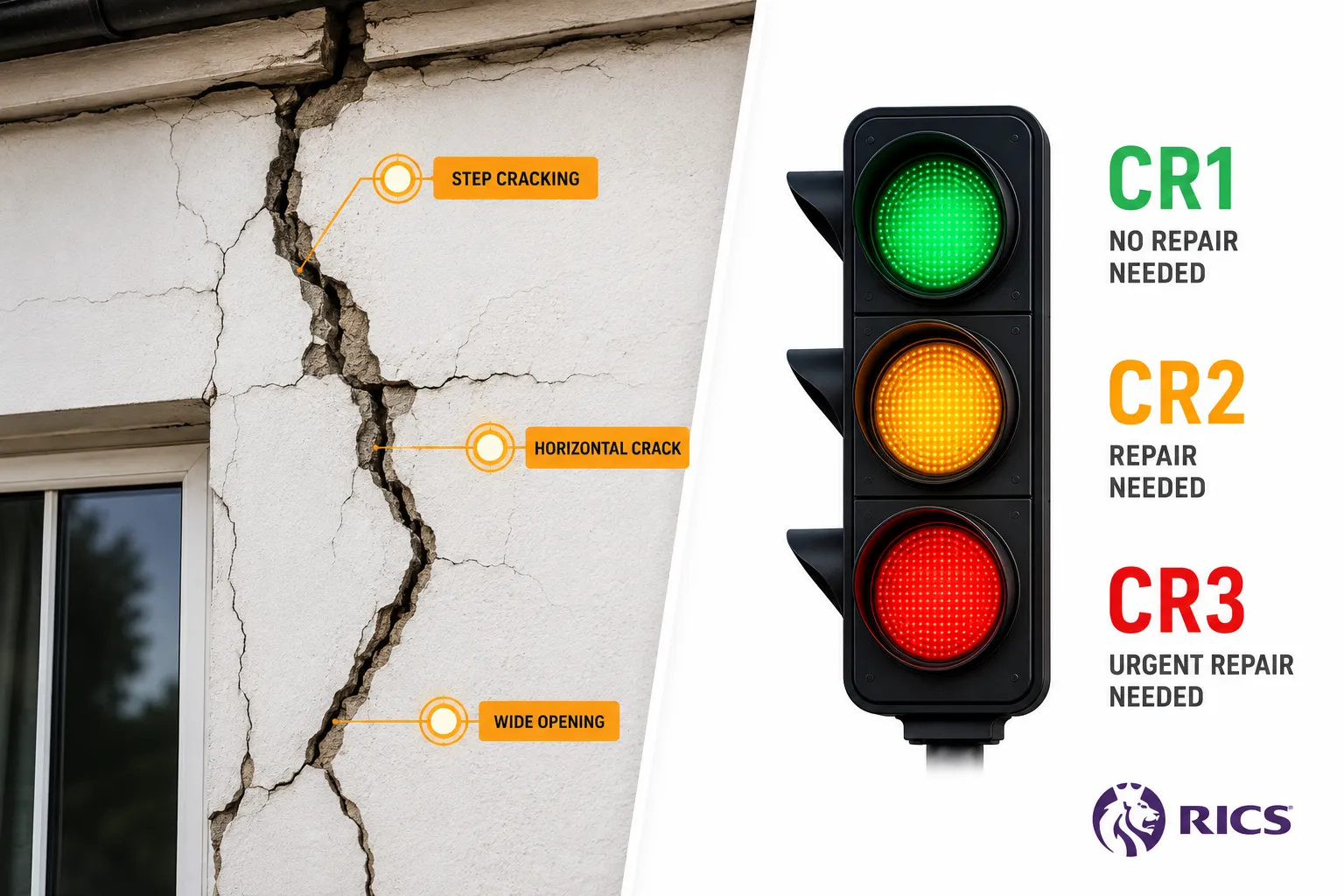
- Structural movement and cracking, diagonal stair-step cracks in brickwork, cracks wider than 5mm, or cracks that have reopened after previous repairs all suggest active movement rather than historic settlement.
- Damp and moisture ingress, rising damp, penetrating damp through failed pointing or flashings, and condensation-related mould growth are among the most commonly flagged issues in UK surveys. See our guide on how to prevent and remove damp and mould growth for more context.
- Roof defects, missing or slipped slates, failed lead flashings, deteriorated flat roof coverings, and blocked guttering are high-frequency findings that escalate quickly if left unaddressed.
- Subsidence, particularly in clay-soil areas of southern England, subsidence linked to tree root activity or inadequate foundations is a serious CR3 concern.
- Hazardous materials, asbestos in pre-2000 properties, lead paint in Victorian stock, and Japanese knotweed on or near the site are non-negotiable red flags.
- Electrical and drainage failures, outdated wiring systems and collapsed or blocked drains consistently appear in surveys of properties built before 1970.
Common mistake: Buyers sometimes dismiss amber (CR2) ratings as minor. In practice, a cluster of CR2 defects across roofing, damp, and drainage can signal a property that has been systematically under-maintained, with costs running into tens of thousands of pounds.
How Often Should RICS Building Survey Checklists Be Updated?
RICS guidance documents are formally reviewed on a rolling cycle, typically every three to five years, but the profession expects practitioners to apply current knowledge continuously. The RICS Home Survey Standard, which governs Levels 1 through 3, was updated in 2019 and took effect in 2021, introducing clearer reporting obligations and standardised condition ratings.
However, formal revision cycles alone are insufficient. Checklists should be updated whenever:
- New hazardous materials or construction defects become prevalent (for example, RAAC concrete panels in post-war non-traditional builds)
- Regulatory changes alter what constitutes a material defect (such as EPC Minimum Energy Efficiency Standards under MEES legislation)
- Climate-related risks shift regionally (increased flood frequency, subsidence patterns driven by prolonged drought)
- New build techniques introduce novel failure modes
A practical rule: any checklist that does not include energy performance, climate resilience, and modern hazardous materials is already outdated for 2026 conditions.
What Structural Issues Affect Property Prices the Most?
Structural defects carry the greatest downward pressure on property valuations because they are costly to remediate, difficult to insure, and can render a property unmortgageable. Lenders routinely decline mortgage applications where a surveyor flags active subsidence, significant structural movement, or major roof failure without a remediation plan.
The structural issues with the greatest price impact, ranked by typical severity:
| Defect | Typical Price Impact | Mortgageability Risk |
|---|---|---|
| Active subsidence | 15-25% reduction | High |
| Major roof failure | 10-20% reduction | Medium-High |
| Structural wall movement | 10-20% reduction | High |
| Damp (extensive) | 5-15% reduction | Medium |
| Hazardous materials | 5-10% reduction | Medium |
| Drainage failure | 3-8% reduction | Low-Medium |
Note: Figures represent surveyor industry estimates and vary by property type, location, and remediation cost. See our detailed analysis of average price reductions after survey for buyer negotiation context.
For buyers looking to negotiate after a survey reveals structural issues, our guide on how to negotiate a house price down after a survey covers the practical steps.
How Do Building Surveyors Identify Problems That Impact Valuation?
Chartered surveyors use a combination of visual inspection, specialist instruments, and professional judgment to identify defects that affect value. The RICS condition rating system provides a structured framework: CR1 (no repair needed), CR2 (repair or replacement needed but not urgent), and CR3 (serious or urgent issues requiring immediate action or further investigation).
Key identification methods include:
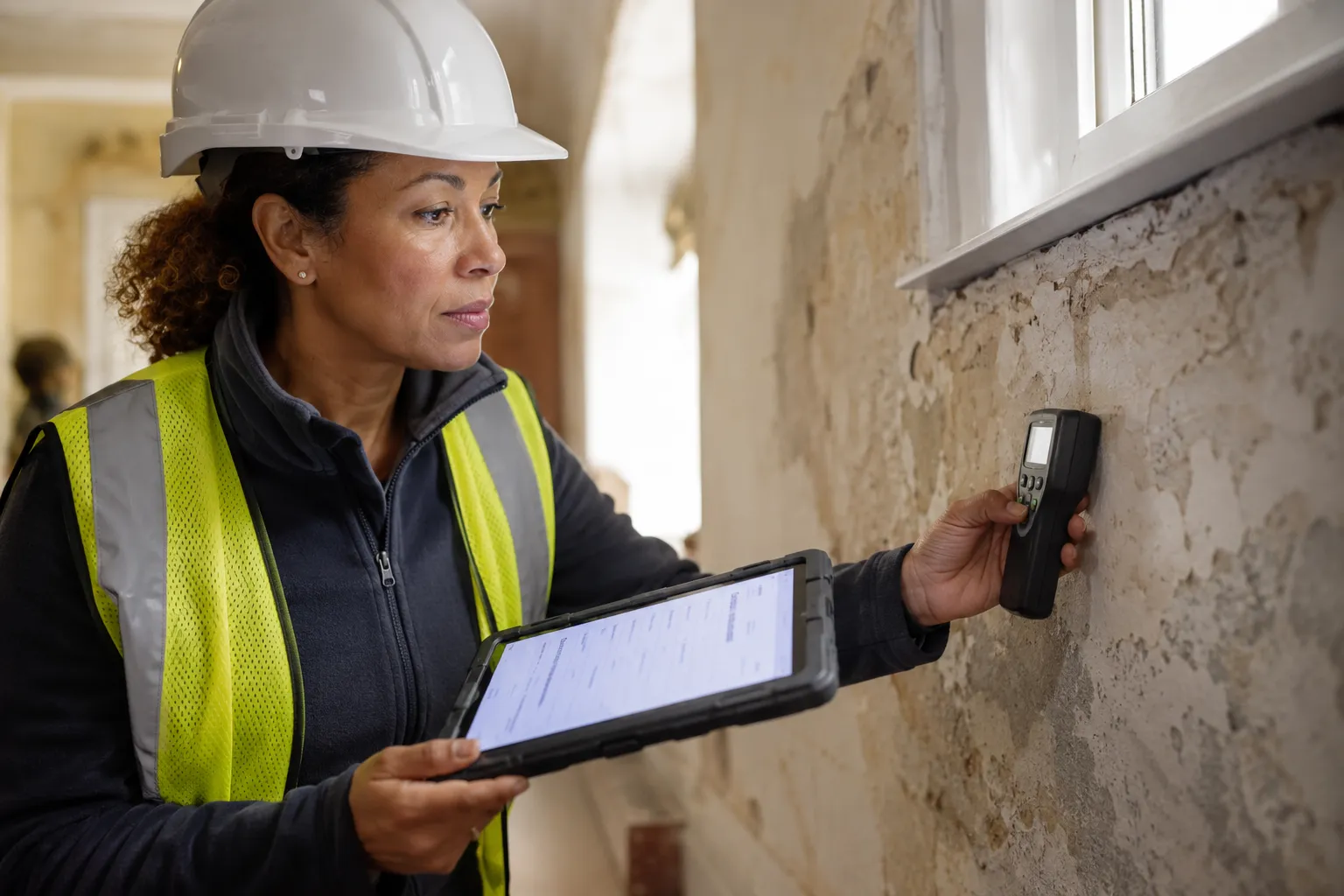
- Moisture meters to detect elevated damp readings in walls and floors
- Drain inspection cameras (or recommendations for specialist drain surveys) to identify root ingress or collapse
- Thermal imaging in some Level 3 surveys to detect hidden moisture or insulation failures
- Structural crack monitoring, surveyors assess crack width, pattern, and whether cracks are live or historic
- Material sampling for suspected asbestos, referred to a specialist laboratory
A Level 3 Full Building Survey provides the deepest investigation, covering all accessible parts of the structure and fabric. For properties with unusual materials or significant age, a building materials assessment adds an additional layer of scrutiny.
What's the Difference Between a Standard Survey and a Detailed Structural Survey?
A standard survey (RICS Level 2 Homebuyer Report) provides a condition overview using the traffic-light rating system and is suited to conventional properties in reasonable condition. A detailed structural survey (RICS Level 3 Full Building Survey) goes significantly further: it examines construction methods, assesses the condition of all accessible elements, identifies defects in greater technical depth, and provides repair recommendations and cost guidance.
Choose a Level 2 survey if: the property is a post-1930s conventional construction in good condition and you want a cost-effective snapshot.
Choose a Level 3 survey if: the property is pre-1930s, has been extended or altered, uses non-standard materials, shows visible defects, or is a listed building.
The full building survey vs homebuyer survey comparison explains the practical differences in detail. For a structured overview of all survey levels, the guide to choosing the right property survey is a useful starting point.
Can Updating Survey Standards Help Stabilise the Housing Market?
Yes, and the mechanism is direct. When survey standards are current and consistently applied, buyers receive accurate information, lenders gain confidence in valuations, and the market prices risk more accurately. Conversely, when checklists are outdated or inconsistently applied, defects go undetected at purchase, surface later as costly repairs, and generate transaction failures, disputes, and price volatility.
"A market where buyers cannot trust survey outputs is a market where risk is mispriced at every transaction. Updating RICS checklists for stabilising national prices is not a bureaucratic exercise, it is a structural market intervention."
Specific ways updated survey standards contribute to price stability:
- Reducing post-purchase defect discoveries that force distressed resales
- Giving mortgage lenders standardised defect data to inform lending decisions
- Helping sellers price accurately rather than over-inflating and then discounting after survey
- Supporting first-time buyers in making informed decisions without relying on vendor assurances
The connection between evergreen red flags in building surveys and national price stability is most visible in transaction collapse rates. Industry data consistently shows that survey findings are among the top reasons UK property transactions fall through, a pattern that drives price uncertainty for all parties.
What Common Defects Do Surveyors Miss That Come Back to Haunt Buyers?
Several defects are under-reported in surveys, either because they require specialist investigation beyond the survey scope or because they are difficult to detect visually. These are the issues most likely to become expensive post-purchase surprises.
- Concealed damp behind dry-lined walls, a common feature of 1970s, 1990s refurbishments that masks penetrating or rising damp
- Flat roof condition, often inaccessible without specialist equipment; surveyors may note "not inspected" without flagging the risk adequately
- Drainage defects, standard surveys rarely include CCTV drain surveys, yet collapsed or root-invaded drains are expensive to repair
- Asbestos in textured coatings and floor tiles, frequently present but not always flagged unless a specialist asbestos survey is commissioned
- Cavity wall insulation failure, blown or degraded insulation can cause persistent damp that is misdiagnosed as other issues
- Japanese knotweed, can be present at the boundary or in adjacent gardens and affect mortgageability even if not on the property itself
Edge case: Properties that have recently been refurbished and presented well can score deceptively low on visual defect counts. A fresh coat of paint over damp or crack filler over active movement are among the oldest concealment techniques in the industry. A building defects survey specifically targets these hidden issues.
How Much Can Hidden Building Problems Reduce Property Value?
Hidden defects, once discovered, typically reduce the achievable sale price by 5-25% depending on the nature and extent of the problem. Active subsidence and major structural movement sit at the upper end of this range. Damp, drainage, and roof defects typically fall in the 5-15% range.
Beyond the direct price reduction, hidden defects generate secondary costs:
- Emergency repair costs that fall entirely on the buyer
- Mortgage retention, lenders may withhold a portion of the loan until specific repairs are completed
- Insurance loading, properties with known structural issues attract higher premiums or exclusions
- Resale difficulty, a defect discovered during ownership must be disclosed on subsequent sale
The financial case for commissioning a thorough survey before exchange is straightforward: survey fees for a Level 3 report typically range from £600 to £1,500 for a standard residential property, while the defects they identify can represent repair costs ten to one hundred times that amount.
What Should Be on a Modern RICS Survey Checklist That Isn't Currently?
A modern checklist for 2026 conditions should go beyond traditional structural and damp checks to include:
- Energy performance and EPC compliance, with MEES regulations tightening, a property's energy rating directly affects its lettability and saleability
- Climate resilience, flood risk assessment, drainage capacity, and evidence of overheating risk in highly insulated properties
- RAAC (Reinforced Autoclaved Aerated Concrete), present in some post-war non-traditional constructions and now a known structural risk
- EV charging infrastructure readiness, increasingly relevant to buyers and lenders
- Solar panel and retrofit assessment, many older properties have had energy retrofits that require structural and waterproofing assessment
- Digital connectivity infrastructure, not a structural issue, but increasingly material to value
The EPC, MEES and building survey guide covers the energy compliance dimension in detail.
Are Older Buildings More Likely to Have Survey Red Flags?
Yes, consistently. Pre-1919 properties built with lime mortar, solid walls, and traditional materials require different maintenance regimes than modern builds, and deferred maintenance accumulates over decades. Victorian and Edwardian terraces, in particular, carry a high baseline probability of damp, roof wear, and outdated services.
That said, post-war properties (1945-1980) carry their own distinct risk profile: non-traditional construction methods (prefabricated concrete panels, system-built housing), asbestos-containing materials in textured coatings and insulation, and early cavity wall construction that may have failed insulation.
New builds are not immune either, snagging defects, drainage failures, and inadequate fire compartmentation have all been documented in recently completed developments. Our guide on whether you need a survey on a new build addresses this directly.
How Do Building Survey Red Flags Vary by Region in the UK?
Regional geology, construction history, and climate all shape the red flags most likely to appear in any given area. Surveyors working nationally apply the same RICS framework but weight their attention differently by location.
- London and South East: Clay soils make subsidence the dominant structural risk; Victorian and Edwardian stock dominates, bringing damp, roof wear, and asbestos
- North West and Yorkshire: Mill-town terraces with back additions, shared drainage, and stone construction prone to frost damage and pointing failure
- South West and coastal areas: Driving rain exposure, salt-laden air accelerating metal corrosion, and flood risk in low-lying areas
- East Midlands and East Anglia: Former mining areas carry ground stability risks; agricultural conversion properties may have non-standard construction
- Scotland: Sandstone tenements with specific damp profiles; wet climate accelerating roof and render deterioration
A surveyor with local knowledge will always outperform a generic checklist in flagging region-specific risks.
What Happens If a Surveyor Fails to Spot Major Issues?
A chartered surveyor who fails to identify a defect that a competent practitioner would reasonably have found may face a professional negligence claim. RICS members are required to carry professional indemnity insurance for this reason. The claimant must demonstrate that the surveyor's report fell below the standard expected of a reasonably competent RICS member and that the failure caused a quantifiable financial loss.
Successful negligence claims have been brought for missed subsidence, undisclosed damp, and undetected structural movement. However, surveyors are not liable for defects that were genuinely concealed, inaccessible, or outside the agreed scope of the survey.
This is why scope clarity matters at instruction: buyers should confirm in writing what the survey will and will not cover, and consider commissioning specialist reports (drainage, asbestos, structural engineering) alongside the main survey where risk warrants it.
How Can Better Survey Practices Help First-Time Homebuyers Avoid Costly Mistakes?
First-time buyers are disproportionately exposed to survey-related financial risk because they lack the experience to interpret defect findings, are often under pressure to proceed quickly, and may be tempted to skip or downgrade surveys to reduce upfront costs.
Better survey practices help in three concrete ways:
- Clearer reporting language, plain-English condition ratings and repair cost estimates give first-time buyers actionable information rather than technical jargon
- Consistent defect flagging, standardised checklists mean buyers can compare reports across properties rather than receiving inconsistent assessments
- Escalation pathways, modern survey reports should clearly identify when specialist investigations are needed and why, rather than leaving buyers to interpret vague caveats
The evergreen red flags in building surveys, structural movement, damp, roof failure, hazardous materials, are precisely the issues that first-time buyers are least equipped to identify independently. A thorough survey is not a cost; it is the cheapest form of due diligence available in a transaction that may represent the largest financial commitment of a buyer's life.
FAQ
What is a Condition Rating 3 in a RICS survey?
Condition Rating 3 (red) means the defect is serious or urgent and requires immediate repair, further investigation, or both. It is the highest severity level in the RICS traffic-light system and should never be ignored or treated as a minor issue.
How long does a Level 3 building survey take to complete?
A Level 3 Full Building Survey typically takes two to four hours on site for a standard residential property, with the written report delivered within three to five working days. Larger or more complex properties take longer. See our building survey timeframes guide for detail.
Can a building survey help me negotiate the purchase price?
Yes. A survey that identifies CR2 or CR3 defects gives buyers documented evidence to renegotiate the agreed price or request that the seller carries out repairs before completion. This is one of the most financially valuable uses of survey findings.
Do surveyors check for Japanese knotweed?
RICS surveyors are expected to note visible evidence of Japanese knotweed within the site boundary and in adjacent areas visible from the property. However, a specialist ecological survey may be needed to confirm its presence and extent, particularly where it is suspected but not clearly visible.
What is the difference between a building survey and a structural survey?
In practice, these terms are often used interchangeably. A RICS Level 3 Full Building Survey is the most detailed residential survey available and covers structural elements thoroughly. A standalone structural engineer's report focuses specifically on structural elements and is typically commissioned when a building survey flags serious structural concerns requiring specialist opinion.
Is a survey required by law when buying a property in the UK?
No. A survey is not legally required, but it is strongly recommended. Mortgage lenders commission their own valuation, but this is not a condition survey and does not protect the buyer's interests. Buyers who waive surveys take on full financial risk for any defects present at purchase.
Conclusion
The evergreen red flags in building surveys, structural movement, damp, roof failure, subsidence, and hazardous materials, have not changed because the underlying physics of building failure has not changed. What must change is the framework used to identify and report them. Updating RICS checklists for stabilising national prices is not a theoretical exercise; it is a practical response to a market where outdated survey standards create information gaps that cost buyers money and erode transaction confidence.
Actionable next steps for buyers and property professionals in 2026:
- Commission a Level 3 Full Building Survey on any property that is pre-1930s, extended, or shows visible defects, the cost is minimal relative to the risk it mitigates
- Request specialist reports for drainage, asbestos, and structural concerns where the main survey flags uncertainty
- Use survey findings as a negotiation tool, not just a checklist, documented defects justify price reductions or seller remediation
- Ensure your surveyor has local knowledge of regional red flags, not just generic national checklists
- For landlords and investors, factor EPC compliance and energy retrofit costs into acquisition valuations, as MEES obligations continue to tighten
A well-executed survey, grounded in current RICS standards and regional expertise, remains the single most cost-effective piece of due diligence available to any UK property buyer.
.cg-checker{font-family:Arial,sans-serif;max-width:560px;margin:2rem auto;border:2px solid #1a3a5c;border-radius:8px;overflow:hidden}
.cg-checker-header{background:#1a3a5c;color:#fff;padding:14px 18px;font-size:1rem;font-weight:700}
.cg-checker-body{padding:16px 18px;background:#f8f9fb}
.cg-item{display:flex;align-items:center;margin-bottom:10px;gap:10px;font-size:.92rem}
.cg-item label{cursor:pointer;flex:1}
.cg-item input[type=checkbox]{width:18px;height:18px;accent-color:#c0392b;cursor:pointer}
.cg-btn{display:block;width:100%;padding:11px;background:#c0392b;color:#fff;border:none;border-radius:5px;font-size:1rem;font-weight:700;cursor:pointer;margin-top:6px}
.cg-btn:hover{background:#a93226}
.cg-result{margin-top:12px;padding:12px;border-radius:5px;font-size:.93rem;display:none}
.cg-low{background:#eafaf1;border-left:4px solid #27ae60;color:#1e6b3a}
.cg-med{background:#fef9e7;border-left:4px solid #f39c12;color:#7d5a00}
.cg-high{background:#fdf2f2;border-left:4px solid #c0392b;color:#7b1a1a}
Tick any issues you have noticed or been told about. This tool gives a general risk indication only, not a substitute for a professional survey.
function cgCheck(){
var checks=[document.getElementById(‘c1’),document.getElementById(‘c2’),document.getElementById(‘c3’),document.getElementById(‘c4’),document.getElementById(‘c5’),document.getElementById(‘c6’)];
var score=checks.filter(function(c){return c.checked}).length;
[‘cg-low’,’cg-med’,’cg-high’].forEach(function(id){document.getElementById(id).style.display=’none’});
var show=score<=1?'cg-low':score<=3?'cg-med':'cg-high';
document.getElementById(show).style.display='block';
}
Tags: building surveys, RICS checklists, red flags in surveys, structural defects, property valuation, Level 3 building survey, damp and subsidence, UK housing market, chartered surveyors, survey red flags, first-time buyers, building defects